
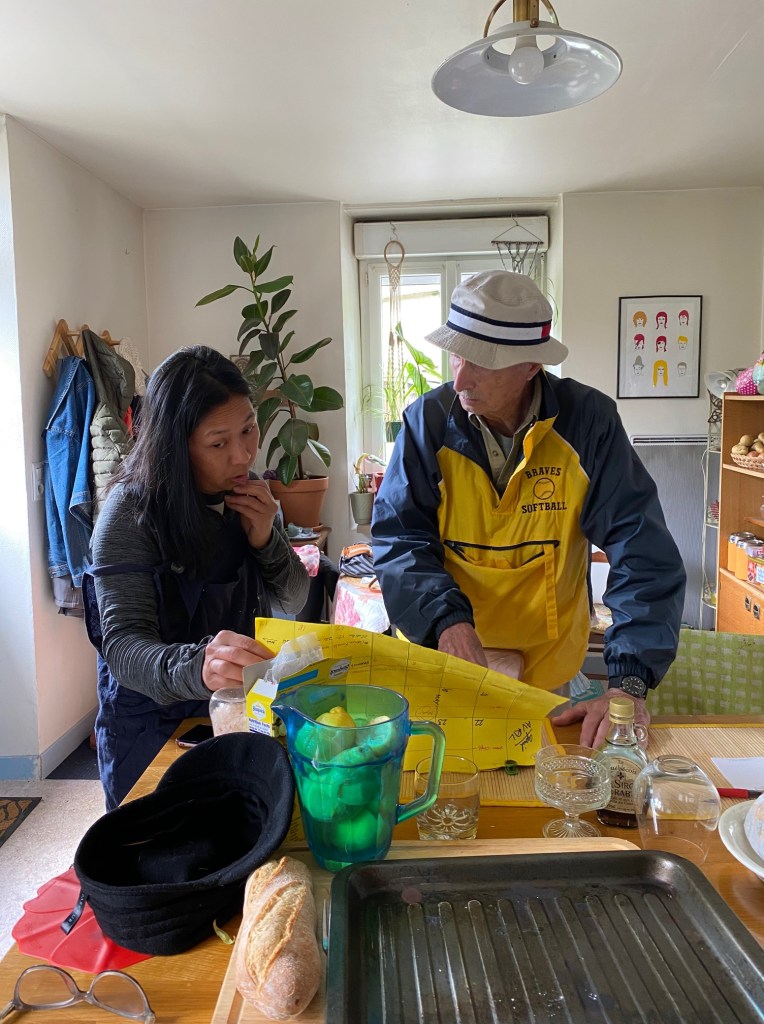
Cliff came ambling down Route de Gueret from the Brasserie, encumbered by three sacks and a backpack. We noticed him first because the dog stood to attention and her hackles rose, but Pat got there in time and the dog rolled over and showed her neck upon noting her lady’s displeasure. Cliff was allowed to approach with no danger to his ankles or eardrums.
As he got closer I realized who it must be. Cliff had contacted me weeks earlier via Google, where he found our website and sent me a message in French. From the grammar I could tell he was a confident speaker with a pretty good knowledge but was certainly not a native speaker, and after seeing his name I thought he must be a Yank or a Brit and I replied in English to the chat.
Cliff had requested lodging for two and a half months, he wasn’t sure when exactly, and he could only pay 25 euros per night because he was retired and on a budget. Of course that’s less than half of what we charge per night for our small studio rental! I told him I would need specific dates and that we already had bookings all over our spring calendar for both apartments, but I would send him some suggestions nearby. After a few back-and-forths via Google he said “well I’ll just come to Treignac around mid-April and we’ll figure it out.” I warned him that Treignac was out of the way and he should reconsider, and he replied that he’d been coming to France for 20 years, often simply showing up and finding a place to stay. His intention was to do so again. “I can camp in your garden if that’s OK.” Then I didn’t hear from him for a while and thought he’d given up.
I was immediately struck by Cliff’s age. I’d assumed he was early to mid 60s, but he’s actually 88 years old. To get to Treignac from his home in Kansas he’d flown to Texas, thence to London, thence to Paris, where he caught a train to Clermont-Ferrand, then a bus to Meymac, and in Meymac he hitch-hiked outside the Renault dealership without luck for several hours. Then he asked the Renault dealership for a piece of cardboard with which he made a sign. Immediately a woman picked him up and drove 26 km out of her way to bring him to town. Unable to find us via GPS she dropped him at the Brasserie next door, where the proprietors directed him to walk across the bridge. I’m almost 55 and that trip would exhaust me! While we had coffee in the kitchen our Frenchie Bou went out on the porch where we’d stowed Cliff’s bags, and a minute later she proudly marched through the kitchen with something in her mouth–an adult undergarment she’d pulled from his backpack pocket. Poor Cliff took this in stride and was more amused than mortified.
We had a bit of a scramble at first. We put Cliff up the first night but had guests checking into both apartments that weekend. So we moved him to a friend’s pilgrim hostile apartment for the following two nights, then back to us for two weeks. Now due to a previous reservation he’ll have to leave again, but we got him situated in a nice studio apartment in a rejuvenated vacation village at the top of town. They can accommodate his budget and host him for the next 2 months. He needed a spot where he could walk to town and to the grocery, and Domaine de Treignac fit the bill.
Cliff says he retired at 39 after making a mound of cash in the PR industry in Pittsburgh and NY and California, but then drank his money away. After sobering up, on $1200 a month social security he managed to save enough to do shoestring world travel a couple months a year by hitching and camping and relying on the kindness of strangers (one time he was adopted by a French actress and stayed at her place in Aix en Provence for two years).
Cliff has been everywhere and remembers dozens of small French villages, including many surrounding us in the Correze and Le Lot and in the Perigord and Dordogne. Of the villages we’ve both visited his memory is far more reliable than my own. He’s a vet who spent a few years in Seoul and when he told me he was an old Boy Scout I told him to help any ladies in town across the street. He said “I surely will, and right into my bed!”
We won’t make much money from Cliff’s stay because it’s been cold and he’s using the electric radiator. Even with the solar panels electric is very expensive. But it’s been amusing to hear his stories and see him each day and help him out with logistics. He’s always asking if he can do odd jobs or work in the garden, and when I say no he takes a stool and his kit into town to sketch and paint old houses and walls. Last night he emailed me a play he wrote about Marx, Carlyle, and Dickens.


 Mysterium Coniunctionis