Goodbye, Dolly

Across the river from us here in rural France, at a spot a bit higher than our house in a somewhat drought-droopy forest, I can hear a dog mournfully howling. Typically I’d go see if the dog was OK, but today I know why he’s howling. It’s for the same reason that my Instagram feed is full of grieving people.

Dolly is dead. She’s of course one of the all-time greats by anyone’s measure. I don’t care about all the other divisive issues currently being used to drive wedges between groups and to sow hatred and anger. But if you don’t like Dolly there is something wrong with you and you should be cast out as unclean, and forced to do some repentence ritual in the desert or high on a mountainside.

I’ve been watching internet tributes all morning, and quietly crying. So many of the tributes are from Black people and Black artists, some of whom are doing mournful versions of Dolly’s songs in a jazz or blues or gospel style. There are tributes from up-the-holler rednecks, drag queen tributes, gay tributes. I’ve seen metalheads, rastas, a couple of dudes in Sub-Saharan Africa, Irish, Welsh, Scottish, English tributes. Even some punk rock MFers have joined in.

As a dude of a certain age I can attest to the enormity of this loss. Dolly was already a superstar when I was a wee lad. The part of Pennsylvania where I was born is in Appalachia, and I knew several people with Dolly posters on their walls when I was in elementary school–the poster with the flannel shirt, jeans, and cowboy hat was most common. She was known for writing great story-telling songs and singing with that angelic voice, that constant and perfect vibrato, those precious flawless clear high notes. Always smiling, always full of ethereal light and grace, even while singing a sad song.

And Dolly was a badass guitar player too. That fingerstyle with the immaculate nails? Ridiculous! And she was very humble about her guitar and banjo skills because she wasn’t known to fill a break with a glitzy solo–but she was always humble about everything.

I was thinking the other day about her blue grass albums from the 90s, and in particular how she crushed a Billy Joel song (“Travelin’ Prayer) on one of them. I also particularly loved her performing old-timey country and church tunes wth Linda Rondstadt and Emmylou Harris. Some of the best harmony singing ever recorded for sure!

I remember when “9 to 5” arrived, and seeing the movie at the drive-in. She really took off into the stratosphere as an actress. Then her cover of the Bee Gee’s “Islands in the Stream” with Kenny Rogers hit. What a boss track! Still a killer decades later.

And of course, Whitney–but everyone knows that story. Everyone knows the generosity. So many tributes I’ve seen today feature young people who only knew Dolly as the Book Lady at first, and only later discovered she was a singer-songwriter. Or those who knew her as an actress but didn’t know the rest…

She was a fixture on TV when I was a kid, from the talk shows and game shows to Hee Haw and The Muppet Show. MAD magazine made routine jokes about her bosoms; this was expected back in the 1970s and 80s. She was always so witty, so charming, and so full of easy grace. And sexy and saucy and unafraid to be herself.

Dolly could have been a billionaire. She could have bought yachts, buildings, and built data centers. But she chose a different path. She identified needs in her community and in the communities of others, and she acted to make things better. She put her resources to work in health care and in literacy and education, and never wanted praise or anything in return. She was gracious to other artists, particularly those just starting out, and never forgot her roots.

The world is a bit dimmer today, but Dolly would want us to be hopeful and optimistic. If the world is dimmer we all need to shine that much harder.

Long Island

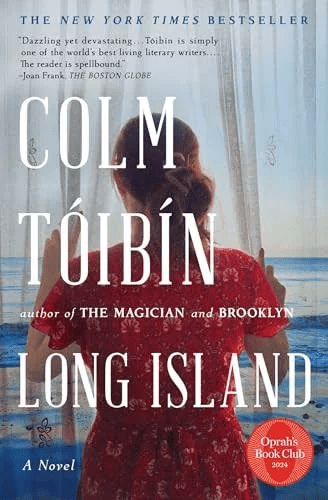
I’ve been struggling all year to finish books. I’m currently engaged in about 2 dozen different books, some substantially. But so far in 2026 I’d only finished one. Desperate for a quick read, I remembered I had Long Island by Colm Toibin available.

Toibin has written and spoken about Henry James with depth and sophistication. He of course wrote a delicious novel about James called The Master. As a prose stylist, Toibin is far from James and those labyrinthine Laocoon-esque sentences. But thematically he is a direct descendant. The characters and events in Long Island could have been written by James around the era of The Awkward Age or What Maisie Knew (but Long island would have been merely a novella to James). Of primary concern in the novel is Eilis and her family and a sudden disruption which launches her on a return to Ireland after 20 years in New York.

Eilis has every reason to be happy with her current circumstance, but her husband has betrayed her and has not committed to accept her terms for a continuation of their life together. Back in Ireland for her mother’s 80th birthday, she becomes a chaos agent and derails the lives of several former acquaintences in a cool, non-chalant manner. But she must be forgiven, for she knows not what she does, or the consequences of her actions, because everyone is too concerned by appearances and impressions to be honest with each other.

In James’s novels, the Americans in Europe were often innocent naifs, manipulated victims of far more sophisticated Italians, French, or English from ancient families and fortunes. Here it’s rather the opposite, where a dazzling Irish girl who’s built a life in New York returns to wreak havoc amongst the small-town yokels. This is a quiet novel and very interior to the concerns of a handful of characters, but I found myself falling deeply for all of them, and felt terribly the potential for catastrophe as the plot unfolded. I was, as I typically am when reading Toibin, totally absorbed.

Human Smoke

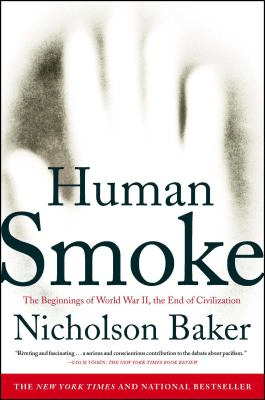
Human Smoke is by the novelist Nicholson Baker, who has written some very touching and outrageously silly books which I’ve enjoyed tremendously. But Human Smoke is not a novel, it’s a sort of experiment in collage, cobbling together diary entries, letters, news reports, and speeches from dozens of sources leading up to and during World War II and the Holocaust. Unlike his novels this work is not touching or silly. It is deeply troubling.

I’m familiar with only two comparable works. One is Baker’s other non-fiction experminet, called Baseless, which focused on the Korean War. In that book Baker investigated the possibility that the US had covertly employed biological weapons against civilians and soldiers during the conflict, and kept a sort of personal journal of his process, his reactions to government secrecy, what it was still possible to find out, and what was likely down the memory hole. Another work similar to Human Smoke is Charles Reznikoff’s Holocaust, a work of poetry created through the artful rearrangement of fragments from witness testimony at the trials of Nazis. I used Reznikoff’s text when I taught Hitler’s rise to power and the Holocaust to public school students.

I’ve read a few dozen books about the second World War, and about Nazi Germany, and about Hitler and the Nazis, about Churchill and FDR, and probably also a few hundred articles along the way. On top of that are the countless documentaries, television shows, news reports, literary works, memoirs, and feature films, etc. Human Smoke is troubling because I learned new things which made me uncomfortable. I had to question my own assumptions that I had the narrative straight, that I knew that story pretty deeply for an amateur who was not a trained historian and yet who had the heavy responsibility to teach it to young people and guide them as they explored the topic. Of course I like when I have to challenge my assumptions–that’s the entire point of the reading life.

I’d long questioned and critiqued what I was taught in high school about US involvement in the war. I was taught that the US intervened to stop the Holocaust and save Jews, and that the US military won the war. Previously I’d known that this was not true and was largely propaganda instead of history. The Soviets defeated the Nazis in Europe, with help from the US. 4 out of 5 Nazis killed by the Allies were killed by the Soviets, and overwhelmingly the Soviets did the heavy lifting and endured the heaviest losses. The US of course did the hard work in Africa and in Italy, and paid a huge cost in Normandy. They did all the ghastly work in the Pacific as well. I don’t minimize the losses or the sacrifice of the United States in the war. But we were outright lied to about why the US intervened when I was a teenager. We were also misinformed about the USSR and its role.

Human Smoke reveals things about Roosevelt and Churchill and their schemes and their tactics which are extremely distasteful. Some of them I knew before, others were grotesque revelations. At a time when heroes are needed badly in the West, you won’t find them here. Again we are confronted with the problem long presented in the western democracies–there are no good guys in power, only somewhat less bad guys. The pacifists are the only worthy ones in this book.

JR by William Gaddis

JR is the third Gaddis novel I’ve read, following The Recognitions (which I recently re-read with great delight) and Carpenter’s Gothic.

It took me nearly 4 months to read JR, but this was largely by design. I read multiple books at a time and decided back in the summer to limit myself to 10 pages a day of this behemoth, and there were many days where I managed only 5 pages per day.

It’s not an easy book. There are no chapter breaks, and the novel is about 99% dialogue (the last novel I remember reading which was virtually all dialogue was The Awkward Age by Henry James). Characters speak often without any identifying information other than what they are saying–it takes some time and effort to shake out who exactly the characters are and how they relate to one another, and sometimes it requires close analysis to understand who is speaking and to whom. Almost every bit of dialogue is interrupted by interpolations from other characters, or phone calls, or delivery drivers. Nothing internal about the characters is shared, simply their dialogue.

But the difficulties of JR are worth it. I laughed out loud repeatedly. Gaddis produced one of the great satires of American style capitalism, and managed it BEFORE American capitalism truly went off the rails and into the even more unimaginable excess and corruption we see now.

There are only a few settings in the book. One is the genteel house of an upper-crust family whose business is falling apart and being raided by their own attorney. Another is the principal’s office at a city elementary school, where corporations have been given free reign to test out closed-circuit TV and pro-business curricula. There is a bizarre small studio apartment where the tub and sink faucets are broken stuffed to the rafters with the detritous of corporate schemes and adverts which becomes the nerve center for a global corporate entity run by an 11-year old boy. There is the administrative office of the previously mentioned family business where the secretaries film pornographic videos off-hours. In every setting commerce and the concerns of big business and Wall Street rudely and repeatedly interrupt everything. Gaddis portrays the impossibility of having true human interactions in a system devoted to greed and the continual grasping after unnecessary objects. And the artist? There are several artists in the novel, including writers and painters and one very important composer. All of them struggle to survive in a system which has no values or meaning beyond acquisition and consumption.

The elites in predatory capitalism are exposed and lampooned repeatedly for their disgusting racism, their unwarranted sense of class superiority, their interference in other countries and in politics to maximize their own profits regardless of the cost to humans or the environment. Everything is commodified, turned into a packaged convenience and thence to trash which litters and chokes a rapidly burning down global order.

JR is a sixth grade boy who has become interested in the business world and builds a global empire despite his sheer bumbling incompetence. He manages it with determined chutzpah and lots of mail-order freebies. JR could be any number of “genius” billionaires currently ruining Earth who imagine themselves examples of superior evolution, when in fact they were born lucky and have a moral capacity beneath that of a sea slug.

Unlike the other Gaddis novels I’ve read and re-read and am planning to re-read, I’ll probably not read JR again. I can simply watch world events play out to see this plot in action.

Dreamwork

This morning I had a vivid work anxiety dream about a profession I left nearly four years ago. In the dream I was a high school teacher working at a new school in a complicated building–it’s a dream setting I’ve been in several times and in which I’ve had similar experiences over the years. Despite leaving teaching completely I still have these sorts of dreams regularly. Class has started, I’m unable to find the lounge where my laptop and schedule and keys are, the corridors are confusing. When I finally find my classroom the students are unsure about the project they’ve been assigned, there are administrators in the room asking questions, the technology is not functioning. It’s type of dream I’ve had since I was a student; can’t find my locker, the locker combination doesn’t work when I do find it, I don’t know where my classroom is and I’m late. Other variations? Trying to board a flight but my ticket/passport/luggage is missing.

There’s a bunch of science about dreams being the brain’s way of processing the days’ events into memories. My dreams are almost NEVER related to daily events, however. They’ve always felt weighty and full of almost-realized profundity. Even basic anxiety dreams are trying to tell me something about myself.

Inner Work by Robert A Johnson is a practial guide to approaching and interacting with dreams and dream materials. Johnson is a Jungian and they are the analytic school I find most interesting when I think about my dreams. As a young teen I often had dreams where different selves would argue, different personalities with completely different wants and points of view. And I’d wake up with their dialogues and discussions still ringing in my head. At times the voices were like a mutiny and I genuinely wondered if I were going mad.

I first read a lot of Freud, and finding his work very interesting but unsatisfactory I moved on to Jung and his school. Jung’s assertion that there are completely autonomous elements of the Unconscious which need to be approached and integrated felt right and made logical sense given the content of many dreams, which I carefully recorded in journals over the decades.

So why would I have an increase in teacher anxiety dreams AFTER leaving teaching? Because teaching, as onerous as I found the job, pushed me to the maximum in many ways. I was by necessity at my creative, innovative, and intellectual peak. I had to navigate so many relationships and so many roles, and was for over 20 years completely outside my comfort zone. Every time I thought “I’m getting the hang of this” some new leadership role or challenging group of students or suddenly having to teach online during COVID would happen. Leaving teaching and opening a small business in France has of course been challenging and rewarding, but I am not being pushed in the same ways. There is some part of my unconscious which is dis-satisfied with this state of affairs and is trying to force me to feed its needs for intellectual and creative rigor. Gardening, lumberjacking, speaking French, and running a tourist lodging business are apparently not enough!

I’m considering using Johnson’s method for a bit to see if I can pin down what is going on internally. He’s actually got two methods in the book–one for interpreting and doing dream work, and another for using Jung’s Active Imagination.

Another feature of my dreams is that I often am left upon waking with a song stuck in my head on repeat for days on end. I’ll wake from a dream hearing the song and then can’t shake it. Recently it’s been “Vienna” by Billy Joel. I decided to look up the lyrics, which I’d never really thought about:

Slow down, you crazy child
You’re so ambitious for a juvenile
But then if you’re so smart
Tell me why are you still so afraid? Mm
Where’s the fire, what’s the hurry about?
You’d better cool it off before you burn it out
You’ve got so much to do
And only so many hours in a day, hey

[Chorus]
But you know that when the truth is told
That you can get what you want or you can just get old
You’re gonna kick off before you even get halfway through, ooh
When will you realize Vienna waits for you?

I’ve noticed of late a tendency to always be thinking of the things I need to get done instead of just doing what I’m doing. I’ll be petting one of our animals and thinking “oh shit I have to finish splitting the firewood” or “that pipe in the Loft apartment is not going to replace itself” or “am I ever going to finish reading that William Gaddis novel?”

My unconscious is sending me this song on repeat for a reason. I don’t know that I ever really heard the lyrics outside of the chorus until now. So part of the dream is telling me I need a more intellectual, more creative outlet, while another part is telling me to relax:

Too bad, but it’s the life you lead
You’re so ahead of yourself, that you forgot what you need
Though you can see when you’re wrong
You know you can’t always see when you’re right
You’re right

Take a chill pill, man. You’re doing fine!

Tai Chi: The Internal Tradition

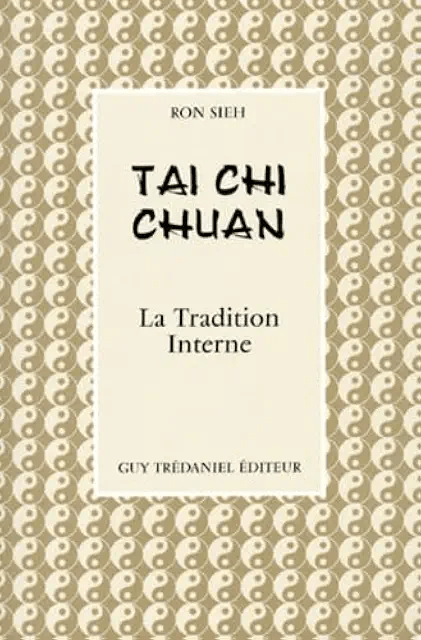
I was quite pleased when we moved to rural France to discover a quality Tai Chi course offered locally and at an astonishingly reasonable price. For the past three years I’ve been working with our instructor on the Yang style long form, and have learned almost the entirety, up to near the end of part 3, “The Sky.”

I’ve found during this time that I’ve become much more limber and more sensible about my movements and my balance. For nearly the entire three years I’ve had as my morning activity a round of Qi Gong followed by the Tai Chi form, outside by the river weather permitting or in our event space. My instructor wanted to push me a bit so he leant me a copy of this book, which was written by an American, but I read the French edition because of course here we are.

It was a good time to read a book about the internal focus of Tai Chi, because due to a few injuries (right knee, right shoulder, a recurrence of a previously repaired umbilical hernia) I’ve not been keeping up with my practice. In fact I’ve not done the form or even any Qi Gong exercises for two months. My body as a consequence feels its age for the first time in ages.

But I have tried nonetheless to bring the internal practice of Tai Chi into my daily life as I heal and get stronger. Sieh’s book is not revelatory or ground-breaking, but it is clear about topics which are often presented in tedious and confounding ways by overly technical writers. While physically sidelined I found it edifying and quite useful, and I hope to bring Sieh’s wisdom to bear when I get back in form.

It’s funny how much of Sieh’s book about the internal practice of Tai Chi relies on training with partners. It’s not easy to find someone to practice push hands with in the middle of nowhere.

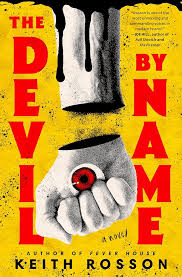
The Devil by Name

It was just over a year ago that I read Rosson’s Fever House. I really enjoyed that novel and the way it reformatted the familiar zombie apocalypse trope.

I’m sad to report however that volume 2 of the duology is less satisfying. The Devil by Name mostly moves characters around in order to get them in the right place at the right time for the climax. And the climax is sort of Clive Barker rewriting The Stand. Lots of gothic horror and special effects, but a bit rote and too tidy a means of tying up multiple loose ends.

If you read the Game of Thrones novels, you may recall that the fifth novel felt as though Mr. Martin had lost the plot, and was sort of moving an enormous cast of characters around aimlessly as he tried to figure out how to resolve the enormous series of events he’d unfolded, while introducing new characters, cultures, and armies along the way. I think a lack of resolution is in some cases better, and Fever House could have stood alone.

That said, I will read more of Keith Rosson. He’s got skills, and won the Shirley Jackson award for a short fiction collection which sounds right up my alley.

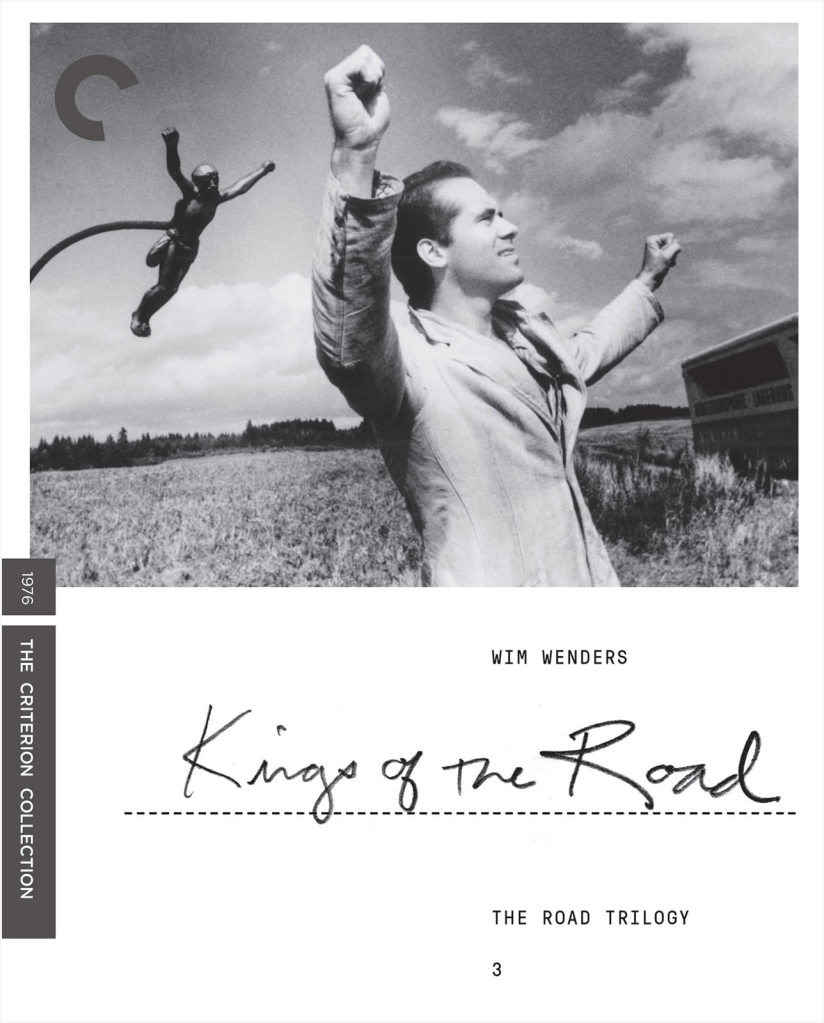
Im Lauf der Zeit (“Kings of the Road”)

I saw Wings of Desire way back when Netflix used to mail DVDs in envelopes. Later I saw Paris, Texas. These are the Wenders films I heard about back when I was first exploring the renowned auteurs of cinema, and I’ve seen them both a few times. Recently I also saw The American Friend.

Kings of the Road is superior to the other Wenders films I’ve seen. It has the loose plotting and crazy energy of the superior Fellini films, but also the rich raw aesthetics of Herzog or Pasolini. Though it clocks in at nearly 3 hours in length, I found it breezy and entirely captivating on multiple levels.

The two main characters are perhaps not the best most noble people, but they are resilient and imaginative and do their best to be kind in a completely mad society. And though the narrative is loose and a bit naive there is some profound meaning in the dialogue and imagery. There is for example a subtle but inisistent critique of US influence in West Germany with as much context and as many exemplars as a good Tony Judt essay.

So it made me feel deep feels, it made me laugh, and it made me think. Someday I’ll be glad to revisit Im Lauf der Zeit.

Halloween approaches

It’s autumn and a young man’s fancy turns to…well I’m too old to remember what young men fancy at any time of year. But I fancy reading horror and ghost stories as Halloween looms.

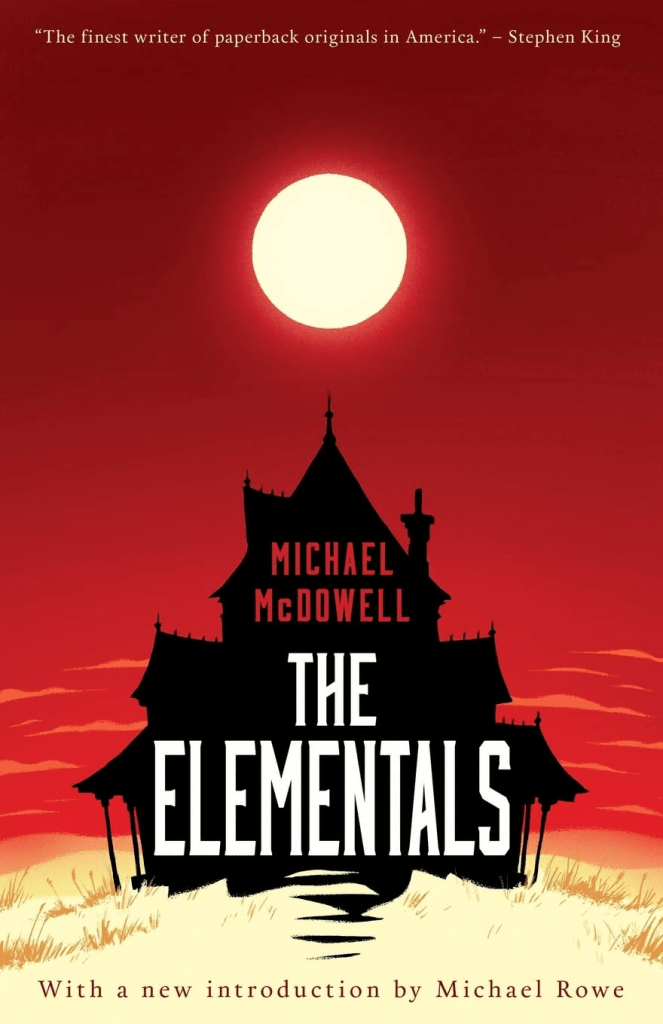
The Elementals is surprisingly well-crafted for an early ’80s mass market horror novel. It’s got a Southern Gothic flair, and without its supernatural elements the book could have succeeded as pop fiction with a literary bent. The families portrayed are Faulknerian, and the individual characters are Flannery O’Connor cute with their humorous quirks and tragic blindnesses. The setting is vivid and swampy and humid, rendered with evocative and stylish description.

The horror however is a bit silly, and didn’t ring true. I prefer subtlety with my haunts and spirits, and the chills here are far too garish and carnivalesque. It’s annoying to see well-rounded and sympathetic characters who do obviously stupid and pointless things contrary to who they are when faced with a crisis. And there is no suspension of disbelief possible with this sort of cartoonish creature. Using a scale likely familiar to those who know Stephen King novels, I’d rate The Elementals as closer in quality to The Tommyknockers than it is to The Dead Zone. But I must also note that McDowell’s prose is superior to King’s.

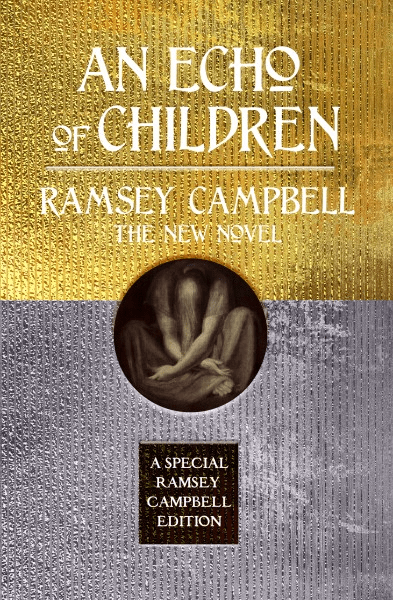
An Echo of Children has similarites with The Elementals, though they were written 45 years apart. Ramsey Campbell’s latest is also primarily a novel about a family in crisis, and its one of his best from the past two decades. Campbell is a personal favorite of mine, but many of the novels from the second half of his career have been interesting failures. I found this one compellkng enough to read nearly straight through.

Allan and Coral Clarendon move with their young son Dean from a crime-ridden neighborhood into a brand new house near the shore. Once they are installed in the new place, both sets of Dean’s grandparents arrive to visit for a weekend. Allan’s parents Jude and Thom note that Dean’s creativity and freedom is severely constrained in ways they find objectionable as parents and former teachers. Dean has an “imaginary” friend called Heady who promises to protect Dean from harm. All four grandparents are charmed by Dean and his friend until Jude and Thom experience Heady’s presence first-hand.

After a few interections with neighbors, a memory Thom has repressed returns, leading Jude to do some internet research. What Jude finds out about the neighborhood’s history, and in particular about Allan and Coral’s house, convinces her that Dean is in immediate danger. There is evidence that Carol and Allan are perhaps doing more than limiting Dean’s potential with helicopter parenting, and have strayed into psychological and physical abuse. They have pulled him from school and begin indoctrinating him with a dour form of Christianity which they’d never followed before. Jude commits herself to rescuing her young grandson, but is what she’s uncovered the truth? Or is her paranoid imagination coupled with senility the source of the horror?

Campbell is a fine writer and perhaps the greatest prose stylist in modern horror. He has the skills to keep the reader on edge as Jude’s potential unreliability competes with the possibility of an actual haunting in the reader’s mind. This one was more to my taste.

The Other

I’d thought as a long-time fan of horror that I was at least aware of all the classics of the genre. Until a few months ago I’d never heard of Thomas Tryon’s The Other, and what I read about it intrigued me sufficiently that when I was able to score a digital version for under 2 bucks I jumped at the chance. The novel was quite an unpleasant surprise.

There’s something particularly disturbing about a child who is pure evil. And when it’s a twin the creepiness is dialed up a few notches.

Niles and Holland Perry lead a bucolic life on a rural estate in New England. They play together and put on dramatic shows and do magic tricks. There’s something off about Holland however; he is more than mischievous, and his behavior descends from adolescent rabble-rousing to cruel and reprehensible acts. Their grandmother Ada is a Russian immigrant who fled the Bolsheviks. She tells them folk tales and bits of family lore from the old country–and introduces them to The Game, which is a sort of hypnotic regression wherein the observer becomes entangled mystically with the observed. Needless to say, The Game comes to have dire consequences for the boys.

Tryon has skills. He writes elegant and sophisticated prose. I’d place him based on this one novel right up with Shirley Jackson and M. R. James as a writer of literary merit beyond genre category. The structure of the novel has a few layers of narrative, and it took a bit of sussing out to realize the clever and unreliable games Tryon was playing. Very Turn of the Screw trickiness afoot here.

But despite its merits as a work of literature, this is still a horror novel, and it delivers the goods. I didn’t see The Twist until it came, which was a great surprise, and I was floored by the utterly appalling climax.