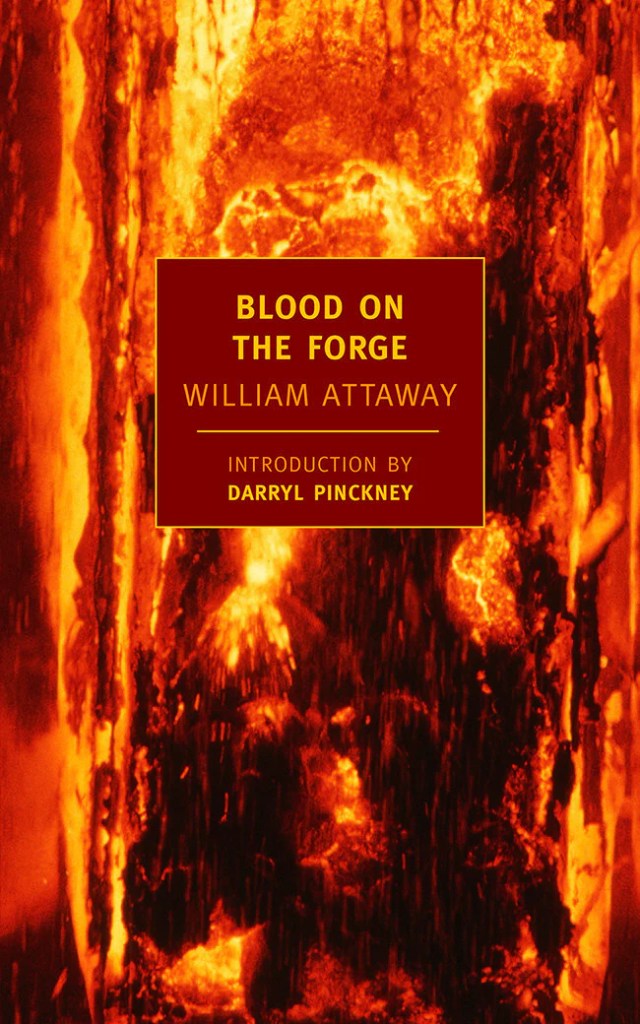
Sometimes going through my own bookcases is like browsing a great used bookshop, and a volume pops out that I didn’t even know I’d purchased. Ironically, William Attaway’s Blood on the Forge was a book I was searching for several years ago without knowing it and I had it all along.
When I was a teacher in Baltimore City Public Schools I was imagining a Great Migration unit starting with an image exploration and analysis using Jacob Lawrence’s Migration series as a starter. It was a fave tactic of mine to start units with images and to teach kids how to make inferences, ask deep questions, interpret, connect to previous knowledge, make predictions, etc before even learning about the topic of the unit. I never wrote that unit, however, because the Lewis Museum in Baltimore had a show of Jacob Lawrence which included works featuring Toussaint L’Ouverture and John Brown and Frederick Douglass and Harriet Tubman. After seeing that show, because I already taught units about Brown and Douglass, I took the Jacob Lawrence idea and tacked it onto those units.
Another reason I decided not to create the Great Migration unit was because I didn’t have a meaty novel-length text to use. And yet I did have the perfect one–and didn’t realize it until I lived in rural France in the 2nd year of not being a teacher. Oh well. There is probably a bit too much prostitution in the novel for 8th graders anyhow!
William Attaway is unfortunately not well-known, though he had a profound cultural impact. Until I read his novel and its fine introduction by Darryl Pinckney I was unaware that Attaway wrote the “Banana Boat Song” for his friend Harry Belafonte. He also influenced Richard Wright and Ralph Ellison, who both knew him and read this searing white-hot novel. (Side note: Darryl Pinckney has a fine article in the current NYRB about the Harlem Renaissance, and Attaway was apparently an indifferent and bored school student until he read a poem by Langston Hughes and found out that Hughes was Black, at which point he devoted himself to writing).
So, Blood on the Forge–talk about going forth and forging in the smithy of his soul the uncreated conscience of his race! This is an incredibly vital document of an important era in US history, the great movement of Black laborers from the South to Northern cities as the industrial revolution took off. Attaway, who was a middle-class son of a teacher and doctor who himself migrated as a child from Mississippi to Chicago, weaves in all the complex societal strands into a short elegant and harrowing story. You’ve got urban/rural, White/Black (Slav/Irish), union/scab, capitalist/socialist, agrarian/industrial, modern/traditional. There is enormous violence and powerful interests interfere in everything to protect what they regard as theirs, and the fates of three sharecropper brothers who are recruited and taken north to Pennsylvania to the steel mills herald prophetically the racial and class tensions to come. HIGHLY recommended.
 Mysterium Coniunctionis