
Way back in the day–early ’90s–I was earning my first master’s degree at Temple U. Ostensibly a creative writing program, Temple also required some rather rigorous literary work. There was, for example, an enormous list of “books you should read before your 2 years here is up.” On that list were three books by Coetzee: Disgrace, The Life & Times of Michael K, and Waiting for the Barbarians. I was floored by these novels, how simple and elegant they seemed, but there was so much artful architecture supporting and obscuring dense layers of meaning. One of the courses I took assigned Coetzee alongside the short fiction of Nadime Gordimer.
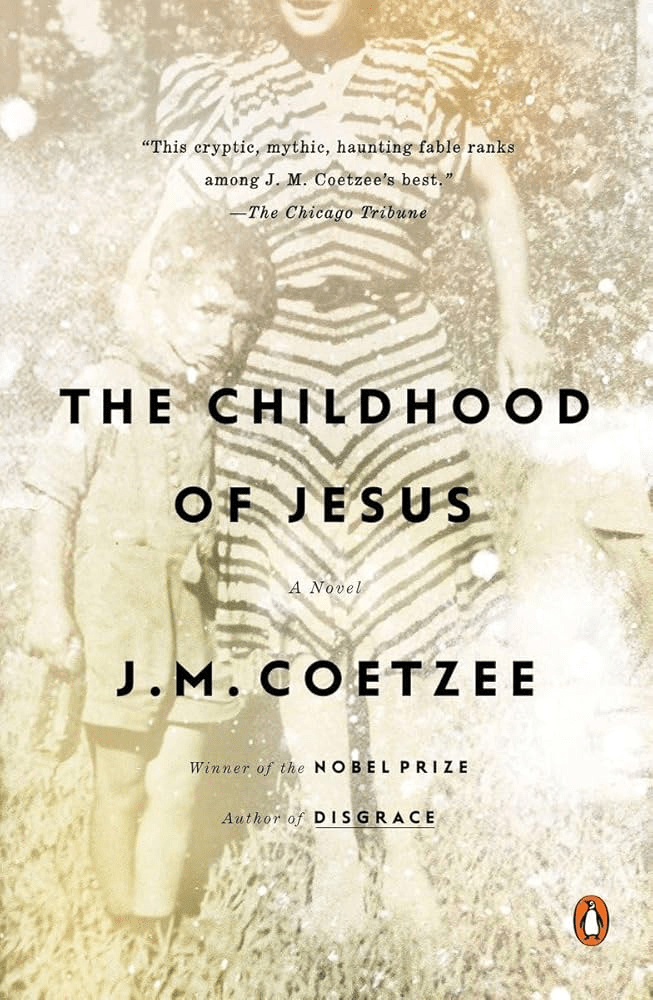
And then, for more than 30 years, I kept my eye on Coetzee and often thought I should pick up something again–I even bought a couple of his novels and put them on the shelf. I think I bought The Childhood of Jesus more than 6 years ago before I finally read it. It was worth the wait.
When I had writerly aspirations as a youth and I’d get stuck in the glue trap of writer’s block, I’d think of a myth or fable or religious story I’d learned as a kid and re-tell it in a different time and setting. Coetzee’s novel reminded me of that useful trick as it retells the story of Christ’s early years but with migrants entering an unnamed Latin country to start a new life. The child David is of uncertain heritage and receives the name David from authorities in his new home. He is guarded by Simon, who took care of David after he lost a letter explaining his presence on a passenger boat, and who resolves to find David’s mother in their new land. Later on other familiar characters emerge but with different names: Ines is the virgin mother, Juan is the Baptist, Magdalene and Anne and other saints and apostles emerge, drop hints about their roles, and disappear.
David speaks and writes his own language, has his own ideas about how the world should work, and struggles with authority and limits on freedom. He learns to read from a child’s version of Don Quixote’s adventures, and cannot abide the idea that Quixote’s story is only in Quixote’s head, and that others around him see the same events in different and more mundane ways. He has mystical visions about numbers and their true meaning and sees people as tiny insects trying to be visible to him as he soars above the world. There are hints that Coetzee wants to underline the merging of early Christian thought and Greek philosophy and the knowledge and symbology of esoteric wisdom schools (for example, a Micky Mouse cartoon features Plato instead of Pluto as Micky’s canine companion). David’s revolutionary pedigree is underlined by his own dog’s name: Bolivar.
The expectations of the society in which David finds himself are too constraining and when the authorities determine he should be placed in a reform school the family of David flee to start a new life.
I enjoyed it so much that now I’m bound to read the rest of the Trilogy (or is it a Trinity?). Of course, it may take me another 30 years to get to the next volume.



 Mysterium Coniunctionis