
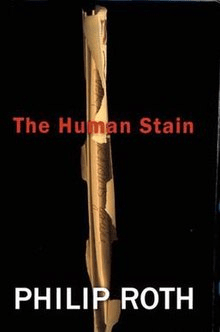
I read a lot of Roth back in the ’90s, to the point where I found myself Zuckered out. When The Human Stain arrived I bought it in hardcover but never got around to reading it (my copy still has a “Borders Books 30% off sticker” on the cover, LOL). Recently the NY Times released their Best Books of the Century list; the novel’s inclusion sent me downstairs to dig it out.
The Human Stain is third in a trilogy of novels (the previous two are American Pastoral and I Married a Communist). There’s a twenty-some year gap between my readings of Volume 2 and Volume 3!
Roth is typically strong at recreating a time period of American political and cultural absurdities, which he’d done in the previous novels in the trilogy for earlier eras. As the title and timing of the novel might indicate, we’re in the era of Bill Clinton and Monica’s stained blue dress. What a terrible time to be alive and American! Moralizing hypocrites unbound, a sleazy and easily manipulated Chief Executive who fell for a honey trap even the bait didn’t understand, the rise of sensationalist and salacious cable ‘news’ coverage, etc. Out of that mess came an extreme and reactionary right-wing movement angry that Clinton out-triangulated them and co-opted their economic wish list to the point where he hammered through the final achievements of the Reagan Revolution. As the Democrats moved right wing economically the Republicans went wholly off the rails. A Democratic Party beholden to Wall St and corporate interests emerged, leaving the political left in the US nobody to support except for the occasional quaint New Deal Dem who got smoked in the primaries or a third-party candidate. What a joke all that was, and yet the consequences were dire and are yet to be resolved in the USA.
The Human Stain centers around (SPOILER ALERT) a Black academic who chose to pass for white and Jewish and pulled it off, who is fired from his position of Dean for using a racist expression while teaching at a small elite liberal arts college in the wilds of New England. But the slur was not necessarily a slur given its ambiguities and the context, and perhaps the firing was an unreasonable rush to judgment (Roth perceived the emerging phenomenon of cancel culture?). Nathan Zuckerman, who befriends the fired prof and former Dean central to the story, sets out to untangle the events leading up to the situation and to write a book.
My favorite Roth novels feature a manic, hilarious, and zesty narrator. If you’ve read Sabbath’s Theater or Portnoy’s Complaint you know what I mean. Those novels breeze by in a vortex of delicious voice, and the reader is ensconced enchantingly in the conscience of a pervert who participates vividly in experience and has things to think about. But this novel (like The Plot Against America) succeeds on its level of refined craft. It brings up big themes, big ideas, big hypocrisies, and the reader is forced to examine her own beliefs and assumptions.
 Mysterium Coniunctionis