
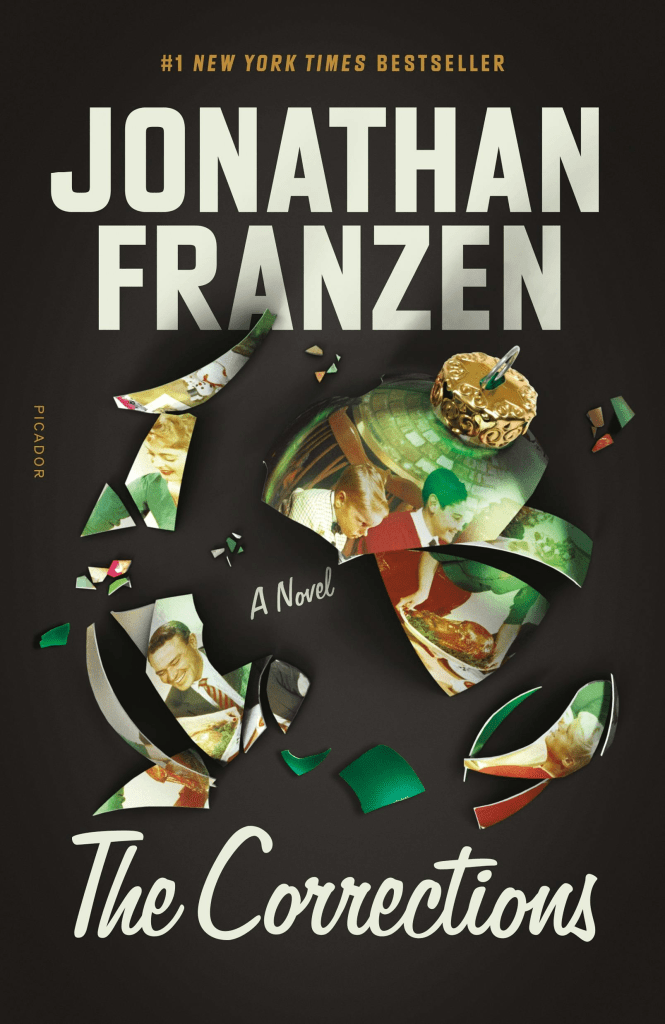
The Corrections

Here’s another novel from the recent NY Times List of “Greatest Books of the 21st Century.” It’s almost 600 pages long, and, given how weighty and dense and serious it is as a work of fiction I was surprised to find the writing quite breezy. I laughed heartily several times and regretted my decision 20-odd years ago to classify Jonathan Franzen as merely one of a crop of young writers at the time whose voices and themes and styles all seemed indistinguishable to me: Safran-Foer, Lethem, Chabon, Schteyngart, etc. I thoroughly enjoyed The Corrections.

I must however admit that the family at the center of the novel is deeply troubling. Most of the characters are eminently likeable and relatable–I found much in the family interactions which was all-too-familiar from my own experiences. And yet every character does hateful, despicable, awful things. Again, pretty typical of my experience not only of my own family but also of others I know well. This is where the sophistication of the book lies: documenting a time period in US/world history via the lives of a single midwestern family teetering on the brink of total and utter disarray and giving us a full picture of why across three generations. Franzen’s book shows us lovable people who we want to care for despite how truly terribly they behave–and given where American society has gone since its publication there is a bit of prescience in his vision. The entire nation these days feels like a dysfunctional family full of badly behaving people who are at heart decent and reasonable but whose unpredictable, selfish, and greedy behavior makes them despicable.

This morning I read an essay by Wallace Shawn in the NY Review of Books. The essay, called The End of a Village, will serve as the introduction to a newly re-issued book about the Vietnam War. Shawn was a college pal of the author Jonathan Schell, and manages to paint an evocative portrait of his friend and what he hoped to achieve through reporting on The Village of Ben Suc. Schell observed the complete and utter destruction of a peasant village by US forces, and tried to portray both the victims of this assault and the perpetrators with as much objectivity as he could muster. Having just finished The Corrections, I was struck when Shawn wrote this about Schell: “He generally seemed to like the military men he encountered. It’s just that what they were doing was appalling.”

This of course leads us to Hannah Arendt in The New Yorker 50-some years ago and her “banality of evil” (Wallace Shawn’s dad was managing editor of The New Yorker at the time). Shawn makes the connection, stating “If one accepts the idea that the ugliest of crimes can by perpetrated by people who aren’t ugly criminals, then the possibility seems to arise that even reasonably nice people might be at times involved in evil.”

The characters in The Corrections do horrible things as their family dangles by a frayed thread over the abyss of the 21st century. But at different parts of the novel, told from their different perspectives, I found myself rooting for each of them and caring deeply about their situations despite the decisions they made. And if individuals can do horrible things despite being “good” people, then so of course can societies and nations.

So we all make poor decisions and we all allow questionable motivations to drive us now and again. But how do we fix things after? When we go catastrophically awry and cause catastrophe, what is the means of repair? The word corrections has a lush ambiguity because the word has so many applications. A teacher corrects her student’s work. Parents correct their children (well, ideally). Some behavior is considered correct, and society drills us in the niceties of acceptable interactions. A captain who discovers her ship is off course will make corrections, a market which is overheated will face an inevitable correction. All of these senses of the word have a similar basis but different nuances. Every generation goes through a reaction to what was considered correct by the previous, now aging members of a family or civilization. So what is correct can be in flux, and those doing the correcting can be wrong or misled or mal-informed. When everything is called into question, when religion, government, the media, when public institutions previously held in high regard, when family itself all face skeptical and factual analysis and are thereby doubted and eventually shorn of their importance, and when much of the traditional underpinnings of a society and its very history are demonstrated as false and hypocritical, what is left? Where can we turn for guidance and support? How do we rebuild? I guess we’ll find out together.

The Book of Ebenezer Le Page

The town where I grew up in the 1970s was still, in many ways, actually in the 1950s. In Stewartstown, PA The Beatles were long-haired hippy freaks who hated Jesus, anyone to the left of Barry Goldwater was a Communist, and guys still hung out in their denim overalls by a potbelly stove in the feed store. My grandfather, who was almost totally bald, walked two blocks to the barber’s to get his “ears lowered” and hung out with the gents there for a couple hours. Our neighbor one house south of us on Main St was Mrs. Hersey.

Mrs. Hersey wore dark blue or black dresses which covered all the way to her neck, to her wrists, and to her ankles. The dresses were finely made and very austere, but there was elaborate white lace at the neck and on the sleeves. She also covered her hair in the traditional manner of churchwomen in that region at the time when she was outside or when she was hosting company. She would summon me to the fence between our yards when I was four or five years old. “Master Godfrey how do you fare today?” She always referred to me as “Master” followed by my last name, and addressed Christmas cards to me in the same manner (I think I still have one of those). After a bit of conversation she would hand me a small paper bag of chestnuts.

Mrs. Hersey didn’t have a living room like everyone else, she had a parlor. But the parlor to my at the time little mind just seemed like an old-timey living room. There were glass oil lamps with globes and wicks which had been converted to electric lamps. The glass was infused with different colors like mauve or mint green, often swirled with white foamy glass and sparkle flakes. Her parlor reminded me of the interiors in old western movies. There were doilies under everything: hard candy dish full of root beer barrels, the lamps, family pictures. And every table was covered with a cloth to boot, as were the chairs, which also had lace at the top and on the arms.

In Stewartstown I had the freedom to go anywhere unsupervised, and my friends and I did so. Favorite haunt was the old town cemetery directly behind our house, but we roamed widely and often for hours at a time without adults or elder siblings. We had this freedom because of the old ladies in town, who knew everyone and everyone’s brood and everyone’s business. From their front porches and from chairs hidden behind front window curtains they somehow divined all the latest gossip. But the old ladies kept an eye on us, took us in when we tumbled by on the sidewalk, came out with Band-Aids when someone fell, and in certain circumstances might deliver a stern lecture, a warning to call our moms, and occasionally, dealt us a smack.

I used to love visiting with the old ladies. They were all born around the turn of the 20th century and had seen so much–imagine they’d all had horses and horse carts when they were teenagers? They told wonderful stories and told me about my grandparents and father when they were all young people. When my parents got divorced and my mom and sister and I moved in with my maternal grandparents in a different small Pennsylvania town, I continued the tradition of visiting old ladies. My grandma would give me a sack of veggies from her garden and say “Take this up to old Mrs. Kent and tell her $1.20 please.” I’d tie the plastic bag to my bike handlebars and ride off. Mrs. Kent had more hair on her chin than on top of her head, and wore simple house dresses with a full body apron as she sat in her rocker and told me about the photos on her tables, or about her knick-knacks, or about that one time she got a train to Baltimore, or about her long-gone husband. Then she’d give me some shoefly pie and $1.20 in coins to take back with me.

All of this as prologue to show I’ve often delighted in the company of old people, and truly treasure my opportunities to do so when I was a very young lad. And this novel by G. B. Edwards reminded me so much of my visits with old folk back in the 1970s and early 1980s that I felt a profound nostalgia, despite never having been to Guernsey Island.

The Book of Ebenezer Le Page came to my attention recently as I was scanning my bookshelves and planning future reads. I’d read a couple articles lately about Guernsey Island and some controversies about its time under German occupation and what exactly happened in the labor camps there. I picked it up to read as a secondary novel (I typically have a primary novel and a secondary going at the same time (and also a primary non-fiction and fiction going at the same time (and routinely a primary novel in French as well))) and with regular 6-8 page chapters finished it off in a couple months.

What a pleasant and interesting old chap Ebenezer Le Page turned out to be. And what a lens through which to see the changes in an island culture over the early 2/3rds of the 20th century. Ebenezer of course is not an old man throughout the novel, but the novel is told by old Ebenezer who is writing his memoirs. If you are a fan of plot and excitement, this is not a novel for you. If you like to visit old folk and set a piece and hear what they have to say–you may well enjoy this book. I particularly enjoyed Ebenezer’s run-ins with Liza and actually laughed out loud reading them. But we get his entire life story and his interactions with friends and family as the island where he lives moves from the 19th century and into the 20th and through the world wars.

Surprisingly, there are gay characters in the book and it’s interesting to note Ebenezer’s mindset and reactions to them. And Ebenezer remembers some details of the Nazi occupation of Guernsey which continue to be controversial. I particularly enjoyed learning about the patois of the island with its mixture of French and English cultures and languages. There is a useful dictionary in the back!

I was genuinely sad to reach the end of this novel–that rarely happens in life, even when you read a lot of great stuff.

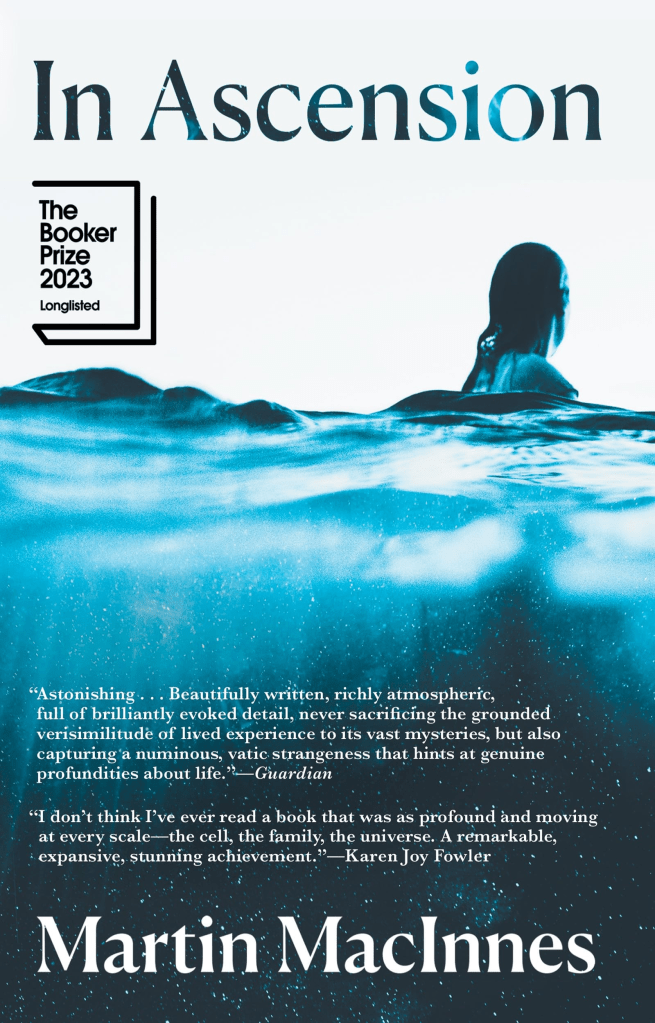
In Ascension

I first heard of the writer Martin MacInnes while having lunch outside the cafeteria at an international school in Panama where I worked as a Social Studies teacher for four years. At my table was the author’s brother, who was director of athletics and who held some other leadership responsibilities, including eventually a Safety Committee role assuring the school’s compliance with all COVID 19 protocols. “I’m sure you’re skeptical because it’s my brother I’m touting, but I assure you he’s a really gifted novelist. I think you need to check out his stuff–he’s got three novels and a fourth on the way. They’re all quite interesting and well-done.”

The “fourth on the way” turned out to be the first MacInnes I’ve read: In Ascension. Based on its quality, it won’t be the last. MacInnes is certainly good–I’d rank the craft of this novel right up there at the upper echelon with folks like Richard Powers, Colm Tóibín, Ian McKewan, Jhumpa Lahiri, Louise Erdrich, etc. This is a science fiction novel, but it’s not merely a genre piece–it’s a work of densely layered literary fiction.

This is a near-future bit of sci-fi and unspools within the next couple decades we face here in the real world. The novel’s protagonist is Leigh, an expert biologist/geneticist who specializes in the study of early life and who loves tiny critters like archaea and algae in particular. Because she is also a deep sea diver she is invited on a scientific expedition to chart a newly discovered volcanic vent which might be home to some interesting microscopic life. While doing a dive at the site Leigh has what can only be described as a mystical experience. She and other divers have visions and develop an unknown illness. They become obsessed with returning to the water. Drifting around for weeks at the surface on site and doing the boat crew and scientific work becomes more difficult as something below calls to them. Leigh meets and interacts with other scientists on this mission, which becomes important later in the story.

Meanwhile a discovery is made which will impact humanity in unforeseeable ways: a new means of propulsion has been uncovered, which can expand the reach of humans to the furthest limits of the solar system and potentially beyond. There are hints that the mystical experience Leigh and her fellow divers had in the Atlantic Ocean may be connected to dreams had by the scientists who discovered this propulsion system simultaneously on different continents. Leigh eventually is invited to work on creating a sustainable food system for the first manned ships which will used this drive.

But Leigh is not merely a scientist tapped as an expert in a near-future sci-fi novel; she is also a fully-rounded human being with all that entails. MacInness is excellent at letting us see her family: the abusive father who had ambitions as an architect which were thwarted, but who still becomes an important engineer who manages the systems which recapture land for the government of the Netherlands; the brilliant mathematician mother who is largely absent and exists solely in a state of academic indifference to human suffering in her household. Just as Leigh is signed up for a top-secret scientific space mission her mother begins showing signs of dementia, and Leigh will be absent as her mother and sister start a terribly difficult stage of their lives.

And so this is a sci-fi story of a certain sort (2001 A Space Odyssey, Annihilation, Solaris come to mind) where there are indications an advanced race is meddling in life on Earth and may perhaps have even seeded life there in the distant past. The sci-fi is twinged with a New Age mysticism; as Arthur C. Clark once intoned, there is no difference really between advanced technology and magic to the more primitive species…

But the novel is still mostly about Leigh and her family relations and how she ended up the person she is. The sci-fi elements aside the themes of the novel are about an inability of children to understand or relate to their parents, and the distances between loved ones are as vast as any physical distances. Despite her incredible levels of technical proficiency and innovative use of science to solve problems, despite her profound specialization concerning the origins of life and how to modify genetic codes, our protagonist still can’t have a simple conversation with her mother or sister. Leigh discovers that even after plumbing the vast depths of the ocean and the outer regions of the solar system and journeying through time itself, our own true self remains the deepest mystery of all.