
I first heard of the writer Martin MacInnes while having lunch outside the cafeteria at an international school in Panama where I worked as a Social Studies teacher for four years. At my table was the author’s brother, who was director of athletics and who held some other leadership responsibilities, including eventually a Safety Committee role assuring the school’s compliance with all COVID 19 protocols. “I’m sure you’re skeptical because it’s my brother I’m touting, but I assure you he’s a really gifted novelist. I think you need to check out his stuff–he’s got three novels and a fourth on the way. They’re all quite interesting and well-done.”
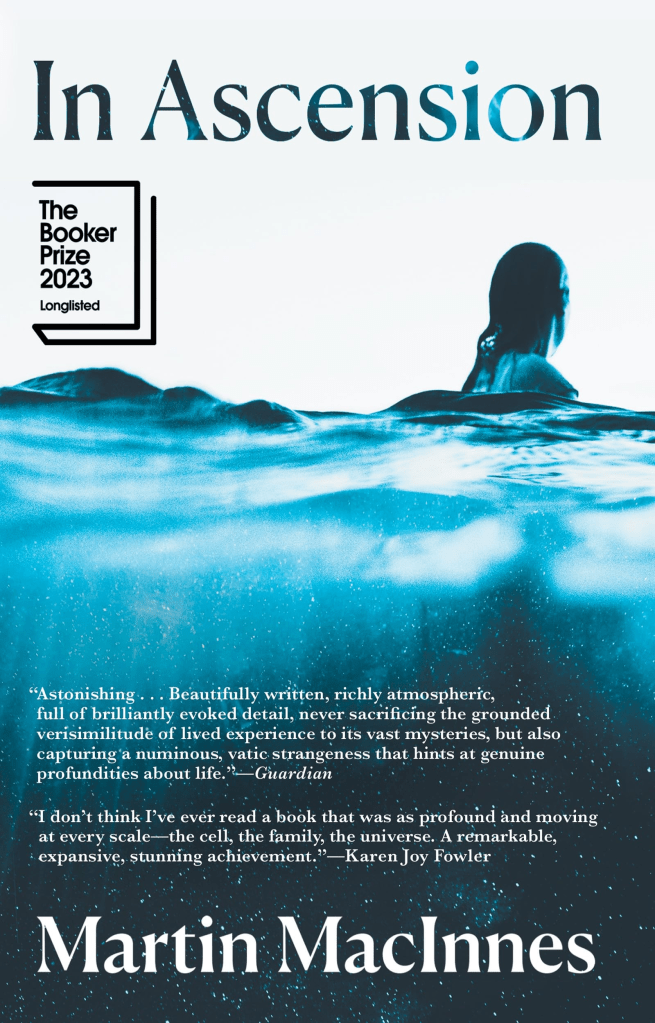
The “fourth on the way” turned out to be the first MacInnes I’ve read: In Ascension. Based on its quality, it won’t be the last. MacInnes is certainly good–I’d rank the craft of this novel right up there at the upper echelon with folks like Richard Powers, Colm Tóibín, Ian McKewan, Jhumpa Lahiri, Louise Erdrich, etc. This is a science fiction novel, but it’s not merely a genre piece–it’s a work of densely layered literary fiction.
This is a near-future bit of sci-fi and unspools within the next couple decades we face here in the real world. The novel’s protagonist is Leigh, an expert biologist/geneticist who specializes in the study of early life and who loves tiny critters like archaea and algae in particular. Because she is also a deep sea diver she is invited on a scientific expedition to chart a newly discovered volcanic vent which might be home to some interesting microscopic life. While doing a dive at the site Leigh has what can only be described as a mystical experience. She and other divers have visions and develop an unknown illness. They become obsessed with returning to the water. Drifting around for weeks at the surface on site and doing the boat crew and scientific work becomes more difficult as something below calls to them. Leigh meets and interacts with other scientists on this mission, which becomes important later in the story.
Meanwhile a discovery is made which will impact humanity in unforeseeable ways: a new means of propulsion has been uncovered, which can expand the reach of humans to the furthest limits of the solar system and potentially beyond. There are hints that the mystical experience Leigh and her fellow divers had in the Atlantic Ocean may be connected to dreams had by the scientists who discovered this propulsion system simultaneously on different continents. Leigh eventually is invited to work on creating a sustainable food system for the first manned ships which will used this drive.
But Leigh is not merely a scientist tapped as an expert in a near-future sci-fi novel; she is also a fully-rounded human being with all that entails. MacInness is excellent at letting us see her family: the abusive father who had ambitions as an architect which were thwarted, but who still becomes an important engineer who manages the systems which recapture land for the government of the Netherlands; the brilliant mathematician mother who is largely absent and exists solely in a state of academic indifference to human suffering in her household. Just as Leigh is signed up for a top-secret scientific space mission her mother begins showing signs of dementia, and Leigh will be absent as her mother and sister start a terribly difficult stage of their lives.
And so this is a sci-fi story of a certain sort (2001 A Space Odyssey, Annihilation, Solaris come to mind) where there are indications an advanced race is meddling in life on Earth and may perhaps have even seeded life there in the distant past. The sci-fi is twinged with a New Age mysticism; as Arthur C. Clark once intoned, there is no difference really between advanced technology and magic to the more primitive species…
But the novel is still mostly about Leigh and her family relations and how she ended up the person she is. The sci-fi elements aside the themes of the novel are about an inability of children to understand or relate to their parents, and the distances between loved ones are as vast as any physical distances. Despite her incredible levels of technical proficiency and innovative use of science to solve problems, despite her profound specialization concerning the origins of life and how to modify genetic codes, our protagonist still can’t have a simple conversation with her mother or sister. Leigh discovers that even after plumbing the vast depths of the ocean and the outer regions of the solar system and journeying through time itself, our own true self remains the deepest mystery of all.
 Mysterium Coniunctionis