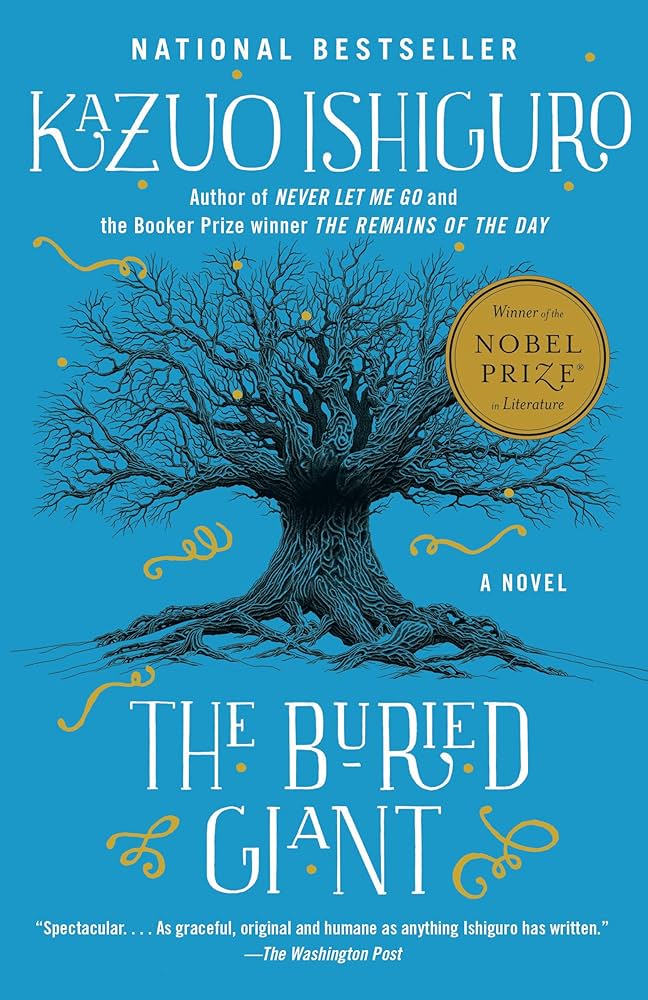
The Buried Giant

Somewhere in the books of Colin Wilson I recall him mentioning the phenomenon of “library faeries.” These creatures mysteriously put books into your path at just the right moment. As I was reading Emma Jung’s analysis of the Arthurian legends I stumbled upon Ishiguro’s The Buried Giant. I won’t really explain why or how as doing so might destroy the reader’s discovery, but this small novel inhabits and extends somewhat the Arthurian universe.

I’d read and loved three previous novels by Ishiguro, most recently Klara and the Sun, which hammered me with its profoundly sad portrait of an exploited lab-created being. Easily the best novel of its kind since the original masterpiece by Mary Shelley!

Here Ishiguro tries his hand at fable and fantasy. We meet an elderly couple named Axl and Beatrice, who live in a warren community and suffer a hardscrabble existence. They decide to make a journey to a nearby village to visit their son. On their journey they realize that something is mysteriously preventing clear memories of their past–and they realize this problem is universal. Britons and Saxons live together in an unstable harmony following the Battle of Badon and its associated slaughters. The couple encounter a Saxon knight named Wistan and a young boy who has been bit by an ogre and outcast from his home village. This band of adventurers sets upon on a quest, but each has an individual agenda which is hidden in the misty haze which drapes the land in a spell of forgetfulness.

Like in his previous novel The Remains of the Day, Ishiguro explores here how revisiting the past has consequences. Axl and Beatrice have been happy together despite their harsh life. The Saxons and Britons have coexisted in peace. Their quest may disrupt what cloaks the memories of all, with dire consequences. As glimpses of what lies buried emerge, Axl and Beatrice begin to worry: Should the past remain forgotten, or must it be rediscovered and dealt with?

The Boatman warns them, to no avail.

I loved this little allegory a great deal, and continue to admire how Ishiguro writes such ostensibly clear and simple novels which have layers and layers of elaborate meaning. Check it out!
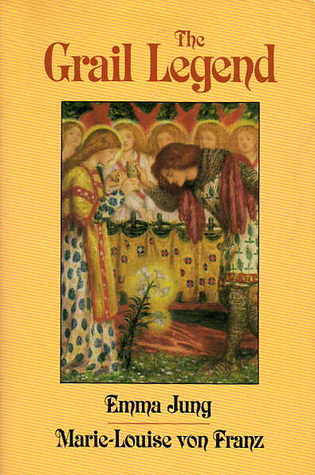
The Grail Legend

Since my mid-teens when I first encountered Modern Man in Search of a Soul and Man and His Symbols, I’ve been interested in Jung and Jungians. In my 20s I worked my way through Jung’s major works, up to a brief attempt at Mysterium Conjunctionis, which defeated me, and like Finnegan’s Wake has resisted any further attempts at reading.

I’d read recently H is for Hawk, which was an interesting memoir about a young woman who deals with the loss of her father by training a goshawk–and in her book Helen MacDonald repeatedly refers to T.H. White’s own book about training a goshawk. T.H. White, of course, was the author of The Once and Future King series about Arthur and the Knights of the Round Table, and I considered reading those novels for the first time but don’t have them on the shelf. I did, however, have Emma Jung’s analysis of the Grail Legend and picked that up instead.

Emma Jung was Jung’s wife and collaborator, and was a sophisticated analyst as well. Her book is introduced by another long-time associate of Jung’s, Marie-Louise von Franz, who edited and finished the work after Emma Jung died.

As is often the case with books by Jung or Jungians, this is a challenging read, and it presumes a familiarity with Jung’s work and in particular his book Aion.

It is Emma Jung’s contention that the Grail Legend is an attempt by the collective unconscious of pagan Europe to adapt to and internalize Christianity. From our home here in the Correze I can very quickly visit several fountains which were originally pagan sacred sites but which were renamed in the 4th or 5th century for Christian saints and turned into Christian sacred sites. There is a lovely one here in Treignac designated The Fountain of St Meen. Also easily accessible nearby are several ancient crosses, dropped by monks on pagan sacred sites in order to Christianize the locals. One of my faves is La Croix en Haute in Lestards.

Christianity of course was an import to Europe from the Middle East, and its doctrines and rituals struck local residents as strange and alien. But over time as society became structured by converted local nobles and local monastaries and abbeys, pagans had little choice but to adopt themselves to the new religion. But the heavily patriarchal belief system with its dogma of sin and repentence and featuring a hostility towards women, magic, sex and nature was hard to swallow for locals who had their own beliefs almost completely at odds with the Christian worldview.

And so a new series of myths and legends erupted in order to compensate for and make more comprehensible the tenets of this new faith. Emma Jung documents carefully how the writers who first codified the Grail legend took material from widely dispersed pagan legends from as far afield as Wales, Ireland, Syria, Persia, and old Saxony. French poets and troubadors and English poets and historians and German poets all began singing and composing verse about Arthur and his knights and their quest for the Grail.

The Grail is typically understood as a cup which at one time held the blood of Christ captured at his crucifiction–but Jung shows that some stories present the grail as a plate or serving dish. It has the power to heal or destroy, and it exists in a hidden realm in an alternate reality accessible only to those pure enough to find it.

Associated symbols are analyzed and discussed in detail. The Fisher King is linked to the Piscean Age, the sudden eruption of the cult of the Virgin to compensate for a lack of the feminine in doctinaire Catholicism is described, connections between the Grail stories and other concurrent trends (Cathar and Templar beliefs, for example) are established and illuminated.

The focus of the work is Percival and his adventures. His family ties to the Fisher King and back through time to Joseph of Arimethea is examined through a Jungian lens.

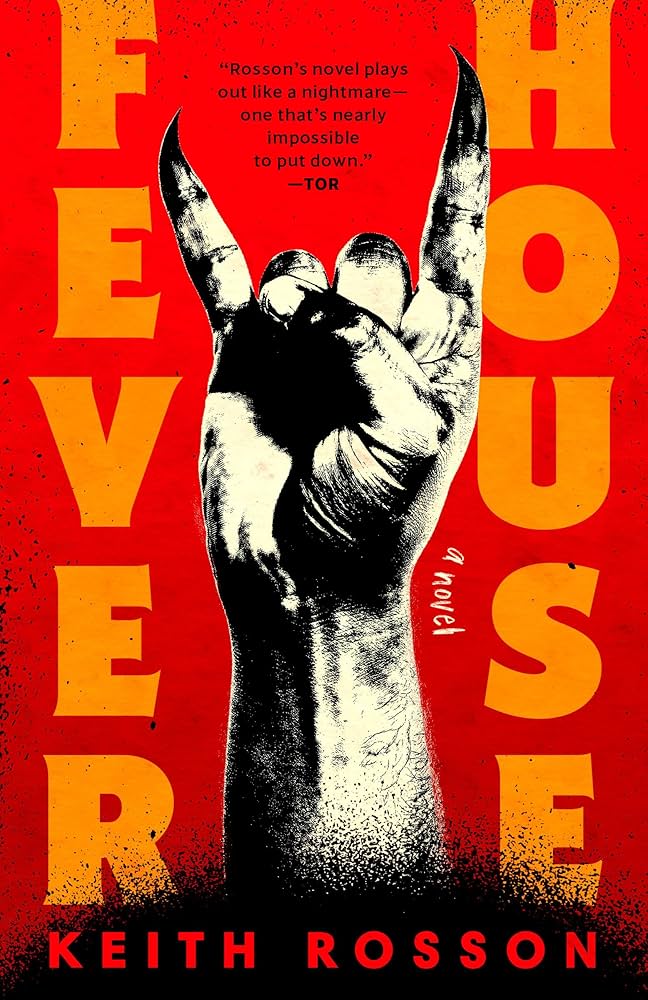
Fever House

Back before Halloween I bumped into a list of recommended recent horror–probably on the NYTimes website. Of the 7 or 8 titles listed I chose a couple to add to my To Read pile.

The first I read from the list was barely OK. Too derivative of a Stephen King novel, and too many clichés from current horror movies (unnatural smiling, kids crawling on the ceiling, animals behaving strangely like humans–yawn). The writing lacked King’s folksy warmth and humor as well, and was more like Tom Clancy’s stiff and uninteresting prose. The characters were not atypical of genre fiction–types rather than people, and the dialogue reminded me of the old Superfriends cartoons popular when I was a kid, where the superheroes would explain what they were doing while doing it as if the audience were too stupid to see what was happening (example: Aquaman would have circles shooting out of his forehead and would intone “I’m using my powers to summon fish friends,” and Superman would have red beams coming out of his eyes while saying “I’m using my infrared heat vision to burn the villain’s shoes off.”). I read Mean Spirited on a flight from Paris to the US and it whiled away the time, but I prefer more profound fare. The ending had an unexpected twist which nearly made it worth getting through.

But the second I read from the list was a knock-out. I’ve seen many zombie films, and have been an enthusiastic fan of the genre since I fist saw Romero’s initial trilogy back in the day. What I like about zombie stuff is how the genre moved from its racist origins to really incisive and often quite witty social commentary.

Fever House is the first zombie novel I’ve read–and it is excellent. There are actual fleshed-out and fully developed human beings involved, and I was on the edge of my seat as the familiar tropes of the zombie apocalypse were delivered with a new and clever backstory. I’d love to go into detail about the novel’s critiques of the hypercapitalist USA and its intelligence apparatus and the military industrial complex, but inevitably I would spoil the experience of finding out for yourself.

Rosson can write–which is atypical of authors in modern horror. Ramsey Campbell is by far the most literary and stylish current writer in the genre, but Rosson can craft sentences and structure a novel at an exceptionally high level. This book is a Slayer album redone as literary fiction. I burned through it in a day and half, and now must give myself a break from the walking dead before jumping into the second volume of the duology.

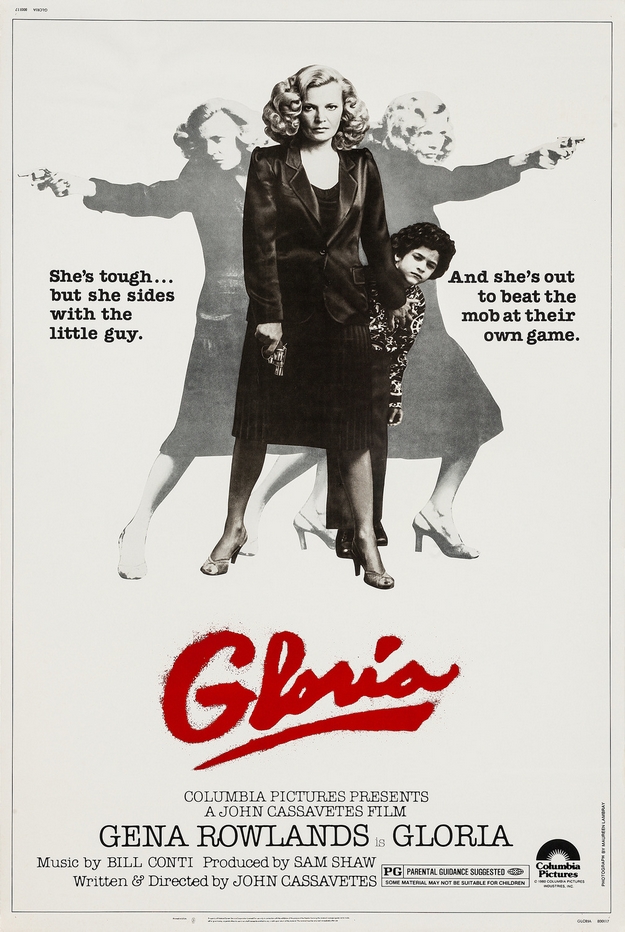
Gloria

Gena Rowlands passed away in August of this year, and it struck me at the time that I’d only seen one film she’d made with Cassavetes: A Woman Under the Influence. I don’t remember much about it after nearly 30 years, other than bits of Rowland’s searing and uncomfortable portrayal of a woman completely falling apart, and the typically warm Peter Falk playing a jerk.

Saw Gloria last evening at a local film club and was impressed by its energy and inventiveness. The plot is ridiculously absurd–a mob accountant has turned informant and has a book recording the dirt about his employers and their businesses. Immediately before getting wacked by a team of goombahs with shotguns and bad suits his wife hands off their 6-year-old son to their neighbor Gloria, giving him the book and telling him to guard it.

What follows is two hours of deleriously entertaining action and farce. When presented with 6-year old Phil, Gloria quips that “I hate kids, and especially yours,” but given the seriousness of the situation she takes him in tow. After some initial rough going between Gloria and her young Puerto Rican charge (played with cute adroitness by John Adames) her maternal instinct is activated and Gloria becomes Dirty Harry, blowing away and confronting gangsters with aplomb and sassy attitude. Despite the silly plot and at times unintentional humor of the action, Rowlands commands the screen and is completely believable. At times she and Adames are like Gable and Davis in a screwball romantic comedy, and the gangsters are Keystone Cops. What fun!

Cassavetes’ use of cruddy late 70s New York is very appealing, and made me nostalgic for the gritty run-down town I used to visit into the late 80s before Times Square became tragically Disney-fied and antiseptic. The sappy and overwrought ending was delicious and there wasn’t a dry eye in the house.

I must further explore Cassavetes’ films and Rowlands’ catalog. There were some die-hard fans of their work, both French and English, at the showing last night, and their enthusiasm was infectious.