
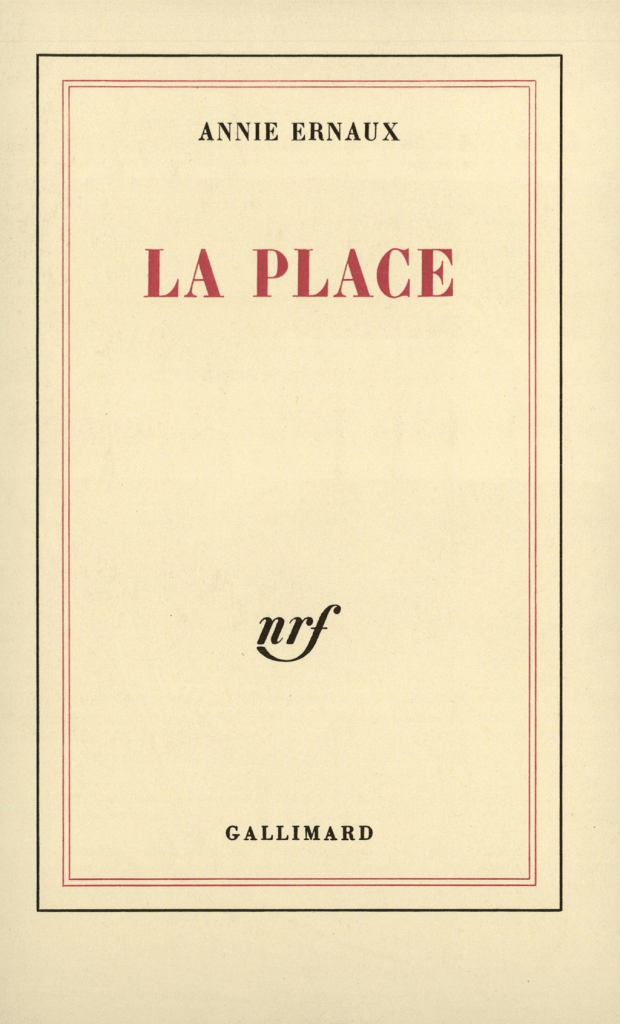
La Place

I’ve not been pushing myself to read French lately, and it is absolutely vital that I continue to work on the language so that I sound less like an adolescent speaking when I interact with locals here in the Correze and particularly with business clients who arrive from cities like Toulouse, Bourdeaux, and Lyon. When Ernaux won the Nobel Prize in 2022 I picked up a couple of her books, one of which was La Place.

Surprisingly the French is quite clear and simple-stylistically I’d compare Ernaux’s writing to Hemingway, with crisp, short declarative sentences. Technically La Place is a novel, but it is also a memoir or autobiographical novel, and her style is very objective and is comparable to Joan Didion’s dispassionate journalism. I was pleased to only need a dictionary a couple dozen times throughout, and mostly for colloquial phrases.

The idea for the novel arose when Ernaux was processing the death of her father, and focuses on him and her family in a small town in Normandy through WW2 and into the 1970s. Her father was raised working on a farm with a quite limited education and his parents were not literate. Through his hard work and survival of the war to working in a factory and rising through the ranks and eventually buying and running a small cafe/epicerie with his wife we can see how the family pulled itself up from poverty to a comfortable middle-class existence. Ernaux’s descriptions of her family’s sensitivity to class and how they tried to hide their rural hick upbringing in front of clients by changing their speech and feigning a more sophisticated vernacular were quite touching. Reflecting on the difficulties her parents faced and her father’s challenges in particular was obviously difficult for Ernaux but she never wavers from her stylistic choices to keep her emotions out of the prose. Sometimes what she describes or recounts make her involvement and her feelings evident, however–there are photographs she finds and events she narrates which are dense with the weight of emotional memory.

Ernaux’s father is never called by his name, only by “him” or “he.” He is adamant that Ernaux continue her education but at the same time he can’t resist pointing out that her life in books is not the real life he lives with his hands in the dirt of the garden or in the till of his business. He is however enormously proud of her accomplishments when she becomes a professor and moves away to start a family of her own. Ernaux winning the Nobel Prize is even more remarkable given the family history recounted here. I look forward to reading more of her work.
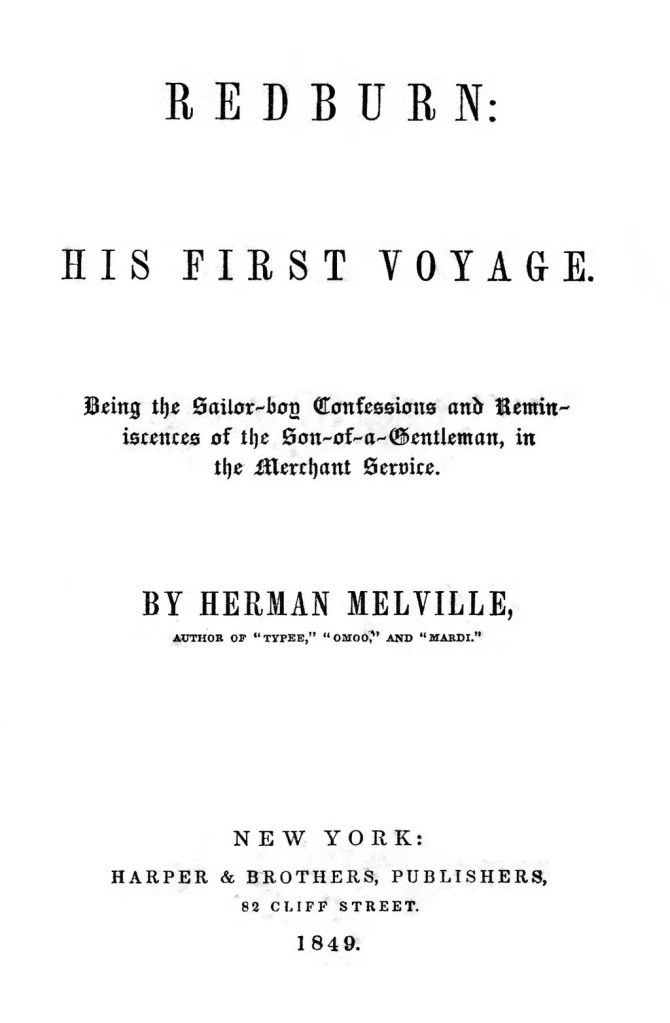

Redburn, His First Voyage

Melville first entered my consciousness the way much of history and culture did when I was a wee tot–via cartoons. I think my first encounter was a Tom and Jerry cartoon featuring Moby Dick but renamed Dicky Moe? And of course I likely encountered the film version directed by John Huston in a butchered and pan-and-scanned version on television.

I did not read Melville until much later. I recall in 8th or 9th grade English class that there were twin girls whose grandparents owned a sailboat, and that after a summer floating around the Chesapeake Bay the girls returned, one having read Omoo and the other Typee while sailing. They dutifully presented book reports to the class with accompanying illustrations. I remember one of the twins declaring in her report that Melville was mostly known during his lifetime for writing adventure novels, but that later he morphed into a creator of SERIOUS LITERATURE.

As an undergrad at Loyola College in Baltimore I was assigned Billy Budd, Sailor and I thoroughly enjoyed it. We had a most excellent discussion of its merits and its Biblical allusions in class, but also a rowdy debate about the ethics of military justice and Billy Budd’s sad fate. Then in grad school I was assigned Bartleby, the Scrivener. I was confounded by that tale, and saw immediately the SERIOUS LITERATURE of which Melville was capable. I reread Billy Budd and Bartleby several times and eventually taught both stories to Freshmen and Juniors in different courses at Towson University.

Then, I resolved despite having heard that it was a brutal slog, to read Moby-Dick, or The Whale. Contrary to rumor the novel proved endlessly entertaining and quite breezy despite its psychological depth and dense symbolism. I in fact had recently resolved to re-read it when I noticed Redburn, His First Voyage on the shelf and took it down on a whim. After a cursory skim of the first page I found myself fully engaged and could not put it down.

Redburn is a poor chap from a once wealthy and influential family. His father was a businessman engaged in international trade before the family went bankrupt, and young Redburn’s imagination was fired by journals and books about his father’s travels. As a result, he signed up as a novice sailor on a boat headed for Liverpool, and we accompany the young naif on his journey “there and back again.”

The cast of characters is large and each is ably portrayed with wit and charm. Redburn’s experiences are vividly and expertly recounted by Melville who of course was himself a similar young chap setting out on the sea at one point. I thought the book as good as anything by Dickens, in particular the scenes of squalor in Liverpool which brought to mind many pathetic and pitiable characters in the works of Charles D.

If you are considering testing the waters of Melville, but you are perhaps not ready for the full-on engagement of Moby-Dick, Redburn might be the place to start your voyage.

…the merciless encounter between the no-longers and the not-yets

I made another trip down to the public events space in our building where most of my books are currently housed and pulled a half-dozen unread titles off the shelves. The book I intended to read first I placed on the coffee table, then went off to complete some errands and returned to find my wife 10 pages in and engrossed. So I grabbed another off the pile.

Exit Ghost is the last of Roth’s Zuckerman novels. Nathan has lost his mojo literally after a bout with prostate cancer. Impotent and incontinent, he has retreated to the Berkshires and lived in isolation for 11 years–part of this history was recounted in The Human Stain. While living in his cabin by a swampy pond Zuckerman has focused entirely on his work and further cemented his reputation as a literary master. He doesn’t watch the news, doesn’t read the paper, doesn’t use the internet–he’s become completely detached from the world. But the promise of a medical procedure which might fix his urinary incontinence draws him back to the New York he’d abandoned. A chance encounter with a woman he knew briefly decades before, compounded by the mistake of buying the current New York Review of Books and seeing an intriguing advert in the the Classifieds section threatens to involve Zuckerman in a literary controversy involving his favorite writer. After more than a decade out of the game, Zuckerman finds himself unwillingly pulled back into an imbroglio.

Like Ishiguro’s The Buried Giant, Exit Ghost is an exploration of history and memory. What should be recorded for posterity, and what can remain unsaid and unmemorialized? Who is a reliable recorder of events? How fallable exactly is memory and how biased? And as one ages, these questions become more immediate and profound.

Nathan Zuckerman of course served as the fictional alter-ego to Roth through several novels across several decades. The early works were full of intense and zesty voice and delighted in experience and the savors of life. The later works develop in craft and profundity and seriousness and serve as powerful documents and indictments of various eras in US political and cultural history.

Exit Ghost is not Roth at the height of his powers. He is putting to rest and tying up the world his alter-ego inhabits, and giving us a glimpse of his own writerly process along the way, as Zuckerman notes his own rapidly failing memory and tries desperately to record his conversations and then to create fictional dialogues using them. An author renowned for his breathless writing about sex and desire finds himself droopily noodling around young women he can no longer seduce because of his age and decaying physique.

I enjoyed the novel a great deal mostly because I could see a lot of myself in its pages. I’ve stopped reading news almost entirely after a life devoted to being informed. I’ve become cantankerous about the internet and social media and refuse to use AI programs (though I’m aware AI is now powering and manipulating other platforms I’ve used for years). I live in an old factory in a rural area and hope to have time at some point to do more reading and writing and serious study. After decades of glorious city living I find cities exhausting for more than a day or two, and prefer a quiet sedate life to the continuous glamor of going out multiple times a week. Hopefully I avoid the other problems Zuckerman experiences, but as my mother says when I tell her about knee or neck or back problems: “All of that just gets worse.”

Another enjoyable aspect of the novel is to read Zuckerman/Roth thinking about writers who were important: Dostoevsky, Hardy, the Bronte sisters, Conrad, Plimpton, Mailer. Zuckerman and some older characters bemoan the state of the world for mercilessly finding fault with Faulkner and Hemingway and banishing their work from the canon for personal failings. Young characters are keen to find those faults in previous generations and expose their sins. Zuckerman exits an exasperated ghost indeed.