
When David Lynch passed away recently I thought “How do I choose which of his films to re-watch?” It felt important to re-watch something and acknowledge the importance of his work in my life. But instead of selecting a Lynch film I watched Tarkovsky’s The Mirror for the first time. I’d seen Solaris, Adrei Rubilev, and The Sacrifice before and thought instead of re-watching something I’d challenge myself with something new.
I’m not sure what brought The Mirror to mind after Lynch died, but I couldn’t help but see the film through Lynch’s cinematic vocabulary. The nonlinear dreamy narrative structure, the inconsistent and often suspicious point of view, the beautifully mysterious and evocative imagery, the masterful painterly touches. As in Lynch’s films, one can’t be sure if what is on screen is real reality, or an internal reality-a dream, a memory, a delusion of one of the characters. Are those really ghosts which tell the young boy left alone to read a certain passage in a certain book? Is the room filled with cascading water an actual memory or event or symbolic or a dream? I’d often heard about The Mirror as an all-time masterpiece, and it proved true. It’s astounding and perturbing like most of Tarkovsky’s films. And, as with Lynch, not ‘getting it’ is part of the pleasure.
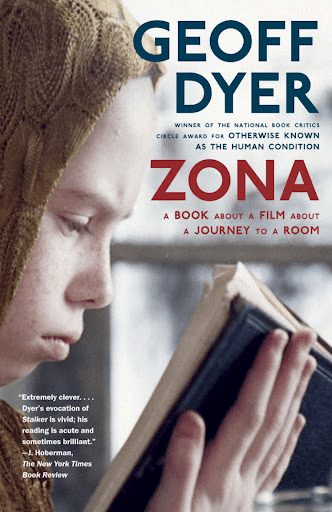
Back when I was gainfully employed with a steady income I would buy books willy-nilly. At some point along the way (perhaps after reading a couple Geoff Dyers in my early 40s) I purchased and downloaded Dyer’s Zona: A Book About a Film About a Journey to a Room. After seeing The Mirror I thought why not read this at last?
Of course Zona is about Tarkovsky’s film Stalker, not about The Mirror. But it’s also a long meditation on Tarkovsky and his style and his work, so the time was right.
Dyer re-watches Stalker while writing and goes through the film scene-by-scene, riffing on each sequence and making connections and interpretations and tying everything to his personal experience and to the various times he’s seen the film. He creates a sort of Talmud of the film. And of course this book has two prerequisites: an interest in Geoff Dyer and his riffing essays and some knowledge of and interest in the films of Tarkovsky, in particular Stalker. Though it had been some time since I’d seen Stalker I found it interesting how pwerfully the film came back to me through Dyer’s discussions. I learned a lot about Tarkovsky along the way, and about Geoff Dyer. And that’s what essays are for of course.
By the way, if you are interested in Tarkovsky, Mosfilms has made his works available on YouTube in pristine digital transfers and subtitled in English. In fact, all of Mosfilms catalogue is available and most certainly worth exploring.
 Mysterium Coniunctionis