
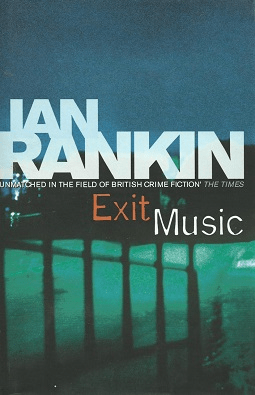
Exit Music

John Rebus is close to retirement. In fact, only days away from turning in his warrant card. A dissident Russian poet is found bludgeoned to death and Rebus and his partner Siobhan Clarke are off to find the killer. As a result they explore the underworld of early 21st century global politics. Big banks are in collusion with Labor and Nationalist politicians and local gangsters to milk Russian oligarchs of their cash. Scotland is aching for independence and the oligarchs find it an attractive place to avoid possibly drinking radioactive tea or falling mysteriously from a high window onto a Moscow street.

Rebus wonders what counts as corruption and illegality when the entire economic and political system is shady. As he tries to unravel the case he ponders his own ethically questionable past doings and wonders if he’ll simply spend retirement in the pub gradually softening himself with malt.

Another murder complicates things. Rebus and Clarke are now no longer detectives in a local precinct police squad; they are George Smileys working in the shadows to uncover an international conspiracy.

Or perhaps not? Maybe there is less there there than appearances suggest. As they work the case Rebus begins the process of handing the reins over to Siobhan as much as possible. She is at once frustrated by his tactics and deeply saddened to be losing his wisdom and experience, but finds herself ready to take over the team.

I jumped into this 17-novel series at book 15 and only read that one and the final volume, but enjoyed them thoroughly. Good pop lit with a cracking plot and sufficient depth and complexity to keep me intrigued. The characters are not one-dimensional types but are fully fleshed out. And Mr. Rankin can indeed write a good sentence. If detective novels and police procedurals are your thing you might want to read these.
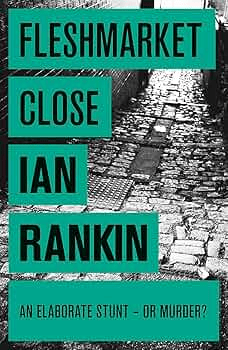
Fleshmarket Close

We were sitting at the local watering hole a few weeks back and mentioned to friends from the UK that we were going to visit Edinburgh this summer for the first time. Immediately one said “Oh, you must read Ian Rankin before you go. I’ll lend you a couple!” Sure enough a day or two later her significant other dropped off two novels at our front door on his way home from work. Fast service!

I’ve not read many detective novels or police procedurals or mysteries–I’ve dabbled in noir now and again, and did read the first Simenon Maigret novel in French last year. But I figured it would be an interesting way to get a taste of Edinburgh in advance without relying on Rick Steves for once, so I dived right into Fleshmarket Close.

I was a bit concerned to begin reading a series at about volume 23 or 24, but the novel stands alone quite well. The detective central to the story is John Rebus, who is being pushed aside by his superiors and sent off to pasture in a shoddy department in a squalid neighborhood. Rebus is an attractive type, familiar from the genre–a gutsy guy, tough-minded, unsophisticated in his tastes and not academically inclined, but eclectic. He likes an enormous variety of niche music from jazz and folk to punk and techno. He likes a pint and a malt perhaps too much, and has an ex-wife and estranged daughter who probably featured prominently in earlier volumes. He’s read Dostoevsky. He tends to intuit things other detectives miss, and instead of thinking linearly about a crime he builds up a huge amount of context and finds all sorts of intricate leads to trace. This frustrates his superiors but he gets results.

In Fleshmarket Close the murder of an immigrant leads to a thriving underworld of criminality involving drugs, Irish milita, human trafficking, slumlords, racism, salacious and carnivalesque right-wing media, celebrity lawyers, and pornography. Rebus and his younger partner Siobhan Clark eventually piece together a vast conspiracy. It’s quite satisfying, and Edinbugh is a character in the story just as much as Baltimore is a character in The Wire. In fact, this novel has some substantial similarities to The Wire Season 2. And, I’d note, Edinburgh as portrayed in this novel has some similarities to Baltimore.

It’s fun to see Detective Rebus struggling with “woke” culture as it began to accelerate, and to note his adapting to “new” tech like laptops and mobile phones and DNA tests. And of course it’s interesting to read a pre-Brexit UK novel which shows a lot of the media agitation which led to anti-immigrant and anti-EU sentiment. Rebus comes from Polish immigrant stock himself and he is not pleased by where he sees Scotland and the UK headed. I’d certainly recommend this to fans of the genre, who might perhaps prefer to start with the first novel instead of one of the last? But also to those who don’t really read this sort of novel as an interesting look at the dark underbelly of a famous tourist destination.

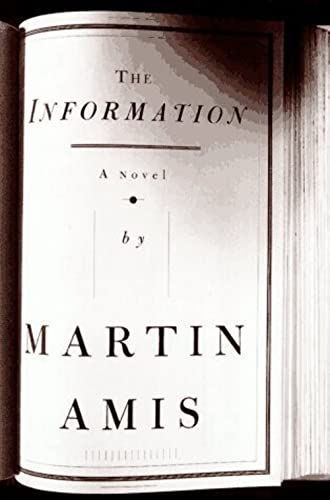
The Information by Martin Amis

It’s been two years since Martin Amis died at age 73, so I figured it was about time I read something of his. He was, after all, one of those writers I was supposed to read back in the ’80s and ’90s, as the conventional wisdom droned on about him capturing the zeitgeist of that time. Somehow I just never got around to reading his novels, though I did see the film version of The Zone of Interest last year.

I had on my shelves The Information, l which I’d received in 1995 when I was running the Literature section of the long-defunct Borders Books & Music just north of Baltimore City. It was a signed first US edition, distributed to promote the work and encourage those of us hand-selling novels to read it and recommend it, and apparently I can get about $50 for it on Abebooks. When we had Christopher Hitchens for an in-store event and discussion of The Missionary Position, I should have asked Hitch about this novel and whether it was worth holding onto and eventually reading. Hitch, like Amis, smoked himself to death, and Martin did his eulogy.

The Information is a seething spite-filled cess pit of self-loathing. The main character Richard Tull is a thinly disguised caricature of Amis himself, and is a most unpleasant bloke to be around for 500 pages. Tull is a pretentious novelist and writes unreadable overly complex books no one cares to understand which pile up unpublished in his study. Meanwhile his best friend Gwyn Barry writes noxious and silly tripe which becomes globally successful and makes him a mint and a celebrity. While Richard is a complete failure who drinks and smokes himself to annhilation, Gwyn is continuously interviewed and photographed and consulted about his opinions. Because Richard regards himself as superior intellectually and artistically to his far more successful friend, he decides to get revenge on Gwyn through a series of demented schemes involving shady underworld stereotypes. All of the schemes however fail and end up bouncing back on their initiator.

All of the characters in this novel are hateful and despicable. Women mostly exist in the book to serve the needs of men and don’t have much depth. The plot is a complete farce and this writer whose works so tapped into the zeitgeist of his time seems now to be as dated as his father Kingsley.

But the prose is gorgeous, scintillatingly so. There are passages of the most delicious and sparkling disdain gloriously served up with malevolent humor. This entire novel encapsulates what it’s like to be an upper-crust twit who feels superior to everyone. It lags in parts and in others is uproariously hilarious and brilliant. As a failure, it’s a rather good one. I might be inclined 20 years from now to pick up another of his books.