
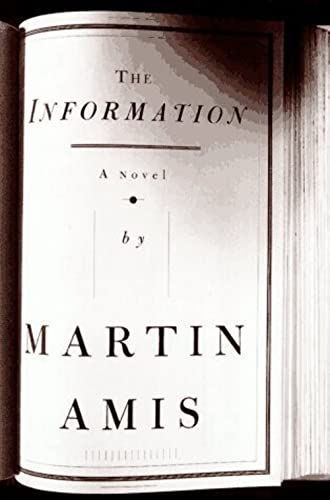
It’s been two years since Martin Amis died at age 73, so I figured it was about time I read something of his. He was, after all, one of those writers I was supposed to read back in the ’80s and ’90s, as the conventional wisdom droned on about him capturing the zeitgeist of that time. Somehow I just never got around to reading his novels, though I did see the film version of The Zone of Interest last year.
I had on my shelves The Information, l which I’d received in 1995 when I was running the Literature section of the long-defunct Borders Books & Music just north of Baltimore City. It was a signed first US edition, distributed to promote the work and encourage those of us hand-selling novels to read it and recommend it, and apparently I can get about $50 for it on Abebooks. When we had Christopher Hitchens for an in-store event and discussion of The Missionary Position, I should have asked Hitch about this novel and whether it was worth holding onto and eventually reading. Hitch, like Amis, smoked himself to death, and Martin did his eulogy.
The Information is a seething spite-filled cess pit of self-loathing. The main character Richard Tull is a thinly disguised caricature of Amis himself, and is a most unpleasant bloke to be around for 500 pages. Tull is a pretentious novelist and writes unreadable overly complex books no one cares to understand which pile up unpublished in his study. Meanwhile his best friend Gwyn Barry writes noxious and silly tripe which becomes globally successful and makes him a mint and a celebrity. While Richard is a complete failure who drinks and smokes himself to annhilation, Gwyn is continuously interviewed and photographed and consulted about his opinions. Because Richard regards himself as superior intellectually and artistically to his far more successful friend, he decides to get revenge on Gwyn through a series of demented schemes involving shady underworld stereotypes. All of the schemes however fail and end up bouncing back on their initiator.
All of the characters in this novel are hateful and despicable. Women mostly exist in the book to serve the needs of men and don’t have much depth. The plot is a complete farce and this writer whose works so tapped into the zeitgeist of his time seems now to be as dated as his father Kingsley.
But the prose is gorgeous, scintillatingly so. There are passages of the most delicious and sparkling disdain gloriously served up with malevolent humor. This entire novel encapsulates what it’s like to be an upper-crust twit who feels superior to everyone. It lags in parts and in others is uproariously hilarious and brilliant. As a failure, it’s a rather good one. I might be inclined 20 years from now to pick up another of his books.
 Mysterium Coniunctionis