A Day in the Life

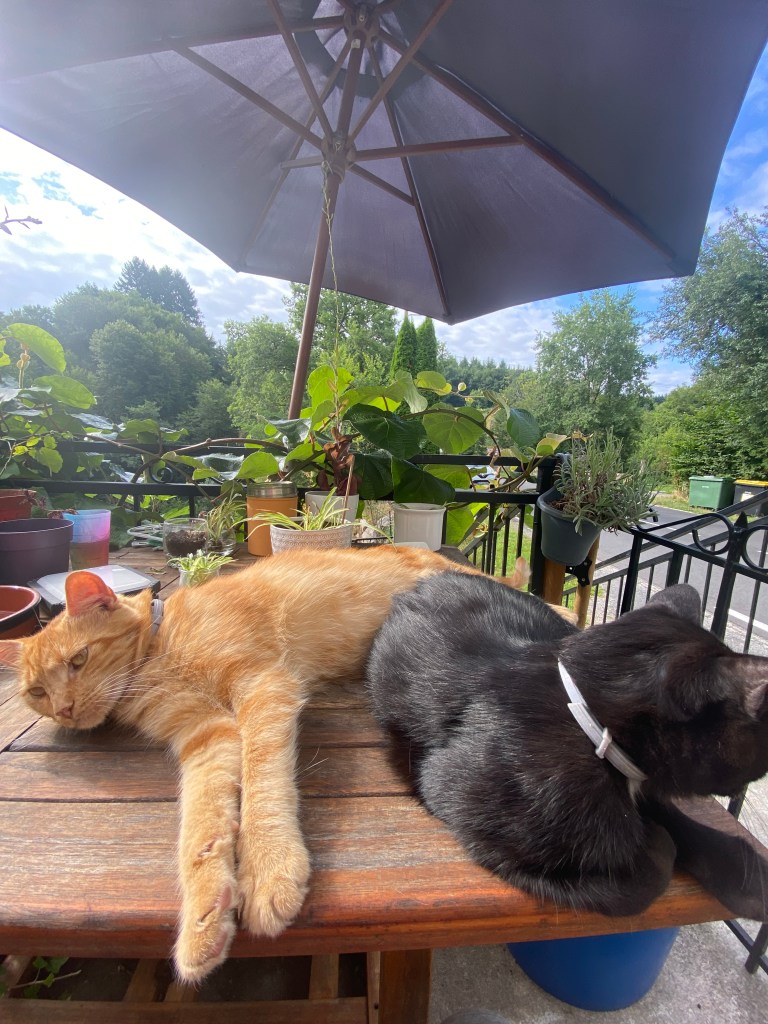
Woke a bit before 6 am this morning. Drank coffee outside on the porch and read an essay in Harper’s by Lydia Davis. She’s an author I’ve encountered many times in journals and magazines, and I’m pretty sure I have a story collection or two of hers somewhere? At any rate she’s writing about observation and the compulsion to write about her observations. She’s got a singular style and voice in her fiction and non-fiction, and does a lot of translation from the French–in fact I’m sure I read an essay by her about French translation at some point. I’m distracted while reading and observing our two cats who are climbing on me one minute, then chasing lizards the next. Lydia Davis is observing cows in her essay, and while I’m reading I hear a horrible guttural stegasaurus groan which I can assume is one of our goats even though it’s a new sound. The male has climbed along a narrow ledge atop a wall which has a metal chain-link fence built into it, at the top of which is a kiwi vine. While standing stretched out full length on his hind hooves to nibble kiwi leaves his hooves slipped off the wall. I rush over to find him being strangled by the kiwi vines with his horns stuck in the fence. I free his horns as he re-positions his hooves on the wall and immediately he is contentedly munching kiwi leaves again as if nothing happened.

At about 8 am guests who’ve rented one of our gite appartements–The Studio–check out. They are two cyclists off to their next destination after a one-night stay in Treignac. I pause my reading to strip down the bed and turnover the apartment for the next guests. Just as I finish hanging the clean sheets and towels from the washer our next guests arrive. They’ve rented The Loft gite for a daytime sleep-over as they are driveing some horrid 24-hour route. They check in at 8:05 and are planning to leave at 5pm. I wonder if they are actually going to sleep or if they are going to fuck. It’s our first overday stay as opposed to overnight stay. And, to complictate things we have a check-in in the same apartment 45 minutes after they are planning to leave. Things will be tight. We are used to it, however, as business has been brisk this year since January.

After checking in the new guests I hear the guttural scream again, and the male goat is once more dangling in the air with his throat tangled in kiwi vines. I free him once more.

I sit again and finish the Lydia Davis piece and then polish off the rest of the magazine. I realize I rarely write about day-to-day stuff anymore the way I used to on a previous and much more successful blog. Has my Muse deserted me? Have I lost interest? On the desk in my office is a pile of language books I put out back in February–I was adamant that I was going to do a daily study/writing routine and that immediately fell apart. Perhaps I’ll get it back together in the fall after tourist season quiets down.

A History of France

I wanted to refresh my general knowledge of French history before focusing in detail on a few eras, regions, and personalities. A History of France seemed a good place to start. John Julius Norwich had written quite readable histories of Byzantium and European monarchs, and his father Duff Cooper was Churchill’s liason with the Free French during WW2, and later was Ambassador to France from the UK. I thought this book merited a try.

There is way too much history in this short and readable history. We start with Julius Ceasar and his campaigns in Gaul, and progress through 2000 years up to Charles DeGaulle. But this is a fun read, written by a lifelong Francophile, and it did what I hoped it would–reminded me of the proper sequencing of early monarchs and refreshed my knowledge of the 100 years war and 30 years war and the long deeply intertwined relationship of France and England. The cast of characters is immense of course, and Norwich is particularly good at bringing them to life, from Eleanor of Acquitaine and her sons to Joan of Arc to Napolean 3.

I must say that even immediately upon finishing the book I can’t differentiate all the King Louises and King Charleses. There are too many of them to remember. But Norwich brings them to life and situates them in the context of their times and analyzes their impact on the entirety of French and European history.

Like many English (and Americans) of his era he seems to truly admire but also to have not inconsiderable contempt for Charles de Gaulle. But a historian worth his or her salt can hold two contrary opinions in his or her mind at once and still manage to get the job done. I had to laugh out loud when De Gaulle tells Churchill that the French people regard him as a reincarnation of Joan of Arc, and Churchill says “we had to burn the first one.” History is so much fun, except when you have to live through it.

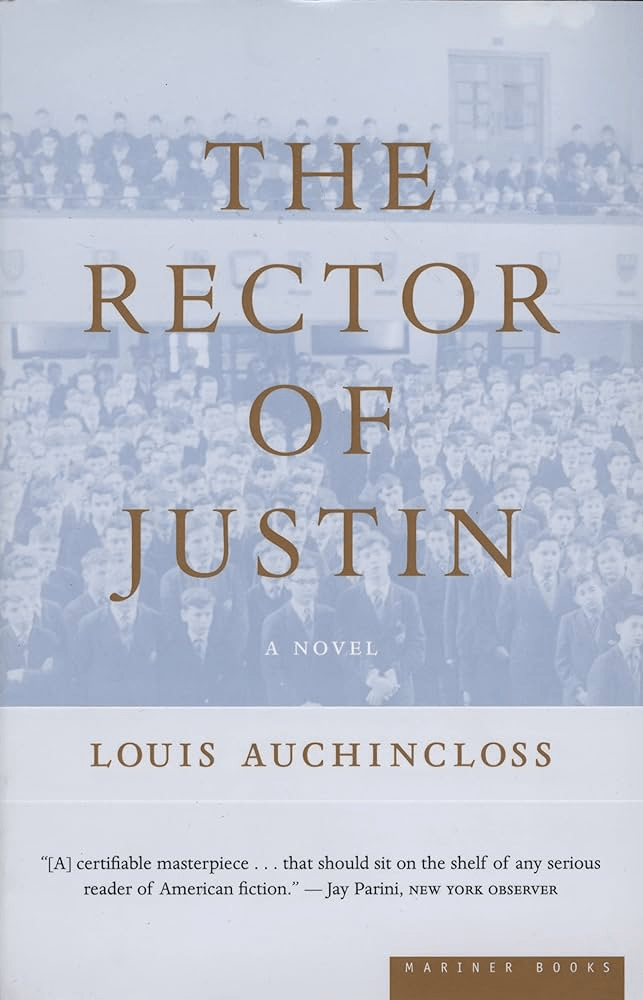
The Rector of Justin

Brian Aspinwall becomes at age 27 a teacher at a prestigious private boys’ school in New England. He is recruited suddenly in 1939 to fill in for a master who has gone off to Canada to enlist in the RAF. It is primarily through Brian’s diary that we learn about the school Justin Martyr and its famous founder Reverend Francis Prescott. Immediately Aspinwall is awestruck by Prescott and comes to admire him and his accomplishments. He seeks to understand what makes Prescott and his world-class upper crust school tick, and The Rector of Justin takes off.

Aspinwall seems surprised to learn that Prescott is an intellectual and a progressive given the focus on sports, strict discipline, and religious tradition at the school. But many more surprises await. As the novel unspools we learn from other sources who come into Aspinwall’s orbit. Eventually Aspinwall is given files and documents by others and he takes on the task of possibly writing Prescott’s biography.

The book is breezy and warmly inviting, despite its substantial and ethically weighty themes. I found it an absolute pleasure. The characters are all interesting, and in particular the Rector himself. There are hints that Justin Martyr was founded out of some dark repressed desires. The WASP identity of the school proves problematic later on as Prescott has an epiphany about the kind of people running the board at his school, and the true values of the wealthy and influential class who send their kids to Justin Martyr. I could in fact trace many of the concerns Reverend Prescott has about his students and their morals down to the ethical catastrophe in current US politics.

Because the novel is from the 60s but set in the 30s and 40s we get groovy stuff intellectuals were into at the time, like Freud. The novel is saturated by Henry James but is not as dense and soupy as The Master’s.

I’d previously read only one other novel by Auchincloss–The Book Class. I remember quite liking that one but nothing about it has stuck with me after 3 decades. I do recall that both novels were given to me by Dan Bouchard in a box of remainders in perhaps ’94? I still have one more book by Auchincloss on the shelf–a collection of short fiction. I look forward to it.

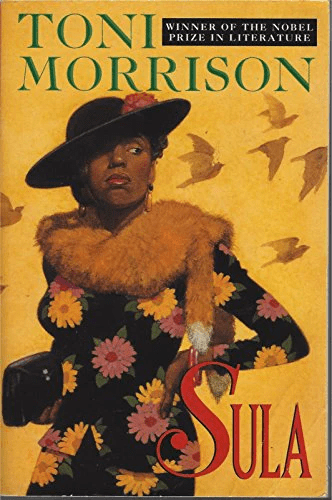
Sula

Sula is a magnificent read, a short novel but a richly realized world. We spend almost a century in Bottom, the Black neighborhood of Medallion, Ohio. Two families entwine in the narrative–one-legged Eva Peace serves as matriarch of one. She manages a thriving bungalow of sorts, a chaotic and haphazard structure akin to the Winchester House in complexity. There are family members, hangers-on, boarders, mountain people, addicts, crooks, working people and feral kids in the Peace home. Eva’s daughter Hannah raises her kids amidst the tumult. One of her kids is Sula.

The other family is Helene Wright’s–Helene was raised by her grandmother. Her mother was a prostitute in New Orleans and granny pulled her out of that drama and brought her up. Helene’s household is calm and organized and there is a sheen of middle class respectability. Her daughter Nel is raised in a tidy and peaceful environment and has adopted the virtues and social mores of the community.

Sula and Nel become best friends. Sula is adamant that she will never be bound in any way by the constraints of her community or its judgments and expectations. She will be free and her self will be unimpeded in its development and evolution by anyone or anything. Nel on the other hand is willing to tow the line and to do what’s right. They have a relationship where one is centripital and the other centrifugal, forces working together to flesh out a beautiful and adventurous childhood.

I recall a scene in Henry James’s The Turn of the Screw when well-mannered Flora is playing in the dirt and makes sexually suggestive gestures with sticks–shortly afterward the Governess has her first encounter with the apparition of Miss Jessel. There’s a similar scene in Sula where Sula and Nel are playing in the dirt and digging holes and burying things in the holes and the girls are frustrated and dis-satisfied in their game but manage somehow to conjure up a horrible event in an almost magical ritual. The reactions of each girl to this event have lasting impacts on the course of their lives.

Eventually Nel does what one is supposed to do in Bottom; she gets married and starts a family and focuses her energies on her children, her husband, and their home. On the day of Nel’s wedding Sula leaves town for ten years. When she returns she will be judged and scape-goated for the sins of her town and its inhabitants.

But what are morals and virtues if they simply hide hypocrisy? What are the consequences to true human freedom when small-town values are oppressive and retrograde? Sula, through her refusal to conform and to follow the niceties, becomes for Bottom an easy target for projection–she absorbs all the guilt and hostility and judgments of the town’s inhabitants. But is Nel really superior to Sula morally? What does genuine friendship entail? What are the costs of motherhood and are they compatible with true freedom? Is a life sacrificed for the benefit of others a worthy life? Bottom learns a lot about itself through Sula’s sad fate, and pays a heavy karmic debt.

Recent Reads

I’d read 100 Years of Solitude about 30 years ago and was absolutely flabbergasted by it. Immediately one of my life goals became “get your Spanish into adequate shape to read more Garcia Marquez but in the original language.” I managed to have some conversations with locals in Spanish on a couple trips to Colombia, but alas never got my skills up to reading novels.

So I caved in and read Love in the Time of Cholera in English. I was a bit concerned with the high bar set by the other novel that this would disappoint–quite the contrary. I think it’s superior. Where 100 Years is a bit of a “loose, baggy monster,” Cholera is fit and trim. The magical realism is dialed down substantially but not the magic of the description, characters, settings…such a dense and humid world to inhabit for too short a time. A rich, sweaty, mournfully sexy book. It truly captures the decayed glamor of old South American colonial cities and the rich mix of cultures and classes. Exquisite!

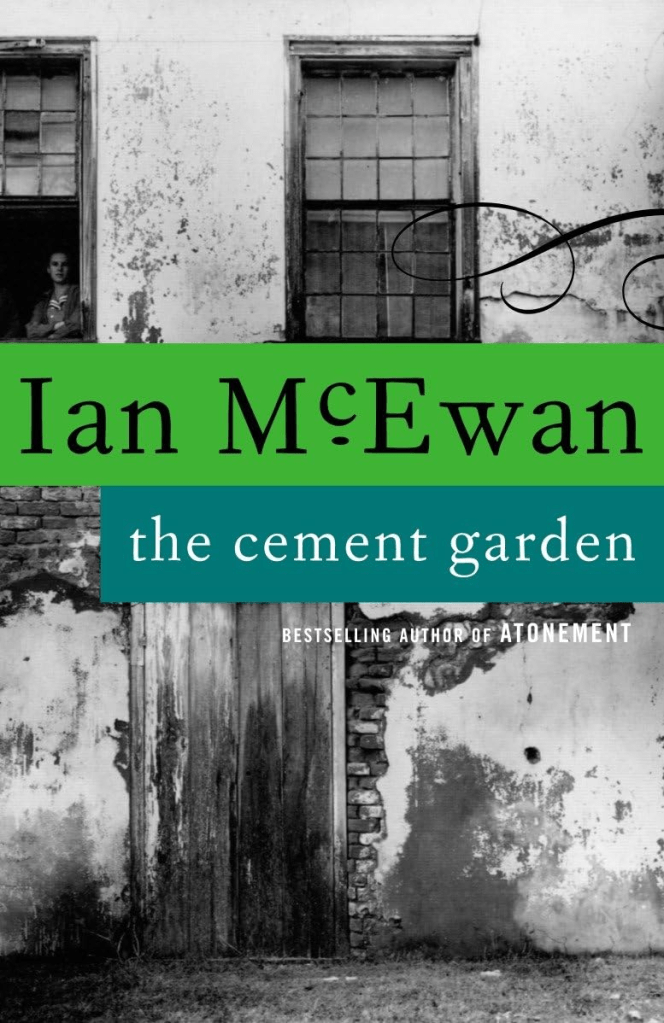
Aw, it’s nice to revisit those care free days of childhood–distant, aloof parents, perverse games, pointless wasted hours at school, the challenge of disposing of corpses…

Not sure how to categorize this one. A bit of Shirley Jackson’s We Have Always Lived in the Castle, a bit of Poe’s Fall of the House of Usher, a bit of 90s pornography.

Four siblings are left alone in a strange castle-like house in the midst of an abandoned urban tower block development when their parents die in quick succession. Instead of the lush natural setting of Eden (or the isle from Lord of the Flies) they inhabit an unnatural cement garden, where only stinging nettles force their way up through cracked concrete to bake in the sun. Without the internet or even TV there is not much to do except go feral.

McKewan can write, and this short gloomfest is arresting and disturbing in equal measure. It probably says something about me to admit that I found it somewhat humorous, the way Rober Coover’s story The Babysitter is humorous. Kids left to their own devices act like adults–and are equally fucked up.

I recently read an article in the NY Review of Books about Ford Madox Ford. Had previously only read The Good Soldier, which is astonishingly good. Thought I should perhaps tackle another of his, but didn’t feel quite up to Parade’s End, which has sat its fat self on my shelves since 1994 without being opened.

So I decided to search the author’s name and pick up whatever book the owlgorithms first suggested. Owltimately it was The Brown Owl, which proved an entertaining little owlegory. Though written for kids it has a sophistication and wit about it which owlevates the book above mere “young adult” fiction.

Read earlier this year an analysis of the Arthurian myths by Emma Jung and Marie Louise von Franz, followed in short order by H is for Hawk. H is for Hawk is a memoir of dealing with the death of a parent while training a hawk and reading T H White’s memoir about training a hawk. All of this brought me round to the realization that I’d never read White’s Once and Future King novels. So I started with The Sword in the Stone. Didn’t much like it. Merlin is too ridiculous, the story is too silly, everything is far too cute. I can see why Disney made a film out it, because it’s tailor made for them.

Despite not enjoying the first volume, I plowed ahead into volume 2 of The Once and Future King. Didn’t like this one even less. Guess I’m too old. I prefer dour, profound old Tolkien to this stuff.