Year 15

I’ve begun year 15 as a middle school teacher. I spent eleven years teaching in Baltimore City Public Schools, and made the switch to an international school in Latin America four years ago.

Year 13 we started to discuss “Um, what if COVID comes here?” in February. We had a meeting about using Canvas to teach remotely and how that might work. The next week we had a meeting about using Google Classroom and Meets instead. Because my team was asked to pilot GC and learn how it worked starting in January, we got to help explain it a bit.

The next week we were closed by the government mid-schoolday, because the entire country was going into lockdown. I remember thinking “We’ll possibly be out a month or so”–and I grabbed a few items I’d gathered with that possibility in mind. The next day I was teaching online.

The rest of that year I taught from our apartment, while my wife taught her Pre-K and Kindergarten art classes in the next room.

My middle schoolers would be doing a Socratic Seminar and they’d hear my wife singing about the continents and oceans in the background.

Year 14 started with remote teaching, which lasted all the way to March. At that point the government granted our school permission to return to campus with strict biosecurity protocols: half the students present, half at home on alternating days, and only for half the day–afternoon classes would be completely remote. Lots of hand sanitizer, very strict mask and distancing enforcement, etc.

This was basically remote learning with some students in the classroom logged in while most were at home logged in.

Year 15 started with hybrid learning.

So, half the kids on one day, half the next, but for full days. We were required to teach both groups equitably, but the kids in class could not be on devices for a least half the class.

Impossible! But teachers routinely do the impossible.

It’s been so strange returning to managing a classroom instead of a Google Meet. I’ve forgotten much about how that works. The enormous amount of innovation and adjustment the past year and a half required make me feel like I can’t remember how do what I used to do. It’s quite a surreal feeling to sit in a classroom as a fifteen year veteran and to be at a loss how to start the school year. But education is so challenging and difficult as a matter of routine that it’s not unusual to feel like I’m lost or unsure.

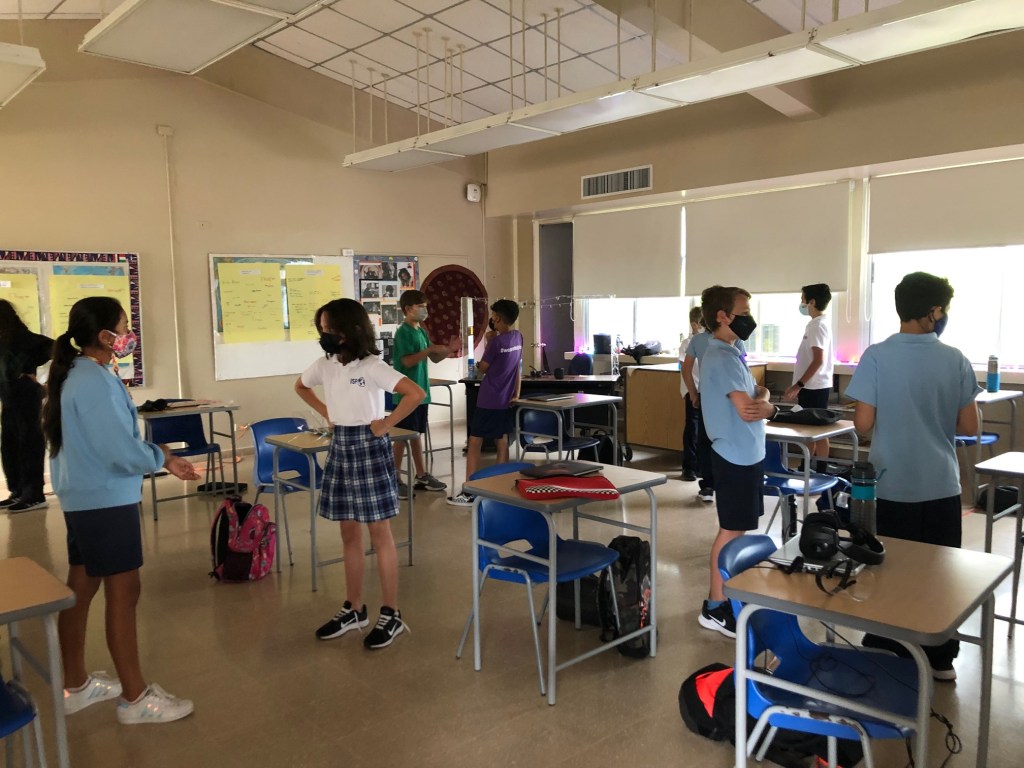
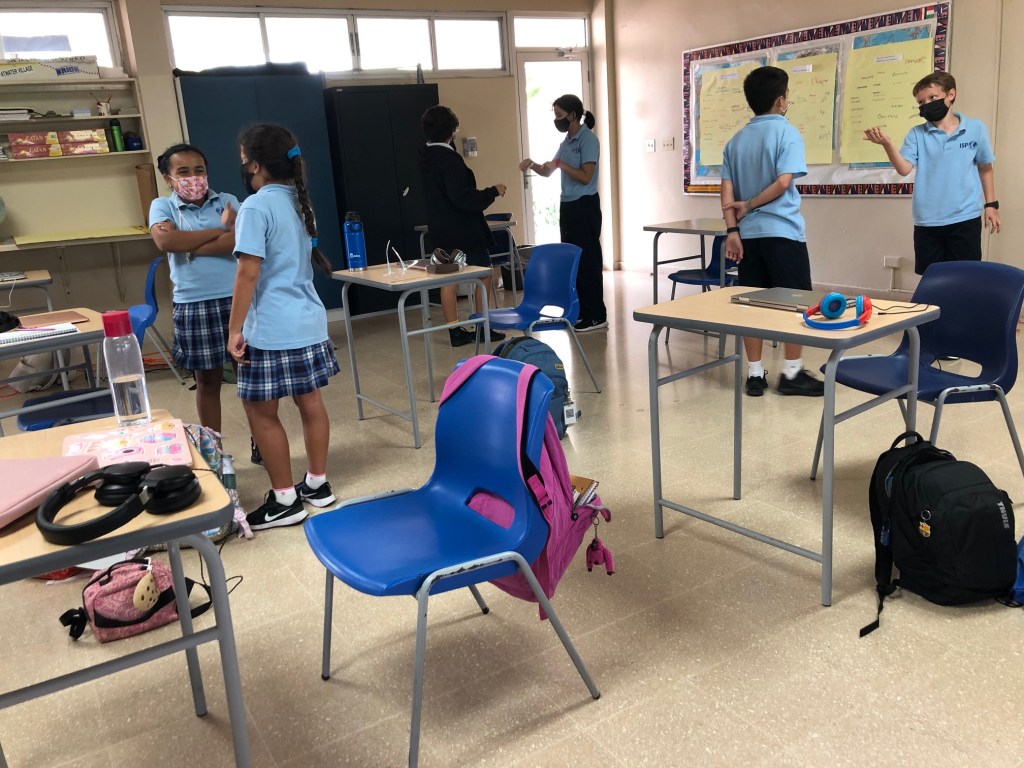
The above photos are of a discussion protocol I used to use regularly. In the protocol, students move to different partners and share their responses to prompts. Some students were online so I made my laptop a partner and then kids in class could include kids at home. I was sitting at my desk trying to plan lessons and I remembered this protocol all of a sudden. I had used Back 2 Back/Front 2 Front routinely before, and had completely forgotten it. Classroom teaching techniques will come back to me.

The government has suddenly given permission for ALL students to be present on campus ALL day for the first time in a year and a half. We still have strict biosecurity measures, but distancing has been eased. Masks are required. We also do contact tracing and regularly already this year entire teams of staff and entire student cohorts have been sent home and taught remotely. 85% of our faculty and staff are vaccinated, and 80% of our students who can be vaccinated have been.

I should point out that Delta has only just arrived here. I have a sinking feeling that we will be on full remote learning again at some point, looking at the situations in several other countries. And I also know that though students will be required to attend campus in order to receive instruction, that when there are confirmed cases on campus entire cohorts and groups of teachers will be working from home while others are present at school.

The hybrid is exhausting, and the hybrid will continue. But if we go on lockdown again, remote teaching is much easier than hybrid!

I’ve done many different jobs over my lifetime, from demanding physical labor on farms and construction crews, to customer service in retail and food service environments, to management positions in HR, Inventory, Operations, Merchandising, to managing an entire multi-floor operation with nearly a hundred salaried and hourly employees, to being an adjunct professor and then to being a librarian, and thence to middle school in the trenches of Baltimore City and then to teaching students of the 1% at an elite international private school.

I know first hand that teaching is the most difficult work I’ve ever done. By far. All of the other jobs I’ve ever done–many of which were highly demanding and taxing–pale in comparison. And teaching during COVID has proven again how adaptable, indefatigable, resilient, and innovative teachers are.

But I think I’m done after this year. I was burned out five years ago, but hung in there and decided to get a change of scene. But the burn out has returned. I think I’m done.

Joe Campbell

It’s fashionable in academic circles to trash Joseph Campbell. At lunch, a colleague in the middle school mentions she’s read “that book” about myth by Joseph Campbell, and a Humanities rock star from the high school sneers and says “he’s light stuff.” A Great Courses series I purchased about myth has a long intro by the professor about how Joseph Campbell is not really a specialist in mythology, he oversimplifies everything for a popular audience, and if you expect that sort of New Age nonsense then you made a bad decision buying this lecture series. When I taught at Universities as a lowly adjunct I often heard the Full Professors gang up on old Joe C.

Professional jealousy, much?

Joseph Campbell was a professor of literature who happened to think about myth a lot. He used Jungian analytical tools to break down literature, including myths, and to discuss what he found. I think his “Power of Myth” is definitely fluff–but that’s more Bill Moyers’ fault than Campbell’s. When I was a teen, The Masks of God series changed my life. Maybe The Hero With a Thousand Faces is “light stuff.” But is it wrong? Or harmful? No.

And let’s not forget that Joseph Campbell “got” James Joyce and was advocating for Joyce’s genius early. Campbell wrote an excellent Skeleton Key to Finnegan’s Wake, and his lectures about Joyce On Wings of Art are essential. I also highly recommend his discussions of Joyce and Mann.

Academics need to back off their gunning for Joe C. It’s like hipsters who saw The Dude in The Big Lebowski trashing the Eagles, and they trash the Eagles because The Dude is cool and that’s their favorite film while not really ever having heard the band. But the Eagles could write songs, they could sing tight four-0r five part harmony, and they could play their instruments at high levels of proficiency and inventiveness. Likewise, academics who trash Joe Campbell for being “light” are missing out on some great guitar work.

Robert Anton Wilson covers the importance of Campbell in the chat above, which I just discovered yesterday.

The Magic Mountain

Reading Thomas Mann’s The Magic Mountain for the first time. Naphta and Settembrini duking it out reminds me that many of the debates which so enervate us and our media platforms these days are in fact eternal.

Naphta would perhaps be anti-vax and anti-mask, and Settemrini the opposite.

But: their politics and ideology would be harder to categorize using today’s American spectrum. Naphta would be a conservative at the time of the novel, and some features of this label overlap with today’s definition–his devout Christianity and his belief that the Church is justified to use Terror and murder to achieve its ends, for example. But despite his conservatism in this regard, Naphta is also a Communist and hopes for the “new religion” of Marx to achieve its ends in the same manner as the Medieval Church. This most definitely places him at the authoritarian left end of today’s spectrum.

Settembrini in his day was a liberal, devoted to the evolution of trade into modern financing and opening up markets for entrepreneurs and increasing ownership opportunities for all. He also advocates powerfully for democracy of the republican sort to replace monarchies, and espouses a belief in humanism, enlightenment scientific progress, and individual liberty. Settembrini these days would be a conservative (almost libertarian) in some aspects of his politics, but a left-of-center liberal in others.

So labels and ideologies shift along the left-right political spectrum over time, but the arguments and the topics of disagreement are eternal.

Back to Work

Today is the first day of my fifteenth year as a Middle School teacher. It is perhaps the last, as well, as we are developing plans to do something else.

We have only three days of PD/meetings and prep time before the kids are on campus Thursday and Friday.

Somehow I’ll be prepared.