Somewhere in the books of Colin Wilson I recall him mentioning the phenomenon of “library faeries.” These creatures mysteriously put books into your path at just the right moment. As I was reading Emma Jung’s analysis of the Arthurian legends I stumbled upon Ishiguro’s The Buried Giant. I won’t really explain why or how as doing so might destroy the reader’s discovery, but this small novel inhabits and extends somewhat the Arthurian universe.
I’d read and loved three previous novels by Ishiguro, most recently Klara and the Sun, which hammered me with its profoundly sad portrait of an exploited lab-created being. Easily the best novel of its kind since the original masterpiece by Mary Shelley!
Here Ishiguro tries his hand at fable and fantasy. We meet an elderly couple named Axl and Beatrice, who live in a warren community and suffer a hardscrabble existence. They decide to make a journey to a nearby village to visit their son. On their journey they realize that something is mysteriously preventing clear memories of their past–and they realize this problem is universal. Britons and Saxons live together in an unstable harmony following the Battle of Badon and its associated slaughters. The couple encounter a Saxon knight named Wistan and a young boy who has been bit by an ogre and outcast from his home village. This band of adventurers sets upon on a quest, but each has an individual agenda which is hidden in the misty haze which drapes the land in a spell of forgetfulness.
Like in his previous novel The Remains of the Day, Ishiguro explores here how revisiting the past has consequences. Axl and Beatrice have been happy together despite their harsh life. The Saxons and Britons have coexisted in peace. Their quest may disrupt what cloaks the memories of all, with dire consequences. As glimpses of what lies buried emerge, Axl and Beatrice begin to worry: Should the past remain forgotten, or must it be rediscovered and dealt with?
The Boatman warns them, to no avail.
I loved this little allegory a great deal, and continue to admire how Ishiguro writes such ostensibly clear and simple novels which have layers and layers of elaborate meaning. Check it out!
Since my mid-teens when I first encountered Modern Man in Search of a Soul and Man and His Symbols, I’ve been interested in Jung and Jungians. In my 20s I worked my way through Jung’s major works, up to a brief attempt at Mysterium Conjunctionis, which defeated me, and like Finnegan’s Wake has resisted any further attempts at reading.
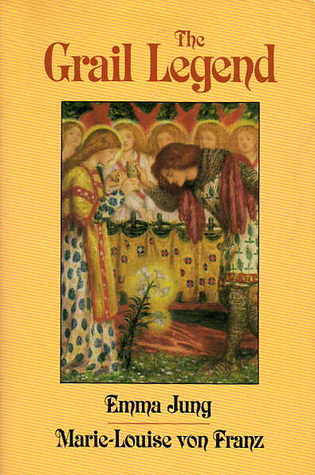
I’d read recently H is for Hawk, which was an interesting memoir about a young woman who deals with the loss of her father by training a goshawk–and in her book Helen MacDonald repeatedly refers to T.H. White’s own book about training a goshawk. T.H. White, of course, was the author of The Once and Future King series about Arthur and the Knights of the Round Table, and I considered reading those novels for the first time but don’t have them on the shelf. I did, however, have Emma Jung’s analysis of the Grail Legend and picked that up instead.
Emma Jung was Jung’s wife and collaborator, and was a sophisticated analyst as well. Her book is introduced by another long-time associate of Jung’s, Marie-Louise von Franz, who edited and finished the work after Emma Jung died.
As is often the case with books by Jung or Jungians, this is a challenging read, and it presumes a familiarity with Jung’s work and in particular his book Aion.
It is Emma Jung’s contention that the Grail Legend is an attempt by the collective unconscious of pagan Europe to adapt to and internalize Christianity. From our home here in the Correze I can very quickly visit several fountains which were originally pagan sacred sites but which were renamed in the 4th or 5th century for Christian saints and turned into Christian sacred sites. There is a lovely one here in Treignac designated The Fountain of St Meen. Also easily accessible nearby are several ancient crosses, dropped by monks on pagan sacred sites in order to Christianize the locals. One of my faves is La Croix en Haute in Lestards.
Christianity of course was an import to Europe from the Middle East, and its doctrines and rituals struck local residents as strange and alien. But over time as society became structured by converted local nobles and local monastaries and abbeys, pagans had little choice but to adopt themselves to the new religion. But the heavily patriarchal belief system with its dogma of sin and repentence and featuring a hostility towards women, magic, sex and nature was hard to swallow for locals who had their own beliefs almost completely at odds with the Christian worldview.
And so a new series of myths and legends erupted in order to compensate for and make more comprehensible the tenets of this new faith. Emma Jung documents carefully how the writers who first codified the Grail legend took material from widely dispersed pagan legends from as far afield as Wales, Ireland, Syria, Persia, and old Saxony. French poets and troubadors and English poets and historians and German poets all began singing and composing verse about Arthur and his knights and their quest for the Grail.
The Grail is typically understood as a cup which at one time held the blood of Christ captured at his crucifiction–but Jung shows that some stories present the grail as a plate or serving dish. It has the power to heal or destroy, and it exists in a hidden realm in an alternate reality accessible only to those pure enough to find it.
Associated symbols are analyzed and discussed in detail. The Fisher King is linked to the Piscean Age, the sudden eruption of the cult of the Virgin to compensate for a lack of the feminine in doctinaire Catholicism is described, connections between the Grail stories and other concurrent trends (Cathar and Templar beliefs, for example) are established and illuminated.
The focus of the work is Percival and his adventures. His family ties to the Fisher King and back through time to Joseph of Arimethea is examined through a Jungian lens.
Back before Halloween I bumped into a list of recommended recent horror–probably on the NYTimes website. Of the 7 or 8 titles listed I chose a couple to add to my To Read pile.
The first I read from the list was barely OK. Too derivative of a Stephen King novel, and too many clichés from current horror movies (unnatural smiling, kids crawling on the ceiling, animals behaving strangely like humans–yawn). The writing lacked King’s folksy warmth and humor as well, and was more like Tom Clancy’s stiff and uninteresting prose. The characters were not atypical of genre fiction–types rather than people, and the dialogue reminded me of the old Superfriends cartoons popular when I was a kid, where the superheroes would explain what they were doing while doing it as if the audience were too stupid to see what was happening (example: Aquaman would have circles shooting out of his forehead and would intone “I’m using my powers to summon fish friends,” and Superman would have red beams coming out of his eyes while saying “I’m using my infrared heat vision to burn the villain’s shoes off.”). I read Mean Spirited on a flight from Paris to the US and it whiled away the time, but I prefer more profound fare. The ending had an unexpected twist which nearly made it worth getting through.
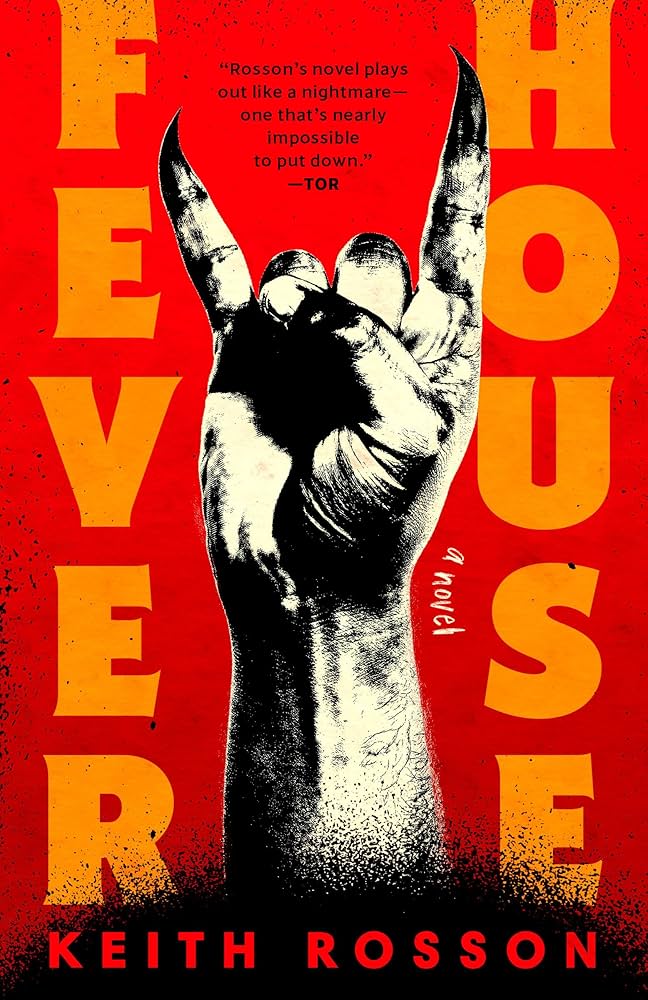
But the second I read from the list was a knock-out. I’ve seen many zombie films, and have been an enthusiastic fan of the genre since I fist saw Romero’s initial trilogy back in the day. What I like about zombie stuff is how the genre moved from its racist origins to really incisive and often quite witty social commentary.
Fever House is the first zombie novel I’ve read–and it is excellent. There are actual fleshed-out and fully developed human beings involved, and I was on the edge of my seat as the familiar tropes of the zombie apocalypse were delivered with a new and clever backstory. I’d love to go into detail about the novel’s critiques of the hypercapitalist USA and its intelligence apparatus and the military industrial complex, but inevitably I would spoil the experience of finding out for yourself.
Rosson can write–which is atypical of authors in modern horror. Ramsey Campbell is by far the most literary and stylish current writer in the genre, but Rosson can craft sentences and structure a novel at an exceptionally high level. This book is a Slayer album redone as literary fiction. I burned through it in a day and half, and now must give myself a break from the walking dead before jumping into the second volume of the duology.
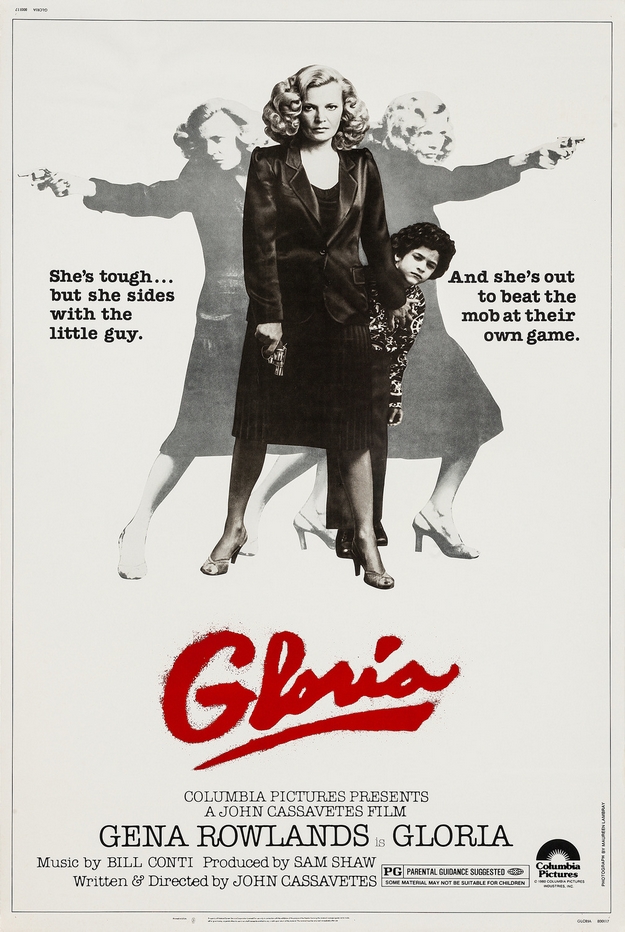
Gena Rowlands passed away in August of this year, and it struck me at the time that I’d only seen one film she’d made with Cassavetes: A Woman Under the Influence. I don’t remember much about it after nearly 30 years, other than bits of Rowland’s searing and uncomfortable portrayal of a woman completely falling apart, and the typically warm Peter Falk playing a jerk.
Saw Gloria last evening at a local film club and was impressed by its energy and inventiveness. The plot is ridiculously absurd–a mob accountant has turned informant and has a book recording the dirt about his employers and their businesses. Immediately before getting wacked by a team of goombahs with shotguns and bad suits his wife hands off their 6-year-old son to their neighbor Gloria, giving him the book and telling him to guard it.
What follows is two hours of deleriously entertaining action and farce. When presented with 6-year old Phil, Gloria quips that “I hate kids, and especially yours,” but given the seriousness of the situation she takes him in tow. After some initial rough going between Gloria and her young Puerto Rican charge (played with cute adroitness by John Adames) her maternal instinct is activated and Gloria becomes Dirty Harry, blowing away and confronting gangsters with aplomb and sassy attitude. Despite the silly plot and at times unintentional humor of the action, Rowlands commands the screen and is completely believable. At times she and Adames are like Gable and Davis in a screwball romantic comedy, and the gangsters are Keystone Cops. What fun!
Cassavetes’ use of cruddy late 70s New York is very appealing, and made me nostalgic for the gritty run-down town I used to visit into the late 80s before Times Square became tragically Disney-fied and antiseptic. The sappy and overwrought ending was delicious and there wasn’t a dry eye in the house.
I must further explore Cassavetes’ films and Rowlands’ catalog. There were some die-hard fans of their work, both French and English, at the showing last night, and their enthusiasm was infectious.
Bou loves to play with our goats…but she has been for the past six months WAY too aggressive and powerful for them. They would try to play with her but inevitably Bou would crash into them and send them flying because despite being a little dog she is a bundle of muscle coming in at almost 30 lbs. And the goats are only 8 months old now—when Bou first started playing with them they were barely 9 weeks old. Typically Bou plays with dogs who are much larger, like our neighbor’s Lab/Mastiff mix or our friend’s bloodhound. When smaller dogs play with her Bou inevitably hammers them with a powerful shoulder shrug or head butt which sends them trembling and whimpering into their owner’s arms.
But our baby goats are growing and the male Cornichon now weighs only one kilo less Bou. As a result Bou recently learned a valuable lesson
Here is the vid:
Of course seeing this after the fact I’m deeply concerned about Bou’s hips and back—Frenchies have terrible problems and often require surgery. But it’s part of owning a Frenchie: she throws herself around like a lunatic every day, jumping off 6-foot high walls, propelling herself into orbit off the back of sofas and landing awkwardly, doing a vertical leap superior to that of Spud Webb and landing on her spine, chasing a ball and crashing into a hardwood bookcase at full speed. I wish that rather than filming Bou getting blasted into the stratosphere and crashing down I’d captured Corni’s victory dance. It was the most adorable thing to see him hopping back and forth and puffing out his chest at having bested his friend and rival for the first time. Now they play more as equals and it’s very cute.
I love how Bou immediately gets up after her chastening and goes after Corni anew–but as soon as he rears up she backs off. Makes me laugh every time.
Back over on the old blog, when I was a much more serious and consistent writer, and before Tweets and Instagrams and Tik Toks took over the internet, I used to record eerie and inexplicable events which happened in our house just outside Baltimore. Things started to go a bit haywire the final year we lived in there. I called the series Haint That a Shame for some reason which now eludes me, but presumably it was because my maternal grandma had used the word haint once to describe a ghost–I found this twisted form of the word haunt charming as a teen, and it stuck with me.
We moved downtown after ten years in that house and had only a few more strange happenings before things calmed down.
It’s been two and a half years since we bought the old mill in France which we currently inhabit. When the previous owner was showing us around before we bought the place he opened one old room with a skeleton key and referred to it as the chambre des fantômes. We had a brief exchange in French when he said this–I asked him if he’d had any experiences with ghosts and he said he was only joking about the room, which was an old machine shop filled with junk. But, he said, there had been some problems which he’d addressed by having an exorcism done on the building by a shaman (more about that another day).
At the end of February we adopted Bou-Bou, a 2.5 year old French Bulldog. Her previous owner had gotten a promotion at work and was unable to give Bou enough attention, so we bought her and have not once regretted the decision.
Before we met the dog we were told that she was the sweetest, most timid of creatures. When going for walks around town she would meet strangers and immediately roll over and display her stomach to everyone. When we went to visit her a couple times before adopting her, this was our experience–immediately she would shrink down and then flop over on her back with belly and neck displayed. This behavior continued the fist two months she lived with us, and when she was running free around our property she would unfailingly roll over when friends or strangers came by. As we run an hébergement we were quite happy to see this behavior. All spring and summer we have tourists in and out of our rental apartments and we of course wanted a happy dog who turned into a wiggly worm around strangers.
One day when we’d had the dog about two months, my wife went down to the 3rd floor of our building with Bou. That floor is unfinished and used to house several concrete spawning beds for trout. It’s basically an 85-meter-square empty space completely unfinished with some old radiators and debris and a bit of scaffolding off to the side. While my wife was doing some tidying she heard the dog rummaging around and then beginning to chew something. As anyone with a dog knows, you have to immediately check what the dog has in its mouth. Upon close examination, and following careful negotiations with our new pooch, Patricia discerned that Bou had found and started to chew the peculiar button pictured above. Somehow she had found it on the cement floor which had been swept clear earlier.
In French it reads Jamais ne dort–Aboie et mord, which translates in English to Never sleep–bark and bite. Pictured is a fierce-looking French bulldog with an angry red eye. On its collar is the ID number 214e-RR. When I searched this ID and the words french bulldog the top result on Google was a chat stream beginning with this description and a request for more info:
Définition de l’insigne
Le bouledogue régional jamais ne dort, aboie et mord. Dormez donc tranquilles braves Parisiens, les ouvrages d’art et les voies navigables de votre région sont bien gardés… Le réveil sera dur!
Sans nom de fabricant.
Le Colonel GEOFFROY prend le commandement du régiment à la mobilisation
Turns out 214e-RR was a regional regiment of the French army charged with protecting Paris, its art treasures, and its means of transport. Its commander during WW2 was Colonel Geoffroy (the French form of my first name). Nice bit of synchronicity there!
But most interestingly, and quite strangely…the very next day after she found this button and chewed it, Bou’s behavior changed dramatically. She barked at a person walking by, which shocked us as we’d never heard her bark or growl; her hackles were raised and she displayed a terrible fierce aspect wholly opposite to anything we’d seen before. She began charging and leaping at strangers and even friends when they knocked on the door. During tourist season we could no longer allow her to roam free around the property because she would charge ferociously at anyone, even people she’d met several times.
To this day she remains a fierce defender of the Moulin and its grounds and its inhabitants. Even daily visitors get the treatment, and sometimes if I walk into the house suddenly she’ll charge and leap at me! We have to keep her locked on the porch or on a lead now. Somehow the ferocious bulldog spirit of 214-RR has inhabited our little regimental commander and transformed her from a gentle and timid soul to a true and aggressive defender of her territory.
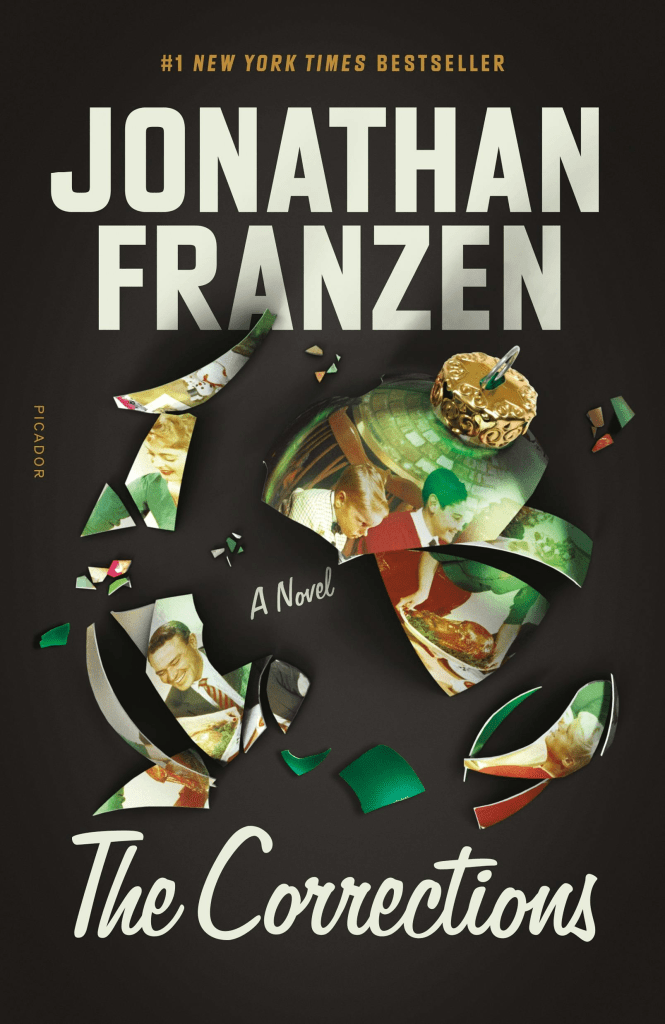
Here’s another novel from the recent NY Times List of “Greatest Books of the 21st Century.” It’s almost 600 pages long, and, given how weighty and dense and serious it is as a work of fiction I was surprised to find the writing quite breezy. I laughed heartily several times and regretted my decision 20-odd years ago to classify Jonathan Franzen as merely one of a crop of young writers at the time whose voices and themes and styles all seemed indistinguishable to me: Safran-Foer, Lethem, Chabon, Schteyngart, etc. I thoroughly enjoyed The Corrections.
I must however admit that the family at the center of the novel is deeply troubling. Most of the characters are eminently likeable and relatable–I found much in the family interactions which was all-too-familiar from my own experiences. And yet every character does hateful, despicable, awful things. Again, pretty typical of my experience not only of my own family but also of others I know well. This is where the sophistication of the book lies: documenting a time period in US/world history via the lives of a single midwestern family teetering on the brink of total and utter disarray and giving us a full picture of why across three generations. Franzen’s book shows us lovable people who we want to care for despite how truly terribly they behave–and given where American society has gone since its publication there is a bit of prescience in his vision. The entire nation these days feels like a dysfunctional family full of badly behaving people who are at heart decent and reasonable but whose unpredictable, selfish, and greedy behavior makes them despicable.
This morning I read an essay by Wallace Shawn in the NY Review of Books. The essay, called The End of a Village, will serve as the introduction to a newly re-issued book about the Vietnam War. Shawn was a college pal of the author Jonathan Schell, and manages to paint an evocative portrait of his friend and what he hoped to achieve through reporting on The Village of Ben Suc. Schell observed the complete and utter destruction of a peasant village by US forces, and tried to portray both the victims of this assault and the perpetrators with as much objectivity as he could muster. Having just finished The Corrections, I was struck when Shawn wrote this about Schell: “He generally seemed to like the military men he encountered. It’s just that what they were doing was appalling.”
This of course leads us to Hannah Arendt in The New Yorker 50-some years ago and her “banality of evil” (Wallace Shawn’s dad was managing editor of The New Yorker at the time). Shawn makes the connection, stating “If one accepts the idea that the ugliest of crimes can by perpetrated by people who aren’t ugly criminals, then the possibility seems to arise that even reasonably nice people might be at times involved in evil.”
The characters in The Corrections do horrible things as their family dangles by a frayed thread over the abyss of the 21st century. But at different parts of the novel, told from their different perspectives, I found myself rooting for each of them and caring deeply about their situations despite the decisions they made. And if individuals can do horrible things despite being “good” people, then so of course can societies and nations.
So we all make poor decisions and we all allow questionable motivations to drive us now and again. But how do we fix things after? When we go catastrophically awry and cause catastrophe, what is the means of repair? The word corrections has a lush ambiguity because the word has so many applications. A teacher corrects her student’s work. Parents correct their children (well, ideally). Some behavior is considered correct, and society drills us in the niceties of acceptable interactions. A captain who discovers her ship is off course will make corrections, a market which is overheated will face an inevitable correction. All of these senses of the word have a similar basis but different nuances. Every generation goes through a reaction to what was considered correct by the previous, now aging members of a family or civilization. So what is correct can be in flux, and those doing the correcting can be wrong or misled or mal-informed. When everything is called into question, when religion, government, the media, when public institutions previously held in high regard, when family itself all face skeptical and factual analysis and are thereby doubted and eventually shorn of their importance, and when much of the traditional underpinnings of a society and its very history are demonstrated as false and hypocritical, what is left? Where can we turn for guidance and support? How do we rebuild? I guess we’ll find out together.
The town where I grew up in the 1970s was still, in many ways, actually in the 1950s. In Stewartstown, PA The Beatles were long-haired hippy freaks who hated Jesus, anyone to the left of Barry Goldwater was a Communist, and guys still hung out in their denim overalls by a potbelly stove in the feed store. My grandfather, who was almost totally bald, walked two blocks to the barber’s to get his “ears lowered” and hung out with the gents there for a couple hours. Our neighbor one house south of us on Main St was Mrs. Hersey.
Mrs. Hersey wore dark blue or black dresses which covered all the way to her neck, to her wrists, and to her ankles. The dresses were finely made and very austere, but there was elaborate white lace at the neck and on the sleeves. She also covered her hair in the traditional manner of churchwomen in that region at the time when she was outside or when she was hosting company. She would summon me to the fence between our yards when I was four or five years old. “Master Godfrey how do you fare today?” She always referred to me as “Master” followed by my last name, and addressed Christmas cards to me in the same manner (I think I still have one of those). After a bit of conversation she would hand me a small paper bag of chestnuts.
Mrs. Hersey didn’t have a living room like everyone else, she had a parlor. But the parlor to my at the time little mind just seemed like an old-timey living room. There were glass oil lamps with globes and wicks which had been converted to electric lamps. The glass was infused with different colors like mauve or mint green, often swirled with white foamy glass and sparkle flakes. Her parlor reminded me of the interiors in old western movies. There were doilies under everything: hard candy dish full of root beer barrels, the lamps, family pictures. And every table was covered with a cloth to boot, as were the chairs, which also had lace at the top and on the arms.
In Stewartstown I had the freedom to go anywhere unsupervised, and my friends and I did so. Favorite haunt was the old town cemetery directly behind our house, but we roamed widely and often for hours at a time without adults or elder siblings. We had this freedom because of the old ladies in town, who knew everyone and everyone’s brood and everyone’s business. From their front porches and from chairs hidden behind front window curtains they somehow divined all the latest gossip. But the old ladies kept an eye on us, took us in when we tumbled by on the sidewalk, came out with Band-Aids when someone fell, and in certain circumstances might deliver a stern lecture, a warning to call our moms, and occasionally, dealt us a smack.
I used to love visiting with the old ladies. They were all born around the turn of the 20th century and had seen so much–imagine they’d all had horses and horse carts when they were teenagers? They told wonderful stories and told me about my grandparents and father when they were all young people. When my parents got divorced and my mom and sister and I moved in with my maternal grandparents in a different small Pennsylvania town, I continued the tradition of visiting old ladies. My grandma would give me a sack of veggies from her garden and say “Take this up to old Mrs. Kent and tell her $1.20 please.” I’d tie the plastic bag to my bike handlebars and ride off. Mrs. Kent had more hair on her chin than on top of her head, and wore simple house dresses with a full body apron as she sat in her rocker and told me about the photos on her tables, or about her knick-knacks, or about that one time she got a train to Baltimore, or about her long-gone husband. Then she’d give me some shoefly pie and $1.20 in coins to take back with me.
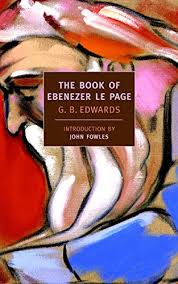
All of this as prologue to show I’ve often delighted in the company of old people, and truly treasure my opportunities to do so when I was a very young lad. And this novel by G. B. Edwards reminded me so much of my visits with old folk back in the 1970s and early 1980s that I felt a profound nostalgia, despite never having been to Guernsey Island.
The Book of Ebenezer Le Page came to my attention recently as I was scanning my bookshelves and planning future reads. I’d read a couple articles lately about Guernsey Island and some controversies about its time under German occupation and what exactly happened in the labor camps there. I picked it up to read as a secondary novel (I typically have a primary novel and a secondary going at the same time (and also a primary non-fiction and fiction going at the same time (and routinely a primary novel in French as well))) and with regular 6-8 page chapters finished it off in a couple months.
What a pleasant and interesting old chap Ebenezer Le Page turned out to be. And what a lens through which to see the changes in an island culture over the early 2/3rds of the 20th century. Ebenezer of course is not an old man throughout the novel, but the novel is told by old Ebenezer who is writing his memoirs. If you are a fan of plot and excitement, this is not a novel for you. If you like to visit old folk and set a piece and hear what they have to say–you may well enjoy this book. I particularly enjoyed Ebenezer’s run-ins with Liza and actually laughed out loud reading them. But we get his entire life story and his interactions with friends and family as the island where he lives moves from the 19th century and into the 20th and through the world wars.
Surprisingly, there are gay characters in the book and it’s interesting to note Ebenezer’s mindset and reactions to them. And Ebenezer remembers some details of the Nazi occupation of Guernsey which continue to be controversial. I particularly enjoyed learning about the patois of the island with its mixture of French and English cultures and languages. There is a useful dictionary in the back!
I was genuinely sad to reach the end of this novel–that rarely happens in life, even when you read a lot of great stuff.
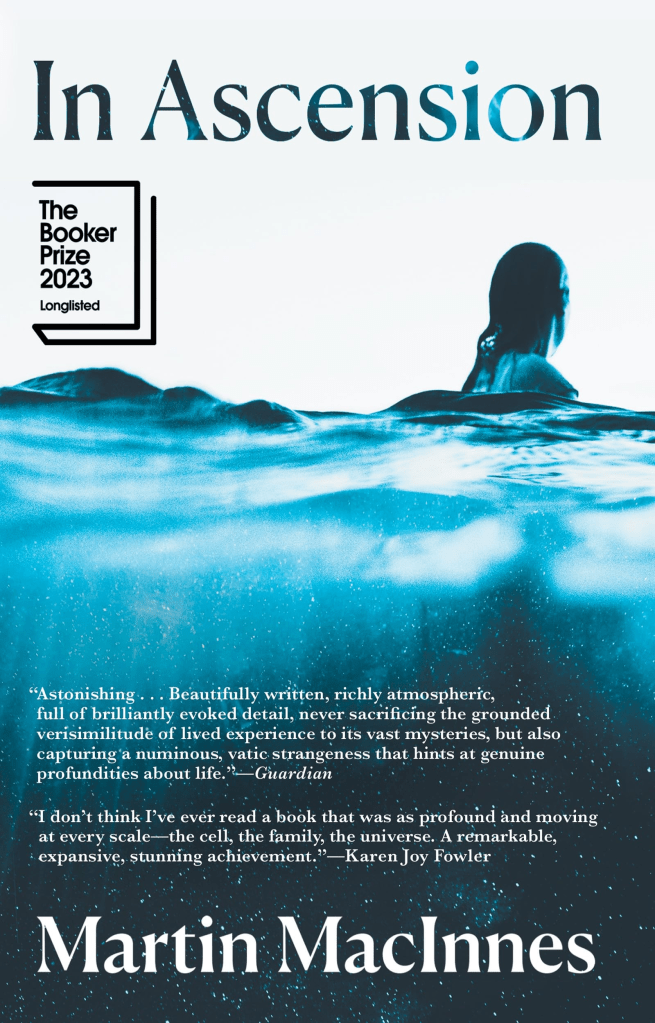
I first heard of the writer Martin MacInnes while having lunch outside the cafeteria at an international school in Panama where I worked as a Social Studies teacher for four years. At my table was the author’s brother, who was director of athletics and who held some other leadership responsibilities, including eventually a Safety Committee role assuring the school’s compliance with all COVID 19 protocols. “I’m sure you’re skeptical because it’s my brother I’m touting, but I assure you he’s a really gifted novelist. I think you need to check out his stuff–he’s got three novels and a fourth on the way. They’re all quite interesting and well-done.”
The “fourth on the way” turned out to be the first MacInnes I’ve read: In Ascension. Based on its quality, it won’t be the last. MacInnes is certainly good–I’d rank the craft of this novel right up there at the upper echelon with folks like Richard Powers, Colm Tóibín, Ian McKewan, Jhumpa Lahiri, Louise Erdrich, etc. This is a science fiction novel, but it’s not merely a genre piece–it’s a work of densely layered literary fiction.
This is a near-future bit of sci-fi and unspools within the next couple decades we face here in the real world. The novel’s protagonist is Leigh, an expert biologist/geneticist who specializes in the study of early life and who loves tiny critters like archaea and algae in particular. Because she is also a deep sea diver she is invited on a scientific expedition to chart a newly discovered volcanic vent which might be home to some interesting microscopic life. While doing a dive at the site Leigh has what can only be described as a mystical experience. She and other divers have visions and develop an unknown illness. They become obsessed with returning to the water. Drifting around for weeks at the surface on site and doing the boat crew and scientific work becomes more difficult as something below calls to them. Leigh meets and interacts with other scientists on this mission, which becomes important later in the story.
Meanwhile a discovery is made which will impact humanity in unforeseeable ways: a new means of propulsion has been uncovered, which can expand the reach of humans to the furthest limits of the solar system and potentially beyond. There are hints that the mystical experience Leigh and her fellow divers had in the Atlantic Ocean may be connected to dreams had by the scientists who discovered this propulsion system simultaneously on different continents. Leigh eventually is invited to work on creating a sustainable food system for the first manned ships which will used this drive.
But Leigh is not merely a scientist tapped as an expert in a near-future sci-fi novel; she is also a fully-rounded human being with all that entails. MacInness is excellent at letting us see her family: the abusive father who had ambitions as an architect which were thwarted, but who still becomes an important engineer who manages the systems which recapture land for the government of the Netherlands; the brilliant mathematician mother who is largely absent and exists solely in a state of academic indifference to human suffering in her household. Just as Leigh is signed up for a top-secret scientific space mission her mother begins showing signs of dementia, and Leigh will be absent as her mother and sister start a terribly difficult stage of their lives.
And so this is a sci-fi story of a certain sort (2001 A Space Odyssey, Annihilation, Solaris come to mind) where there are indications an advanced race is meddling in life on Earth and may perhaps have even seeded life there in the distant past. The sci-fi is twinged with a New Age mysticism; as Arthur C. Clark once intoned, there is no difference really between advanced technology and magic to the more primitive species…
But the novel is still mostly about Leigh and her family relations and how she ended up the person she is. The sci-fi elements aside the themes of the novel are about an inability of children to understand or relate to their parents, and the distances between loved ones are as vast as any physical distances. Despite her incredible levels of technical proficiency and innovative use of science to solve problems, despite her profound specialization concerning the origins of life and how to modify genetic codes, our protagonist still can’t have a simple conversation with her mother or sister. Leigh discovers that even after plumbing the vast depths of the ocean and the outer regions of the solar system and journeying through time itself, our own true self remains the deepest mystery of all.
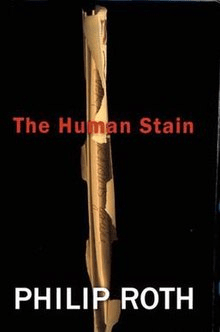
I read a lot of Roth back in the ’90s, to the point where I found myself Zuckered out. When The Human Stain arrived I bought it in hardcover but never got around to reading it (my copy still has a “Borders Books 30% off sticker” on the cover, LOL). Recently the NY Times released their Best Books of the Century list; the novel’s inclusion sent me downstairs to dig it out.
The Human Stain is third in a trilogy of novels (the previous two are American Pastoral and I Married a Communist). There’s a twenty-some year gap between my readings of Volume 2 and Volume 3!
Roth is typically strong at recreating a time period of American political and cultural absurdities, which he’d done in the previous novels in the trilogy for earlier eras. As the title and timing of the novel might indicate, we’re in the era of Bill Clinton and Monica’s stained blue dress. What a terrible time to be alive and American! Moralizing hypocrites unbound, a sleazy and easily manipulated Chief Executive who fell for a honey trap even the bait didn’t understand, the rise of sensationalist and salacious cable ‘news’ coverage, etc. Out of that mess came an extreme and reactionary right-wing movement angry that Clinton out-triangulated them and co-opted their economic wish list to the point where he hammered through the final achievements of the Reagan Revolution. As the Democrats moved right wing economically the Republicans went wholly off the rails. A Democratic Party beholden to Wall St and corporate interests emerged, leaving the political left in the US nobody to support except for the occasional quaint New Deal Dem who got smoked in the primaries or a third-party candidate. What a joke all that was, and yet the consequences were dire and are yet to be resolved in the USA.
The Human Stain centers around (SPOILER ALERT) a Black academic who chose to pass for white and Jewish and pulled it off, who is fired from his position of Dean for using a racist expression while teaching at a small elite liberal arts college in the wilds of New England. But the slur was not necessarily a slur given its ambiguities and the context, and perhaps the firing was an unreasonable rush to judgment (Roth perceived the emerging phenomenon of cancel culture?). Nathan Zuckerman, who befriends the fired prof and former Dean central to the story, sets out to untangle the events leading up to the situation and to write a book.
My favorite Roth novels feature a manic, hilarious, and zesty narrator. If you’ve read Sabbath’s Theater or Portnoy’s Complaint you know what I mean. Those novels breeze by in a vortex of delicious voice, and the reader is ensconced enchantingly in the conscience of a pervert who participates vividly in experience and has things to think about. But this novel (like The Plot Against America) succeeds on its level of refined craft. It brings up big themes, big ideas, big hypocrisies, and the reader is forced to examine her own beliefs and assumptions.



 Mysterium Coniunctionis