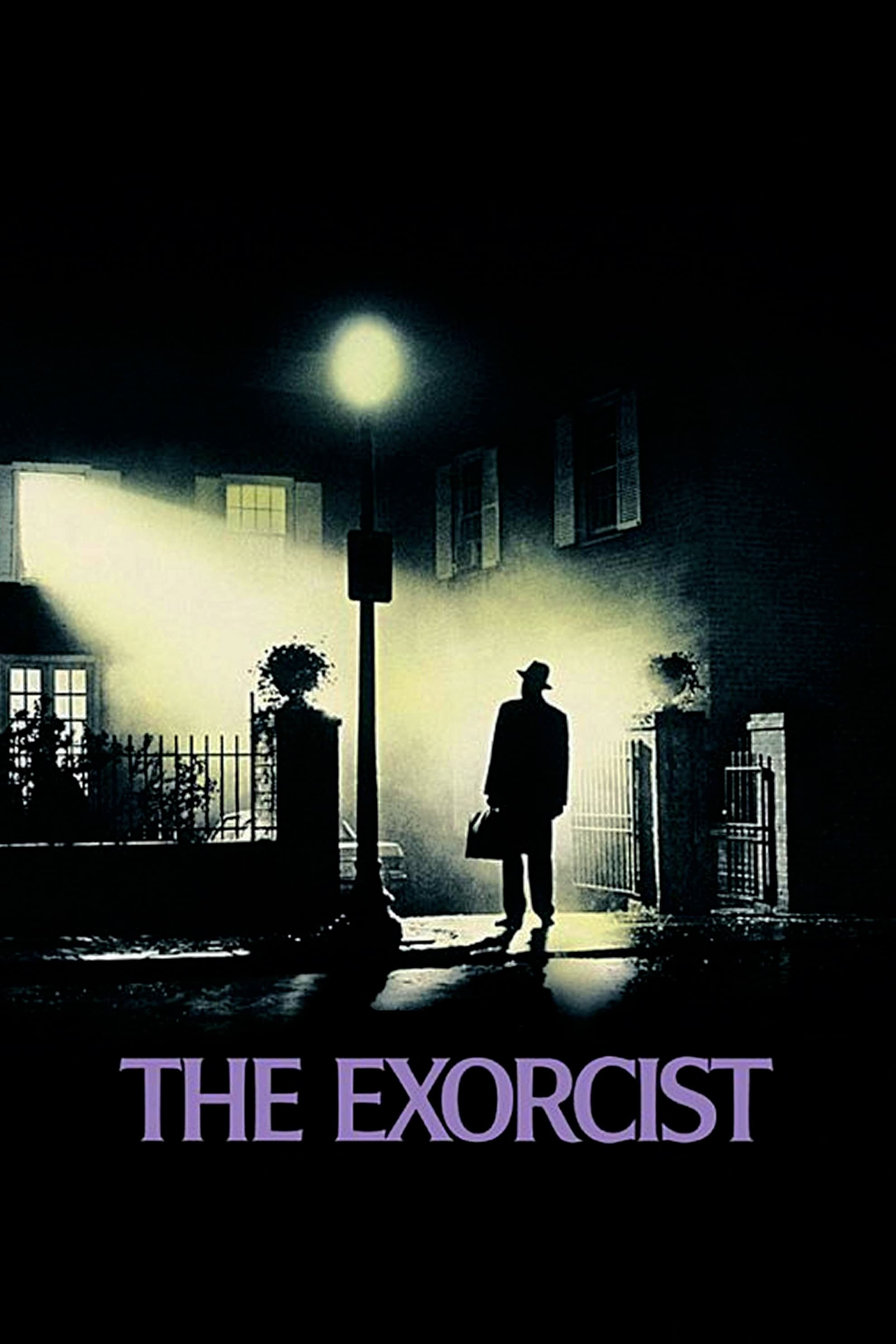
Recently I saw that Amazon in France was selling The Exorcist for 2.99 euros. I’d not seen it for decades, and wanted to see how it held up. Also, the numerous times I’d watched it previously were on US television, heavily edited and pan-and scanned to fit the square TV screens at that time. I thought it would be fun to revisit.
I was absolutely horrified and disgusted and terrified! What a searing, potent film. Yes, some of the effects are a bit wobbly in our age of perfect CGI, but oh my god this is highly effective horror. I literally could not bear it.
On broadcast television I used to be bored by all the medical scenes and the initial consultations with the priest, etc. But re-watching now as an adult in a pristine high-quality stream on a large television I was totally absorbed.
I’d say that it’s in my top three horror films of all time, easily. I’ve read the novel and know the “true” case upon which the story is based, had seen edited versions likely a dozen times–but still I found the tension and the tragedy of the film difficult to endure. I love the hard-drinking, cigarette-smoking priests, and of course Max von Sydow was a force of nature in everything he ever did.
Interesting to notice how much influence The Exorcist had on other movies–particularly there are several scenes or shots completely ripped off by Spielburg/Lucas in Raiders of the Lost Ark. That initial sequence introducing Father Merrin in the desert is re-used substantially to build Indiana Jones’s character.
Funny a couple days after watching The Exorcist to receive in the mail the current issue of Harper’s Magazine. The cover story is about a surge in exorcisms performed in the USA of late. Old Scratch is busy as ever possessing the economically dispossessed in Appalachia.
I should also note that the previous owner of our building in France had an exorcism performed to clear away a malevolent female spirit he encountered several times, including one instance where he was physically attacked. I asked him what the ceremony entailed, and he said “love and forgiveness and total acceptance of the entity.”
I bought this Bantam mass market paperback at the B. Dalton Booksellers shop in Hunt Valley Mall, probably around 1985 or ’86. At the time I’d read a lot of sci-fi, horror, and fantasy but I was beginning to push out and explore other stuff. Not that the sci-fi, horror, and fantasy weren’t satisfying, but I wanted something else. The reason for this was due partially to reading a bit of Dickens, Shakespeare, Steinbeck, Harper Lee, William Golding, and Hemingway in school. What mostly made me crave more ‘literary’ fare was Samuel R. Delany and his novel Dhalgren.
Dhalgren is supposed to be a sci-fi novel, and it is, but it was actually the first absolutely confounding and densely packed work of serious artistic and philosophic intention (what would later be called a “Post-Modern novel”) that I’d ever read. I had a couple different jobs at the time and I used my money to buy records and books (I should have bought shares in Apple, but WTFK back then?). I was drawn to Dhalgren by its spectacular cover and its length–I’d recently finished a couple Dostoevsky novels and this one was like Bros. K long; and that first sentence!
to wound the autumnal city.
I went all-in. The plot? Simple. Guy walks around a post-apocalyptic urban hell-scape. Keeps a notebook, writes poetry. Gets laid a lot, men and women. There are parties and things are collapsed but people still host dinners in their apartments. But inside the text are other texts inserted in strange places, and featuring different events and characters and settings than the novel narrative itself. But, since these were also in the novel narrative, despite being kind of asides and or comments or edits or revisions or re-imaginings of the primary action, I assumed they must be important also. Were these excerpts from the protagonist’s notebook? Who knew for sure, but probably. At one point the narrator sees himself in the mirror and describes what he sees and what he describes is the author of the novel, and my mind just went soaring. I read all the Delany novels I could get–Babel-17, Nova, Triton, The Einstein Intersection. But then I got to the Tales of Neveryon series and couldn’t cut it. I saw Stars in My Pocket when it came out and bought it, thinking I’d read it in 1986 0r 1987. And now in France I pulled that same mass market off my bookshelves and read it after nearly 40 years. When was the last time I read a mass market paperback?! LOL the text is so tiny. And of course due to age the book was yellowed and crumbly despite being unread.
I really liked it a lot. There are similarities to Dhalgren and the novel has aged well. I mean here in the early 80s Delany has imagined the Web, and called it the Web, and there are many interesting questions raised about what constitutes gender and who is really male and female despite their genitalia, and there are difficulties with meaning and visual representation of language and how gestures and utterances between species and races become confused for multiple reasons. It’s a surprising series of accurate predictions of the near-future from the perspective of the 1980s but imagined FAR in the future. Again, like in Dhalgren, there is not much plot, but there is a lot of meat packed onto this skeleton. It starts off with a kind of reverse Frederick Douglass–a kid on the fringes who undergoes a treatment to render him “less anxious” and a bit incapacitated intellectually, knowing that following this treatment he will become a slave. But he undergoes the treatment and we join him as he is exploited but doesn’t really care because his brain has been altered. But a set of special finger rings attached to a Web database, provided by a female kidnapper who uses him for sex, give him a taste of what he’s missed and then the story takes off.
I’d recommend it, but not as the first Delany you read. Get to know him first!
These past two months have been a bit exhausting. We’ve hosted an open mic night with a full band, a harp concert, several workshops and a dance performance, as well as the usual run of weekly classes and ateliers. All of this on top of the two rental apartments ramping up into tourist season, the crush of garden maintenance, a quick five-day vacation in Spain AND working at the local street food festival, electrical and plumbing challenges, renovations, etc, etc.
We’ve also adopted a French bulldog, two baby goats, and four songbirds. I’ve put in at least 50 hours on fencing alone over the past three months–building the goat enclosure, then expanding it, adapting it as needed, and repairing it several times as the goats found weaknesses and pushed through.
And with all this work going on I’ve allowed some major milestones to pass unacknowledged here.
The Milestones
As of June 2024 it has been 6 years since we moved out of the USA. We left behind an elaborate social calendar, a Victorian rowhome filled with art and objects, political and business connections, the best next-door neighbors ever, our pet dove Godzilla (RIP), and a city with which we were infinitely familiar, where we’d carefully developed an intricate network of deep involvements over the years. And, of course we left behind beloved family members and dear friends.
But, I regret nothing. All of the challenges and myriad difficulties of being voluntary immigrants were worth the sacrifices. I was looking for a new push, a new means of developing skills and becoming a stronger and better version of myself, and moving abroad definitely pushed all my faculties to the brink on multiple occasions. I often thought about involuntary immigrants, those who have no choice but to migrate, and considered how my difficulties paled in comparison (while the privileges granted by my paleness greased many wheels for us). Our experiences in Panama–living in luxurious high-rises by the ocean, pushing ourselves professionally in a completely different environment than the Baltimore City Public School System at a swank international school, making friendships with locals and other expats from around the world, going routinely to beaches on two oceans, going into the mountains, rainforests, cloud forests, jungles, seeing wild animals, getting the most out of our crippled Spanish–we loved it all. Further, there is nothing more liberating (after the trauma subsides) of getting rid of all the stuff Americans accumulate over decades. So many possessions! It was a lot to let go but we learned how to do that.
As of the first half of June 2024 we’ve lived in France for 2 years. Our French expat experience has been much different from the Panamanian, and for beyond the expected reasons of climate, geography, culture, history, language, as well as living in a decolonized nation versus living in a former colonial power. In Panama we had jobs and an employer with lawyers and an HR department who handled the heavy lifting for us. For the move to France we did much of our own heavy lifting, with the help of an excellent hand-holding service based in Paris. And we had no employer, instead we started our own business, which I suppose counts as another milestone (In June 2024 we marked the two year anniversary of not working for The Manand became ‘self-employed‘).
Our humble abode from an island in the Vezere River: Moulin Sage
We are loving the Correze region of France. The village of Treignac has proved to be everything we hoped when we chose it after touring dozens of small medieval towns across France as we researched moving here. Many people in and around Treignac have helped and supported us as we work toward our goal of creating an event space/concert venue/professional development center/arts and crafts atelier/pop-up cafe/retreat center/eco resort/organic farm/anarchist commune/naturalist resort/vinyard/exposition space. Yeah, we live in a run-down apartment in a largely decrepit old factory building, but it’s the best life! People come here for concerts and shit, which amuses me no end (our first concert was a gathering of about 30 people to hear ellen cherry). People we need seem to arise by magic at the exact moment we need them–could we host yoga classes here? A yoga teacher appears. Can we find a contractor willing to use recycled or repurposed materials found in the mill to create new useful spaces? Tom puts a home-made flier in our mailbox. It’s been a blast, and quite exhausting at times. But it’s different working hard for yourselves and your clients and not for somebody else.
We earn about 8% of the income we had when we had jobs. But our stress and anxiety is way down, and we can afford to live a quality life here on a small income.
Our growing menagerie of small mammals: Cornichon, Capri, and Bou-Bou the Frenchie
On May 13th, I turned 55 years old
So being in my mid-fifties is pretty much the same as every other age I’ve been. Differences? My collection of unguents and gels has grown, my toes suddenly look like my grandfather’s toes, and I go to bed before 10pm every day. 85% of the time I feel physically like I’m in my early 30s–in fact, due to Tai Chi I often feel more limber than I did back then. But the other 15% of the time is where mid-fifties life gets interesting: 5% of the time I feel exactly my age, 5% of the time I feel like I’m in my 70s, and the last 5% of the time I’m stiff and sore and feel at least 90 years old. I can do renovation projects and work in the garden cutting and stacking and digging like a maniac no problem, and then get injured standing up from the couch or opening a pickle jar.
The biggest realization over the first half of this decade? Shut the fuck up. Keep your opinions to yourself, listen to what others have to say and shut the fuck up. Don’t participate in or encourage gossip of any kind. Petty annoyances and grievances? Let that shit go. This is the time to work on the inner self and start preparing for the next stages. What books to read, what books to re-read, what places to visit or revisit?–all of these questions become more delicate and nuanced. Typically American dudes live to be 75. Maybe I’ll get there, maybe not–maybe I’ll go beyond? But it’s time to start considering the fact that you’ve got a couple strong decades left, and how to spend them is a key consideration.
As of June 11, 2024, we’ve been married 30 years. How does this happen? In the blink of an eye we’ve been married 30 years. It really seems like our 20th anniversary party was just a few years ago. It’s been a true pleasure seeing my wife bloom since we moved abroad–unfettered by an employer she’s just madly arranging events and ateliers and adding more and more artists and craftspeople and creatives to her roster. But as my Baltimore 8th graders used to say, “she do too much.” Sometimes I get completely wiped out trying to run logistics and preparing for all the gazillion things she’s got going on, and yet she continues adding more and trying more. We have this amazing piece of garden and an old stone building and sometimes I’d like to rest on my laurels and set a spell in a hammock by the river. Patricia tells me “you have to schedule some days off when you’re self-employed or you’ll burn out,” and then she adds two more retreats and another workshop to the calendar and buys some massive thing on FB Marketplace that I have heft downstairs. But it’s all about the love, and there’s nobody I’d rather spend 24/7 with as a business partner and life partner and lover and animal co-parent. She is a dynamo with a world-changing mission and has no interest in slowing down a bit, and I could not be luckier to see it all up close.
Way back in the day–early ’90s–I was earning my first master’s degree at Temple U. Ostensibly a creative writing program, Temple also required some rather rigorous literary work. There was, for example, an enormous list of “books you should read before your 2 years here is up.” On that list were three books by Coetzee: Disgrace, The Life & Times of Michael K, and Waiting for the Barbarians. I was floored by these novels, how simple and elegant they seemed, but there was so much artful architecture supporting and obscuring dense layers of meaning. One of the courses I took assigned Coetzee alongside the short fiction of Nadime Gordimer.
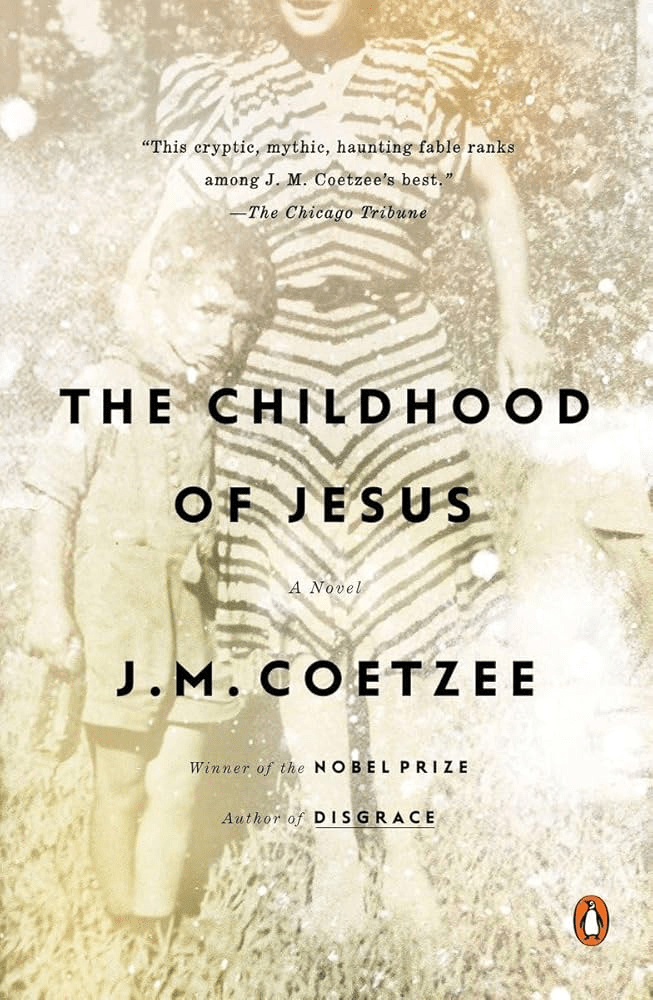
And then, for more than 30 years, I kept my eye on Coetzee and often thought I should pick up something again–I even bought a couple of his novels and put them on the shelf. I think I bought The Childhood of Jesus more than 6 years ago before I finally read it. It was worth the wait.
When I had writerly aspirations as a youth and I’d get stuck in the glue trap of writer’s block, I’d think of a myth or fable or religious story I’d learned as a kid and re-tell it in a different time and setting. Coetzee’s novel reminded me of that useful trick as it retells the story of Christ’s early years but with migrants entering an unnamed Latin country to start a new life. The child David is of uncertain heritage and receives the name David from authorities in his new home. He is guarded by Simon, who took care of David after he lost a letter explaining his presence on a passenger boat, and who resolves to find David’s mother in their new land. Later on other familiar characters emerge but with different names: Ines is the virgin mother, Juan is the Baptist, Magdalene and Anne and other saints and apostles emerge, drop hints about their roles, and disappear.
David speaks and writes his own language, has his own ideas about how the world should work, and struggles with authority and limits on freedom. He learns to read from a child’s version of Don Quixote’s adventures, and cannot abide the idea that Quixote’s story is only in Quixote’s head, and that others around him see the same events in different and more mundane ways. He has mystical visions about numbers and their true meaning and sees people as tiny insects trying to be visible to him as he soars above the world. There are hints that Coetzee wants to underline the merging of early Christian thought and Greek philosophy and the knowledge and symbology of esoteric wisdom schools (for example, a Micky Mouse cartoon features Plato instead of Pluto as Micky’s canine companion). David’s revolutionary pedigree is underlined by his own dog’s name: Bolivar.
The expectations of the society in which David finds himself are too constraining and when the authorities determine he should be placed in a reform school the family of David flee to start a new life.
I enjoyed it so much that now I’m bound to read the rest of the Trilogy (or is it a Trinity?). Of course, it may take me another 30 years to get to the next volume.
I’ve been lax about posting lately; things are chaotic and our schedules have been packed with events and tourist rentals and visitors and animal care, then we went to Spain for a few days. So here are some rapid-fire blurbs about books I’ve read lately.
Written in a charged “hair-on-fire” tone, They Knew by Sarah Kendzior will raise your hackles whether you agree with her or not. It’s a book about conspiracy theories which notes that conspiracy theories are quite often true but are labeled conspiracy theories to make them seem crazy or loony and unworthy of your attention. She provides many examples of actually true and demonstrable conspiracies which have been lampooned or ignored in the press, which is guilty of aiding and abetting a long-standing conspiracy by major corporations, billionaire oligarchs, and DC politicians and insiders to undercut the rule of law and drain the USA dry. When your own government has become a self-policing criminal enterprise, what remains to be done? She notes that January 6 was a surprise to no one, and there were warnings from many sectors about its imminence and possible success which were shrugged off by the mainstream media until members of Congress were hiding in locked closets from a rampaging mob of deranged people who had been misled by well-funded conspiracy theories hatched in propaganda labs as part of a vast and ongoing conspiracy to delude Americans. Read it and weep.
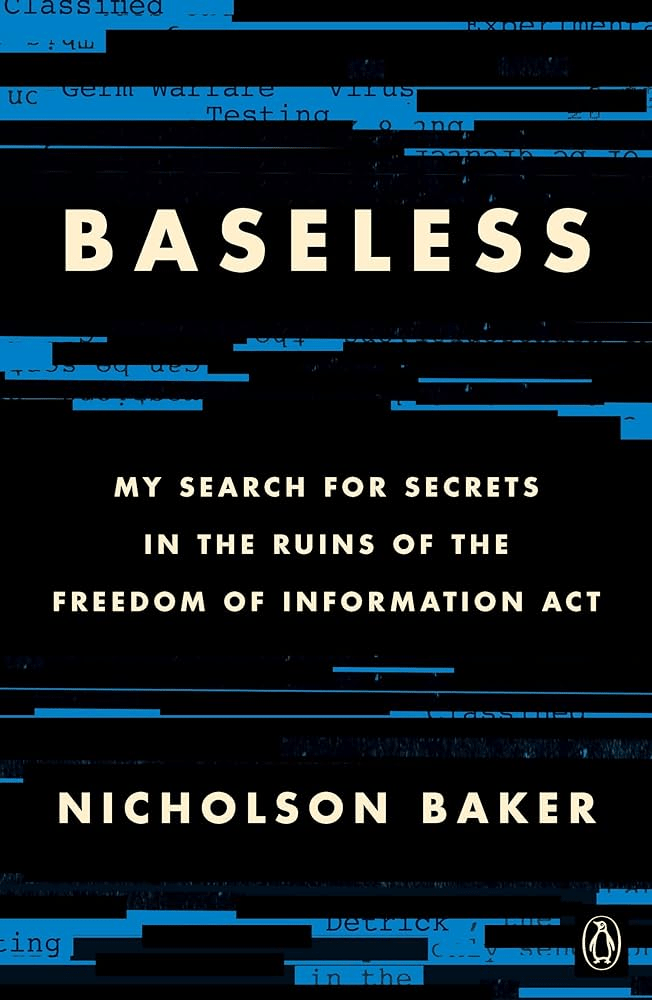
And, speaking of conspiracies…I’ve read and enjoyed a few novels by Nicholson Baker, including the hilarious and randy The Fermata, as well as his breathless Checkpoint, about a conspiracy theorist who is so frightened by the unreal realities of the George W. Bush presidency that he imagines assassinating the then president in all sorts of nutty and creative ways. But this book is not a novel; Baseless delves deeply into the idea that the United States recruited Nazi and Japanese war criminals who helped develop biological weapons which were secretly used against North Korea, and that the intelligence agencies have hidden this history away in classified documents which are rapidly disappearing. Baker shares his frustration with the CIA’s often total disregard of Freedom of Information Act requirements, and he documents documents which have disappeared from their folders and which are redacted to the point of complete insensibility despite legal requirements that they be freely available. His conclusion is that the government is not protecting “sources or methods” but rather high crimes and misdemeanors. Like Sarah Kendzior, Baker notes that people in power and in the media scoffed absolutely at the idea that the USA would ever use dreadful weapons of this sort, and yet from his research and many testimonials it seems that the USA indeed did use them.
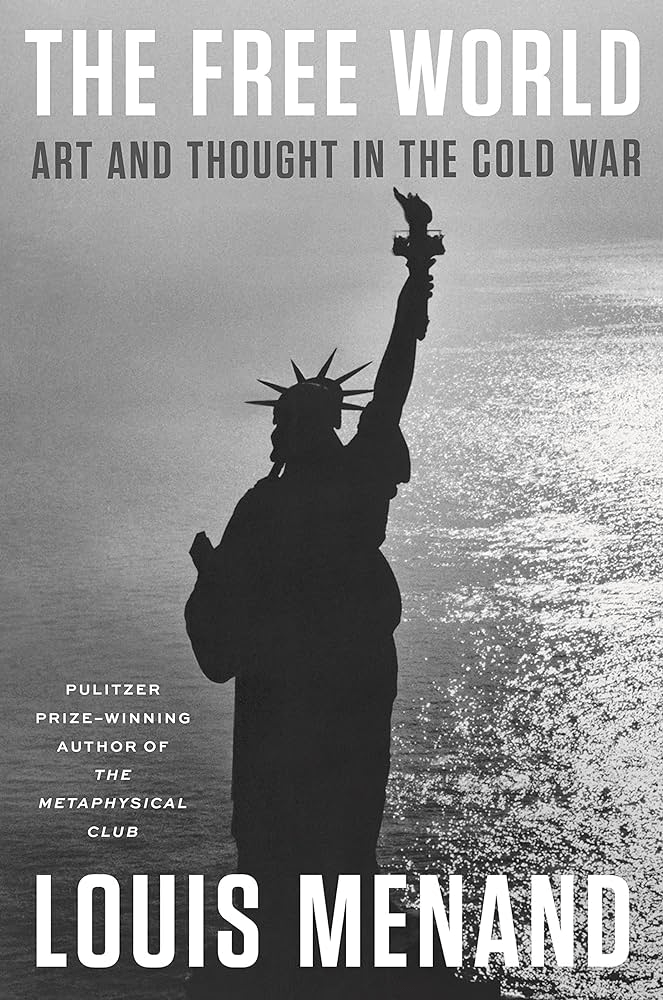
About 30 years ago I remember hosting a book signing and discussion with Mr. Menand at the Borders Books & Music just north of Baltimore in Towson. At the time he had published The Metaphysical Club, and though I never read that book I did attend the discussion. In The Free World, which I read periodically over a half-decade, Menand delves into intellectual, literary, critical, and artsy trends poinging back and forth across the Atlantic between Paris and New York during the height of the Cold War. There are chapters about popular music and trends in visual arts and art criticism, chapters about film, chapters about writers and editors. There are also some revelations about the CIA secretly funding publishers and certain writers and intellectuals and even founding journals, which Menand shrugs off as no big deal, because the Soviets also funded such stuff. But, I’d respond: the West always claimed to be a free marketplace of ideas, not a marketplace where some ideas received covert funding to place them in the forefront of mainstream media coverage and public discussion. Menand shrugs off US interference in elections in France and Italy as part of the game, and his take on Vietnam seems a bit shallow. But I rate this book highly nonetheless as an interesting examination of creative and intellectual trends at a time when many people thought we were going to blow ourselves up.
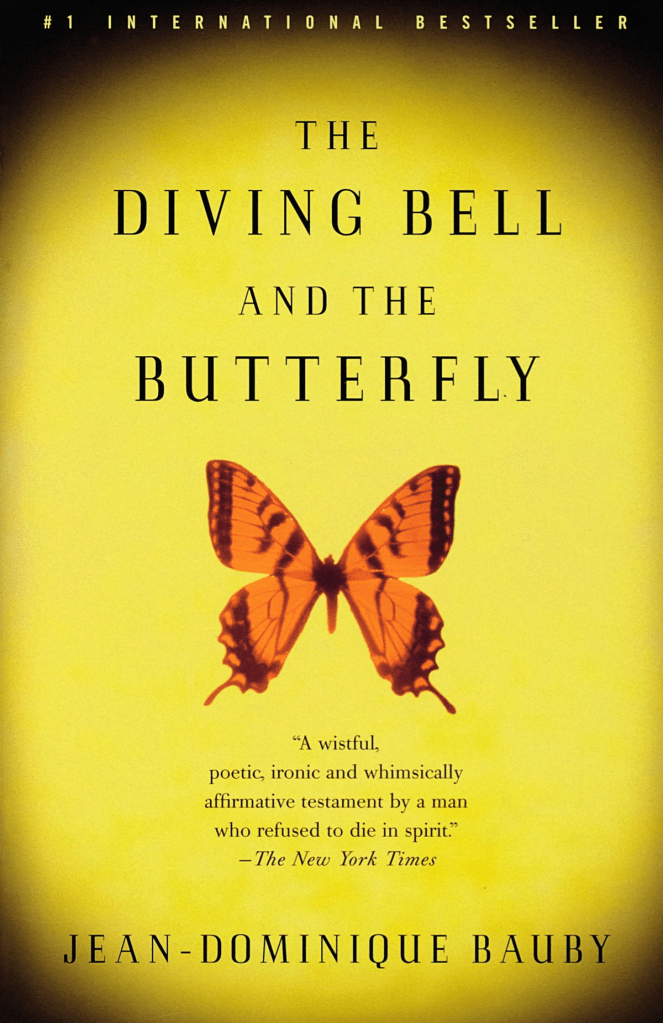
Beautiful, tender, deeply melancholic, and yet also surprisingly funny at times. What happened to Mr. Bauby was simply awful. How he processed his tragedy in this short elegant book, written by blinking his eye a letter at a time as he lay paralyzed in a hospital bed, deserves our awe.
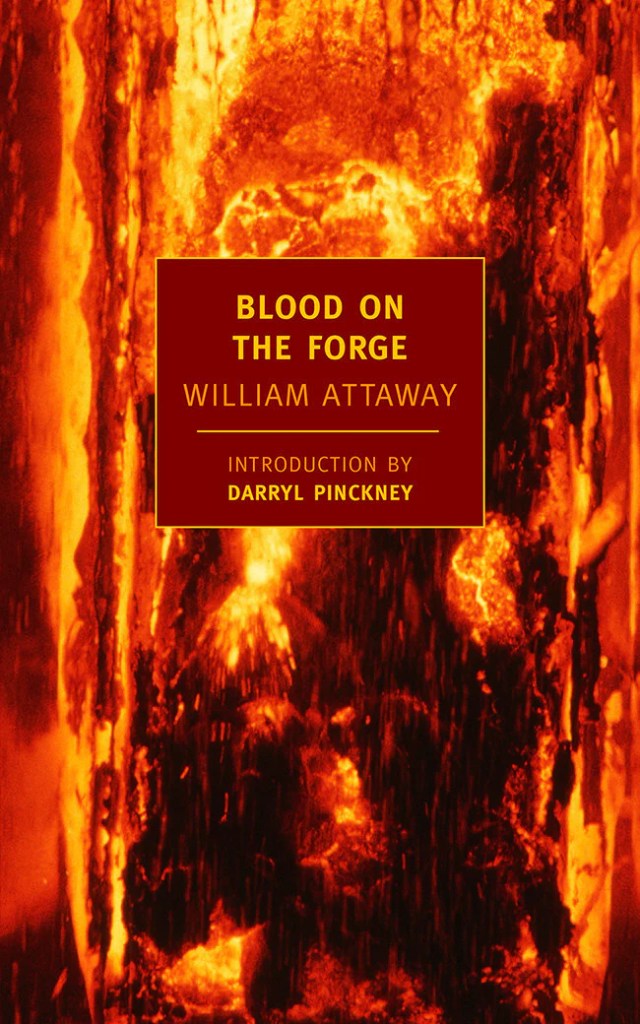
Sometimes going through my own bookcases is like browsing a great used bookshop, and a volume pops out that I didn’t even know I’d purchased. Ironically, William Attaway’s Blood on the Forge was a book I was searching for several years ago without knowing it and I had it all along.
When I was a teacher in Baltimore City Public Schools I was imagining a Great Migration unit starting with an image exploration and analysis using Jacob Lawrence’s Migration series as a starter. It was a fave tactic of mine to start units with images and to teach kids how to make inferences, ask deep questions, interpret, connect to previous knowledge, make predictions, etc before even learning about the topic of the unit. I never wrote that unit, however, because the Lewis Museum in Baltimore had a show of Jacob Lawrence which included works featuring Toussaint L’Ouverture and John Brown and Frederick Douglass and Harriet Tubman. After seeing that show, because I already taught units about Brown and Douglass, I took the Jacob Lawrence idea and tacked it onto those units.
Another reason I decided not to create the Great Migration unit was because I didn’t have a meaty novel-length text to use. And yet I did have the perfect one–and didn’t realize it until I lived in rural France in the 2nd year of not being a teacher. Oh well. There is probably a bit too much prostitution in the novel for 8th graders anyhow!
William Attaway is unfortunately not well-known, though he had a profound cultural impact. Until I read his novel and its fine introduction by Darryl Pinckney I was unaware that Attaway wrote the “Banana Boat Song” for his friend Harry Belafonte. He also influenced Richard Wright and Ralph Ellison, who both knew him and read this searing white-hot novel. (Side note: Darryl Pinckney has a fine article in the current NYRB about the Harlem Renaissance, and Attaway was apparently an indifferent and bored school student until he read a poem by Langston Hughes and found out that Hughes was Black, at which point he devoted himself to writing).
So, Blood on the Forge–talk about going forth and forging in the smithy of his soul the uncreated conscience of his race! This is an incredibly vital document of an important era in US history, the great movement of Black laborers from the South to Northern cities as the industrial revolution took off. Attaway, who was a middle-class son of a teacher and doctor who himself migrated as a child from Mississippi to Chicago, weaves in all the complex societal strands into a short elegant and harrowing story. You’ve got urban/rural, White/Black (Slav/Irish), union/scab, capitalist/socialist, agrarian/industrial, modern/traditional. There is enormous violence and powerful interests interfere in everything to protect what they regard as theirs, and the fates of three sharecropper brothers who are recruited and taken north to Pennsylvania to the steel mills herald prophetically the racial and class tensions to come. HIGHLY recommended.
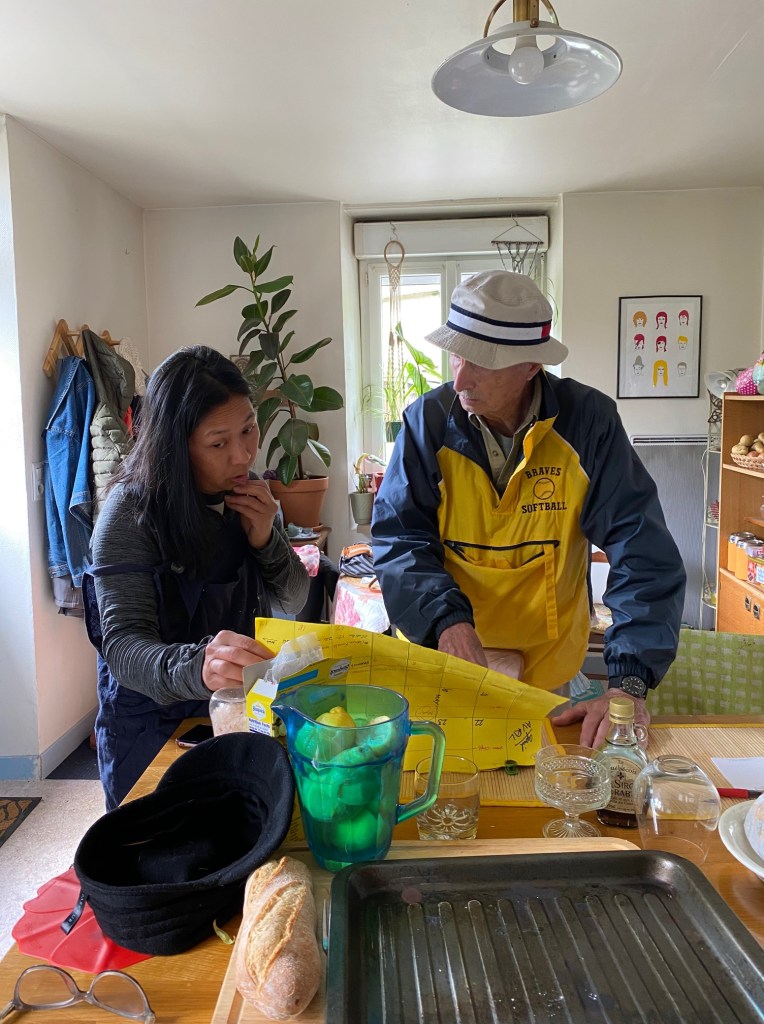
Cliff came ambling down Route de Gueret from the Brasserie, encumbered by three sacks and a backpack. We noticed him first because the dog stood to attention and her hackles rose, but Pat got there in time and the dog rolled over and showed her neck upon noting her lady’s displeasure. Cliff was allowed to approach with no danger to his ankles or eardrums.
As he got closer I realized who it must be. Cliff had contacted me weeks earlier via Google, where he found our website and sent me a message in French. From the grammar I could tell he was a confident speaker with a pretty good knowledge but was certainly not a native speaker, and after seeing his name I thought he must be a Yank or a Brit and I replied in English to the chat.
Cliff had requested lodging for two and a half months, he wasn’t sure when exactly, and he could only pay 25 euros per night because he was retired and on a budget. Of course that’s less than half of what we charge per night for our small studio rental! I told him I would need specific dates and that we already had bookings all over our spring calendar for both apartments, but I would send him some suggestions nearby. After a few back-and-forths via Google he said “well I’ll just come to Treignac around mid-April and we’ll figure it out.” I warned him that Treignac was out of the way and he should reconsider, and he replied that he’d been coming to France for 20 years, often simply showing up and finding a place to stay. His intention was to do so again. “I can camp in your garden if that’s OK.” Then I didn’t hear from him for a while and thought he’d given up.
I was immediately struck by Cliff’s age. I’d assumed he was early to mid 60s, but he’s actually 88 years old. To get to Treignac from his home in Kansas he’d flown to Texas, thence to London, thence to Paris, where he caught a train to Clermont-Ferrand, then a bus to Meymac, and in Meymac he hitch-hiked outside the Renault dealership without luck for several hours. Then he asked the Renault dealership for a piece of cardboard with which he made a sign. Immediately a woman picked him up and drove 26 km out of her way to bring him to town. Unable to find us via GPS she dropped him at the Brasserie next door, where the proprietors directed him to walk across the bridge. I’m almost 55 and that trip would exhaust me! While we had coffee in the kitchen our Frenchie Bou went out on the porch where we’d stowed Cliff’s bags, and a minute later she proudly marched through the kitchen with something in her mouth–an adult undergarment she’d pulled from his backpack pocket. Poor Cliff took this in stride and was more amused than mortified.
We had a bit of a scramble at first. We put Cliff up the first night but had guests checking into both apartments that weekend. So we moved him to a friend’s pilgrim hostile apartment for the following two nights, then back to us for two weeks. Now due to a previous reservation he’ll have to leave again, but we got him situated in a nice studio apartment in a rejuvenated vacation village at the top of town. They can accommodate his budget and host him for the next 2 months. He needed a spot where he could walk to town and to the grocery, and Domaine de Treignac fit the bill.
Cliff says he retired at 39 after making a mound of cash in the PR industry in Pittsburgh and NY and California, but then drank his money away. After sobering up, on $1200 a month social security he managed to save enough to do shoestring world travel a couple months a year by hitching and camping and relying on the kindness of strangers (one time he was adopted by a French actress and stayed at her place in Aix en Provence for two years).
Cliff has been everywhere and remembers dozens of small French villages, including many surrounding us in the Correze and Le Lot and in the Perigord and Dordogne. Of the villages we’ve both visited his memory is far more reliable than my own. He’s a vet who spent a few years in Seoul and when he told me he was an old Boy Scout I told him to help any ladies in town across the street. He said “I surely will, and right into my bed!”
We won’t make much money from Cliff’s stay because it’s been cold and he’s using the electric radiator. Even with the solar panels electric is very expensive. But it’s been amusing to hear his stories and see him each day and help him out with logistics. He’s always asking if he can do odd jobs or work in the garden, and when I say no he takes a stool and his kit into town to sketch and paint old houses and walls. Last night he emailed me a play he wrote about Marx, Carlyle, and Dickens.
A friend kindly leant me this. I often refuse to borrow books because I like to read my own copy and put it on a bookshelf for decades after. But I’d read and really enjoyed Shadow of the Silk Road, and I’m a (very) small business owner trying to live more frugally than when I was a lavishly funded public school teacher in the USA (LOL). So I accepted it (and three other excellent books she kindly offered).
Ostensibly, this is a travel book, and it does indeed recount a truly remarkable voyage to a particularly special and demanding destination. But this is actually a book about grief, and it’s the best book about grief I’ve read since Joan Didion’s The Year of Magical Thinking. Though the family members grieved by Thubron are present for less than 10 pages of the 220 in the book, they haunt its passages about Nepal and Tibet like the dakini spirits he describes.
Of course there is no better country than Tibet in which to devote a mournful pilgrimage and to explore loss and impermanence. Turbron describes the destruction by artillery of several ancient monasteries and the smashing of others by hand during the Cultural Revolution. He meets many people who have their own griefs about family and displacement and the Himalayas become a resonator for sorrow. Many practitioners of Tibetan Buddhism have been displaced by state terror or official exile. And yet the Hindu and Bon and Buddhist pilgrims still come and do their circuits of Mount Kailas. Thurbron does his as well, but finds little comfort in the astonishing myth-enshrouded terrain, birthplace of the Earth and abode of the gods and demons for several religions.
I adore the NYRB re-issues–high quality paperbacks with great cover design and kick-ass introductions
When it comes to fiction genres, I’ve got my faves. As a young dude those were horror, sci-fi, and fantasy. Over the years I drifted away from all of these only to check in now and again on the hot new thang. Occasionally I’ve dabbled in mystery/thriller stuff, but never have I been a reader of Westerns (unless one includes Cormac McCarthy in that category).
I bought a remaindered copy of Warlock probably 20 years back and only just pulled it down off the shelf. Glad I did, because it’s a banger! Like Clint Eastwood’s Unforgiven it’s a rather sophisticated deconstruction of the myths associated with the American West and gunslingers and cowboys. The hero of the story has a morally ambiguous past and when hired to be Marshall of Warlock struggles with the ethics of his situation. Is he a murderer for hire, or a representative of law and order? What is a government other than an agency dictating behavior via the threat extreme violence? Can citizens have a sense of peace and freedom without a killer to back up those ideals? How is a hired gun who kills to keep the peace different from a blackguard who kills to take money from a stagecoach?
The novel features some historical figures and also transposes mythic characters from the OK Corral into thinly disguised avatars. There are IWW prototypes working the mines and rebelling against brutal treatment, there are cross-border skirmishes between cattle rustlers in the US and Mexico, there are Apaches, there is the US Cavalry and a half-crazed senile general. Whores, saloon keepers, merchants, deputies, judges, and rugged outlaws eek out a living in a land where law is dictated by force and mob rule. There is the outlaw turned deputy who, like the hero, tries to do the right thing but cannot always navigate the complexities of the myriad relationships and power struggles. And there is revenge; a LOT of revenge.
The novel surprised me often by subverting standard genre tropes familiar from TV and film. The writing was elegant and Oakley Hall created engaging and multifaceted characters and situated them in an intricately detailed setting.
My one critique involves a love scene which descends into bodice-ripper cliché. But overall I thought Warlock was excellent and it pulled me inevitably to its satisfying conclusion. Thomas Pynchon called it one of America’s greatest novels–it’s certainly better than anything he wrote (excepting perhaps The Crying of Lot 49).
When Roma came out a few years back a twenty-something colleague said he spent the entire film bored and wondering when something would happen. I had a completely different reaction to that film, and thought it was a miracle how much happened in 2 hours and 15 minutes.
So, take this as a warning. Jeanne Dielman clocks in at over 3 hours, and if you prefer CGI action films or comedies this will absolutely not be the movie for you!
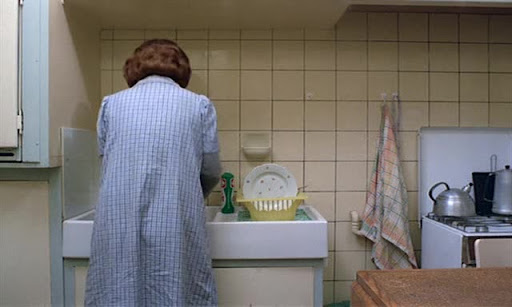
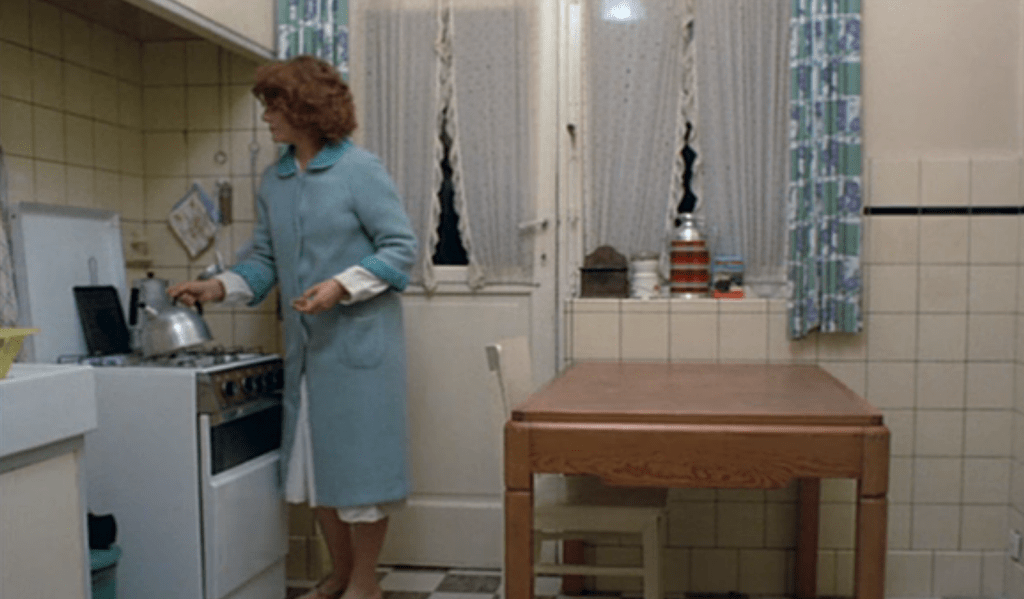
The first hour focuses on Jeanne Dielman in her daily routine. We watch the steps to her day and the way she manages tasks and it is evident from every scene that these are well-rehearsed and routine activities, and Jeanne is a marvel of efficiency. The way she folds, her fussy insistence on maintaining a tidy and immaculate living space for herself and her teenage son, her industrious and thrifty mannerisms–all reveal a woman enmeshed in the oppressive values of “woman’s work” and “mother’s duty.” She has honed and practiced her approach to preparing coffee, making dinner, cleaning, doing laundry, and converting her living room into a bedroom for her son each night, and the camera rarely moves as we watch Jeanne do her chores like an automaton. Which, of course, is what women even in wealthy “advanced” nations have often been reduced to in the past, and sadly movements like MAGA in the USA hope to bring back this state of affairs.
In the afternoons, between starting potatoes for her son’s dinner and awaiting his return from school, Jeanne has a small window of time where she takes clients as a prostitute. As a widow trying to maintain a bougie lifestyle for her son the implication is that she has no choice. Like all her tasks, there is an aloof practiced routine to these interactions. We only see the arrival of her client and his departure, and then the bathing and clean-up process Jeanne goes through after the visit. Then, her earnings are saved in a large soup tourine.
You may get restless watching Jeanne do the dishes for 20 minutes, or watching her bustle from room to room always closing doors and turning off switches and putting everything back where it belongs. But it is important to the film and its themes to see how Jeanne spends her day and how carefully her time is managed because on day 2 if you are watching closely you may notice things going awry very subtly. A dropped polish brush, a dropped spoon, potatoes overcooked and untidy hair. An undone button. These very subtle hints really add up and caused me a creeping anxiety. Jeanne is in absolute control of her activities and her life for a reason–because there is a burbling turmoil inside.
Her interactions with her son are quite frustrating to witness, for reasons you’ll understand if you see the film. Jeanne’s life even as a widow is wrapped up completely in satisfying male needs and making life easier or more pleasant for males. Only rarely do we witness Jeanne enjoying herself or experiencing a rich aesthetic moment–while knitting a sweater for her growing son, she becomes oh so quietly enraptured by a Beethoven piano sonata, and though she continues to work she is expressing some internal state, something trying to burst free.
When the coffee comes out wrong, when a missing button on her son’s coat proves impossible to replace, when a pair of scissors is not returned to its proper place–all these small details lead to an appalling finale full of resonance and open to interpretation. More viewings are required to piece together what actually transpires because though it’s quiet and subtle there are many small things happening in the last 15 minutes and I had oh so many questions.
So I can’t recommend it enough, but to endure it you have to be the sort who enjoys dense, beautifully edited and acted long-ass art films. It’s brilliant and revolutionary and tedious all at once. It jumped two years ago to number 1 on the BFI list of greatest films of all time. I might argue that there are better films, but I certainly see why it’s a powerful contender. I must explore more works by the director Chantal Akerman.
She lives on Quai Du Commerce–the film manages to critique women’s traditional roles as well as the economic system which relies on poorly compensated women’s labor






 Mysterium Coniunctionis