Taikoza @ Moulin Sage

It was our great honor to host Marco Lienhard and his student Mark as Taikoza performed in our garden by the river. We’ve known Marco for more than 15 years, and he and musicians touring with him often stayed at our home in Reservoir Hill in Baltimore. To have musicians of this caliber perform in our garden for an audience of 90 people was quite special.

In my introductory remarks (in clumsy French) I tried to express that we host these events to share our garden space with as many people as possible, and hope to curate events which allow artists and audiences to forge connections. We actually met a man who lives in Paris but has a second home in nearby Veix because of this concert. He is French-Vietnamese and is a huge Taiko hobbyist, collecting drums and doing workshops for young people. He was so thrilled that Marco and Taikoza were performing in the Correze that he offered the use of his larger drum, and helped Marco carry it down to the garden and set up. Connection forged!

This was the third garden concert we’ve hosted, and by far the largest. It was the first time we charged admission and were able to give the musicians money, and a local Japanese caterer made and sold lovely Bento boxes which added substantially to the event.

Also, for the first time, we had a substantial number of French attendees–the previous concerts attracted a few but those audiences consisted mostly of Anglo-Saxon expatriates.

The evening was a huge success and we received positive feedback across the board. Excited audience members interacted with Taikoza during and after the show and asked about the drums and several T-shirts and CDs were sold.

Marco also performed on the Shakuhachi. He is an internationally recognized master of the instrument.

I must, however, address some concerns shared the next day by a friend who attended. I’ll preface my response by noting that this is an important topic and that I’m happy to have this conversation.

Concern “White Europeans should not dress in Japanese clothes to do such a performance. This is like white dudes who play the didgeridoo barefoot and think they are woke when they are actually appropriating and exploiting another culture.”

My response In this era it is common to assume that any white person performing music which is not of European or North American origin is appropriating another’s culture. Marco is of Swiss German heritage and his student Mark is American, so I can understand this assumption, and again raising this concern is important.

BUT, it is vital before making snap judgments to at least look at Marco’s biography. A “white dude barefoot playing the didj” likely learned to play the instrument betwixt snapping bong hits and most probably did not travel to Australia to study with an indigenous musician, perhaps deserving a bit of contempt. But Marco went to Japan and learned and toured Japan for 18 years with a famous Taiko group. Further, he attained mastery of various Japanese flutes in the traditional manner by studying in Japan with Japanese masters. He speaks and reads fluent Japanese and is deeply passionate and knowledgeable about the culture and history of these instruments and the music. It is his life-long mission and his career to share his knowledge and expertise of these art forms and this culture. In Japan he tours regularly and is regarded as a master musician and he performs regularly with Japanese musicians and in front of Japanese audiences. Any concerns that he is exploiting another culture are easily dismissed by a glance at his resume. Marco is hardly exploiting these traditions–he is a recognized master of these traditions, and has been a highly regarded teaching artist of these forms for decades with audiences around the world.

As for the costumes, they are a requisite part of the performance, and to perform this music in Western clothes–t-shirts and sweat pants or even suits–would be deeply disrespectful to the tradition and could not be advertised as a Taiko performance. Were Marco to do so it would actually be cultural appropriation.

I asked a Japanese friend who lives in Treignac and who was in attendance if she was worried that Taikoza was exploiting Japanese culture. Her response was simple: “This was a beautiful and authentic performance of Japanese music. I know many Japanese who go to the West and study violin or piano for years, and who perform Beethoven and Mozart around the world in Western dress. This is not stealing another’s culture.”

While it is important to raise these issues and have these conversations, we must not rush to judgment. We also must be cautious not to confuse cultural appropriation with cultural exchange. Artists of different ethnicities, cultures, nationalities have always traded ideas and learned each others’ music and instruments and traditions. They take each others’ art forms and are inspired to create new and evolving forms. Taiko itself owes heavy debts to Chinese art forms, from which it borrowed heavily and eventually evolved. In our quest to avoid exploitation and further colonial degradation, we must not stifle genuine work to promote cultural forms and to share them.

You can find links to Marco’s recordings for sale here

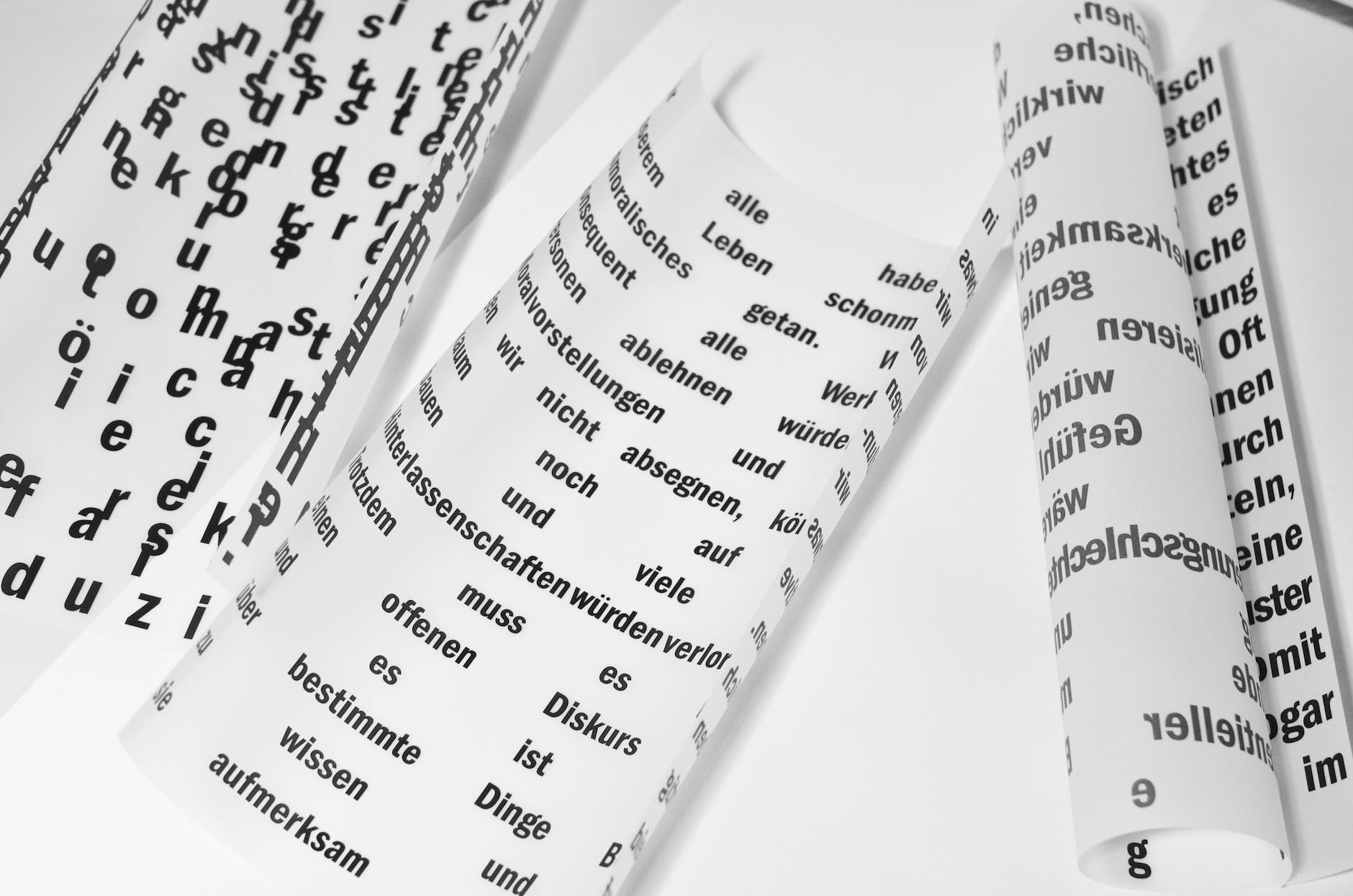
Tongue Tied

Photo by Skylar Kang on Pexels.com

After 13 months in France my confidence with the spoken tongue has developed reasonably well. I try to push myself to read French daily, to read literary French and also news media French. But I should listen more to the radio and watch television and films in French because my ear needs work–sometimes I simply don’t hear things correctly, and I need much more facility with he idioms and also the shortcuts French speakers use, their means of simplifying and contracting and making musical the language.

Also–I need to speak French more regularly with locals. I do speak to clients often but these are formal and simple interactions, well-rehearsed host-client stuff, typically very basic. Occasionally a client will have more complex questions, or will venture into questions about my origins or accent or how we ended up in remote rural France from the USA, and I’ll get to push my French a bit. Often I end up in these situations trying to remember the subjunctive form of a verb and stalling out. Nobody cares, however, about the subjunctive and I should simply throw the verb out in any form because the sense will be understood and that’s what matters more than grammatical exactitude and precision. I need the confidence to say something incorrectly rather than the confidence to speak fluently.

I was outside last week speaking to a gite client from England and a small white van pulled over. The driver said something to my guest but he did not understand, and waved me over. There was a woman at the passenger window nearest me. The driver asked from over her shoulder “Is there a store in this town which sells paint and paint supplies?”

I replied, in French, “Yes, there is a store called Brico, and it is about 800 meters up the road on the left at the circle.” The driver of the van looked at me and was a bit confused. Then I realized he had asked the question in SPANISH, not French, so I replied in Spanish as best I could and he smiled and waved and drove off.

It was a weird experience to understand his question and how to answer but to have not realized which language it was. For a moment I was in that zone where instead of thinking about language and response I was simply doing it. But in the wrong tongue!

Recently I’ve caught myself mixing Spanish into French again. At a local flea market yesterday a French woman asked how I was doing (“tous va bien?”) and I replied “Muy bien,” which made her laugh. I’ve also been saying “y” instead of “et” for and regularly–not sure why!

The quest for speaking and listening fluency I suppose will last as long as I’m here. I want to learn some German or Italian also to make things worse.

The Devil’s Eye

When I think of Bergman’s films it’s always the dour, troubling, magically shot despair engines which come to mind. Films where characters look directly into the camera and harangue the viewer with an uncomfortable scathing monologue about hypocrisy, some blunt sneering assessment of another’s faults, or a damning and unprovoked confession of immense guilt and trauma. Those films are so much fun!

And yet despite his reputation for making punishing and anguished films about tortured relationships and miserable empty interior lives, he could be quite funny. Smiles of a Summer Night, for example, is a delightful and light-hearted little romantic comedy.

And I’ve only recently seen The Devil’s Eye which I highly recommend. The plot: Satan develops a sty in his eye, and quickly he and his advisers realize that there is a young woman who is virtuous and intends to remain so until her wedding night. This fact causes Satan no end of annoyance, and he and his counselors hit upon a plan to divest Bibi Andersson of her virginity. They will send Don Juan from hell on a mission to seduce our heroine and thus remove her virtue and thence the cause of the Devil’s sty eye.

Hilarity ensues. My favorite bits are the scenes of Don Juan being tortured in hell. Knee-slapping!

Le Croix en Haute

This morning I had a To Do list, which I’ve been working through this week. I glanced at it around 9am, and looked at the weather forecast, and thought: “I’m not going to get most of this done before it rains anyway.” I did a bit of gite prepping for guests arriving tomorrow, I put a first coat of paint on my antique window greenhouse, and I hopped in the car to do a bit of site-seeing.

Just around Treignac and throughout the Correze are multiple layers of history: neolithic sites, Druid/Celt sites, Gallo-Roman sites, medieval ruins, Romanesque and Gothic churches and abbeys, painted caves, etc. We’ve lived here a year and have done some exploration, but it’s easy to get into a rut of “I’m working in the garden” and to forget one of the primary reasons we chose to live here: to see cool shit.

Today I drove 10 minutes over to the small village of Lestards. Sprinkled about Lestards in the forested hills are several medieval crosses–some dating back to immediately after the fall of Rome. I’d passed a small sign next to the main road several times which read “Le Croix en Haute.” Today I parked alongside the entrance to the trail and hiked up.

“En Haute” is an apt description. The hike was short–perhaps ten minutes, but it was steep. The path is an old rocky lumber road mostly overgrown and it runs directly uphill between pastures dappled in the typical French wildflower display.

There is on the left hand side a forest after a bit of a climb, and at the edge of the forest is a grove which feels different somehow from the rest of the landscape. One gets the sense immediately that this is a sacred spot, and likely was long before the Croix itself was placed, probably by monks desperate to convert the local pagans to Christianity by decorating their holy sites and sacred wells with crosses and saint’s names. The air is fresher and cooler in the grove, the loamy moss-covered earth invites one to move slowly and thoughtfully. The birds sing but they are less raucous than elsewhere. Whatever spirit or deity was originally evoked in long-forgot rites at this place still whispers around the trunks and amongst the grasses and flowers.

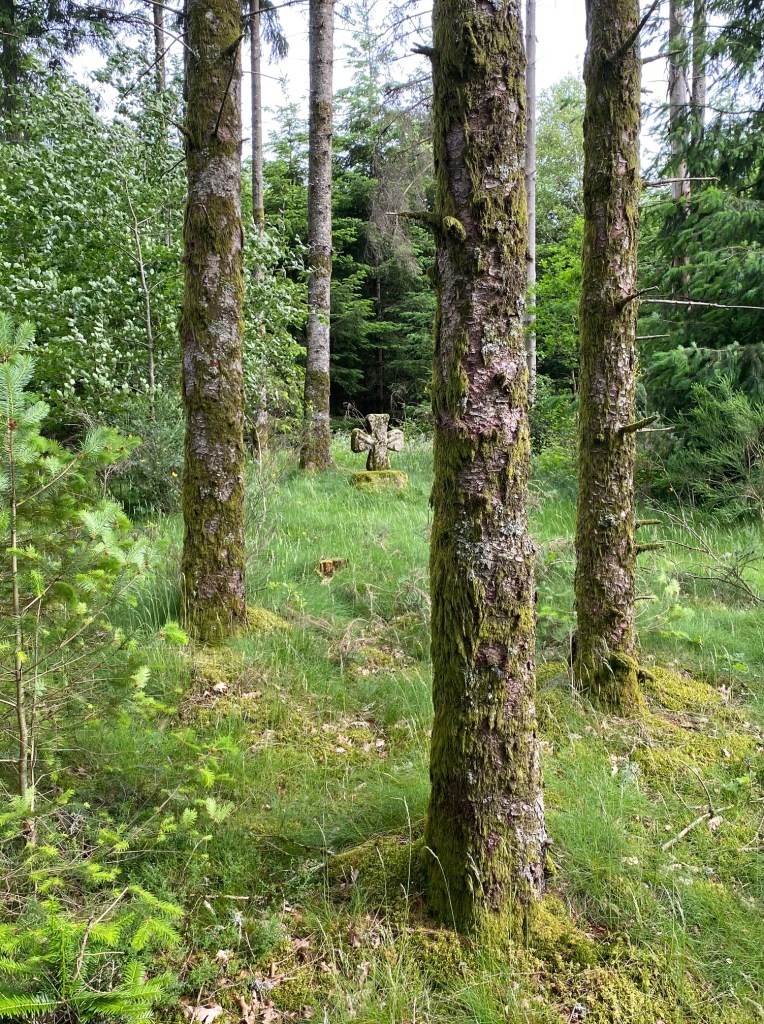
Le Croix en Haute from behind

But there is room here for the early Christian sentiment as well, and it pervades the spot with a more dense and contemplative mood in counterpoint to the brisk and playful fay. I spent a good 40 minutes at the site, examining the cross and its surroundings, then doing my daily Qi Gong routine at the grove’s edge. As I moved through the sequence of slow movements, village church bells rung 10 am–the first sounding deep and bronzy from Lestards, then a moment later from Veix somewhat tinny and a bit further down the valley. The long-stemmed flower varietals swayed in a strong steady wind up the slope from below, indicating an approaching storm. Somewhere above and behind a woodpecker did his tapping devotions .

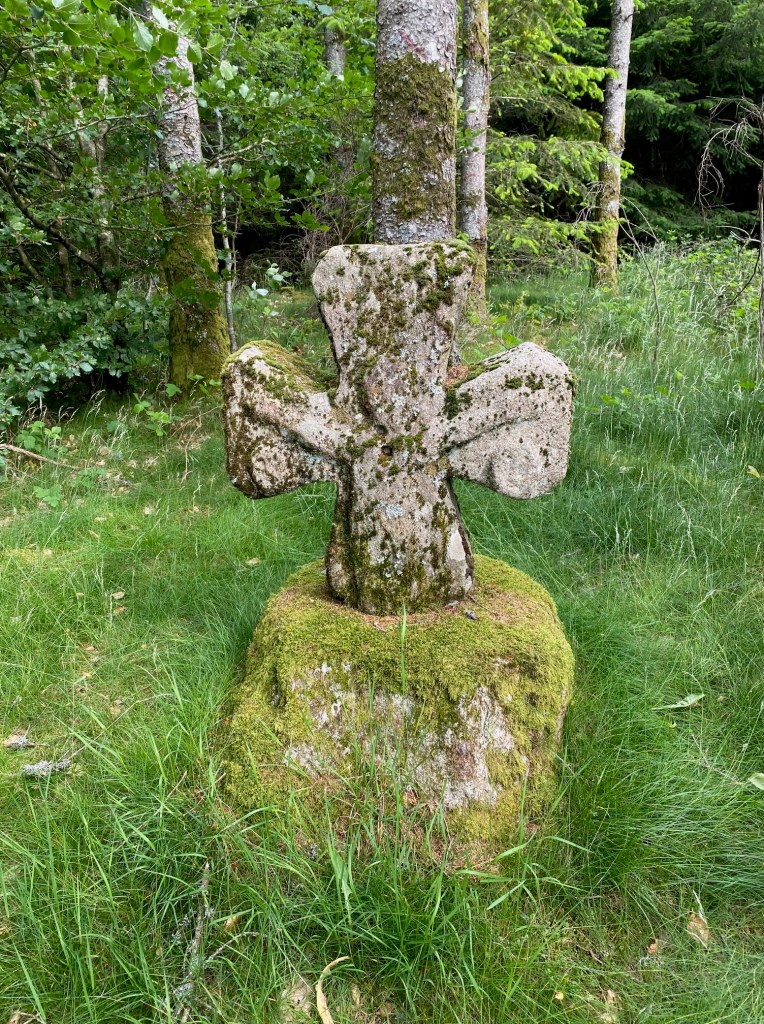
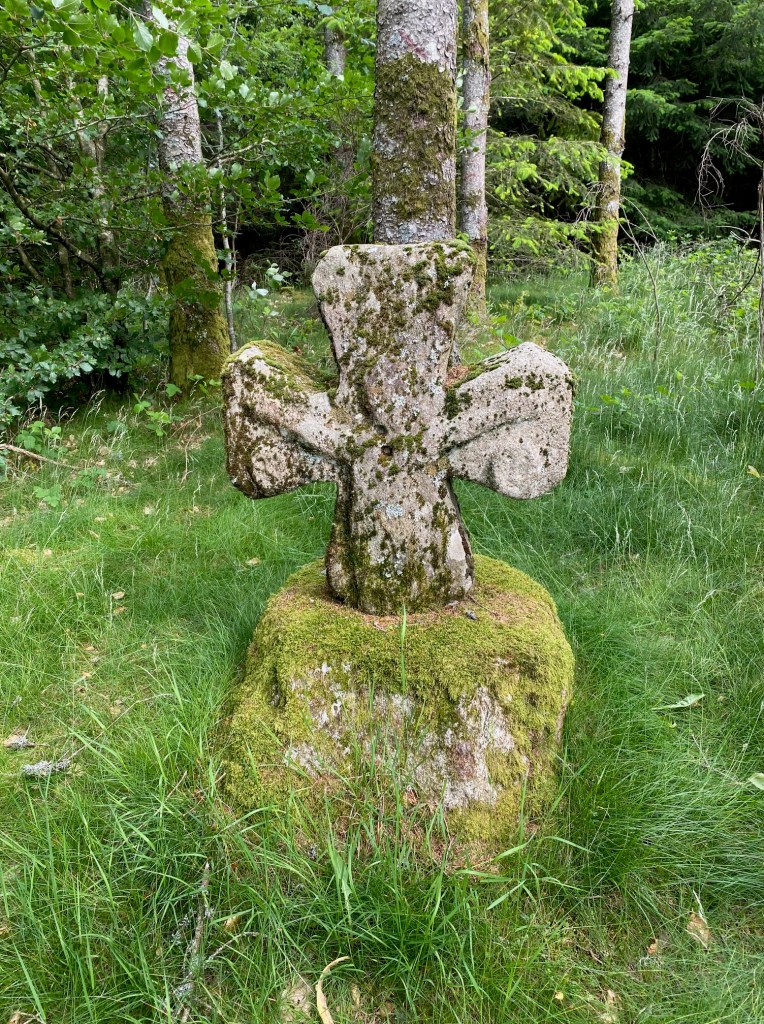
Christ on the cross is pretty clear in this rough carving, as are the faces of two others beneath his arms. Are they those crucified alongside him that day? Or witnesses to his execution? The two Marys perhaps, or Roman centurians? Were I to scrape away the lichen and moss on its base would I find any markings? Or spots worn smooth by the touch of generations of genuflecting seekers?

Definitely a mystical aura to this place

I imagine I’ll come here often over the years we spend in Treignac. It’s a very evocative place, and Lestards with its small thatched-roof eglise and spring water fountain is a favorite regular destination for us. I might later this summer or fall have to tackle the trail which hits several of these crosses around the village.

Down the Vézère

This weekend in Treignac there was a water sports festival. The local power company turned on the taps at the dam upriver from our house and let loose a torrent from Friday to Monday. Last year Treignac hosted the world kayaking championships, and does so regularly–but this year they hosted the championship trials. Our home is on a bend in the river and it was interesting to see how dramatically the water level and mood of the river changed behind our garden.

We signed up for a rafting excursion which started on the north end of town and wound around to the south end. Our total time in the raft was about 45 minutes.

My wife and I have rafted several times in the USA, and once on the border of Panama and Costa Rica. She got a group of friends together to join our team and after the typical safety gear and instruction period we were off.

Our guide was a bit adventurous. There is a small dam 300 meters upstream from our house which has a gentle ramp built in for kayaks and rafts. He told us “We are not going down the slide, we are going over the wall.” Quite exciting to take a 4-foot vertical plunge into churning foam!

The Barrage du Pisciculture at the end of our property–our rafting guide took us down over the wall!

It was lovely seeing our building from the water. The most tranquil part of the river floats around a slow bend which borders our garden and then goes under the Pont de la Brasserie, built in 1840. A friend was stationed at the wall to snap photos of us as we passed. Poor soul–she was originally a team member but fell and broke her arm a few days before the adventure and could not participate! We definitely owe her a bottle of wine for waiting so long at our place.

Photo by Kate Gratton, taken from our garden as we passed Moulin SAGE

I was pleasantly surprised by the course–I thought it would be rather tranquil and had no idea how choppy and full of attitude the water would be. There were a few really rugged spots of more than 100 meters and at least 3 substantial drops of class 3 or more. Fortunately our raft was equipped with foot straps or we would have lost crew members at different points. On one steep drop by a large outcropping we almost tipped over.

Photo by Barb Wigley, taken from her garden near the Vieux Pont, Treignac
Photo by Barb Wigley. “You two look like marauding Vikings in this one,” she wrote.

We got to pass under the medieval Vieux Pont in the center of town, and see the famous post card view of Treignac from a raft. My favorite spot however was seeing the Rocher de Folles from underneath. We’d done the hike to the outcropping previously, and got to see it from a different vantage.

It was quite an experience, and already we are looking forward to doing it again next year. Today is all about recovery after the strenuous workout–and also about cleaning up the gite apartment after a 5-man kayaking team checks out later this morning!

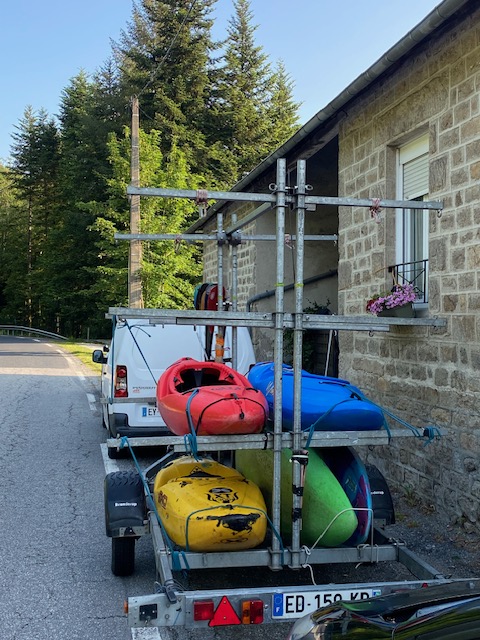
When your gite guests are kayak bros

Films

I’ve gone to the cinema for the first time here in France, and seen a wonderful Czech film from the 1960s, called Daisies in English and Les Petites Margarites in French.

I found it vastly entertaining, with a sort of relentless anarchic silliness propelling its basic storyline. Two disaffected young ladies decide to humiliate older men out for a roll in the hay, and they have a great time frolicking and pranking their way through the city and eventually the countryside.

The film’s use of color and prismatic effects, its clever montages and collage sequences, its peculiar cuts and crisp photography demonstrate a mastery of technique. Young director Věra Chytilová made a small miracle behind the Iron Curtain. Which, of course, was promptly banned.

While watching Daisies I had to wonder if John Waters saw this film–it features his sort of merciless energetic absurdity. There is a lot of food porn thrown in for good measure.

The film was shown in Uzerche at the Cinema Louis-Jouvet. The theater is sort of like Baltimore’s Charles with its art-house fare mixed in with big release horror and French and Hollywood releases. I had no trouble following the French subtitles except for the word vioc, which occurred twice, and apparently is argot for old dudes.

I’ve also watched Stalker on the MosFilm YouTube channel. They have several classic Soviet films and other arthouse fare available on high-quality streams with English subtitles. I was quite happy to note they had several Andrei Tarkovsky films I’d not seen.

Stalker puts the bleak in oblique. It is, like many of this maestro’s titles, a spiritual workout. You’ll feel like you spent a month in Gurdjieff’s labor program after slogging through nearly 3 hours in The Zone. It is harrowing and beautiful. Imagine Estragon, Pozzo, and Lucky no longer waiting for Godot but trying to find him/her/it/they instead.

Mother Nature

Back in the early spring I was cutting brambles and digging out weeds and noticed in the side of a steep hill on our property that there was a tiny bird nest.

Inside the nest were three very tiny eggs. In this part of France there is a law that one cannot cut hedges between March 15 and July 31 because of nesting birds, and I take this rule seriously. I pay attention to all the birds I see and like to observe breeding pairs and note where they hang out. This nest made me very happy because it was in the ground and easy to see when I walked up and down from the garden daily. The mother would often flit in and out as I worked nearby.

Last week I noted that the eggs had hatched, and I could see moving chicks in the nest. I didn’t stay to watch or examine because I didn’t want to cause anxiety in the mother, who I figured was close about and foraging. Again I was quite happy to see these babies and to think about nature and its small miracles. Often a trip to our garden is like an un-narrated David Attenborough special.

But shortly after I noticed the chicks had hatched, I found two of them on the cement path early in the morning.

I don’t know if they fell out, or were pulled out by a mammal, or if the mother had cast them out (which happens sometimes). I did hear and see a cat very early that morning on the other side of our building. One chick was completely gone, the other two were left behind.

How devastating! My entire day was colored by this discovery. I’d looked forward to seeing these little guys go through adolescence and thence into the world, ideally to return to our garden with mates to create future generations. I thought how cruel Mother Nature can be!

But of course Mother Nature is not cruel, she is indifferent and neutral. Can’t have yang without yin, after all.

I feel for the mother, who worked so hard! Hopefully she and her mate try again next year with more success.

Balzac

Pere Goriot took a while. I started reading it over a year ago as we prepared to move from Panama to France. I felt I needed to brush up my language skills, and had never read a Balzac novel.

The French was challenging at first, and I took it slow, reading a few pages a day. Lots of detailed descriptions, often quite flowery, with unfamiliar adjectives and colloquial expressions. Also, the use of the literary past tense which is not typical in spoken French was a bit difficult at first–I’d forgotten some of those forms.

But the last 20% of the novel I blew through quickly. I think my confidence in French reached a level I’d not had in 20 years, and suddenly I could breeze through pages instead of struggling and looking up multiple words.

It’s strange that when I got my degree in French Lit we did not read Balzac. Pere Goriot is a true masterpiece, a document of Parisian culture, a portrait of class divisions and the morals and ethical complications individuals faced when trying to break into the life of the glittering upper crust, or trying desperately to remain there. It’s difficult to say much without spoiling it–but Rastignac certainly learns a great deal about himself and the woman he ‘loves’ (or at least needs in order to ascend in society).

I would like to continue reading the Comedie Humaine, but must be selective. Perhaps Illusions Perdus and a couple others? I’m at the stage of life where I have to decide carefully what reading I want to accomplish, and what I would like to reread. I likely have a couple decades left and I already have 30 years of books I would like to read or re-read, LOL. And trying to complete reading lists in French and English, while hopefully adding some Spanish into the mix–makes me wonder where I’ll find the time.

And speaking of searching for time, I’d like to tackle Proust in French, and fear that might take up more than I have left!

Recurrent Dreams

I don’t simply have recurring dreams in the typical sense that narratives and plot events return again and again. I have rather dreams which happen in the same settings over and over. These settings change and evolve mysteriously over decades, and have recurring characters as well as themes.

Some Examples

A cove at an ocean beach. Was initially undeveloped, then had a house, then a small development. Most recently there was some sort of detention camp there.

An undiscovered wing of my childhood home. It’s impossibly large and far older and more mysterious, and is accessed through different closet or cabinet doors, or via the basement, of the “real” home.

An urban neighborhood of Victorian rowhomes with bars and frequented houses and alleys. The different bars often have the same regulars but sometimes I go to one and not the others, or to all in one dream. Often after the bars I retire to one of the friend’s houses. In these dreams, some friends from the real world arrive, but most of the characters are recurring dream characters, but the dreams are never the same. The bars and houses often change decor and remodel just as in real life, but remain recognizable. The regular customers often greet me as though I’ve been away for a long time.

The bookshop I worked in for 7 years in my 20s. I regularly re-visit it in dreams, and parts of it are closed off or have been reopened. Sometimes it is thriving and others near decrepit. The employees there are dream employees, never the actual colleagues I worked with. The employees have heard about me and my tenure in this place, or knew someone who worked for me or with me ‘back in the day.’

Schools and classrooms from a variety of teaching positions I’ve held. Often the school is unfamiliar from the real world but the classroom is mine, or vice-versa. These schools maintain their structure but alterations are made each time I visit.

Unconscious to Conscious

Often, I’ll have dreams in these settings for years, and life goes on in these dreams just as life goes on in real life. But many times I don’t remember these dreams or these settings when awake until one sudden vivid dream renders it all conscious, and then I’ll wake and have powerful memories of multiple dreams in this location going back many years. I’ll even note that certain characters in the settings have evolved over time, having matured, or aged, or been sick and healed, etc.

“Deep” Dream Settings

Sometimes my dreams seem to happen concurrently and at different settings at different depths. I used to dream regularly of a world that was a sketch of a place, where everything was black except for silver lines denoting walls and roofs and trees, where the characters were simply lights or silvery profiles. I always knew I had “gone deep” when I dreamt in this setting. But at the same time, a different component of my self would be experiencing a different dream, like a typical work anxiety dream.

The same feeling is associated with strange “temple” dreams I’ve had, situated in stone rooms with baths featuring Egyptian tiles. In such dreams I often found gems or minerals or plants emerging from my skin. These dreams are powerful and come from a place beyond the limits of my own experience in this lifetime.

I’ve occasionally dreamt of a room where several people who’ve been important comrades in this life voyage and I are seated and laughing–and in this dream I know we are all just finished one existence and are preparing/selecting our roles in the next existence. We are joking about who played what role and the decisions they made and their karmic consequences for that individual and the whole group next time round.

Recording Dreams

After a long hiatus, I’ve begun to dream vividly again, and have begun recording them in depth when I can recall them sufficiently. I always feel more alive and more creative and healthy when I have powerful and mysterious dreams. Grateful they are returning.