
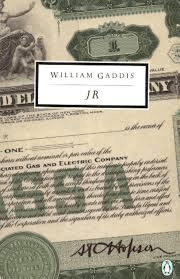
JR is the third Gaddis novel I’ve read, following The Recognitions (which I recently re-read with great delight) and Carpenter’s Gothic.
It took me nearly 4 months to read JR, but this was largely by design. I read multiple books at a time and decided back in the summer to limit myself to 10 pages a day of this behemoth, and there were many days where I managed only 5 pages per day.
It’s not an easy book. There are no chapter breaks, and the novel is about 99% dialogue (the last novel I remember reading which was virtually all dialogue was The Awkward Age by Henry James). Characters speak often without any identifying information other than what they are saying–it takes some time and effort to shake out who exactly the characters are and how they relate to one another, and sometimes it requires close analysis to understand who is speaking and to whom. Almost every bit of dialogue is interrupted by interpolations from other characters, or phone calls, or delivery drivers. Nothing internal about the characters is shared, simply their dialogue.
But the difficulties of JR are worth it. I laughed out loud repeatedly. Gaddis produced one of the great satires of American style capitalism, and managed it BEFORE American capitalism truly went off the rails and into the even more unimaginable excess and corruption we see now.
There are only a few settings in the book. One is the genteel house of an upper-crust family whose business is falling apart and being raided by their own attorney. Another is the principal’s office at a city elementary school, where corporations have been given free reign to test out closed-circuit TV and pro-business curricula. There is a bizarre small studio apartment where the tub and sink faucets are broken stuffed to the rafters with the detritous of corporate schemes and adverts which becomes the nerve center for a global corporate entity run by an 11-year old boy. There is the administrative office of the previously mentioned family business where the secretaries film pornographic videos off-hours. In every setting commerce and the concerns of big business and Wall Street rudely and repeatedly interrupt everything. Gaddis portrays the impossibility of having true human interactions in a system devoted to greed and the continual grasping after unnecessary objects. And the artist? There are several artists in the novel, including writers and painters and one very important composer. All of them struggle to survive in a system which has no values or meaning beyond acquisition and consumption.
The elites in predatory capitalism are exposed and lampooned repeatedly for their disgusting racism, their unwarranted sense of class superiority, their interference in other countries and in politics to maximize their own profits regardless of the cost to humans or the environment. Everything is commodified, turned into a packaged convenience and thence to trash which litters and chokes a rapidly burning down global order.
JR is a sixth grade boy who has become interested in the business world and builds a global empire despite his sheer bumbling incompetence. He manages it with determined chutzpah and lots of mail-order freebies. JR could be any number of “genius” billionaires currently ruining Earth who imagine themselves examples of superior evolution, when in fact they were born lucky and have a moral capacity beneath that of a sea slug.
Unlike the other Gaddis novels I’ve read and re-read and am planning to re-read, I’ll probably not read JR again. I can simply watch world events play out to see this plot in action.
 Mysterium Coniunctionis