
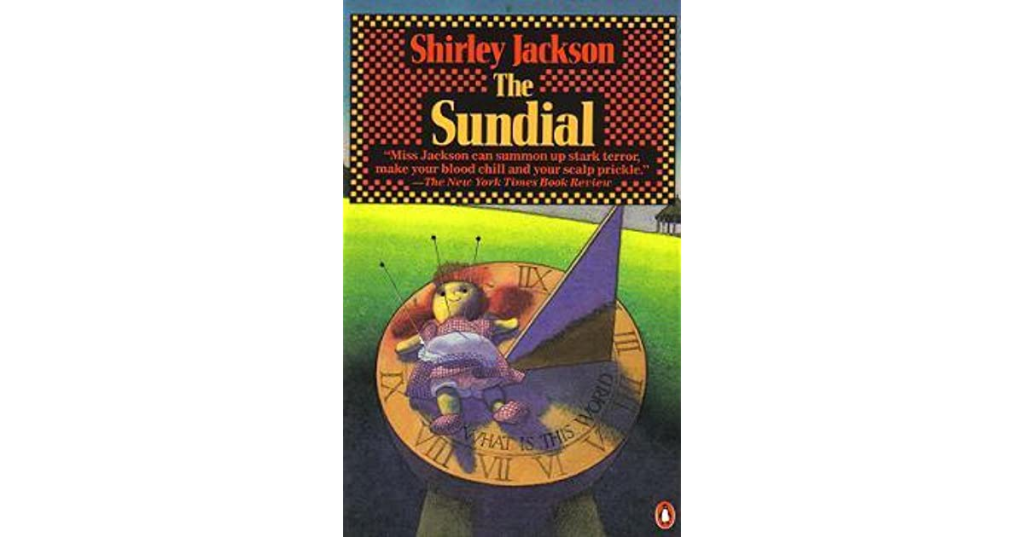
Shirley Jackson has the distinction of having written the novel I’ve re-read the most. As of last January I’ve read The Haunting of Hill House seven times. I’ve also read many of her short stories and the lovely and mysterious novel We Have Always Lived in the Castle as well. But for some reason my 1990s paperback re-issue of The Sundial sat on several shelves in several houses for a few decades before I got around to it this week.
I suppose I needed to wait until the collapse of civilization in order to fully appreciate the book. We’ve had several near collapses since I purchased The Sundial–Y2K, the end of the Mayan Calendar, various planetary alignments, wars, pestilences, George W. Bush elected twice–but something about recent events conjures more serious reflection on the End Times than all those others.
The Sundial is focused on the coming End of the World–or, more exactly, how people respond when they genuinely believe the End is nigh. The setting is a genteel massive manse in a New England town, built a generation previously by some fabulously wealthy businessman and currently inhabited by his two children and his grandson’s widow and daughter. The children are Mr. Halloran, confined to a wheelchair and in evident decline, and his sister Aunt Fanny. Mr. Halloran’s wife is still around as well, and is suspected by the grandson’s widow and granddaughter of having murdered his son by pushing him down the stairs in order to secure her own inheritance of the house.
Aunt Fanny one early morning takes a walk around the gardens she’s known since childhood, becoming somehow lost and suffering a potent vision of her father telling her the end is nigh, but that those inside his house will be saved to repopulate the Earth. What ensues is pure hilarity. Fanny shares her vision and somehow it becomes doctrine with all those trapped inside. They will be Robinson Crusoes and Noahs and Adams and Eves, left stranded to rebuild and repopulate.
As in every Jackson novel the characters are all delightfully awful and are skewered by her sharp sensibilities. The dialogue is funnier and better and more sophisticated than anything in Dorothy Parker, the wit makes Evelyn Waugh seem amateurish, and Dickens himself would have been awed by Jackson’s ability to lampoon class differences so efficiently. What took him 5 or 6 hundred pages takes her much less than 3.
I note that as we pass from Pisces and into Aquarius that the old gods have all lined up to watch our current collapse. The Planet Parade of late February/early March this year showed them all coming back to witness our decline once again into rebirth and renewal, just as the change from Aries to Pisces saw the cratering of all the great Mediterranean civilizations and the birth of new orders. In Jackson’s novel the end doesn’t matter so much as the way people behave anticipating it. And just as she predicted, they behave shamelessly and hilariously so–Buckle up, folks!


 Mysterium Coniunctionis