
When Roma came out a few years back a twenty-something colleague said he spent the entire film bored and wondering when something would happen. I had a completely different reaction to that film, and thought it was a miracle how much happened in 2 hours and 15 minutes.
So, take this as a warning. Jeanne Dielman clocks in at over 3 hours, and if you prefer CGI action films or comedies this will absolutely not be the movie for you!
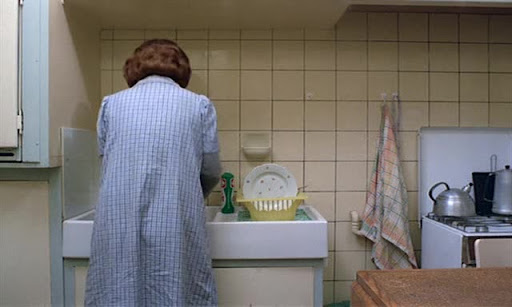
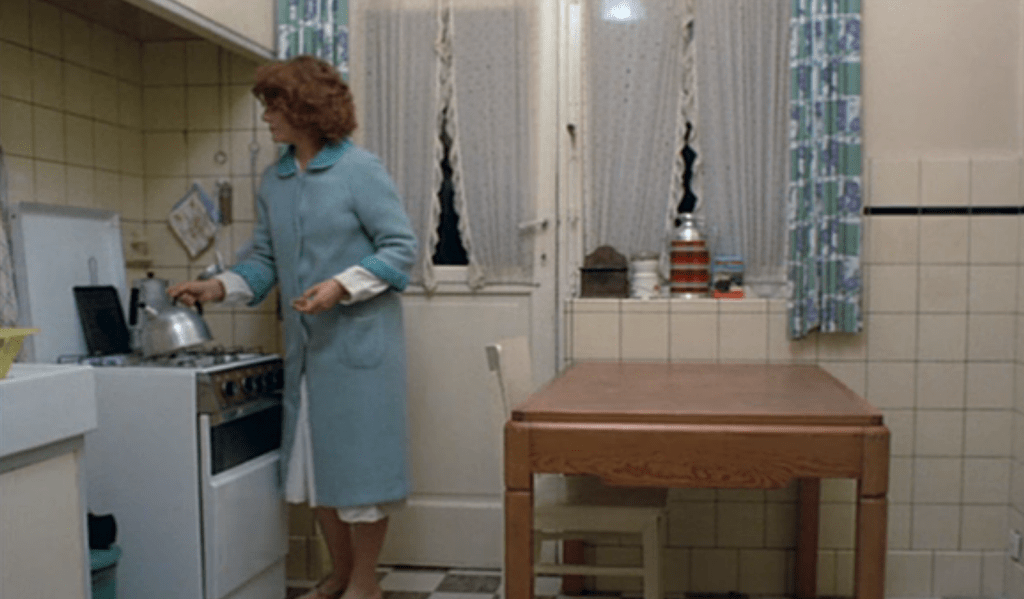
The first hour focuses on Jeanne Dielman in her daily routine. We watch the steps to her day and the way she manages tasks and it is evident from every scene that these are well-rehearsed and routine activities, and Jeanne is a marvel of efficiency. The way she folds, her fussy insistence on maintaining a tidy and immaculate living space for herself and her teenage son, her industrious and thrifty mannerisms–all reveal a woman enmeshed in the oppressive values of “woman’s work” and “mother’s duty.” She has honed and practiced her approach to preparing coffee, making dinner, cleaning, doing laundry, and converting her living room into a bedroom for her son each night, and the camera rarely moves as we watch Jeanne do her chores like an automaton. Which, of course, is what women even in wealthy “advanced” nations have often been reduced to in the past, and sadly movements like MAGA in the USA hope to bring back this state of affairs.
In the afternoons, between starting potatoes for her son’s dinner and awaiting his return from school, Jeanne has a small window of time where she takes clients as a prostitute. As a widow trying to maintain a bougie lifestyle for her son the implication is that she has no choice. Like all her tasks, there is an aloof practiced routine to these interactions. We only see the arrival of her client and his departure, and then the bathing and clean-up process Jeanne goes through after the visit. Then, her earnings are saved in a large soup tourine.
You may get restless watching Jeanne do the dishes for 20 minutes, or watching her bustle from room to room always closing doors and turning off switches and putting everything back where it belongs. But it is important to the film and its themes to see how Jeanne spends her day and how carefully her time is managed because on day 2 if you are watching closely you may notice things going awry very subtly. A dropped polish brush, a dropped spoon, potatoes overcooked and untidy hair. An undone button. These very subtle hints really add up and caused me a creeping anxiety. Jeanne is in absolute control of her activities and her life for a reason–because there is a burbling turmoil inside.
Her interactions with her son are quite frustrating to witness, for reasons you’ll understand if you see the film. Jeanne’s life even as a widow is wrapped up completely in satisfying male needs and making life easier or more pleasant for males. Only rarely do we witness Jeanne enjoying herself or experiencing a rich aesthetic moment–while knitting a sweater for her growing son, she becomes oh so quietly enraptured by a Beethoven piano sonata, and though she continues to work she is expressing some internal state, something trying to burst free.
When the coffee comes out wrong, when a missing button on her son’s coat proves impossible to replace, when a pair of scissors is not returned to its proper place–all these small details lead to an appalling finale full of resonance and open to interpretation. More viewings are required to piece together what actually transpires because though it’s quiet and subtle there are many small things happening in the last 15 minutes and I had oh so many questions.
So I can’t recommend it enough, but to endure it you have to be the sort who enjoys dense, beautifully edited and acted long-ass art films. It’s brilliant and revolutionary and tedious all at once. It jumped two years ago to number 1 on the BFI list of greatest films of all time. I might argue that there are better films, but I certainly see why it’s a powerful contender. I must explore more works by the director Chantal Akerman.
 Mysterium Coniunctionis