The (Oppen)Hammer of the Gods

Typically during a debate or argument I maintain my cool, and rarely get emotional even when provoked by claims I find distasteful or offensive. But last Thursday at dinner with friends I totally went off the rails during a debate about covid and vaccines and mask requirements. Perhaps it was the full Blue Super Moon pulling tides in my brain and causing me to lose it and show my exasperation? Whatever the cause, I regretted my display–which included repeated interruptions and a contemptuous tone and several loud “that’s not true” interjections. This behavior was disrespectful and atypical of how I usually handle such situations: listen quietly, seek to understand, and respond out of interest and love.

I was arguing that mask mandates and stay-at-home orders were perfectly understandable given the circumstances. Even ancient civilizations knew that when the pestilence came around it was best stay indoors until it passed. In retrospect we can see that some covid restrictions were too severe and perhaps even ridiculous (I had to sit behind a thick plexiglass wall at a desk while masked, for example, with a classroom of masked students present and the other half at home on the internet–definitely overkill). As for vaccines, I was all for them, and the idea that vaccines based on more than 40 years of laboratory research were “rushed” and were killing more people than the disease set me off. And when one friend suggested that covid was a hoax and not really serious and that hospitals were never overrun I went into the stratosphere. I heard a lot of “they’re saying” and “they know” arguments to which I kept responding “WHO, WHO says, WHO knows?” The evidence almost always was a slickly produced YouTube video, or a politician referring to one.

A friend said “I’m surprised you of all people would take the side of government agencies and defend Big Pharma.” This was a good angle of attack, and hit hard. But like Noam Chomsky, I see that there is a move underfoot by oligarchs and major corporations to undermine trust in public institutions because these are the only remaining restraint on the power of super-wealthy amoral elites whose avarice and contempt for law and ethics is having profound and perhaps irreversible impacts on not only the social fabric but perhaps the survival of humanity as a species. And like Chomsky, I know that even a long time skeptic and critic of government can realize that public agencies at least somewhat responsive to the will of the masses are the only brake we have on the continued destruction of Earth for profit. Yes, agencies like the FDA and CDC have been corrupted by Big Pharma and Big Insurance, but this is a simple tweak to fix by law. If the corruption comes from corporations, why blame the government agencies? Instead blame those who pull the levers and clean up the agencies with regulations about conflict of interest and ethics requirements.

Do I share skepticism of gigantic corporations like Pfizer and Moderna making billions of dollars from mandated vaccines? Of course I do. I don’t think medicines or health care should be for profit at all. I also respect suspicions that the vaccine was rushed, and particularly understand the reluctance of many people of color to get the vaccine given the long and sordid history of medical “experimentation” and abuse by authorities. But there is a great deal of wholesale quackery disseminated on the internet–remember how vaccines would magnetize your blood and make keys stick to your body? And a lot of the goofiness is given a veneer of scientific respectability by doctors who create videos on YouTube and get click/view money for saying unproven outrageous things to scare people to death (so they rush out and buy herbal supplements to counteract mythical side effects).

But I think a more important and often ignored moral and ethical question is why do these companies get all their R&D and testing paid for by public money and then they get to take government funded drugs and vaccines, patent them, make enormous profits from them while paying executives and stockholders huge dividends, while in turn they don’t even pay taxes. THAT is the real problem, and Big Pharma is certainly content to have people debating whether or not Dr. Fauci is a lizard being from the Pleiades or whether sheep medicine is a valid treatment instead of “why is the system rigged this way?”

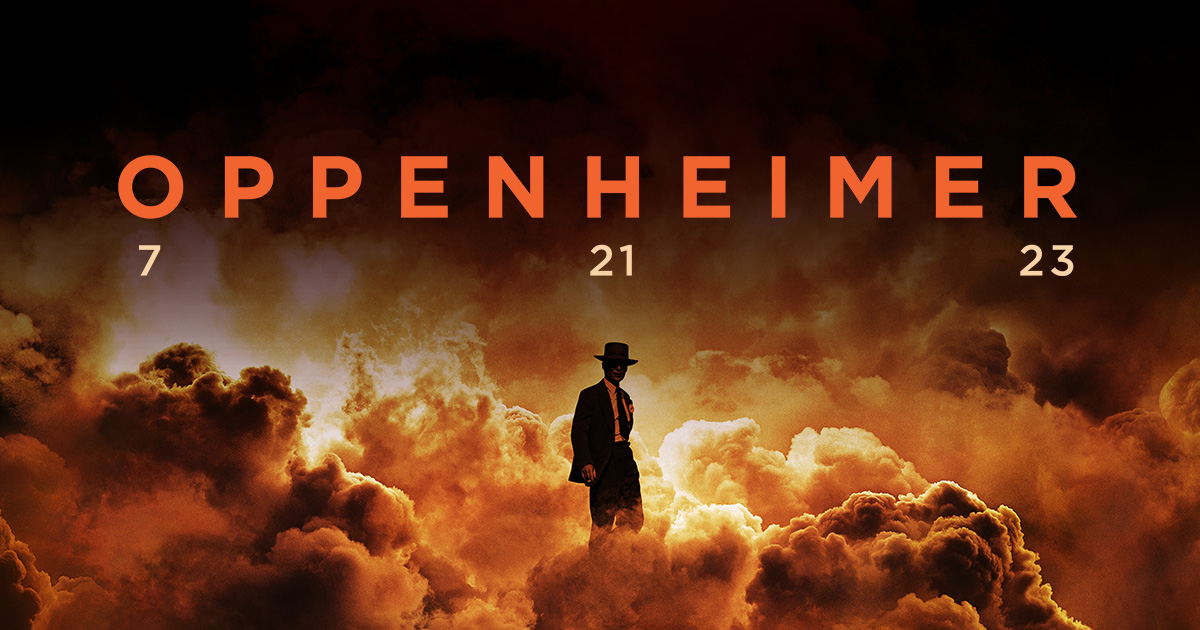
All of this is my roundabout introduction to having seen the Oppenheimer film. I thought it was a strong attempt to address a lot of the concerns raised in our discussion last Thursday about science and ethics and who decides what is right or wrong, etc. Should we get vaccines during a raging pandemic because scientists and government officials say so? Or, more in line with the themes of the film: Should we detonate a device which the government wants but which has a close to zero chance of igniting the atmosphere of the entire Earth?

Oppenheimer was of course a brilliant scientist, but he was also steeped in the humanities and was well-aware of the ethical considerations complicating his work on the Manhattan Project. The continual butchery on two fronts during World War II, the likelihood that Nazi scientists were themselves close to the bomb and could give Hitler an unspeakable weapon, the ongoing Holocaust–all of this provided enormous impetus to successfully construct a nuclear bomb and test it first. But Oppenheimer was also a literary-minded guy who’d read his John Donne and Bhagavad Gita. He was also a socialist flirting with communism and had profound doubts about what might become of the United States if it had this ultimate weapon. These doubts were of course later shared by President Eisenhower as he left office. And the film makes it clear that the second use of the bomb in Oppenheimer’s opinion was unnecessary overkill and was even more likely than the first to provoke a disastrous arms race–which proved correct. (Of course Paul Fussell would disagree that the 2nd bomb should not have been dropped on Japan.)

Oppenheimer is a massive film and will sap all your energies, but if you like dense character studies full of moral ambiguity and difficult ethical questions, you will dig it. In its scale and tone it’s reminiscent of Scorsese’s long films with their questions about ethics and violence (think Taxi Driver, or The Silence, or Raging Bull, or even Bringing Out the Dead). I think all the performances were excellent, and appreciated the use of a brief interaction between Einstein and Oppenheimer as a bookend to the plot. This is clearly Christopher Nolan taking his best shot at a Best Picture nod, and he might pull it off. There are of course problems with the film–after the excitement of the bomb build-up, it’s difficult to reset and endure the political persecution of Oppenheimer by right-wingers and professional rivals which goes on for another hour. But this part of the story also must be told. And yes, because everything else is thrown in, Nolan should have at least mentioned or shown what happened to the residents of New Mexico, largely Latino and Native American, before and after the tests, and though the horrors unleashed on Japanese civilians are suggested in a kind of panic attack hallucinatory sequence, I’m not sure it’s an adequate portrayal particularly given the thematic concerns of the film and its focus on the dilemmas navigated by Oppenheimer, et al.

One of my dinner conversation adversaries pointed out that we might not know the answers to many of our questions about covid and vaccines for many years. And, just like the atom bomb, Pandora’s Box has been opened and we live with the consequences.

Side note: nice to see Robert Downey Jr without a goofy super her0 costume!

Another side note: Twin Peaks The Return Episode 8 is still the pre-eminent cinematic exploration of the ethical questions around the explosion of the first bomb. In the Twin Peaks universe the explosion results in the birth of Bob, a demonic character who causes some chaos in the small town. Bob–Robert Oppenheimer? Or Bomb? Or, Bob’s Big Boy?

A further side note: I’ve recently been re-reading books which had a profound impact on me as a young person. One of these is a volume of science fiction stories edited by Harlan Ellison called Again, Dangerous Visions. I’d just read two stories in the volume which were not sci-fi, but rather fiction with science involved. These were by Bernard Wolfe. One was about a woman who takes her poofy expensive pure-bred dog to witness a test of napalm at a local military base. Her dog gets immolated in the test, which is so sad and terrifying for her and the other witnesses who fail to make the leap that this stuff will be dropped on actual human beings elsewhere. The other was about sleep experiments gone awry. But at any rate Wolfe’s accompanying essay excoriates sci-fi authors and the scientists they idolize. Further, he damns US-style hyper- capitalism and its “fawning upon scientists” while exploiting them and “their fake charisma.” He thought scientists exploited by capitalists were set to unleash profound and unforseable horrors on the world, and bemoaned the privileging of science over the humanities. Like Colin Wilson used to say, the “library faeries” will drop the reading material you need in your lap when you need it.
The Uncanny

(note: I began this post in Panama nearly two years before re-discovering it and completing it in France)

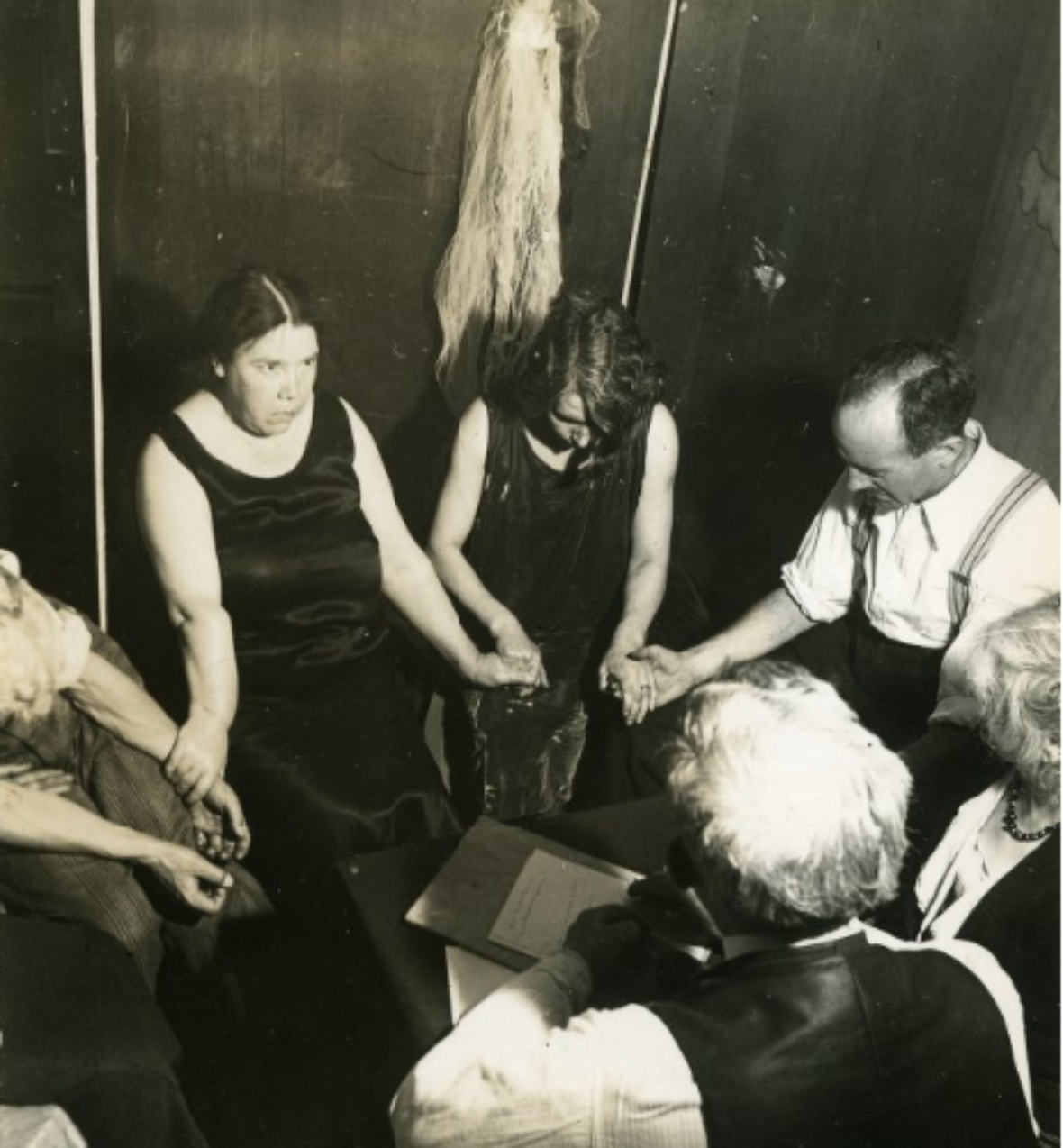
Image Source

Have you ever experienced the uncanny? That sudden intense feeling of detachment and dread when an occurrence doesn’t quite fit our rational ideas of what counts as possible or real? During these moments, one is thrust back to early childhood, when the world was imbued with magic and each object and event was a profound and inexplicable mystery.

I’ve had this type of experience many times. Here is the most recent.

My wife and I live in Panama. Panama had a merciless lock-down when COVID started. For nearly 6 months we were stuck in our tiny apartment in a high-rise on the coast in Panama City. I was allowed outside only for an hour a week based on the last digit of my ID card. We could not walk in hallways or stairwells in our apartment building. The city was cordoned off and split into neighborhoods with checkpoints everywhere. If you did not have a salvaconducto saying you were headed to work in an essential capacity for the functioning of society, the police could arrest you and fines were up to $1000.

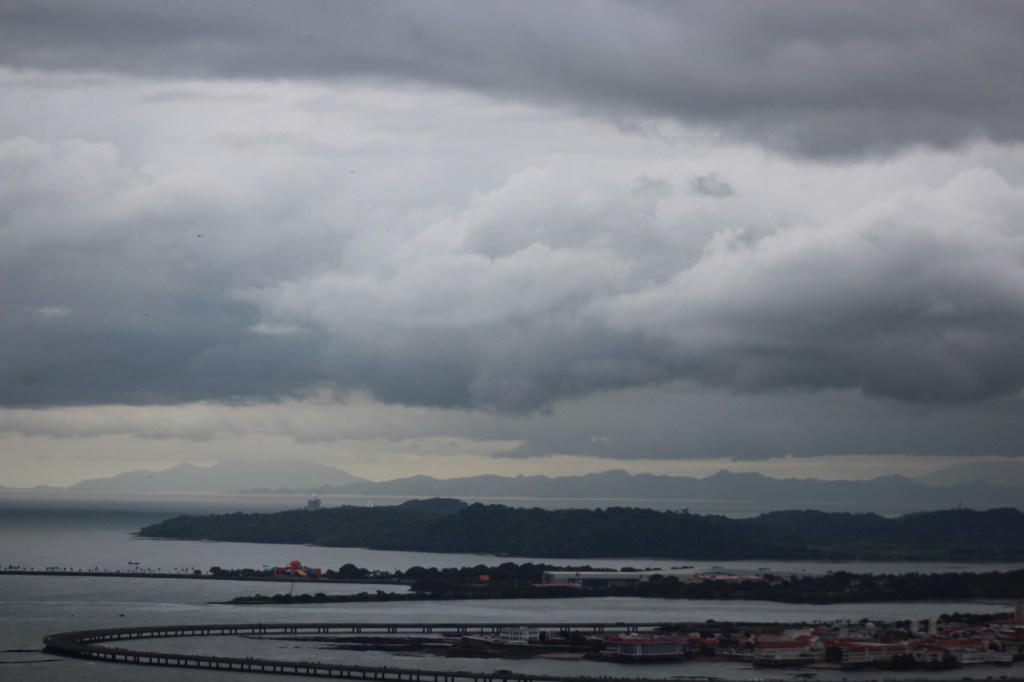
So, for 6 months we taught from and lived in our tiny place on the 54th floor above the sea. I spent hours on the balcony photographing random things because aside from reading and doing Tai Chi and fooling around and cooking, there was not much else to do.

Casco Viejo, the Amador Causeway, and the Canal from our 54th floor lockdown

When we finally escaped Panama City we did not have a salvaconducto. At the edge of Panama Province there was a police checkpoint where they were sending cars back into the City if the driver could not produce one. We lucked out because a pickup-truck with a bed full of workers pulled up at the other side along with a huge bus and the cops from our side of the checkpoint rushed over to the other side of the highway. I drove through without getting stopped.

Freedom! We drove 6 hours to Cambutal, which is super-remote and undedeveloped. It’s mostly farmland with a jungle down to the beach where a couple hotels and a few small housing developments and restaurants have sprung up. It’s on the Pacific side close to the border with Costa Rica. The beaches in Panama were all closed at the time because of COVID, but in Cambutal there are no police, so we could go to the beach and ride horses and go hiking with no problem.

We stayed in a small compound of cabins built by a young Dane over a couple years. I woke early in the morning one day, perhaps around 5:15, and decided to walk the 400 meters to the beach. My hope was to see sea turtles nesting, or perhaps even more luckily to witness a hatching. I’d seen several baby turtle trails in the sand the day before.

When I got to the beach there were no turtles. The sun was just emerging above the costal hills down to the left. The waves were a dark verdigris and pelicans were skimming the foamy crests looking for food. A young man–the local surf spotter–emerged from his wooden teepee on the beach and started texting the local surfing groups to let them know the conditions.

A few stray dogs I’d already befriended ran over and I played chase and fetch with them for a few minutes, then I decided to walk back to the cabin to see if the wife was awake.

As I walked along the road I felt a strong sensation of alert. My entire spine and in particular the back of my neck started tingling to the point almost of vibration. A mist had arisen from the trees and fields and was moving across the road. The birds which had been cacophonous moments before at dawn were suddenly silent.

Then, a regular and heavy clopping echoed along the road. At first I couldn’t place its origins, as the sound echoed from a hill to my left. Turning in the mist I looked behind me and the vapors parted. In the center of the road to my rear was a white horse, its head lowered menacingly, its eyes fixed intently on me. Its jaw was working as though at an invisible bit. It was one hundred or so meters away. When I turned to look it immediately picked up its pace.

I worked at a horse farm as a very young kid, aged 11 and 12. I know the behavior of horses, and feel fairly comfortable around them. This one wasn’t right. I am not one to panic around animals, even aggressive ones, but as soon as this mysterious apparition picked up its pace I bolted and ran full-tilt. The compound was just ahead and I figured I might have enough time to get inside and evade this creature which would be much faster than I.

I got through the gate at the compound as my pursuer reached me. Our cabin was immediately inside the entrance on the left, seated behind a tall hedge. I got to the hedge entry and behind it just as the horse reared and neighed. Its hooves crashed down through some yellow flowers bordering the hedge and not a meter behind me.

Then, winded, I watched through a gap in the hedge as the horse turned and returned to the road via the gate to continue on its way. Its muscular thighs trembled and shook and its mane was scraggly and covered in burrs as it swung its head around and grunted. I could hear its slow clopping long after it dissolved into the mist.

A bit more than a week later, my wife and I went on a horseback excursion to visit some old petroglyphs carved into ancient rocks. When our horses arrived I saw the one I was to use and thought: “oh, no!”

But it was a lovely day.

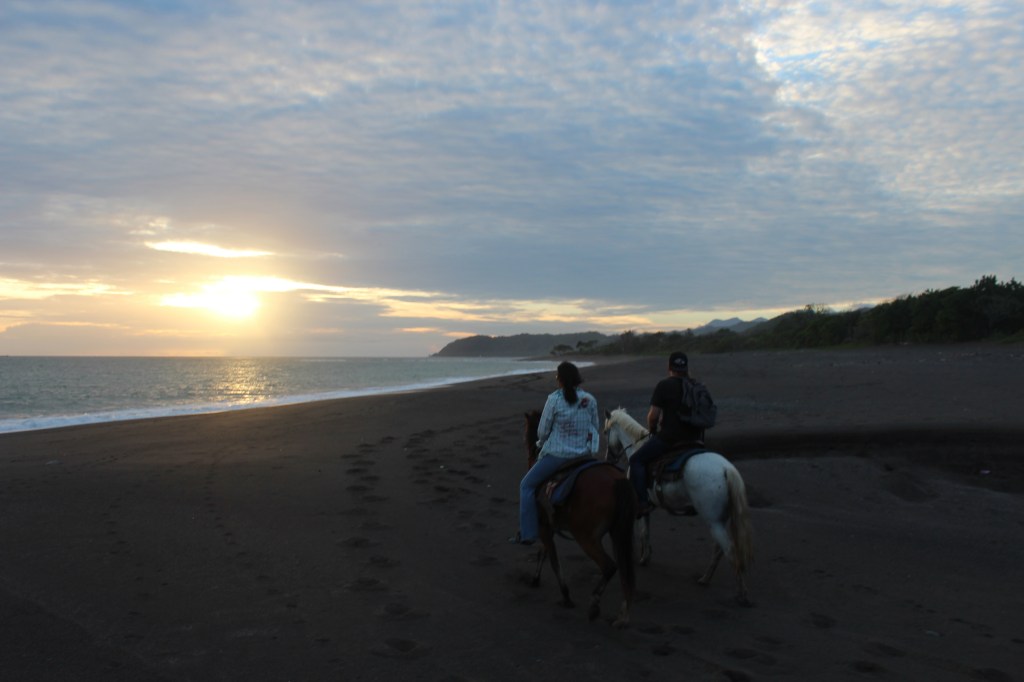
returning from our petroglyph excursion along the beach in Cambutal

Year 15

I’ve begun year 15 as a middle school teacher. I spent eleven years teaching in Baltimore City Public Schools, and made the switch to an international school in Latin America four years ago.

Year 13 we started to discuss “Um, what if COVID comes here?” in February. We had a meeting about using Canvas to teach remotely and how that might work. The next week we had a meeting about using Google Classroom and Meets instead. Because my team was asked to pilot GC and learn how it worked starting in January, we got to help explain it a bit.

The next week we were closed by the government mid-schoolday, because the entire country was going into lockdown. I remember thinking “We’ll possibly be out a month or so”–and I grabbed a few items I’d gathered with that possibility in mind. The next day I was teaching online.

The rest of that year I taught from our apartment, while my wife taught her Pre-K and Kindergarten art classes in the next room.

My middle schoolers would be doing a Socratic Seminar and they’d hear my wife singing about the continents and oceans in the background.

Year 14 started with remote teaching, which lasted all the way to March. At that point the government granted our school permission to return to campus with strict biosecurity protocols: half the students present, half at home on alternating days, and only for half the day–afternoon classes would be completely remote. Lots of hand sanitizer, very strict mask and distancing enforcement, etc.

This was basically remote learning with some students in the classroom logged in while most were at home logged in.

Year 15 started with hybrid learning.

So, half the kids on one day, half the next, but for full days. We were required to teach both groups equitably, but the kids in class could not be on devices for a least half the class.

Impossible! But teachers routinely do the impossible.

It’s been so strange returning to managing a classroom instead of a Google Meet. I’ve forgotten much about how that works. The enormous amount of innovation and adjustment the past year and a half required make me feel like I can’t remember how do what I used to do. It’s quite a surreal feeling to sit in a classroom as a fifteen year veteran and to be at a loss how to start the school year. But education is so challenging and difficult as a matter of routine that it’s not unusual to feel like I’m lost or unsure.

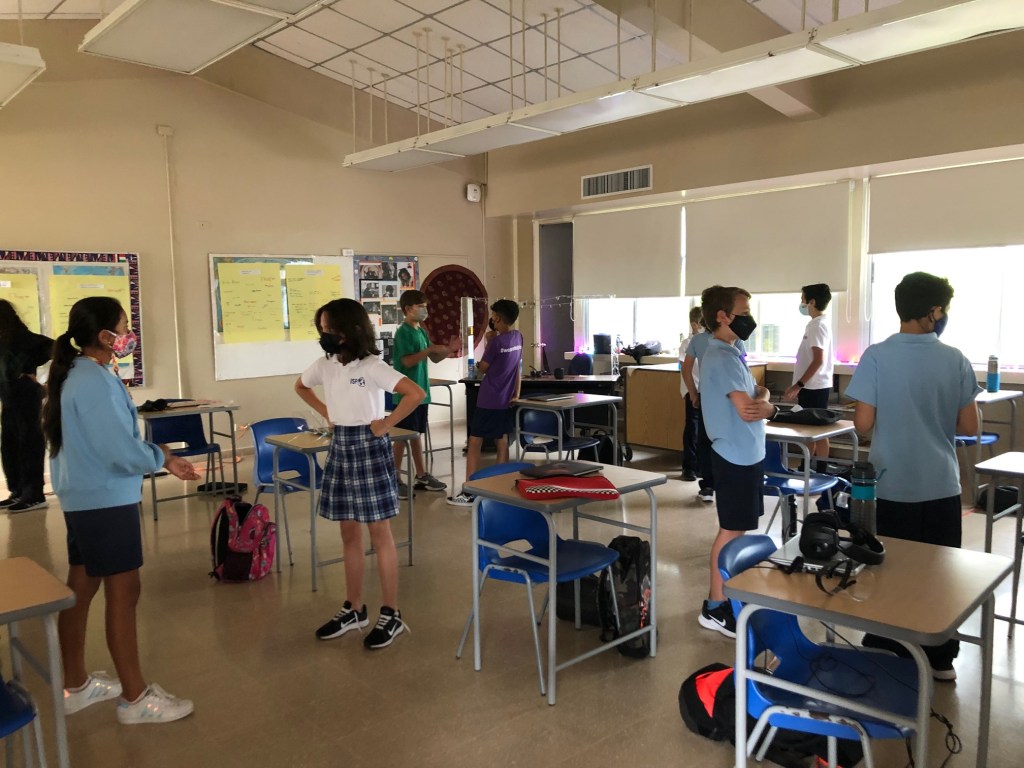
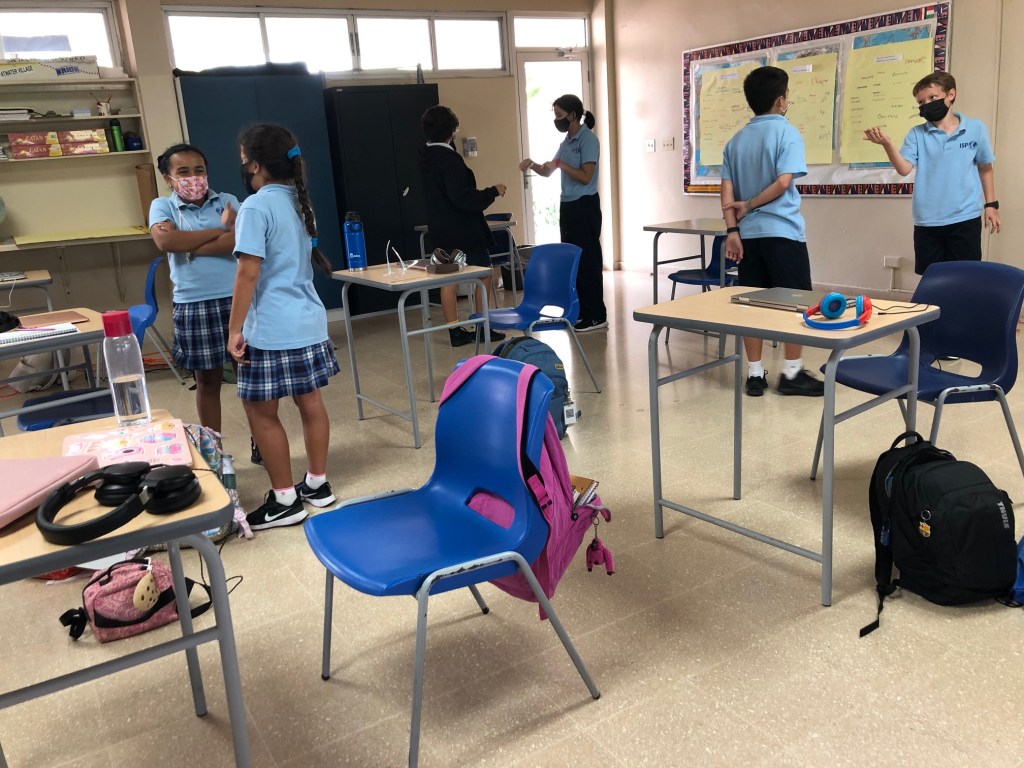
The above photos are of a discussion protocol I used to use regularly. In the protocol, students move to different partners and share their responses to prompts. Some students were online so I made my laptop a partner and then kids in class could include kids at home. I was sitting at my desk trying to plan lessons and I remembered this protocol all of a sudden. I had used Back 2 Back/Front 2 Front routinely before, and had completely forgotten it. Classroom teaching techniques will come back to me.

The government has suddenly given permission for ALL students to be present on campus ALL day for the first time in a year and a half. We still have strict biosecurity measures, but distancing has been eased. Masks are required. We also do contact tracing and regularly already this year entire teams of staff and entire student cohorts have been sent home and taught remotely. 85% of our faculty and staff are vaccinated, and 80% of our students who can be vaccinated have been.

I should point out that Delta has only just arrived here. I have a sinking feeling that we will be on full remote learning again at some point, looking at the situations in several other countries. And I also know that though students will be required to attend campus in order to receive instruction, that when there are confirmed cases on campus entire cohorts and groups of teachers will be working from home while others are present at school.

The hybrid is exhausting, and the hybrid will continue. But if we go on lockdown again, remote teaching is much easier than hybrid!

I’ve done many different jobs over my lifetime, from demanding physical labor on farms and construction crews, to customer service in retail and food service environments, to management positions in HR, Inventory, Operations, Merchandising, to managing an entire multi-floor operation with nearly a hundred salaried and hourly employees, to being an adjunct professor and then to being a librarian, and thence to middle school in the trenches of Baltimore City and then to teaching students of the 1% at an elite international private school.

I know first hand that teaching is the most difficult work I’ve ever done. By far. All of the other jobs I’ve ever done–many of which were highly demanding and taxing–pale in comparison. And teaching during COVID has proven again how adaptable, indefatigable, resilient, and innovative teachers are.

But I think I’m done after this year. I was burned out five years ago, but hung in there and decided to get a change of scene. But the burn out has returned. I think I’m done.