
The Sundial

https://bookshop.org/widgets.js

Shirley Jackson has the distinction of having written the novel I’ve re-read the most. As of last January I’ve read The Haunting of Hill House seven times. I’ve also read many of her short stories and the lovely and mysterious novel We Have Always Lived in the Castle as well. But for some reason my 1990s paperback re-issue of The Sundial sat on several shelves in several houses for a few decades before I got around to it this week.

I suppose I needed to wait until the collapse of civilization in order to fully appreciate the book. We’ve had several near collapses since I purchased The Sundial–Y2K, the end of the Mayan Calendar, various planetary alignments, wars, pestilences, George W. Bush elected twice–but something about recent events conjures more serious reflection on the End Times than all those others.

The Sundial is focused on the coming End of the World–or, more exactly, how people respond when they genuinely believe the End is nigh. The setting is a genteel massive manse in a New England town, built a generation previously by some fabulously wealthy businessman and currently inhabited by his two children and his grandson’s widow and daughter. The children are Mr. Halloran, confined to a wheelchair and in evident decline, and his sister Aunt Fanny. Mr. Halloran’s wife is still around as well, and is suspected by the grandson’s widow and granddaughter of having murdered his son by pushing him down the stairs in order to secure her own inheritance of the house.

Aunt Fanny one early morning takes a walk around the gardens she’s known since childhood, becoming somehow lost and suffering a potent vision of her father telling her the end is nigh, but that those inside his house will be saved to repopulate the Earth. What ensues is pure hilarity. Fanny shares her vision and somehow it becomes doctrine with all those trapped inside. They will be Robinson Crusoes and Noahs and Adams and Eves, left stranded to rebuild and repopulate.

As in every Jackson novel the characters are all delightfully awful and are skewered by her sharp sensibilities. The dialogue is funnier and better and more sophisticated than anything in Dorothy Parker, the wit makes Evelyn Waugh seem amateurish, and Dickens himself would have been awed by Jackson’s ability to lampoon class differences so efficiently. What took him 5 or 6 hundred pages takes her much less than 3.

I note that as we pass from Pisces and into Aquarius that the old gods have all lined up to watch our current collapse. The Planet Parade of late February/early March this year showed them all coming back to witness our decline once again into rebirth and renewal, just as the change from Aries to Pisces saw the cratering of all the great Mediterranean civilizations and the birth of new orders. In Jackson’s novel the end doesn’t matter so much as the way people behave anticipating it. And just as she predicted, they behave shamelessly and hilariously so–Buckle up, folks!

Jillian

This book is awful. When I write that I’m not speaking at all of the quality of the novel–it’s actually quite good and very entertaining. But everything about it is truly terrible. Jillian is a troublingly accurate record of life in the current late-stage neoliberal capitalist hellscape we all inhabit. As such, it’s an abyss of despair, a Nietszchean vortex, a singularly piercing examination of approaching Singularity. I laughed heartily reading it, and cringed each time I laughed, because ‘funny, not funny.’

The novel centers on two characters: Megan, a recent college grad who works in a gastroenterologist’s office. Her job is to look at images of people’s colons all day as she scans the images into their medical files. She is alienated from her labor, but also from her friends, from her boyfriend, from her family, from her society, and from herself. Marx wrote Grundrisse just for Megan. She sees how empty everything is and how difficult it will be to find meaning at all in a life doomed to this sort of work. As a result she gets smashed on canned American beer and smokes too many cigarettes while becoming more and more of an intolerable asshole. Megan is infuriated that nobody else can see how fake everything is and how their successes at their own fake shitty jobs are contemptible.

And then there is Jillian, Megan’s co-worker. Jillian is about a decade older than Megan and because unconsciously Megan sees herself becoming Jillian in ten years, still working at the doctor’s office, still cheerfully scanning poopy intestinal images, she starts to really loathe her coworker and herself. Half the novel is from Jillian’s point of view, half from Megan’s (with brief moments from the POV of a few other scattered characters, including Jillian’s son Adam and from a dog, a bird, a racoon).

Jillian is a total wreck, and drives on a suspended license because she is completely deluded about the state of her world and unable to face the realities of her situation. A single mom who got knocked up after hooking up at a club while high, she has discovered religion and has made a mess of that as well. After drifting thoughtlessly through a red light her car gets impounded, she is arrested and arraigned, and she has to rely on the kindness of a fellow church member to get her kid to daycare every day while she goes to the office. Megan sees through all of Jillian’s bullshit and it makes her totally crazy. She goes home and obsesses about Jillian to the point her boyfriend starts to get annoyed by this obsession.

Meanwhile Jillian has lied to her employer about her car and about an upcoming court date and about her fine for driving on an expired license. And to solve all her problems she adopts a dog because happy families have dogs, right? Then a painkiller addiction makes everything that much better.

In this novel we get to experience the collapse into despair of these miserably entwined people. And what makes it all worse is that Megan, despite being a terrible asshole, is actually correct about the people around her and the society she is in and about her prospects. And she is correct about Jillian and her thin cheerful veneer, the inevitable collapse of which affects not only herself but her child and her dog and Megan and the entire society they are trapped inside. And yet these are the sort of people churned out and crushed by America the Beautiful in the 21st century.


Jeanne Dielman 23, Quai Du Commerce, 1080 Bruxelles

When Roma came out a few years back a twenty-something colleague said he spent the entire film bored and wondering when something would happen. I had a completely different reaction to that film, and thought it was a miracle how much happened in 2 hours and 15 minutes.

So, take this as a warning. Jeanne Dielman clocks in at over 3 hours, and if you prefer CGI action films or comedies this will absolutely not be the movie for you!

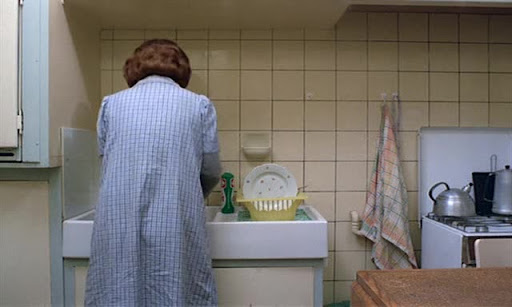
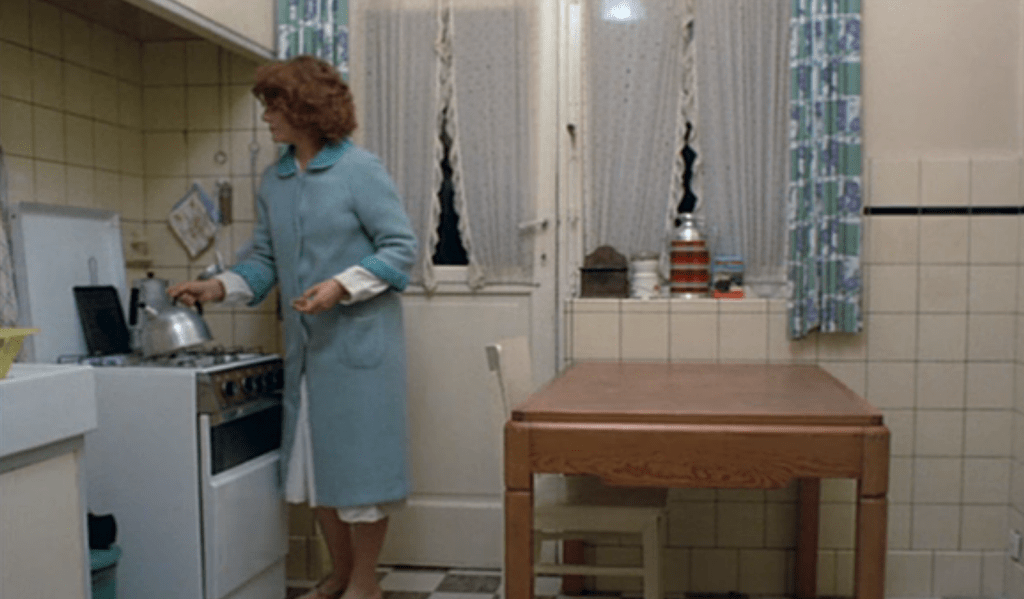
The first hour focuses on Jeanne Dielman in her daily routine. We watch the steps to her day and the way she manages tasks and it is evident from every scene that these are well-rehearsed and routine activities, and Jeanne is a marvel of efficiency. The way she folds, her fussy insistence on maintaining a tidy and immaculate living space for herself and her teenage son, her industrious and thrifty mannerisms–all reveal a woman enmeshed in the oppressive values of “woman’s work” and “mother’s duty.” She has honed and practiced her approach to preparing coffee, making dinner, cleaning, doing laundry, and converting her living room into a bedroom for her son each night, and the camera rarely moves as we watch Jeanne do her chores like an automaton. Which, of course, is what women even in wealthy “advanced” nations have often been reduced to in the past, and sadly movements like MAGA in the USA hope to bring back this state of affairs.

In the afternoons, between starting potatoes for her son’s dinner and awaiting his return from school, Jeanne has a small window of time where she takes clients as a prostitute. As a widow trying to maintain a bougie lifestyle for her son the implication is that she has no choice. Like all her tasks, there is an aloof practiced routine to these interactions. We only see the arrival of her client and his departure, and then the bathing and clean-up process Jeanne goes through after the visit. Then, her earnings are saved in a large soup tourine.

You may get restless watching Jeanne do the dishes for 20 minutes, or watching her bustle from room to room always closing doors and turning off switches and putting everything back where it belongs. But it is important to the film and its themes to see how Jeanne spends her day and how carefully her time is managed because on day 2 if you are watching closely you may notice things going awry very subtly. A dropped polish brush, a dropped spoon, potatoes overcooked and untidy hair. An undone button. These very subtle hints really add up and caused me a creeping anxiety. Jeanne is in absolute control of her activities and her life for a reason–because there is a burbling turmoil inside.

Her interactions with her son are quite frustrating to witness, for reasons you’ll understand if you see the film. Jeanne’s life even as a widow is wrapped up completely in satisfying male needs and making life easier or more pleasant for males. Only rarely do we witness Jeanne enjoying herself or experiencing a rich aesthetic moment–while knitting a sweater for her growing son, she becomes oh so quietly enraptured by a Beethoven piano sonata, and though she continues to work she is expressing some internal state, something trying to burst free.

When the coffee comes out wrong, when a missing button on her son’s coat proves impossible to replace, when a pair of scissors is not returned to its proper place–all these small details lead to an appalling finale full of resonance and open to interpretation. More viewings are required to piece together what actually transpires because though it’s quiet and subtle there are many small things happening in the last 15 minutes and I had oh so many questions.

So I can’t recommend it enough, but to endure it you have to be the sort who enjoys dense, beautifully edited and acted long-ass art films. It’s brilliant and revolutionary and tedious all at once. It jumped two years ago to number 1 on the BFI list of greatest films of all time. I might argue that there are better films, but I certainly see why it’s a powerful contender. I must explore more works by the director Chantal Akerman.

She lives on Quai Du Commerce–the film manages to critique women’s traditional roles as well as the economic system which relies on poorly compensated women’s labor