Passings

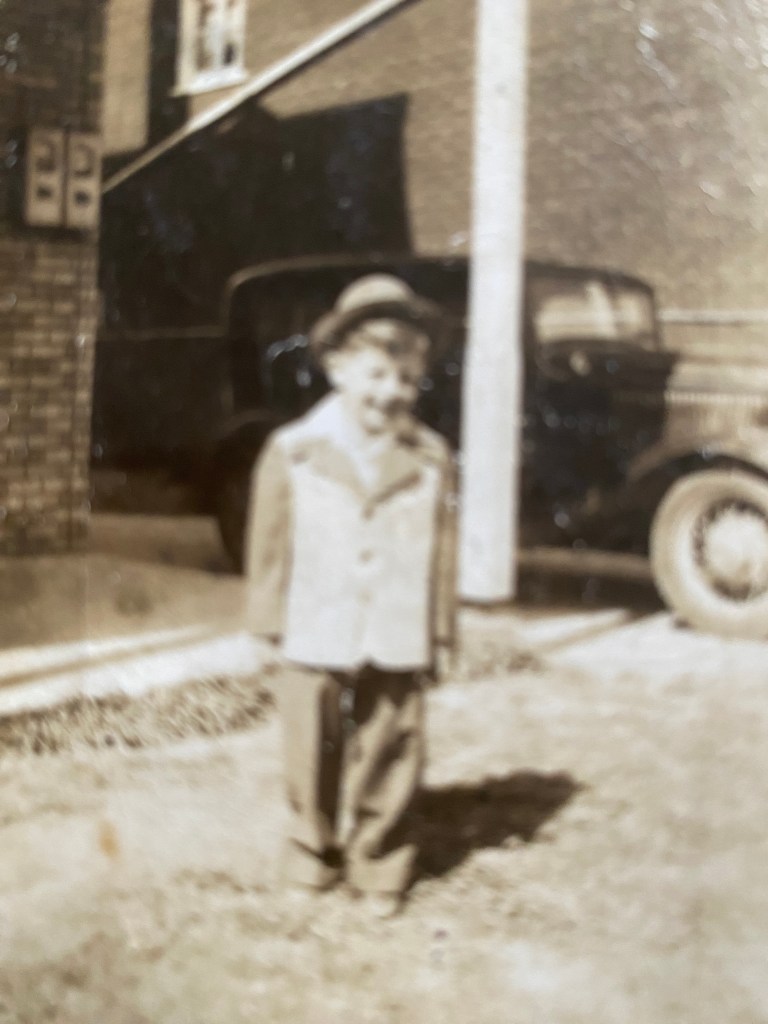
The reverse of this tiny sepia-toned photograph reads “Paul Godfrey Easter 1949 Stewartstown, PA.” It was originally written in pencil but was later partially fleshed out in ink. The handwriting I immediately recognize as that of Mary Godfrey, my paternal grandmother. I’ve no recollection of how I came into possession of this photograph, but after moving to France it fell out of a book as I was unboxing and shelving stuff we’d had shipped from the USA. It’s possible Paul himself sent it. He used to mail me strange messages including Garfield or Far Side clippings from the newspaper and hand-scrawled notes on old receipts. Once he sent me a Polaroid of a woman he was then involved with–she was nude and far younger than he. He’d scrawled “daily vitamin pill” on the photo. I don’t know the name of the young woman but I heard later that she took Paul’s ATM card and emptied his bank account. A bit later Paul became unhoused.

On June 1st at 8:45 pm Paul Godfrey died in hospice care in Gettysburg PA, the town where I was born in 1969. He’d had a stroke a few weeks earlier which left him a bit weak on the left side. He was institutionalized to undergo rehab but refused to participate, refused food and water, and went into a rapid decline. Eventually staff gave up trying to engage him and instead medicated him against the pain of starvation. He was 80.

Paul Benjamin Godfrey was my biological father. Your inclination might be to offer sympathy in this circumstance; that’s kind and considerate but wholly unnecessary. We weren’t close, and were in fact estranged from one another for decades. I think we spoke a half-dozen times in 35 years. My younger sister heroically assisted him his last few years and had visited him in hospice without getting much response. I, on the other hand, had almost entirely excised him from my life quite some time ago. Due to the staid dictum don’t speak ill of the dead, I’ll refrain from cataloging the reasons here. I’ll simply state that my mother gathered our belongings into a few trash bags and left his house after calling the police one night in the 1970s, my sister and I in tow. She wanted the police there as she fled in case Paul showed up. He worked night shift and we escaped to shelter in a good samaritan’s house for a couple weeks before moving into the home of my maternal grandparents. Later, there was a brief attempt at reconciliation which failed and divorce procedings were engaged. I was 7 years old, my sister 5.

My sister asked if I’d write an obituary. I could barely come up with 500 words. It says something that a man of 56 years could know so little about his father’s life that minimal details were tough to scrape together into a brief narrative. But such was our relationship, or lack of.

There will come a time when I have more to write about Paul Godfrey. For now, however I’ll remain silent and allow that photo from 1949 to be my memory of him. It was taken 20 years before my birth, and it’s a very cute and charming photo of a presumably loveable little chap. May the conditions and torments which caused that young child to become the man I knew be laid to rest.

To A Mountain in Tibet

A friend kindly leant me this. I often refuse to borrow books because I like to read my own copy and put it on a bookshelf for decades after. But I’d read and really enjoyed Shadow of the Silk Road, and I’m a (very) small business owner trying to live more frugally than when I was a lavishly funded public school teacher in the USA (LOL). So I accepted it (and three other excellent books she kindly offered).

Ostensibly, this is a travel book, and it does indeed recount a truly remarkable voyage to a particularly special and demanding destination. But this is actually a book about grief, and it’s the best book about grief I’ve read since Joan Didion’s The Year of Magical Thinking. Though the family members grieved by Thubron are present for less than 10 pages of the 220 in the book, they haunt its passages about Nepal and Tibet like the dakini spirits he describes.

Of course there is no better country than Tibet in which to devote a mournful pilgrimage and to explore loss and impermanence. Turbron describes the destruction by artillery of several ancient monasteries and the smashing of others by hand during the Cultural Revolution. He meets many people who have their own griefs about family and displacement and the Himalayas become a resonator for sorrow. Many practitioners of Tibetan Buddhism have been displaced by state terror or official exile. And yet the Hindu and Bon and Buddhist pilgrims still come and do their circuits of Mount Kailas. Thurbron does his as well, but finds little comfort in the astonishing myth-enshrouded terrain, birthplace of the Earth and abode of the gods and demons for several religions.

Mother Nature

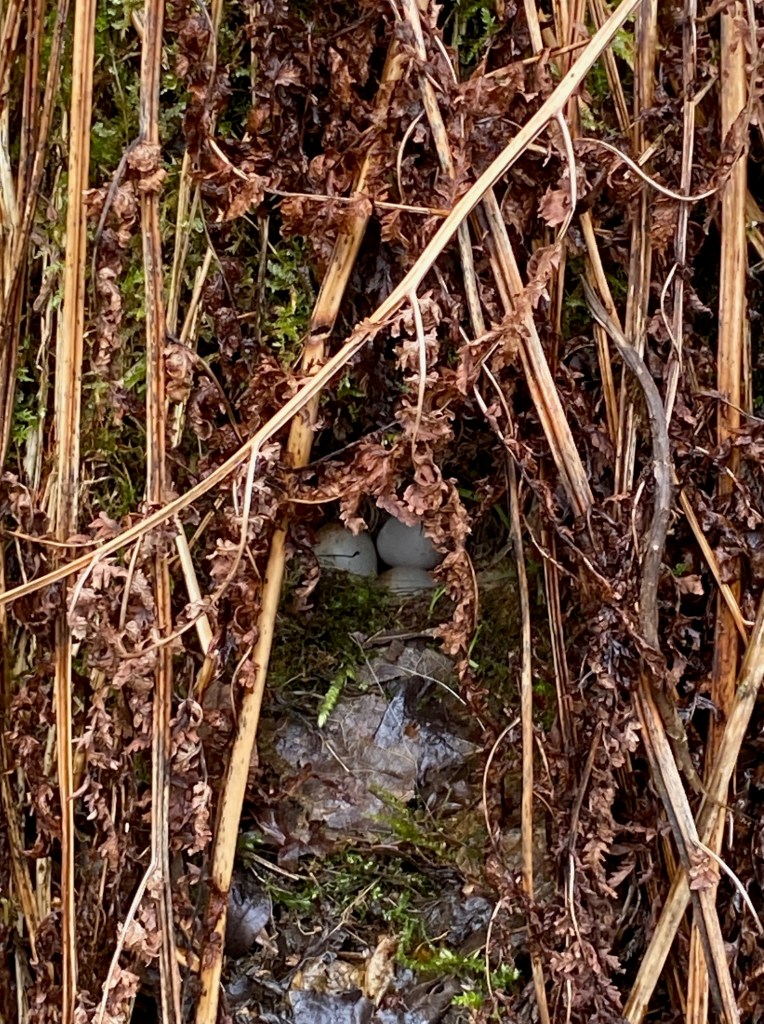
Back in the early spring I was cutting brambles and digging out weeds and noticed in the side of a steep hill on our property that there was a tiny bird nest.

Inside the nest were three very tiny eggs. In this part of France there is a law that one cannot cut hedges between March 15 and July 31 because of nesting birds, and I take this rule seriously. I pay attention to all the birds I see and like to observe breeding pairs and note where they hang out. This nest made me very happy because it was in the ground and easy to see when I walked up and down from the garden daily. The mother would often flit in and out as I worked nearby.

Last week I noted that the eggs had hatched, and I could see moving chicks in the nest. I didn’t stay to watch or examine because I didn’t want to cause anxiety in the mother, who I figured was close about and foraging. Again I was quite happy to see these babies and to think about nature and its small miracles. Often a trip to our garden is like an un-narrated David Attenborough special.

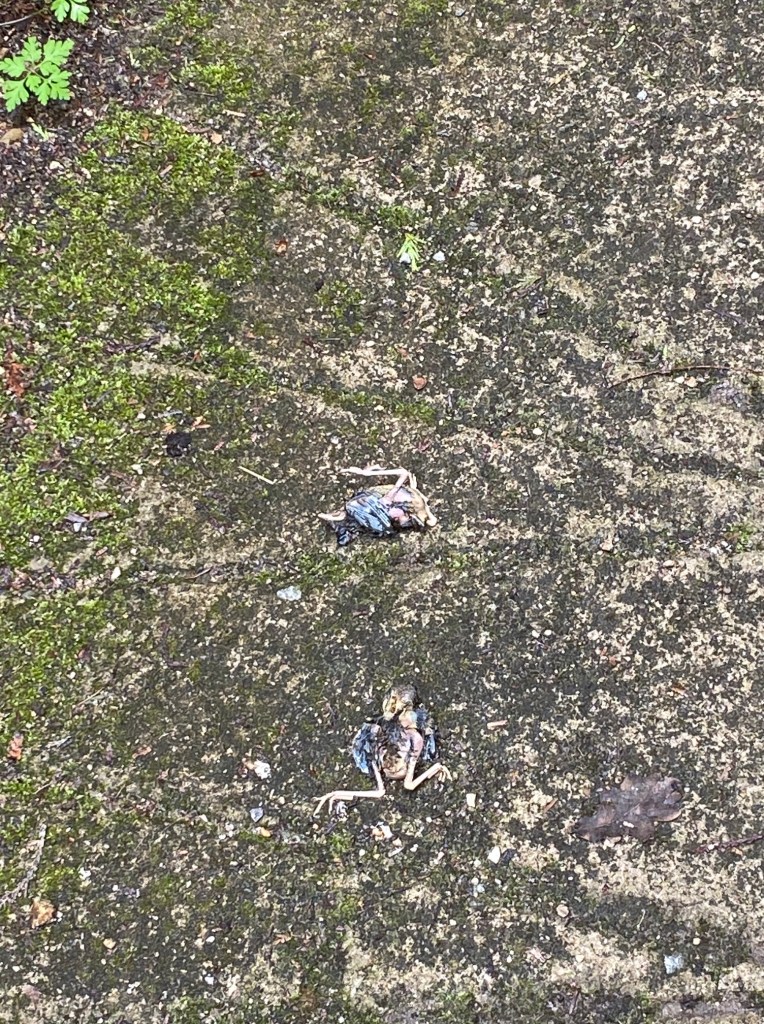
But shortly after I noticed the chicks had hatched, I found two of them on the cement path early in the morning.

I don’t know if they fell out, or were pulled out by a mammal, or if the mother had cast them out (which happens sometimes). I did hear and see a cat very early that morning on the other side of our building. One chick was completely gone, the other two were left behind.

How devastating! My entire day was colored by this discovery. I’d looked forward to seeing these little guys go through adolescence and thence into the world, ideally to return to our garden with mates to create future generations. I thought how cruel Mother Nature can be!

But of course Mother Nature is not cruel, she is indifferent and neutral. Can’t have yang without yin, after all.

I feel for the mother, who worked so hard! Hopefully she and her mate try again next year with more success.