I wanted to refresh my general knowledge of French history before focusing in detail on a few eras, regions, and personalities. A History of France seemed a good place to start. John Julius Norwich had written quite readable histories of Byzantium and European monarchs, and his father Duff Cooper was Churchill’s liason with the Free French during WW2, and later was Ambassador to France from the UK. I thought this book merited a try.
There is way too much history in this short and readable history. We start with Julius Ceasar and his campaigns in Gaul, and progress through 2000 years up to Charles DeGaulle. But this is a fun read, written by a lifelong Francophile, and it did what I hoped it would–reminded me of the proper sequencing of early monarchs and refreshed my knowledge of the 100 years war and 30 years war and the long deeply intertwined relationship of France and England. The cast of characters is immense of course, and Norwich is particularly good at bringing them to life, from Eleanor of Acquitaine and her sons to Joan of Arc to Napolean 3.
I must say that even immediately upon finishing the book I can’t differentiate all the King Louises and King Charleses. There are too many of them to remember. But Norwich brings them to life and situates them in the context of their times and analyzes their impact on the entirety of French and European history.
Like many English (and Americans) of his era he seems to truly admire but also to have not inconsiderable contempt for Charles de Gaulle. But a historian worth his or her salt can hold two contrary opinions in his or her mind at once and still manage to get the job done. I had to laugh out loud when De Gaulle tells Churchill that the French people regard him as a reincarnation of Joan of Arc, and Churchill says “we had to burn the first one.” History is so much fun, except when you have to live through it.
Back when I was young and energetic I spent a couple decades working a full-time job, a part-time job, and going to university full-time. At some point in this burst of insanity I was working in the Cook Library at Towson University, while teaching in the English Department, and still working at Borders Books & Music, while pursuing a degree in French Literature and also taking courses necessary to become a public school teacher. At that time I’d already earned a Bachelor’s Degree and a Master’s Degree–but it was never enough, LOL.
During that burst I took a really brilliant class with Dr. Lena Ampadu focused on literature in English coming out of post-colonial Africa, and also took a delicious class in French with Dr. Katia Sainson focused on postcolonial lit. So a couple decades later when an algorithm suggested Notre Dame du Nil on sale I purchased it while living in an oceanside apartment in a high-rise in Panama. I desperately wanted to improve my Spanish but also wanted to keep my French alive. Six years later I finally got around to reading it.
It was worth the wait. Ostensibly a memoir novel set in an all-girl’s school in Rwanda in the early 1970s, it is actually a densely layered critique of colonialism. Imagine Mean Girls if Franz Fanon dropped in as script advisor.
The French was not too difficult, and I needed to consult a dictionary only a few times each chapter. The characters are engaging and I found much of the novel quite interesting and at times hilarious. The girls at Notre Dame du Nil are all Rwandans who are being groomed for elite roles–they are daughters of wealthy merchant families, of diplomats, of government figures or military officers. Many come from small rural villages and of course “elite” grooming requires the learning of European languages, European traditions, European religion, European manners…The Europeans teaching in the school are hapless and ridiculous and deserve the mocking they receive. The Catholics in charge of the institution are just as bad. The school has as its setting one of the furthest away sources of the Nile river, hence the designation in the title. The bits about Rwandan culture, including a fascinating sequence when two students visit a rain-making shaman to purchase a love spell-were excellent. And the fishy Catholic priest in charge of the school who bestows nice garments on girls but only if they try them on in front of him? Classic.
One tangent of the plot involves a European man who lives on an old coffee plantation and has a bizarre theory that Tutsis are descended from Pharoahs–he abducts a student and then begins painting her and using her in a film he’s making. Another involves a visit to campus by the Queen of Belgium.
But the novel slowly simmers and builds a truly dark and disturbing undercurrent as the typical mean teen girl drama reveals roots deeply entwined in Hutu and Tutsi history, with absolutely catastrophic results. What at first seems like surly teen sniping eventually develops an undercurrent of tribal hatreds and it becomes clear that the parents of several students are encouraging the cataclysmic outcome. “It’s not lies, it’s politics,” says a ringleader who happens to be the daughter of the President of Rwanda. One student, who is half Tutsi and half Hutu, does her best to straddle two worlds and attempts to insinuate herself into the dominant group but redeems herself to a degree when the crisis comes.I shan’t say more to avoid spoilers.
Since my mid-teens when I first encountered Modern Man in Search of a Soul and Man and His Symbols, I’ve been interested in Jung and Jungians. In my 20s I worked my way through Jung’s major works, up to a brief attempt at Mysterium Conjunctionis, which defeated me, and like Finnegan’s Wake has resisted any further attempts at reading.
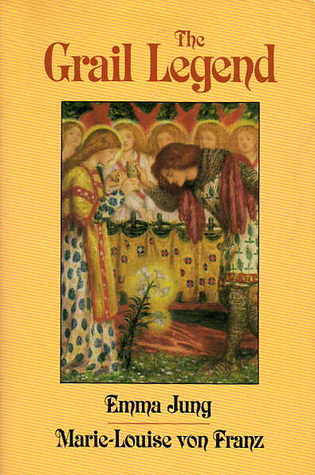
I’d read recently H is for Hawk, which was an interesting memoir about a young woman who deals with the loss of her father by training a goshawk–and in her book Helen MacDonald repeatedly refers to T.H. White’s own book about training a goshawk. T.H. White, of course, was the author of The Once and Future King series about Arthur and the Knights of the Round Table, and I considered reading those novels for the first time but don’t have them on the shelf. I did, however, have Emma Jung’s analysis of the Grail Legend and picked that up instead.
Emma Jung was Jung’s wife and collaborator, and was a sophisticated analyst as well. Her book is introduced by another long-time associate of Jung’s, Marie-Louise von Franz, who edited and finished the work after Emma Jung died.
As is often the case with books by Jung or Jungians, this is a challenging read, and it presumes a familiarity with Jung’s work and in particular his book Aion.
It is Emma Jung’s contention that the Grail Legend is an attempt by the collective unconscious of pagan Europe to adapt to and internalize Christianity. From our home here in the Correze I can very quickly visit several fountains which were originally pagan sacred sites but which were renamed in the 4th or 5th century for Christian saints and turned into Christian sacred sites. There is a lovely one here in Treignac designated The Fountain of St Meen. Also easily accessible nearby are several ancient crosses, dropped by monks on pagan sacred sites in order to Christianize the locals. One of my faves is La Croix en Haute in Lestards.
Christianity of course was an import to Europe from the Middle East, and its doctrines and rituals struck local residents as strange and alien. But over time as society became structured by converted local nobles and local monastaries and abbeys, pagans had little choice but to adopt themselves to the new religion. But the heavily patriarchal belief system with its dogma of sin and repentence and featuring a hostility towards women, magic, sex and nature was hard to swallow for locals who had their own beliefs almost completely at odds with the Christian worldview.
And so a new series of myths and legends erupted in order to compensate for and make more comprehensible the tenets of this new faith. Emma Jung documents carefully how the writers who first codified the Grail legend took material from widely dispersed pagan legends from as far afield as Wales, Ireland, Syria, Persia, and old Saxony. French poets and troubadors and English poets and historians and German poets all began singing and composing verse about Arthur and his knights and their quest for the Grail.
The Grail is typically understood as a cup which at one time held the blood of Christ captured at his crucifiction–but Jung shows that some stories present the grail as a plate or serving dish. It has the power to heal or destroy, and it exists in a hidden realm in an alternate reality accessible only to those pure enough to find it.
Associated symbols are analyzed and discussed in detail. The Fisher King is linked to the Piscean Age, the sudden eruption of the cult of the Virgin to compensate for a lack of the feminine in doctinaire Catholicism is described, connections between the Grail stories and other concurrent trends (Cathar and Templar beliefs, for example) are established and illuminated.
The focus of the work is Percival and his adventures. His family ties to the Fisher King and back through time to Joseph of Arimethea is examined through a Jungian lens.
These past two months have been a bit exhausting. We’ve hosted an open mic night with a full band, a harp concert, several workshops and a dance performance, as well as the usual run of weekly classes and ateliers. All of this on top of the two rental apartments ramping up into tourist season, the crush of garden maintenance, a quick five-day vacation in Spain AND working at the local street food festival, electrical and plumbing challenges, renovations, etc, etc.
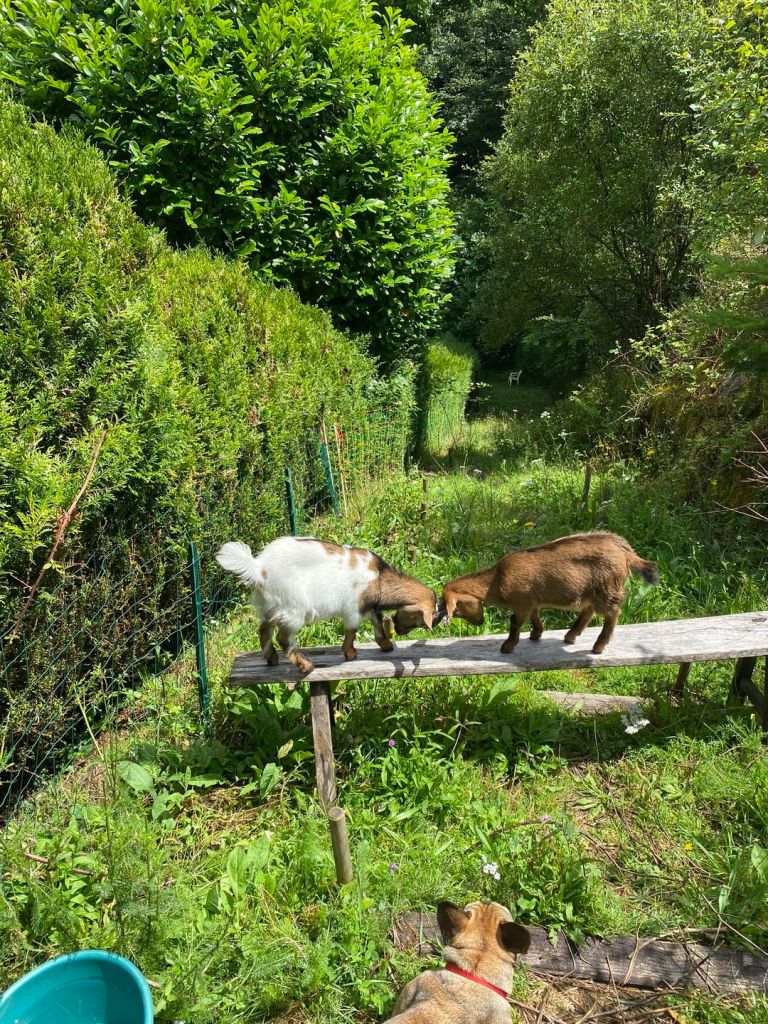
We’ve also adopted a French bulldog, two baby goats, and four songbirds. I’ve put in at least 50 hours on fencing alone over the past three months–building the goat enclosure, then expanding it, adapting it as needed, and repairing it several times as the goats found weaknesses and pushed through.
And with all this work going on I’ve allowed some major milestones to pass unacknowledged here.
The Milestones
As of June 2024 it has been 6 years since we moved out of the USA. We left behind an elaborate social calendar, a Victorian rowhome filled with art and objects, political and business connections, the best next-door neighbors ever, our pet dove Godzilla (RIP), and a city with which we were infinitely familiar, where we’d carefully developed an intricate network of deep involvements over the years. And, of course we left behind beloved family members and dear friends.
But, I regret nothing. All of the challenges and myriad difficulties of being voluntary immigrants were worth the sacrifices. I was looking for a new push, a new means of developing skills and becoming a stronger and better version of myself, and moving abroad definitely pushed all my faculties to the brink on multiple occasions. I often thought about involuntary immigrants, those who have no choice but to migrate, and considered how my difficulties paled in comparison (while the privileges granted by my paleness greased many wheels for us). Our experiences in Panama–living in luxurious high-rises by the ocean, pushing ourselves professionally in a completely different environment than the Baltimore City Public School System at a swank international school, making friendships with locals and other expats from around the world, going routinely to beaches on two oceans, going into the mountains, rainforests, cloud forests, jungles, seeing wild animals, getting the most out of our crippled Spanish–we loved it all. Further, there is nothing more liberating (after the trauma subsides) of getting rid of all the stuff Americans accumulate over decades. So many possessions! It was a lot to let go but we learned how to do that.
As of the first half of June 2024 we’ve lived in France for 2 years. Our French expat experience has been much different from the Panamanian, and for beyond the expected reasons of climate, geography, culture, history, language, as well as living in a decolonized nation versus living in a former colonial power. In Panama we had jobs and an employer with lawyers and an HR department who handled the heavy lifting for us. For the move to France we did much of our own heavy lifting, with the help of an excellent hand-holding service based in Paris. And we had no employer, instead we started our own business, which I suppose counts as another milestone (In June 2024 we marked the two year anniversary of not working for The Manand became ‘self-employed‘).
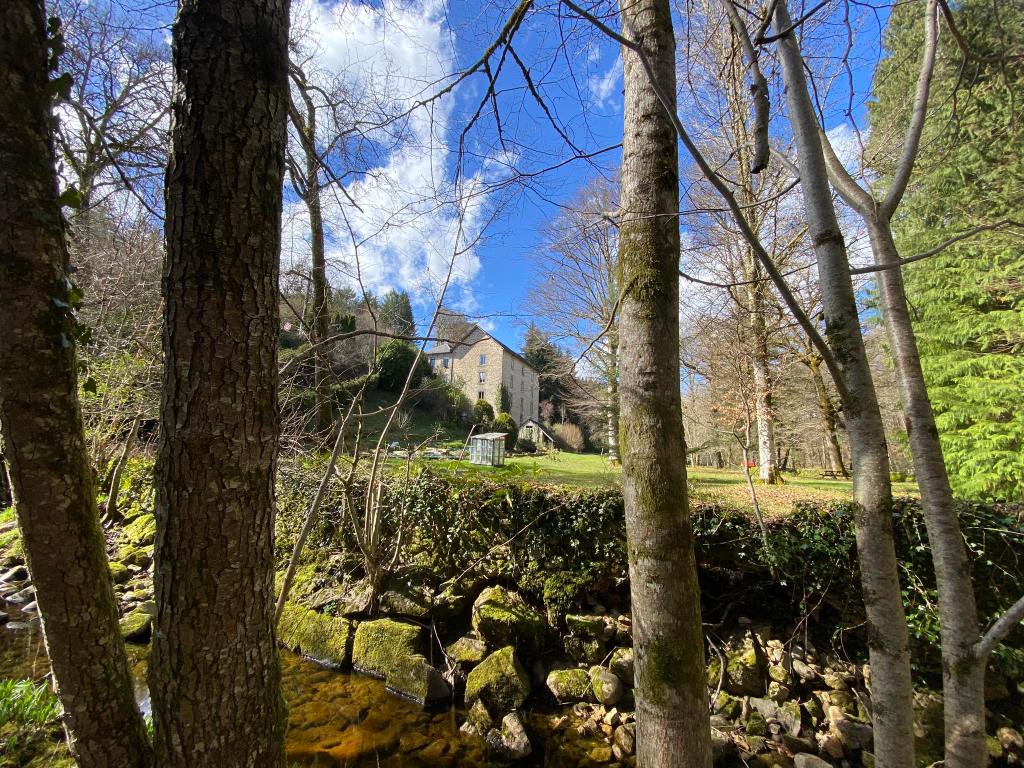
Our humble abode from an island in the Vezere River: Moulin Sage
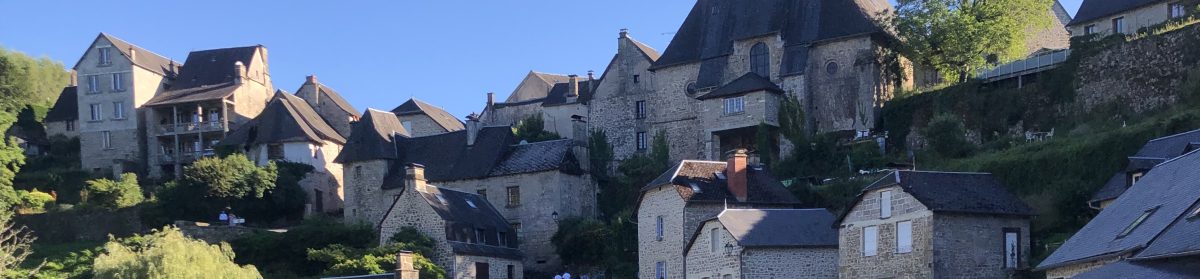
We are loving the Correze region of France. The village of Treignac has proved to be everything we hoped when we chose it after touring dozens of small medieval towns across France as we researched moving here. Many people in and around Treignac have helped and supported us as we work toward our goal of creating an event space/concert venue/professional development center/arts and crafts atelier/pop-up cafe/retreat center/eco resort/organic farm/anarchist commune/naturalist resort/vinyard/exposition space. Yeah, we live in a run-down apartment in a largely decrepit old factory building, but it’s the best life! People come here for concerts and shit, which amuses me no end (our first concert was a gathering of about 30 people to hear ellen cherry). People we need seem to arise by magic at the exact moment we need them–could we host yoga classes here? A yoga teacher appears. Can we find a contractor willing to use recycled or repurposed materials found in the mill to create new useful spaces? Tom puts a home-made flier in our mailbox. It’s been a blast, and quite exhausting at times. But it’s different working hard for yourselves and your clients and not for somebody else.
We earn about 8% of the income we had when we had jobs. But our stress and anxiety is way down, and we can afford to live a quality life here on a small income.
Our growing menagerie of small mammals: Cornichon, Capri, and Bou-Bou the Frenchie
On May 13th, I turned 55 years old
So being in my mid-fifties is pretty much the same as every other age I’ve been. Differences? My collection of unguents and gels has grown, my toes suddenly look like my grandfather’s toes, and I go to bed before 10pm every day. 85% of the time I feel physically like I’m in my early 30s–in fact, due to Tai Chi I often feel more limber than I did back then. But the other 15% of the time is where mid-fifties life gets interesting: 5% of the time I feel exactly my age, 5% of the time I feel like I’m in my 70s, and the last 5% of the time I’m stiff and sore and feel at least 90 years old. I can do renovation projects and work in the garden cutting and stacking and digging like a maniac no problem, and then get injured standing up from the couch or opening a pickle jar.
The biggest realization over the first half of this decade? Shut the fuck up. Keep your opinions to yourself, listen to what others have to say and shut the fuck up. Don’t participate in or encourage gossip of any kind. Petty annoyances and grievances? Let that shit go. This is the time to work on the inner self and start preparing for the next stages. What books to read, what books to re-read, what places to visit or revisit?–all of these questions become more delicate and nuanced. Typically American dudes live to be 75. Maybe I’ll get there, maybe not–maybe I’ll go beyond? But it’s time to start considering the fact that you’ve got a couple strong decades left, and how to spend them is a key consideration.
As of June 11, 2024, we’ve been married 30 years. How does this happen? In the blink of an eye we’ve been married 30 years. It really seems like our 20th anniversary party was just a few years ago. It’s been a true pleasure seeing my wife bloom since we moved abroad–unfettered by an employer she’s just madly arranging events and ateliers and adding more and more artists and craftspeople and creatives to her roster. But as my Baltimore 8th graders used to say, “she do too much.” Sometimes I get completely wiped out trying to run logistics and preparing for all the gazillion things she’s got going on, and yet she continues adding more and trying more. We have this amazing piece of garden and an old stone building and sometimes I’d like to rest on my laurels and set a spell in a hammock by the river. Patricia tells me “you have to schedule some days off when you’re self-employed or you’ll burn out,” and then she adds two more retreats and another workshop to the calendar and buys some massive thing on FB Marketplace that I have heft downstairs. But it’s all about the love, and there’s nobody I’d rather spend 24/7 with as a business partner and life partner and lover and animal co-parent. She is a dynamo with a world-changing mission and has no interest in slowing down a bit, and I could not be luckier to see it all up close.
Cliff came ambling down Route de Gueret from the Brasserie, encumbered by three sacks and a backpack. We noticed him first because the dog stood to attention and her hackles rose, but Pat got there in time and the dog rolled over and showed her neck upon noting her lady’s displeasure. Cliff was allowed to approach with no danger to his ankles or eardrums.
As he got closer I realized who it must be. Cliff had contacted me weeks earlier via Google, where he found our website and sent me a message in French. From the grammar I could tell he was a confident speaker with a pretty good knowledge but was certainly not a native speaker, and after seeing his name I thought he must be a Yank or a Brit and I replied in English to the chat.
Cliff had requested lodging for two and a half months, he wasn’t sure when exactly, and he could only pay 25 euros per night because he was retired and on a budget. Of course that’s less than half of what we charge per night for our small studio rental! I told him I would need specific dates and that we already had bookings all over our spring calendar for both apartments, but I would send him some suggestions nearby. After a few back-and-forths via Google he said “well I’ll just come to Treignac around mid-April and we’ll figure it out.” I warned him that Treignac was out of the way and he should reconsider, and he replied that he’d been coming to France for 20 years, often simply showing up and finding a place to stay. His intention was to do so again. “I can camp in your garden if that’s OK.” Then I didn’t hear from him for a while and thought he’d given up.
I was immediately struck by Cliff’s age. I’d assumed he was early to mid 60s, but he’s actually 88 years old. To get to Treignac from his home in Kansas he’d flown to Texas, thence to London, thence to Paris, where he caught a train to Clermont-Ferrand, then a bus to Meymac, and in Meymac he hitch-hiked outside the Renault dealership without luck for several hours. Then he asked the Renault dealership for a piece of cardboard with which he made a sign. Immediately a woman picked him up and drove 26 km out of her way to bring him to town. Unable to find us via GPS she dropped him at the Brasserie next door, where the proprietors directed him to walk across the bridge. I’m almost 55 and that trip would exhaust me! While we had coffee in the kitchen our Frenchie Bou went out on the porch where we’d stowed Cliff’s bags, and a minute later she proudly marched through the kitchen with something in her mouth–an adult undergarment she’d pulled from his backpack pocket. Poor Cliff took this in stride and was more amused than mortified.
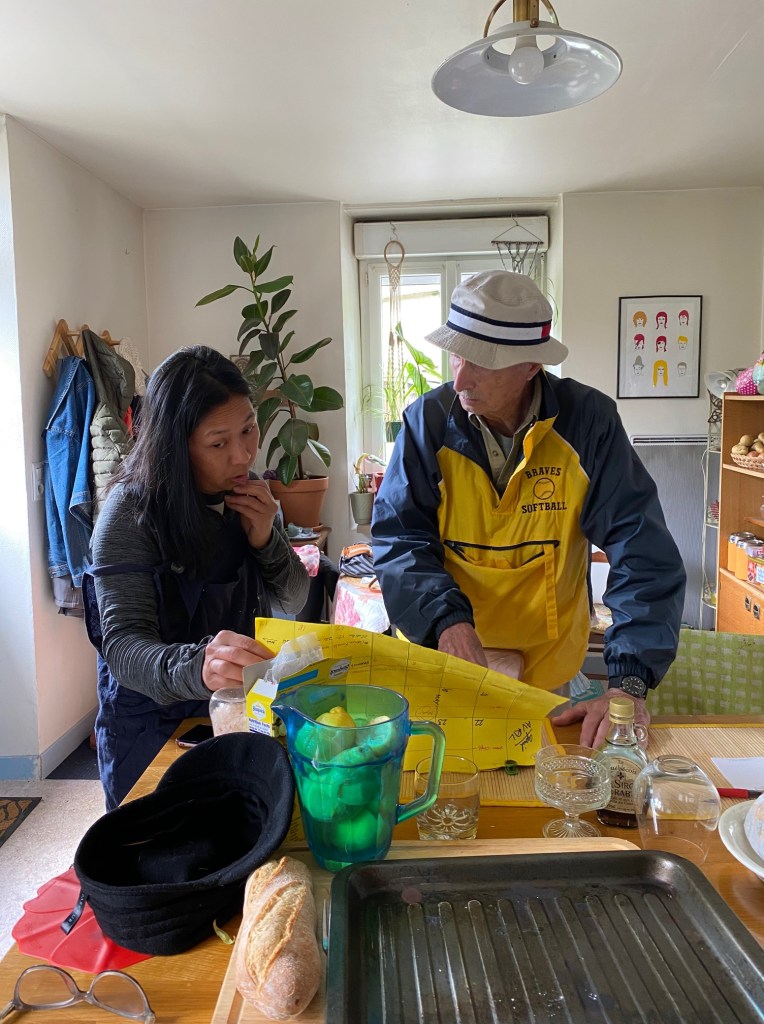
We had a bit of a scramble at first. We put Cliff up the first night but had guests checking into both apartments that weekend. So we moved him to a friend’s pilgrim hostile apartment for the following two nights, then back to us for two weeks. Now due to a previous reservation he’ll have to leave again, but we got him situated in a nice studio apartment in a rejuvenated vacation village at the top of town. They can accommodate his budget and host him for the next 2 months. He needed a spot where he could walk to town and to the grocery, and Domaine de Treignac fit the bill.
Cliff says he retired at 39 after making a mound of cash in the PR industry in Pittsburgh and NY and California, but then drank his money away. After sobering up, on $1200 a month social security he managed to save enough to do shoestring world travel a couple months a year by hitching and camping and relying on the kindness of strangers (one time he was adopted by a French actress and stayed at her place in Aix en Provence for two years).
Cliff has been everywhere and remembers dozens of small French villages, including many surrounding us in the Correze and Le Lot and in the Perigord and Dordogne. Of the villages we’ve both visited his memory is far more reliable than my own. He’s a vet who spent a few years in Seoul and when he told me he was an old Boy Scout I told him to help any ladies in town across the street. He said “I surely will, and right into my bed!”
We won’t make much money from Cliff’s stay because it’s been cold and he’s using the electric radiator. Even with the solar panels electric is very expensive. But it’s been amusing to hear his stories and see him each day and help him out with logistics. He’s always asking if he can do odd jobs or work in the garden, and when I say no he takes a stool and his kit into town to sketch and paint old houses and walls. Last night he emailed me a play he wrote about Marx, Carlyle, and Dickens.
We moved to France in June 2022. I figured “hey, living in Europe we can really see Europe!” But we’d started a small business. Then, my wife added a non-profit organization. We hired a contractor to do some work, we did some work. The garden in itself is a full-time job.
After a year and half, we hadn’t really seen Europe. We saw some really spectacular France (all within a couple hours’ drive of out place): the Correze of course, Lot, the Dordogne… But we’d had little opportunity to get out and explore new places beyond France. Our three trips since arriving here had been to Tunisia when Patricia got a teaching gig for a week, and two trips back home to the USA.
Then, friends from the International School of Panama got in touch. They were teaching in Croatia and Italy and planned to meet up in Civezzano in the Dolomites. It gave us the excuse we needed to shut down operations for 10 days and hit the road.
First Stop: Turin
Statues of Augustus and his uncle/step dad Julius bookend the Palatine Gate.
I’d heard about Turin as a small child watching the old “In Search of…” TV series with Leonard Nimoy. They did an episode about the Shroud of Turin, and showed monks dutifully tending it in its glass case high up on an altar. There was even a re-enactment of a monk saving it from fire in the 14th century. We went to see the Shroud, but because it is old AF and fragile (and likely also because it has been conclusively proven a fiendishly clever medieval fraud designed to milk cash out of pilgrims and wealthy donors alike), it is not on display any more, but is stored in an enclosed box visible through a glass window with a replica on foam core mounted for the curious. The faithful still come in droves and genuflect, and though I did not actually see the Shroud I did score a truly tacky holographic post card.
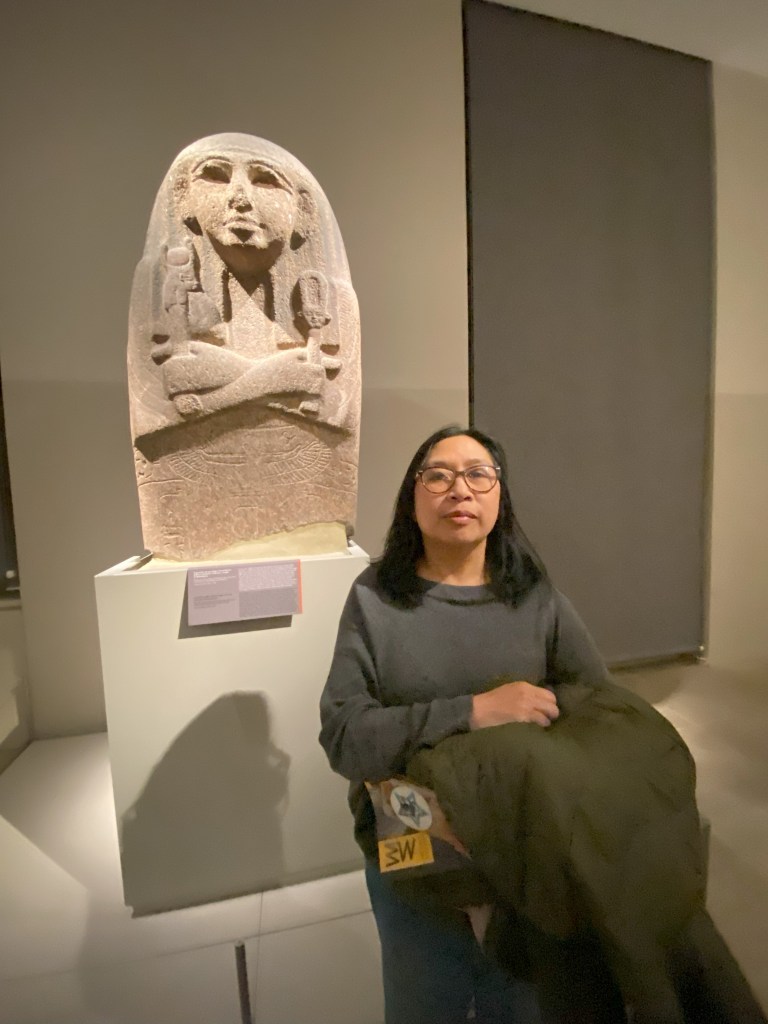
Just next to the cathedral housing the Shroud were some fab Roman ruins. Also nearby was an excellent outdoor market and an indoor multi-vendor restaurant space. Turin has many grand plazas and exquisite architecture spanning centuries and styles. It also has one of the greatest Egyptian museums outside Cairo.
We spent four hours exploring the magnificent Egyptian Museum in Turin.
Stop Two: Milan
We headed over to Milan where we were promptly stopped by the local police. They were very polite about detaining us by the side of the road for twenty minutes and carefully checking our French residence visa cards and passports.
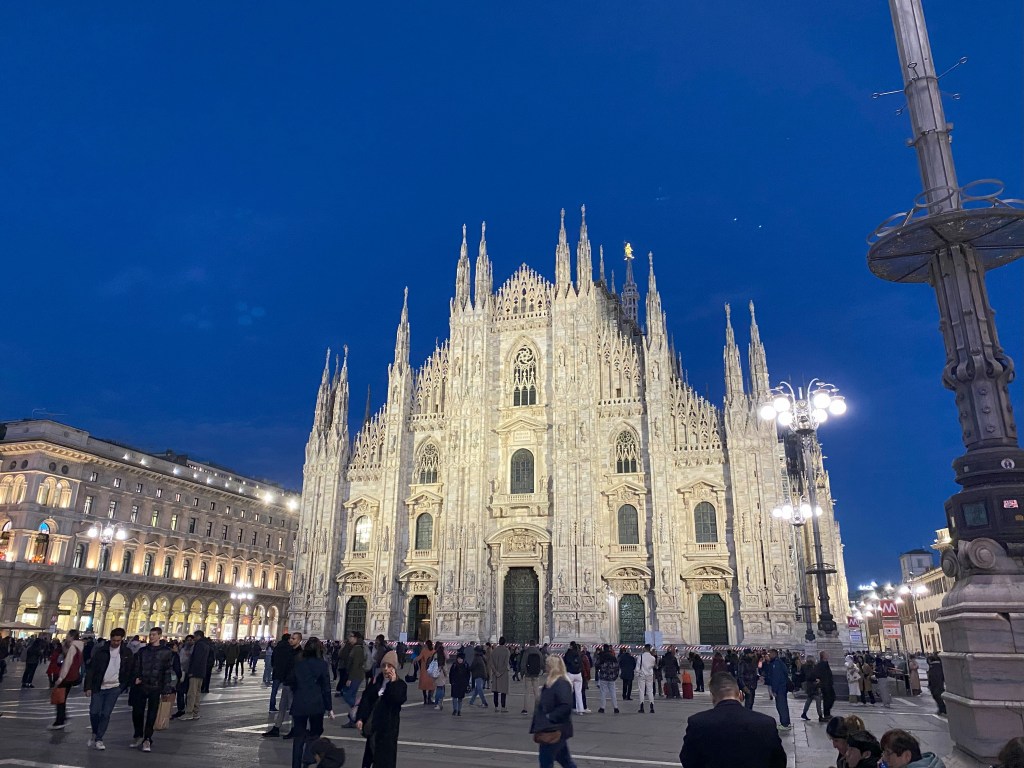
Nobody does outdoor public spaces like the Italians, with their marble paving stones and extraordinary buildings. Walking into the Piazzo del Duomo is quite an experience.
Piazza del Duomo, Milano
I’ve been visiting Europe since the early ’90s. Many things about travel there are far superior and more efficient than in the past. But one truly hateful change is the fact that access to these magnificent old structures is often via paid appointment. Gone are the days when tourists could wander into the Duomo and other nearby monuments with a Bedaeker’s in hand. Now you have to wait in a queue to purchase a ticket, or pre-book online, and travel guides have been replaced by Rick Steves videos and TripAdvisor.
But, totally worth it. I’m more of a Romanesque/Gothique guy, and the Duomo has been Baroqued to death. But it is spectacular and overwhelming. And you can ride a lift to the various roofs. Get up close and personal with those gargoyles!
Spectacular views of Milan and every square meter of the exterior of the Duomo is packed with luscious art. What’s not to like?
Milan is a bustling and vibrant modern city with all the restaurants. Because we live in remote rural France we often crave international foods we can no longer order for delivery–Indian, Thai, Mexican, Vietnamese, Ethiopian, etc. But you can get anything in Milan, and often a lot of food for under 12 euros. We had perhaps the best pizzas we ever tasted for lunch our second day and paid less than 23 euros.
Stop Three: Verona
I was a bit suspicious of Verona because of the whole Juliet’s House thing. Tourists waiting in line to touch the breast of a statue of a teenage girl who exists only in literature? Yeah, whatever. But we managed two days here without Romeo or Juliet interfering at all (I was curious about the museum in Juliet’s house–but we saw plenty of remarkable art in the Castelvecchio, the GAM, and at the Maffei Palace).
And, like Milan and Turin, the city Verona is itself a work of art. Every street and plaza in the old city is lovely. Check out the Roman Arena, stroll Piazza Bra, and head off in any direction at random. There are a handful of remarkable churches to see, in particular the Basilica of Zeno with its bronze doors and crypt to the African saint. I was terribly amused by the centuries of graffiti carved into the 13th century murals: “Hugo was here, 1453,” etc.
If you visit Trento, go to the Tourist Office by the Arena and immediately buy the Verona card, it is TOTALLY worth it if you plan to visit more than a couple museums or sites. We paid 35 euros each for the two-day card and it paid for itself and then some.
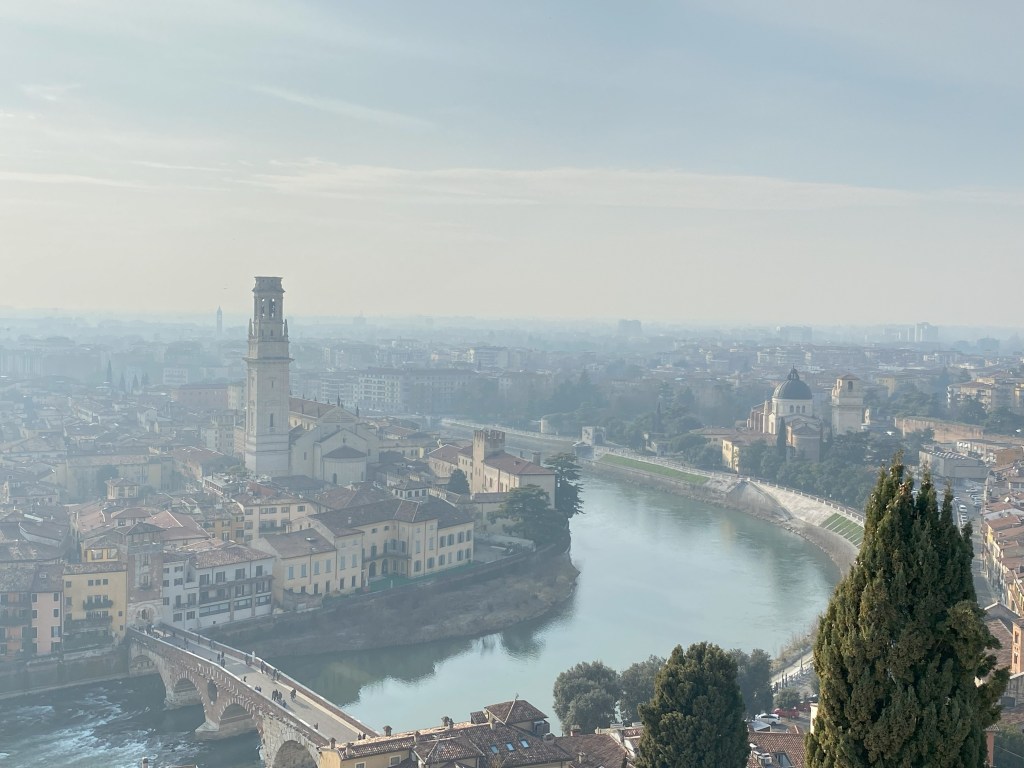
Ride the funicula up to Castel San Pietro for those money-shot pics. Even on a smoggy hazy global warming 70-degree February day it’s a great view of the city.
Stop Four: Trento/Civezzano
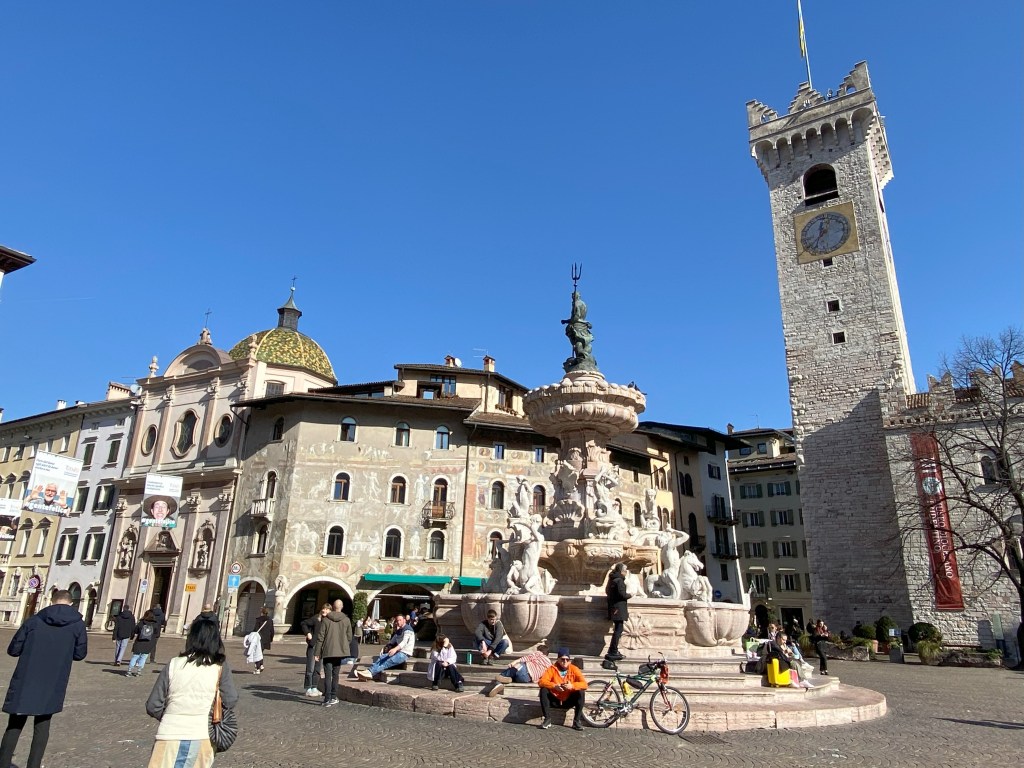
We toured a bit of Trento with friends from ISP in Panama. I said to Chris, who currently lives and teaches in Rome, “no one does public space like the Italians.” He said “it’s true–but good luck finding a park with trees!”
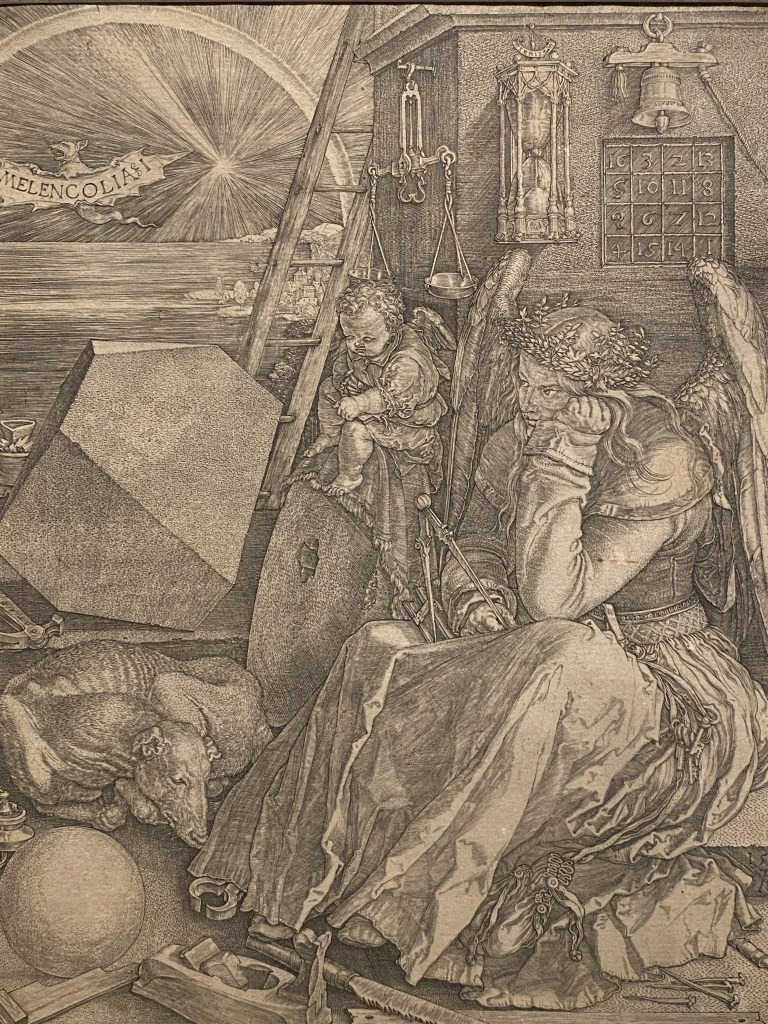
Civezzano, where we met friends and stayed for a couple nights, is a cute little town which functions as a base for skiers, but there was no snow on the surrounding peaks because of draughts and far warmer than typical winters. It has some nice old homes but not much else going on. On our way there we found the MART museum, which is a magnificent facility. And, we had the great luck to see an exhibition centered on melancholy featuring several engravings by Durer and Rembrandt, as well as more modern masters. There was also a massive show of current Chinese painting. The permanent holdings are substantial and definitely worth a stroll, even on aching 20,000 steps a day tourist feet.
Bonus: The MART museum accepts the Verona card for free admission!
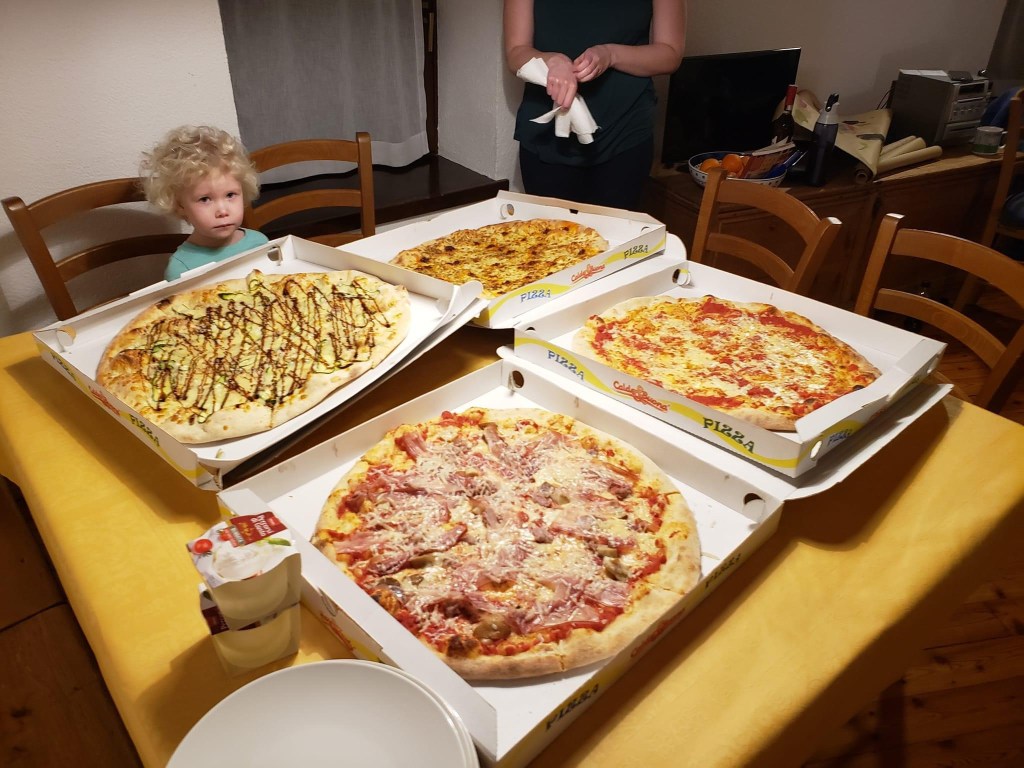
Civezzano has a tiny pizza joint which produces gigantic pizzas. Here is Harper wondering what the rest of us would eat.Truly a pleasure to get up close and personal with several Durer etchings at MART outside Trento
Stop 5: Bergamo Alto
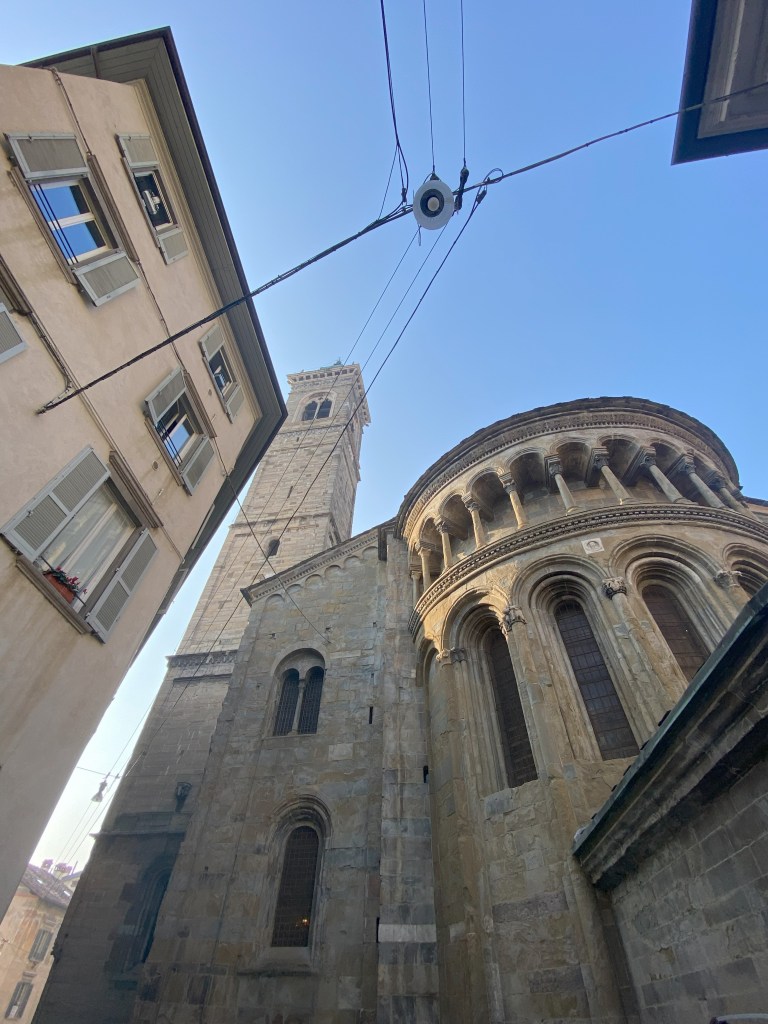
Perhaps the most walkable and warmest of the cities we visited. Magnificent shops and restaurants in centuries-old buildings, public art, more museums, more towers and churches.
Every corner of Bergamo Alto is a treat. Catch it in the late afternoon for that remarkable golden light.clever marketing to put the Hello Kitty and other cartoon shaped treats at child’s height





 Mysterium Coniunctionis