Some Milestones

These past two months have been a bit exhausting. We’ve hosted an open mic night with a full band, a harp concert, several workshops and a dance performance, as well as the usual run of weekly classes and ateliers. All of this on top of the two rental apartments ramping up into tourist season, the crush of garden maintenance, a quick five-day vacation in Spain AND working at the local street food festival, electrical and plumbing challenges, renovations, etc, etc.

We’ve also adopted a French bulldog, two baby goats, and four songbirds. I’ve put in at least 50 hours on fencing alone over the past three months–building the goat enclosure, then expanding it, adapting it as needed, and repairing it several times as the goats found weaknesses and pushed through.

And with all this work going on I’ve allowed some major milestones to pass unacknowledged here.

The Milestones

As of June 2024 it has been 6 years since we moved out of the USA. We left behind an elaborate social calendar, a Victorian rowhome filled with art and objects, political and business connections, the best next-door neighbors ever, our pet dove Godzilla (RIP), and a city with which we were infinitely familiar, where we’d carefully developed an intricate network of deep involvements over the years. And, of course we left behind beloved family members and dear friends.

But, I regret nothing. All of the challenges and myriad difficulties of being voluntary immigrants were worth the sacrifices. I was looking for a new push, a new means of developing skills and becoming a stronger and better version of myself, and moving abroad definitely pushed all my faculties to the brink on multiple occasions. I often thought about involuntary immigrants, those who have no choice but to migrate, and considered how my difficulties paled in comparison (while the privileges granted by my paleness greased many wheels for us). Our experiences in Panama–living in luxurious high-rises by the ocean, pushing ourselves professionally in a completely different environment than the Baltimore City Public School System at a swank international school, making friendships with locals and other expats from around the world, going routinely to beaches on two oceans, going into the mountains, rainforests, cloud forests, jungles, seeing wild animals, getting the most out of our crippled Spanish–we loved it all. Further, there is nothing more liberating (after the trauma subsides) of getting rid of all the stuff Americans accumulate over decades. So many possessions! It was a lot to let go but we learned how to do that.

As of the first half of June 2024 we’ve lived in France for 2 years. Our French expat experience has been much different from the Panamanian, and for beyond the expected reasons of climate, geography, culture, history, language, as well as living in a decolonized nation versus living in a former colonial power. In Panama we had jobs and an employer with lawyers and an HR department who handled the heavy lifting for us. For the move to France we did much of our own heavy lifting, with the help of an excellent hand-holding service based in Paris. And we had no employer, instead we started our own business, which I suppose counts as another milestone (In June 2024 we marked the two year anniversary of not working for The Man and became ‘self-employed‘).
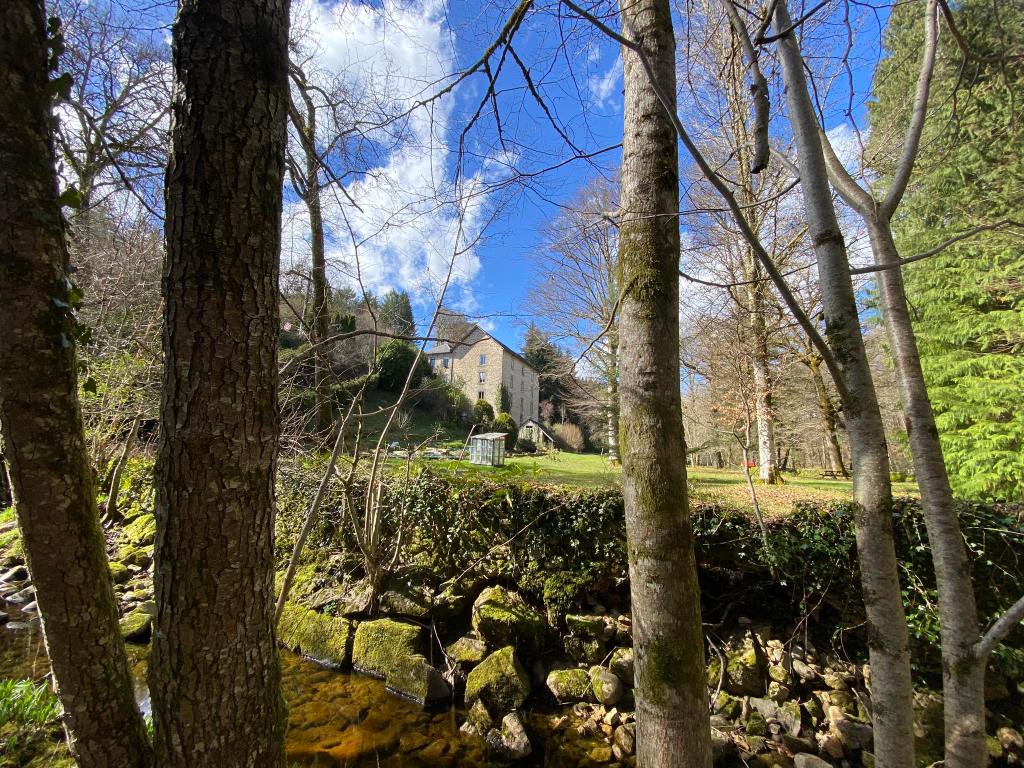
Our humble abode from an island in the Vezere River: Moulin Sage

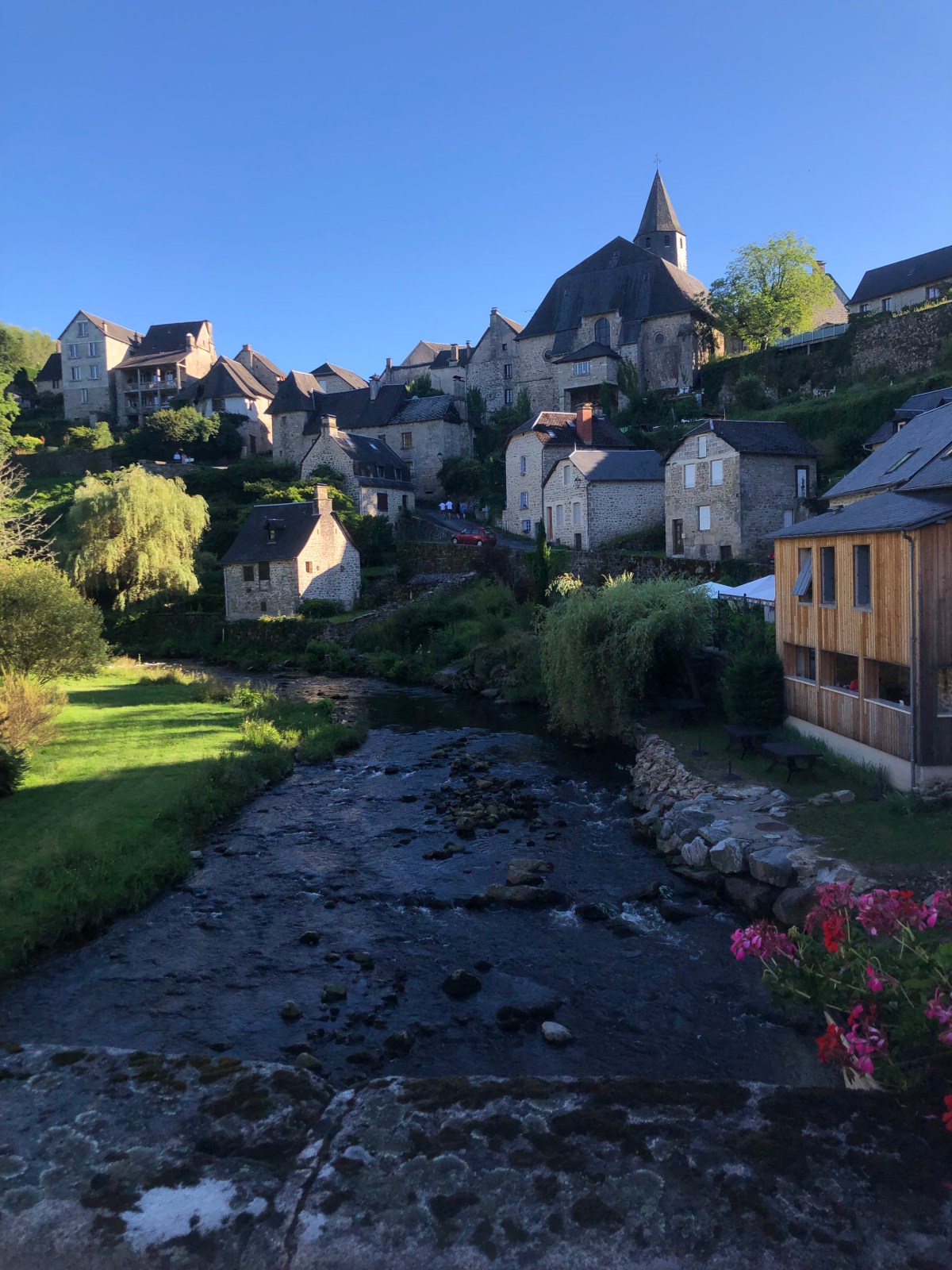
We are loving the Correze region of France. The village of Treignac has proved to be everything we hoped when we chose it after touring dozens of small medieval towns across France as we researched moving here. Many people in and around Treignac have helped and supported us as we work toward our goal of creating an event space/concert venue/professional development center/arts and crafts atelier/pop-up cafe/retreat center/eco resort/organic farm/anarchist commune/naturalist resort/vinyard/exposition space. Yeah, we live in a run-down apartment in a largely decrepit old factory building, but it’s the best life! People come here for concerts and shit, which amuses me no end (our first concert was a gathering of about 30 people to hear ellen cherry). People we need seem to arise by magic at the exact moment we need them–could we host yoga classes here? A yoga teacher appears. Can we find a contractor willing to use recycled or repurposed materials found in the mill to create new useful spaces? Tom puts a home-made flier in our mailbox. It’s been a blast, and quite exhausting at times. But it’s different working hard for yourselves and your clients and not for somebody else.

We earn about 8% of the income we had when we had jobs. But our stress and anxiety is way down, and we can afford to live a quality life here on a small income.
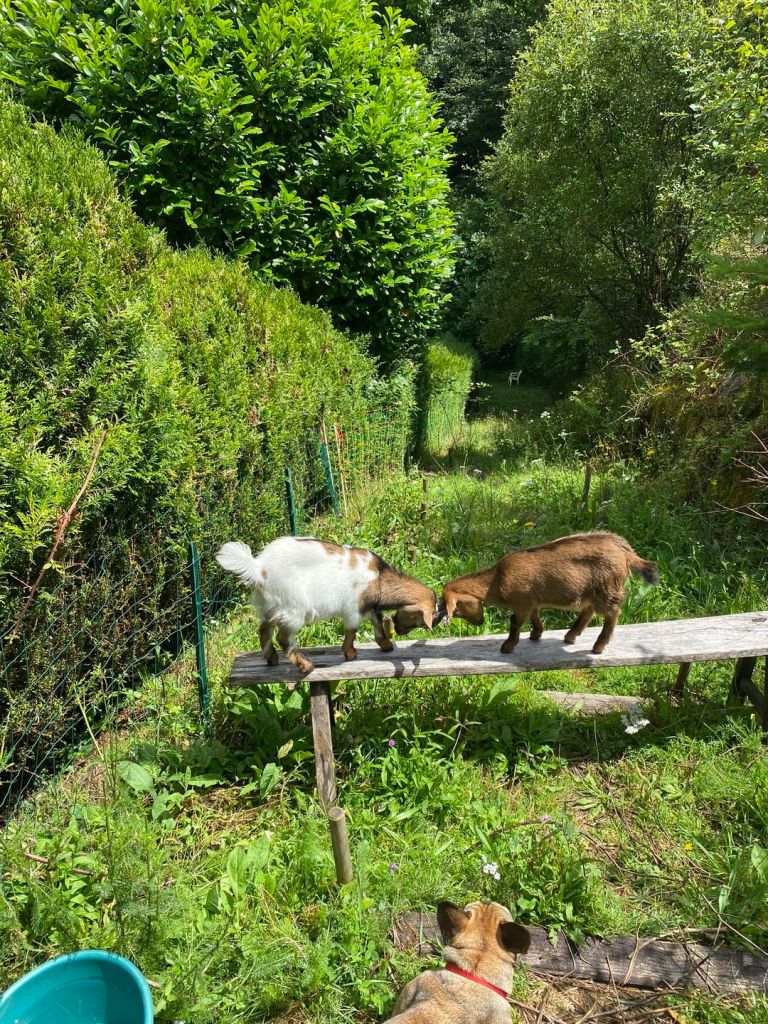
Our growing menagerie of small mammals: Cornichon, Capri, and Bou-Bou the Frenchie

On May 13th, I turned 55 years old

So being in my mid-fifties is pretty much the same as every other age I’ve been. Differences? My collection of unguents and gels has grown, my toes suddenly look like my grandfather’s toes, and I go to bed before 10pm every day. 85% of the time I feel physically like I’m in my early 30s–in fact, due to Tai Chi I often feel more limber than I did back then. But the other 15% of the time is where mid-fifties life gets interesting: 5% of the time I feel exactly my age, 5% of the time I feel like I’m in my 70s, and the last 5% of the time I’m stiff and sore and feel at least 90 years old. I can do renovation projects and work in the garden cutting and stacking and digging like a maniac no problem, and then get injured standing up from the couch or opening a pickle jar.

The biggest realization over the first half of this decade? Shut the fuck up. Keep your opinions to yourself, listen to what others have to say and shut the fuck up. Don’t participate in or encourage gossip of any kind. Petty annoyances and grievances? Let that shit go. This is the time to work on the inner self and start preparing for the next stages. What books to read, what books to re-read, what places to visit or revisit?–all of these questions become more delicate and nuanced. Typically American dudes live to be 75. Maybe I’ll get there, maybe not–maybe I’ll go beyond? But it’s time to start considering the fact that you’ve got a couple strong decades left, and how to spend them is a key consideration.

As of June 11, 2024, we’ve been married 30 years. How does this happen? In the blink of an eye we’ve been married 30 years. It really seems like our 20th anniversary party was just a few years ago. It’s been a true pleasure seeing my wife bloom since we moved abroad–unfettered by an employer she’s just madly arranging events and ateliers and adding more and more artists and craftspeople and creatives to her roster. But as my Baltimore 8th graders used to say, “she do too much.” Sometimes I get completely wiped out trying to run logistics and preparing for all the gazillion things she’s got going on, and yet she continues adding more and trying more. We have this amazing piece of garden and an old stone building and sometimes I’d like to rest on my laurels and set a spell in a hammock by the river. Patricia tells me “you have to schedule some days off when you’re self-employed or you’ll burn out,” and then she adds two more retreats and another workshop to the calendar and buys some massive thing on FB Marketplace that I have heft downstairs. But it’s all about the love, and there’s nobody I’d rather spend 24/7 with as a business partner and life partner and lover and animal co-parent. She is a dynamo with a world-changing mission and has no interest in slowing down a bit, and I could not be luckier to see it all up close.

Our Brief Italian Adventure

We moved to France in June 2022. I figured “hey, living in Europe we can really see Europe!” But we’d started a small business. Then, my wife added a non-profit organization. We hired a contractor to do some work, we did some work. The garden in itself is a full-time job.

After a year and half, we hadn’t really seen Europe. We saw some really spectacular France (all within a couple hours’ drive of out place): the Correze of course, Lot, the Dordogne… But we’d had little opportunity to get out and explore new places beyond France. Our three trips since arriving here had been to Tunisia when Patricia got a teaching gig for a week, and two trips back home to the USA.

Then, friends from the International School of Panama got in touch. They were teaching in Croatia and Italy and planned to meet up in Civezzano in the Dolomites. It gave us the excuse we needed to shut down operations for 10 days and hit the road.

First Stop: Turin

Statues of Augustus and his uncle/step dad Julius bookend the Palatine Gate.

I’d heard about Turin as a small child watching the old “In Search of…” TV series with Leonard Nimoy. They did an episode about the Shroud of Turin, and showed monks dutifully tending it in its glass case high up on an altar. There was even a re-enactment of a monk saving it from fire in the 14th century. We went to see the Shroud, but because it is old AF and fragile (and likely also because it has been conclusively proven a fiendishly clever medieval fraud designed to milk cash out of pilgrims and wealthy donors alike), it is not on display any more, but is stored in an enclosed box visible through a glass window with a replica on foam core mounted for the curious. The faithful still come in droves and genuflect, and though I did not actually see the Shroud I did score a truly tacky holographic post card.

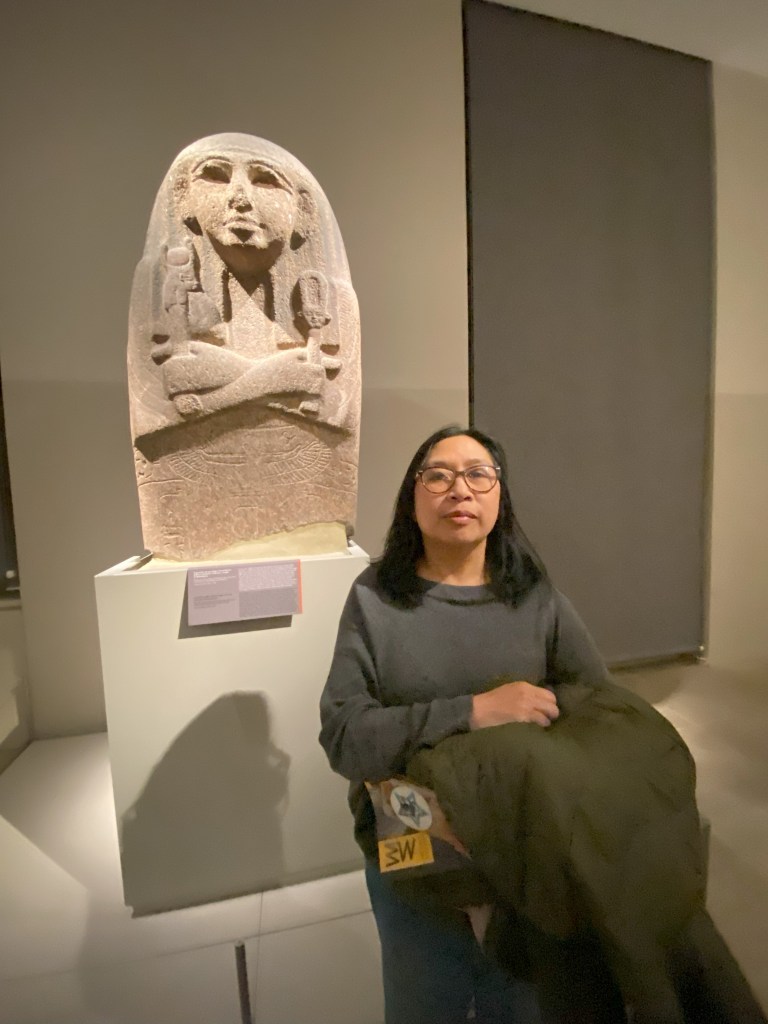
Just next to the cathedral housing the Shroud were some fab Roman ruins. Also nearby was an excellent outdoor market and an indoor multi-vendor restaurant space. Turin has many grand plazas and exquisite architecture spanning centuries and styles. It also has one of the greatest Egyptian museums outside Cairo.

We spent four hours exploring the magnificent Egyptian Museum in Turin.

Stop Two: Milan

We headed over to Milan where we were promptly stopped by the local police. They were very polite about detaining us by the side of the road for twenty minutes and carefully checking our French residence visa cards and passports.

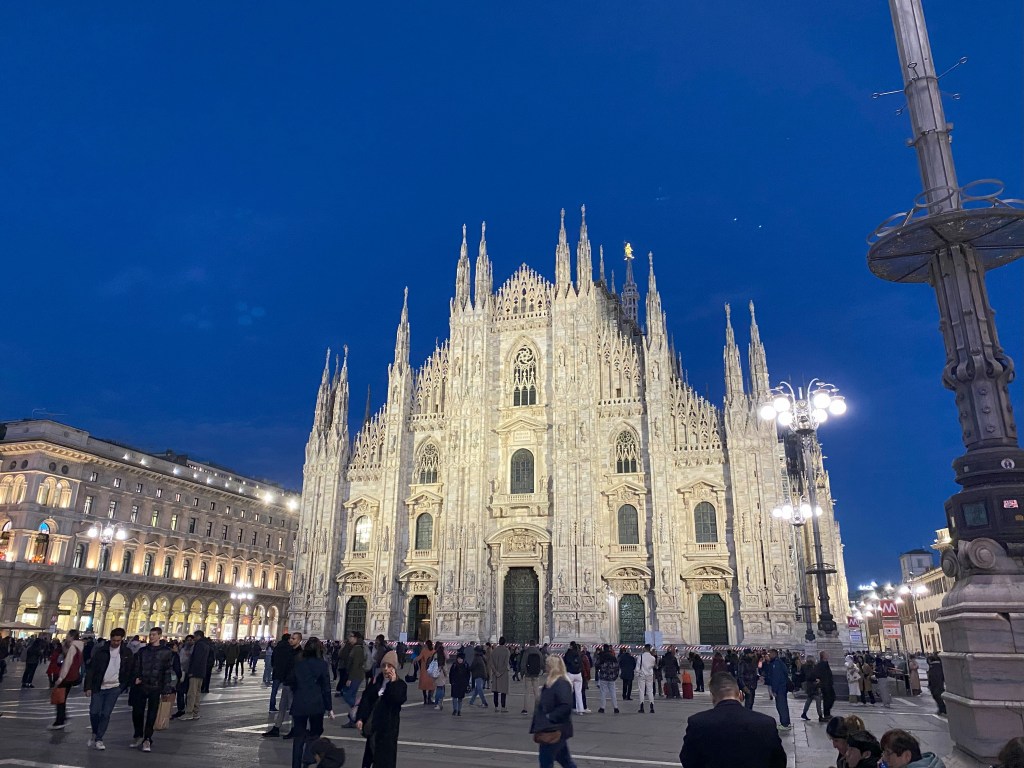
Nobody does outdoor public spaces like the Italians, with their marble paving stones and extraordinary buildings. Walking into the Piazzo del Duomo is quite an experience.

Piazza del Duomo, Milano

I’ve been visiting Europe since the early ’90s. Many things about travel there are far superior and more efficient than in the past. But one truly hateful change is the fact that access to these magnificent old structures is often via paid appointment. Gone are the days when tourists could wander into the Duomo and other nearby monuments with a Bedaeker’s in hand. Now you have to wait in a queue to purchase a ticket, or pre-book online, and travel guides have been replaced by Rick Steves videos and TripAdvisor.

But, totally worth it. I’m more of a Romanesque/Gothique guy, and the Duomo has been Baroqued to death. But it is spectacular and overwhelming. And you can ride a lift to the various roofs. Get up close and personal with those gargoyles!

Spectacular views of Milan and every square meter of the exterior of the Duomo is packed with luscious art. What’s not to like?

Milan is a bustling and vibrant modern city with all the restaurants. Because we live in remote rural France we often crave international foods we can no longer order for delivery–Indian, Thai, Mexican, Vietnamese, Ethiopian, etc. But you can get anything in Milan, and often a lot of food for under 12 euros. We had perhaps the best pizzas we ever tasted for lunch our second day and paid less than 23 euros.

Stop Three: Verona

I was a bit suspicious of Verona because of the whole Juliet’s House thing. Tourists waiting in line to touch the breast of a statue of a teenage girl who exists only in literature? Yeah, whatever. But we managed two days here without Romeo or Juliet interfering at all (I was curious about the museum in Juliet’s house–but we saw plenty of remarkable art in the Castelvecchio, the GAM, and at the Maffei Palace).

And, like Milan and Turin, the city Verona is itself a work of art. Every street and plaza in the old city is lovely. Check out the Roman Arena, stroll Piazza Bra, and head off in any direction at random. There are a handful of remarkable churches to see, in particular the Basilica of Zeno with its bronze doors and crypt to the African saint. I was terribly amused by the centuries of graffiti carved into the 13th century murals: “Hugo was here, 1453,” etc.

If you visit Trento, go to the Tourist Office by the Arena and immediately buy the Verona card, it is TOTALLY worth it if you plan to visit more than a couple museums or sites. We paid 35 euros each for the two-day card and it paid for itself and then some.

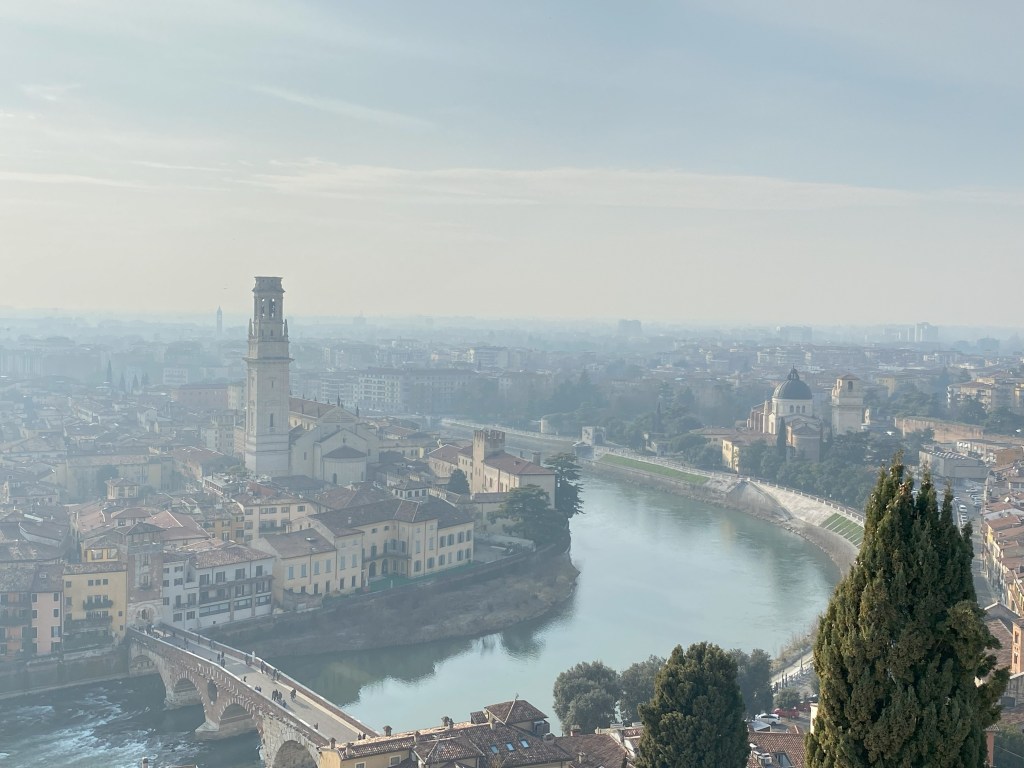
Ride the funicula up to Castel San Pietro for those money-shot pics. Even on a smoggy hazy global warming 70-degree February day it’s a great view of the city.

Stop Four: Trento/Civezzano

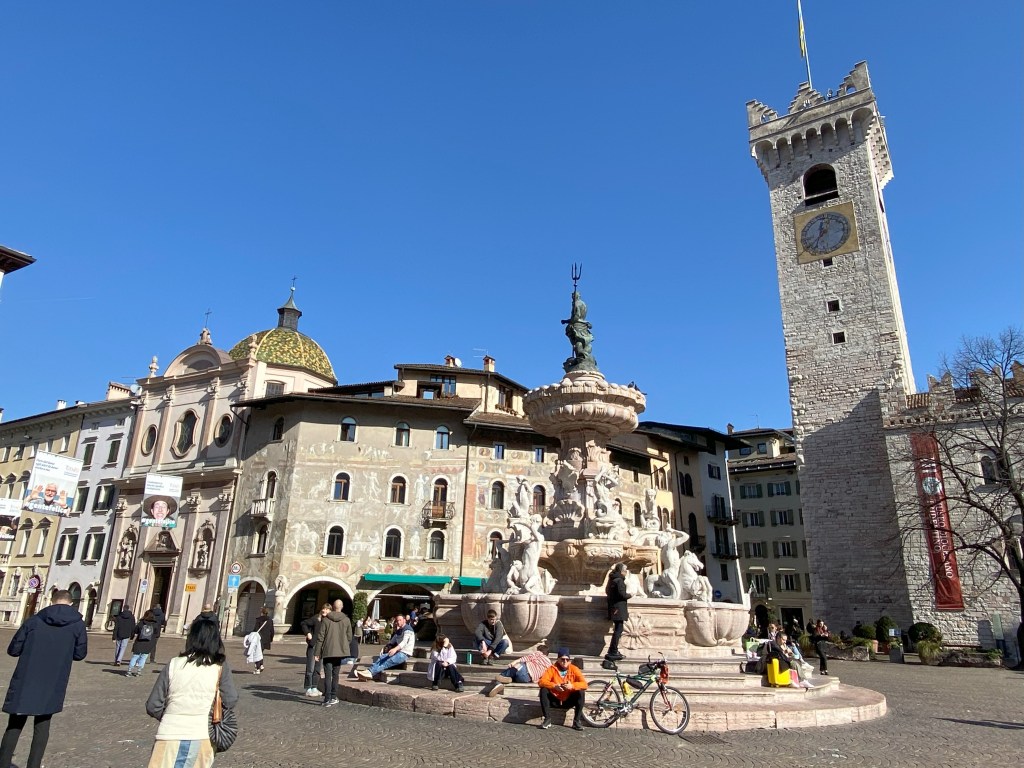
We toured a bit of Trento with friends from ISP in Panama. I said to Chris, who currently lives and teaches in Rome, “no one does public space like the Italians.” He said “it’s true–but good luck finding a park with trees!”

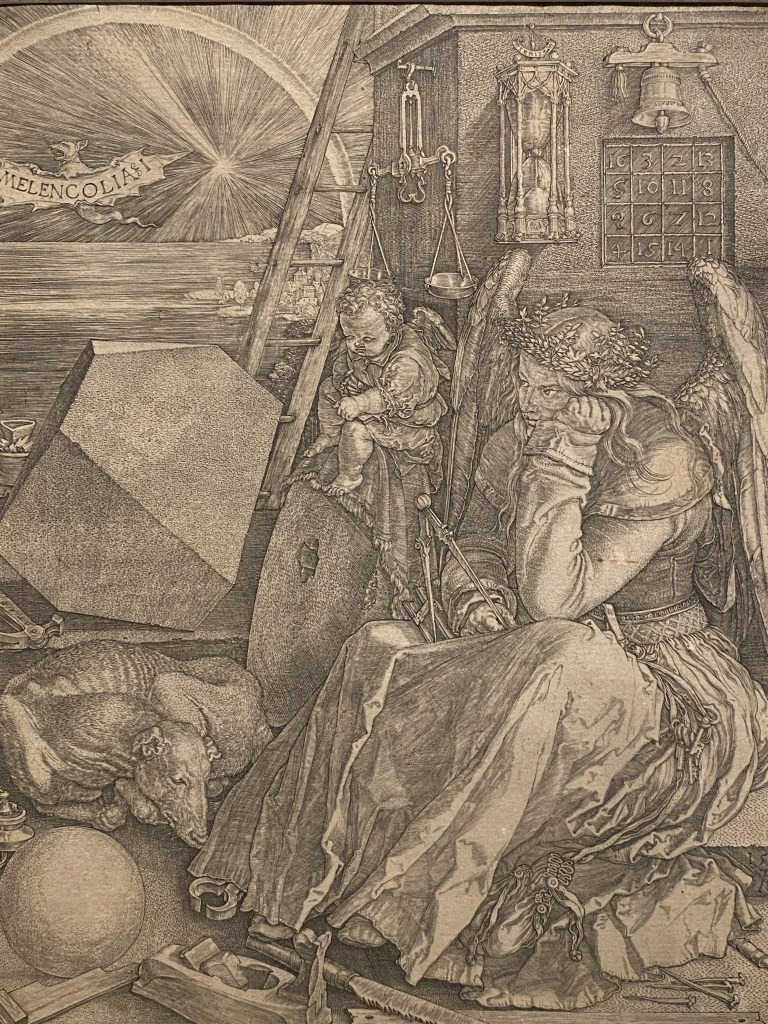
Civezzano, where we met friends and stayed for a couple nights, is a cute little town which functions as a base for skiers, but there was no snow on the surrounding peaks because of draughts and far warmer than typical winters. It has some nice old homes but not much else going on. On our way there we found the MART museum, which is a magnificent facility. And, we had the great luck to see an exhibition centered on melancholy featuring several engravings by Durer and Rembrandt, as well as more modern masters. There was also a massive show of current Chinese painting. The permanent holdings are substantial and definitely worth a stroll, even on aching 20,000 steps a day tourist feet.

Bonus: The MART museum accepts the Verona card for free admission!

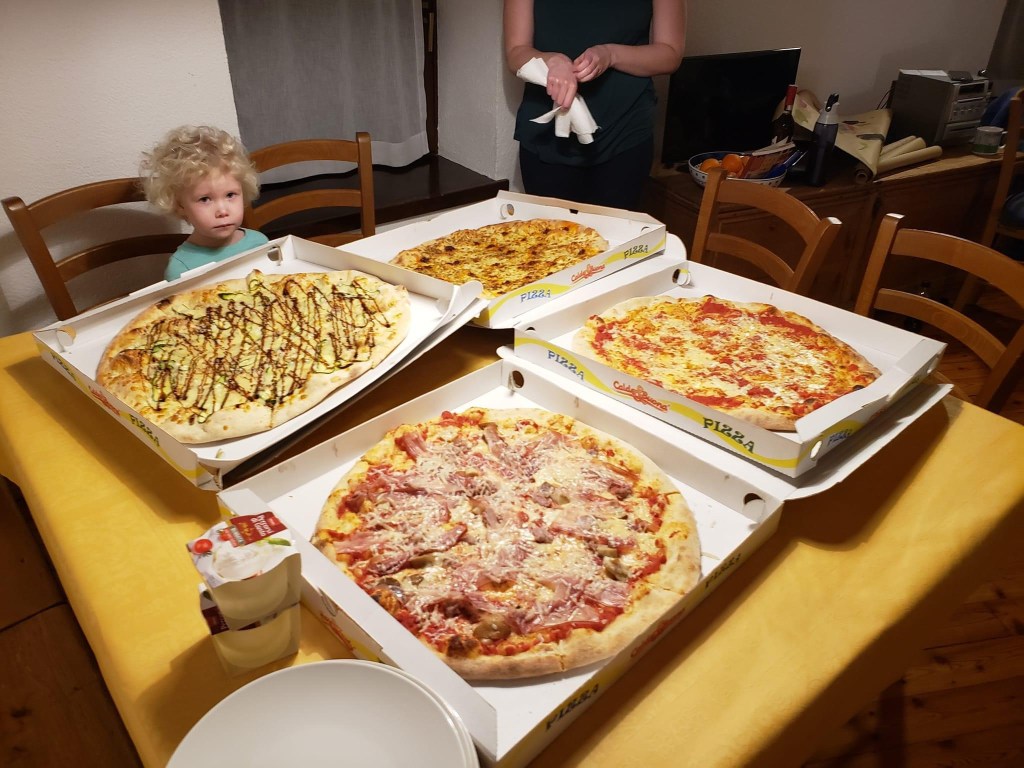
Civezzano has a tiny pizza joint which produces gigantic pizzas. Here is Harper wondering what the rest of us would eat.
Truly a pleasure to get up close and personal with several Durer etchings at MART outside Trento

Stop 5: Bergamo Alto

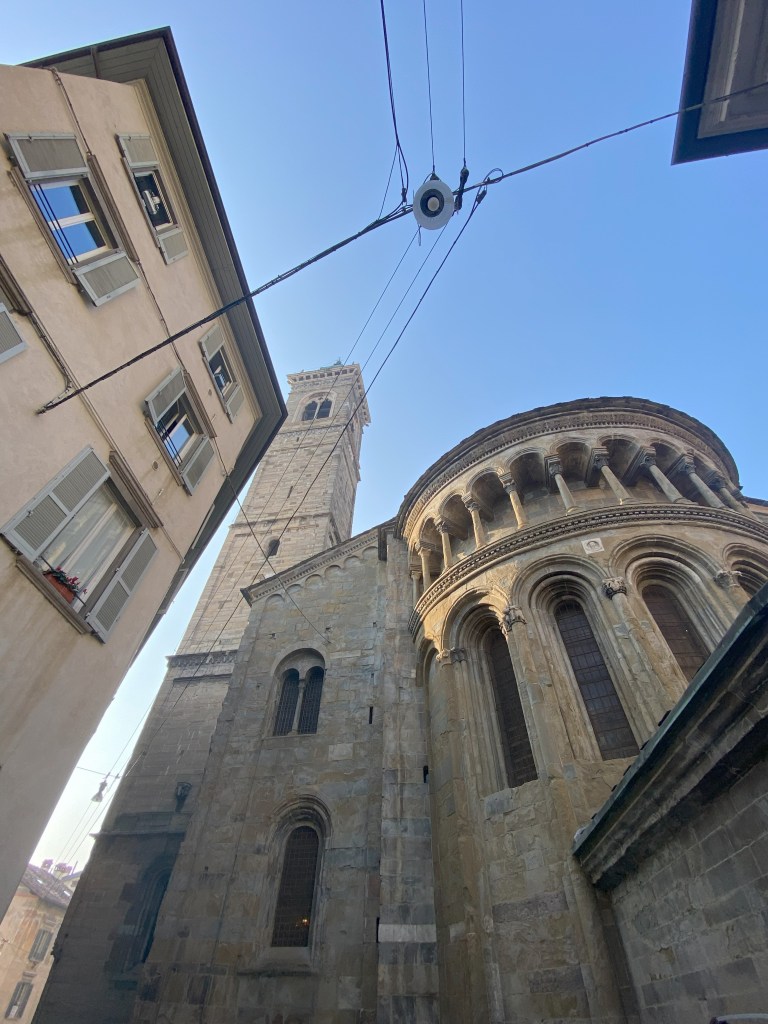
Perhaps the most walkable and warmest of the cities we visited. Magnificent shops and restaurants in centuries-old buildings, public art, more museums, more towers and churches.

Every corner of Bergamo Alto is a treat. Catch it in the late afternoon for that remarkable golden light.
clever marketing to put the Hello Kitty and other cartoon shaped treats at child’s height

Mother Nature

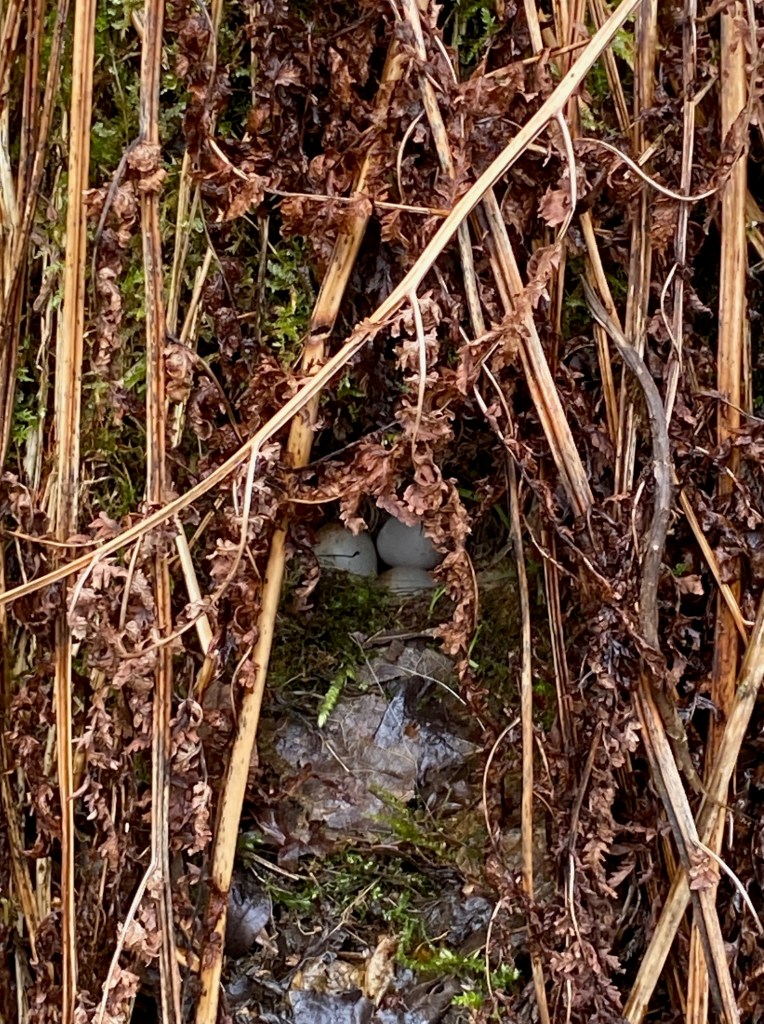
Back in the early spring I was cutting brambles and digging out weeds and noticed in the side of a steep hill on our property that there was a tiny bird nest.

Inside the nest were three very tiny eggs. In this part of France there is a law that one cannot cut hedges between March 15 and July 31 because of nesting birds, and I take this rule seriously. I pay attention to all the birds I see and like to observe breeding pairs and note where they hang out. This nest made me very happy because it was in the ground and easy to see when I walked up and down from the garden daily. The mother would often flit in and out as I worked nearby.

Last week I noted that the eggs had hatched, and I could see moving chicks in the nest. I didn’t stay to watch or examine because I didn’t want to cause anxiety in the mother, who I figured was close about and foraging. Again I was quite happy to see these babies and to think about nature and its small miracles. Often a trip to our garden is like an un-narrated David Attenborough special.

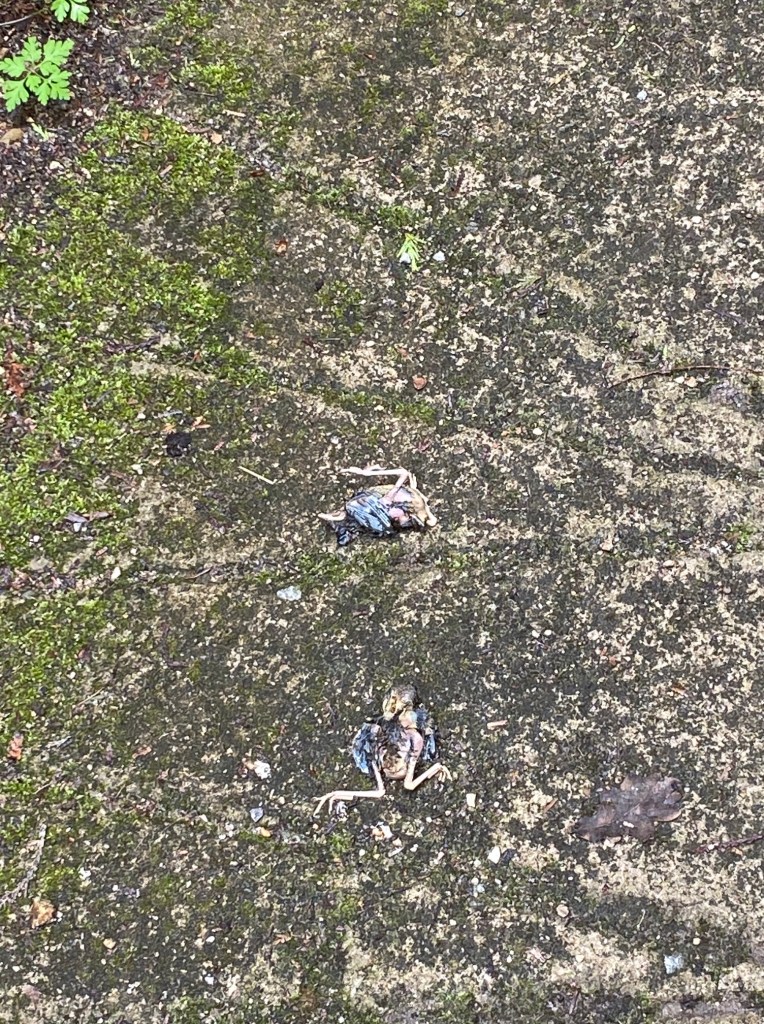
But shortly after I noticed the chicks had hatched, I found two of them on the cement path early in the morning.

I don’t know if they fell out, or were pulled out by a mammal, or if the mother had cast them out (which happens sometimes). I did hear and see a cat very early that morning on the other side of our building. One chick was completely gone, the other two were left behind.

How devastating! My entire day was colored by this discovery. I’d looked forward to seeing these little guys go through adolescence and thence into the world, ideally to return to our garden with mates to create future generations. I thought how cruel Mother Nature can be!

But of course Mother Nature is not cruel, she is indifferent and neutral. Can’t have yang without yin, after all.

I feel for the mother, who worked so hard! Hopefully she and her mate try again next year with more success.

Re-Wilding

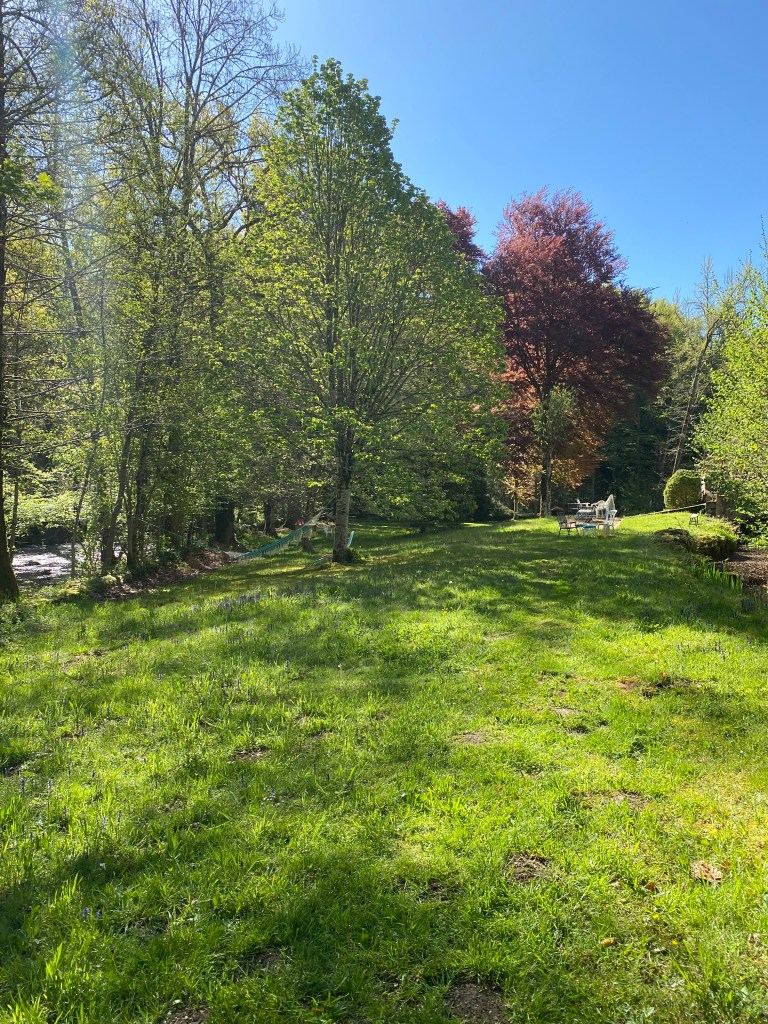
Our lawn from its north end–the Vezere River is to the left, and the canal from the days when our building was a mill runs along the right.

We have 1.6 hectares of land along the Vezere River in Correze. That’s almost exactly 4 acres for those of you across the pond. About 2 acres is a relatively flat lawn, the rest is on very steep hillside including a section of forest.

It takes about 2.5 hours to mow the “lawn” here, which is combination of moss, lichen, weeds, dandelions, and about five different types of grass.

Last Thursday I noted how the bees and butterflies were excitedly flitting around the wildflowers in our yard, and decided not to mow for a couple extra days. Then on Sunday my wife invited a half-dozen people over for an impromptu garden BBQ. It’s really hard for me, raised as I was in the USA, to have an “unkempt” lawn when there are guests over, and as tourist rental hosts, we often have guests!

In the USA, of course, the aesthetic expectations for lawn care are quite rigid. There must be a uniform coverage by one specie of grass, cut short and tended regularly. Any flowers or plants other than that specie of grass must be confined to carefully bordered beds or containers. If there is dandelion, or clover, or crabgrass, or anything else in the lawn, it must be pulled up by the roots or bombarded with chemicals to destroy it. I was indoctrinated as a young man into this way of seeing outdoor living space, and it’s hard to escape those expectations.

But those expectations have nearly eradicated many pollinators and bird populations.

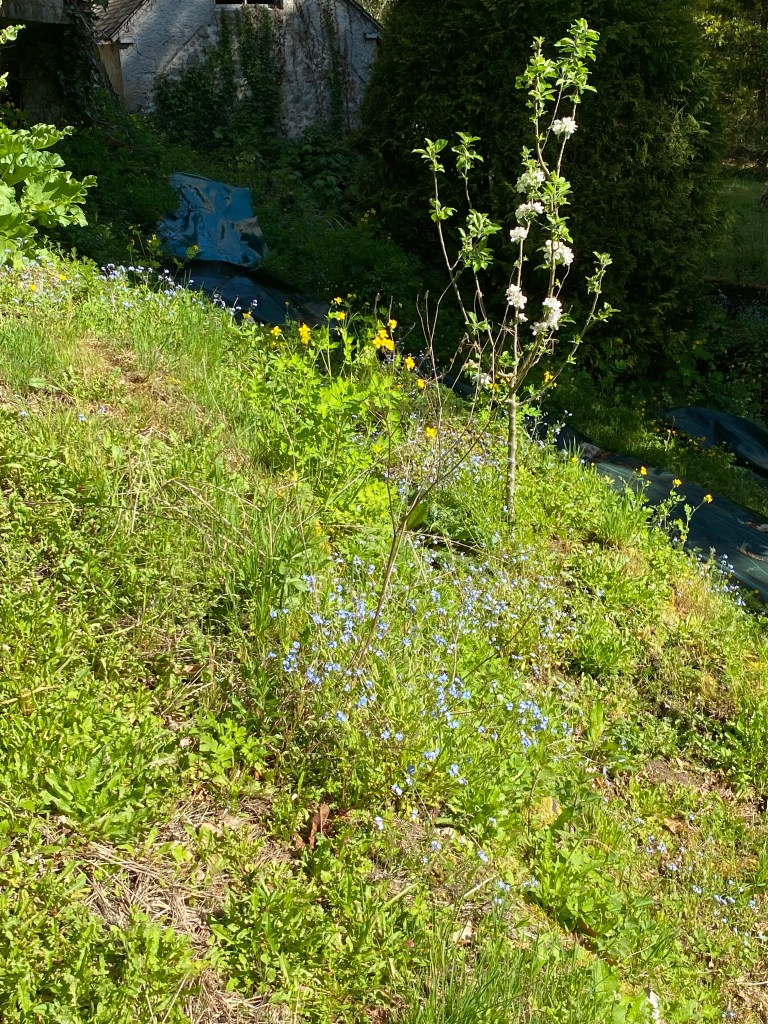
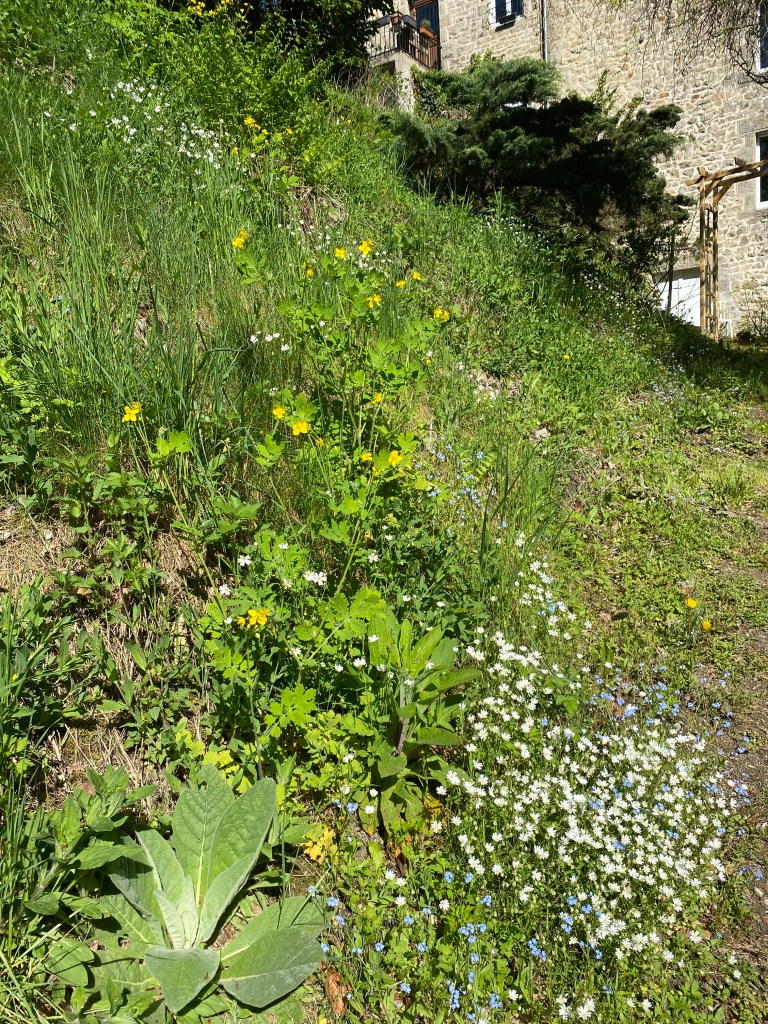
We have a three-tiered veg garden dug into one of the steep hills on our property. I’m allowing the spaces around the veg beds and fruit trees to go nuts.

Our guests at the BBQ were unconcerned that the grass was a bit overgrown and that there were wildflowers and dandelions everywhere. In fact, they marveled at the variety of butterflies and bees. They insisted that I should re-wild large parts of the lawn section of our garden. “Just cut a path around several islands of rewilded earth,” one suggested. Another said “We stopped mowing our lawn at our previous house in France and were amazed at what came up–it was quite lovely without any tending at all.”

So when I finally got around to mowing yesterday, I swerved around large clumps of wildflowers. I cut a few flat sections where we keep tables and chairs for guests, and left a patch of lawn appropriate for lounging on blankets or for a game of soccer/volleyball/what have you. I cut a meandering path around several large islands which I left natural. We will see what comes up.

The bees and butterflies were very happy with the decision. And, after having reduced 2.5 hours of mowing to about 35 minutes–so was I!

These steep hillsides on our property are very difficult to cut–but with all the wildflowers perhaps I should let them go feral?

An Adorabe Infestation

We figured along with all the upsides of living in France and running a tourist rental biz that there would inevitably be problems. Our apartments are functional and comfy but they are not fancy, and we expect that at some point there will be plumbing and electrical problems, or leaky roofs, etc.

But our first major problem has been a spring insect infestation. Of course in a rural area one expects lots of bugs, and we’ve had in our apartment: flies, bees, beetles, spiders, and ants. But until this spring there hasn’t been a problem with bugs in the rentals. Since April, one of our rental apartments has been over-run with lady bugs (lady birds to our friends from the UK).

We’ve had several guests who stayed in the gite with the lady bugs running rampant–all of them have been super polite and understanding. I’ve been warning incoming guests that sometimes lady bugs enter the apartment and no one has backed out. One fisherman said they only bothered him when they landed on his tablet screen or his shoulders.

In early April there were HUNDREDS of lady bugs on the ceiling. It happened in our apartment as well. I really don’t mind–I sweep them up into a dustpan and release them outside whenever I see them. But my wife is the only human being in history who is terrified of ladybugs. She can’t abide them, and refuses to touch them, and tries to capture them with long-handled spoons, which is hilarious to watch. Whenever she sees one she becomes ferociously angry, despite having lived in the tropics for four years where insects all up in your grill is simply a fact of life.

So far our guests have been understanding. I told them I am reluctant to use chemicals or to call a professional because we are trying to be eco, and all our clients have been in accord with this, and one woman actually swept them herself and put them in our garden. “J’aime beaucoup les coccinelles!” she said.

I’ve tried several online folk remedies, but nothing works (vinegar, BTW, is always a remedy for everything–it does not, however, cover the pheromone trail which attracts lady bugs back inside). Now that the weather is warmer at night they seem to have stopped coming in–I hope that remains the case, because eventually someone is going to object to lady bugs all over the place on their vacation.

I suppose if one must endure an infestation in France, that having it be swarms of lady bugs is perhaps the best option. After all, at every local market there is some craftsperson selling ceramic lady bugs, hand-painted lady bug tiles, or embroidered lady bug pillows, or lady-bug t-shirts. They are black, red, orange, yellow, they eat aphids, and they are adorable!

The Tao of Treignac

Trying to choose a village in France to set up a small tourist rental biz was a challenging process. There were a lot of things to consider, we had very limited resources, we did hours of online research. All of that culminated in a three-week journey from Paris to Limoges and then all the way over to Marseille and back a couple summers ago.

There are literally hundreds of small towns in France which are charming and where houses are inexpensive. Many of these villages, however, are in decline. The businesses are closed, there are no young people, the tourists might drop by to see the local church or to do a hike, but they don’t stay or spend money. We visited a few dozen towns, some of which were magnificent and had exactly what we were looking for at very low prices.

But too often it was obvious that a town was fading irrevocably. Risking one’s life savings on a town without the potential to make a living was something we had to consider carefully.

We hit Treignac twice on our initial visit. It checked off several boxes: A medieval town with layers of history, a charming natural setting with a river and lakes, forests and mountains, a modern supermarket and hardware store, some small local specialty shops, a nice expat community of folks from the UK, proximity to a few larger cities. And, most importantly, an outdoor sports infrastructure and a developed beach at a lake which attracts tourists from late spring into the fall. Treignac had an energy that was missing in many other similar towns across south central France. And the population had actually increased lately.

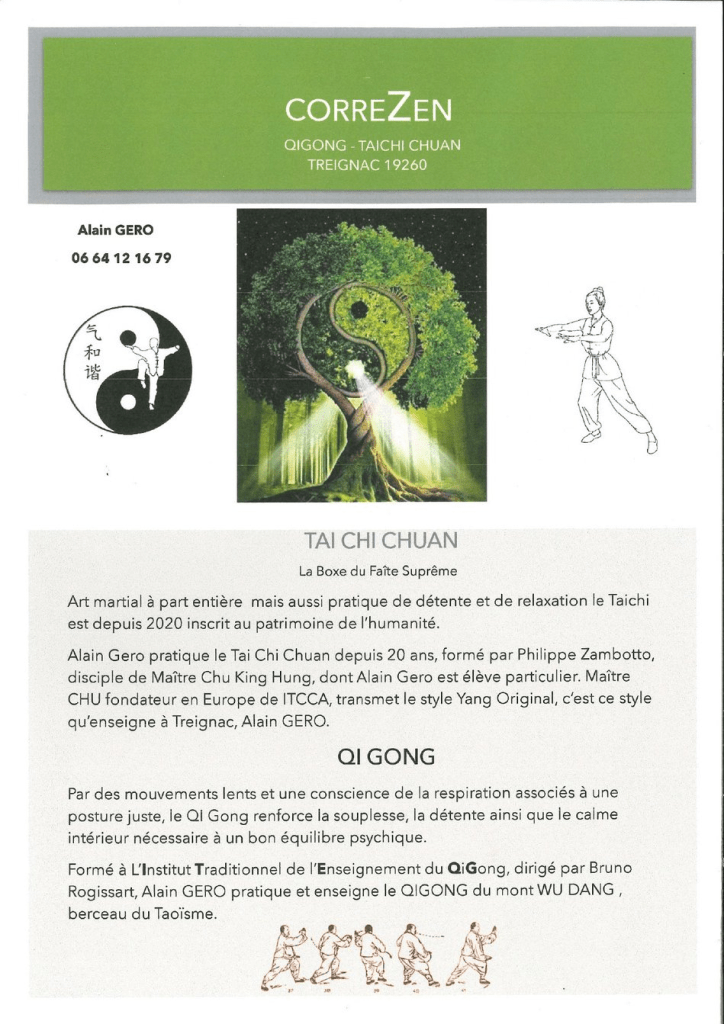
One quite pleasant surprise here has been a Tai Chi course. For $40 a year we get three 90-min classes a week, two focused on Tai Chi and one on Qi Gong. Fifteen years ago I took two years of Tai Chi in Baltimore and I’d continued practicing on my own ever since. Having the opportunity to learn a new form and practice with a highly skilled teacher was something I never expected to happen in a village of under 1300 people in rural France.

Our instructor is nearly 70 but looks and moves like a man in his early 40s. He studied with a master from China and has a certification from the French government as an instructor. He is a patient, funny, and serious practitioner and instructor and gives detailed personal feedback. I’ve been doing Tai Chi and mindfulness for a long time and he has broken my bad habits down and rebuilt my practice in just a few months.

I hope to learn the full Yang style form with Alain. So far we have completed and are fine-tuning part I, ‘The Earth.’ Next up is Part II, ‘Man.’

It’s been a huge adjustment going from 20 years teaching and having either a small yard or no yard to having a massive garden on multiple levels to maintain. Often the work is intense and as an oldie I get stiff and sore. Tai Chi and Qi Gong have been a huge help in keeping these old bones limber, and as I reconnect to the natural world a bit of Taoist philosophy and attentiveness to my body and its connection to the universe will continue to ease my aches and pains.

Living in Another Language

In the USA there is an unfortunately large group of people who are absolutely intolerant of anyone who speaks other than English. These people often get exasperated and even violent when they hear others speaking Spanish on the street, or when a shop or restaurant is playing the TV or radio in another tongue. Spanish of course was spoken in large areas of what is now the USA LONG before English…

But any American who has had the experience of living abroad in a place where English is not the primary language understands immediately how difficult and how taxing it is to become comfortable in another tongue.

We lived in Panama for four years. I never got my Spanish up to snuff while living there. We worked for an international school and all teaching and learning was required to happen in English, we gravitated socially to staff and expats who spoke English, we were in lockdown for almost an entire year during covid–there are lots of excuses I can make. On top of these reasons, the Spanish in Panama is quite ‘gummy’ and difficult for an untrained ear. Words are lopped off casually and crammed together. The pace is rapid but the articulation is laconic. It’s beautiful to listen to but challenging to comprehend. Nevertheless, I was able to navigate my way through basic conversations by the end, to feel confident in restaurants and shops, and I even got through a hospital admittance process when I had to get a hernia operation, totally in Spanish. But my Spanish remained at the level of an early elementary student’s.

When we travelled to Colombia or Mexico, however, I could comprehend the Spanish much more easily. Every consonant and syllable was carefully articulated. Riding in a hired car from Medellin to Guatape I had a 3-hour conversation with the driver. I noted his name was Alain which was not a Spanish but a French name, and he told me his mother was a fan of the French actor Alain Delon and his mysterious green eyes. I told Alain how much more easily I understood his Spanish than the Panamanian Spanish and he said ‘they speak that soft Caribbean Spanish over there.’ Others we encountered said that Panama was full of hicks and was regarded as the equivalent of Texas in Colombia, with its own peculiar language.

When we left Panama we flew directly to France and spent a couple nights in Toulouse to adjust to the time difference. French felt easy and after struggling for four years in Spanish I was immediately much more confident in a language I’d studied extensively as a young man. When we arrived at the house we were buying the owner had set it up so we could stay in the gite apartments for a couple days before settlement. He gave me long, detailed tours of the house and instructions about the systems and how things worked. Then, we went through the notary process and the purchase. I was surprised at how quickly French returned after 2 decades of under-use. But it was EXHAUSTING. I wasn’t thinking in French, I was translating in my head. I became so tired and frustrated after a few days that I wanted simply to sleep for a week.

But we had clients in one apartment the very first day–no rest for the weary!

I still have great difficulty listening to French radio or watching movies. I read much better than I hear! Subtitles for films are necessary but the colloquialisms and slang phrases are beyond my ken. I work on trying to improve daily by revisiting old text books I used before ( French for Reading currently is helping a lot). I also subscribe to and read a couple journals and try to go beyond the “quick tour” of apartments with clients and to engage in a bit of conversation with them. And: novels. Balzac you are killing me!

There are many people here in town who are native English speakers, most of whom have lived in France for more than a decade. The majority of them speak almost no French at all. An Australian friend who moved here last year got a phone call when we were out to dinner and immediately thrust his phone at me because the speaker was French–it was a real estate agent calling about a property he’d seen. When I handled this fairly simple phone transaction our Aussie mates thought I was some kind of wizard.

Most French people, even out here in the rural Correze, are quite patient with those who can’t speak French. I wish folks back home could be like that: don’t judge someone for not speaking your language. Be empathetic and compassionate with them. It’s really difficult to pick up another tongue. Try it and you’ll see.

Jobless

It’s been a bit more than 10 months since we arrived in France. We quit our jobs and used 85% of our savings to buy an old mill in a small village in the Correze. We are “jobless,” in the sense that we’ve dropped out of the system which requires you to show up at a place of employment and subject yourself to the whims of an employer for huge swaths of your life.

But we are hardly “not working.” Today, for example, I weed whacked for two hours, I cut down scrub brush and overgrown ivy and dead trees for two hours, I prepared two rental apartments for overnight guests and greeted them and toured them around (in French). My wife and I carted barrows full of gravel down from the street level at our property to the garden where we intend to set up a glamping tent.

Tomorrow we will have to clean the apartments and do laundry and prep them for the next guests. We don’t make anywhere near the money we used to make when we had salaries–but we make enough. We own our property free and clear. We have solar panels. We have a basic and simple life, and I’m starting a vegetable garden. The goal is to have a business sufficient to live a simple and comfortable life without all the rat race BS we faced for decades in the USA. And 10 months in, we are doing so.

Whatever your dream is–whatever it is that you wish you could do, or hope to do someday–do it NOW. Stop buying into the culture that you must rent yourself to a corporation in order to be successful and happy. Get out of that mindset. It’s not easy. The visa renewal process and French taxes are driving me crazy! But–you can live by a river in an old mill in France (or wherever you want) for a fraction of the price of a condo in DC or NY or Vegas. Do it now!

We have two families of four staying over tonight. They had luck with the weather and spent their first few hours here in the garden exploring. They told me how cool our place was and they took many photos of our building and the river, and their kids ran around kicking a soccer ball and having a blast. That is all I need. I don’t need a big salary and retirement. I don’t need 65 hour work weeks and stress.