Melville first entered my consciousness the way much of history and culture did when I was a wee tot–via cartoons. I think my first encounter was a Tom and Jerry cartoon featuring Moby Dick but renamed Dicky Moe? And of course I likely encountered the film version directed by John Huston in a butchered and pan-and-scanned version on television.
I did not read Melville until much later. I recall in 8th or 9th grade English class that there were twin girls whose grandparents owned a sailboat, and that after a summer floating around the Chesapeake Bay the girls returned, one having read Omoo and the other Typee while sailing. They dutifully presented book reports to the class with accompanying illustrations. I remember one of the twins declaring in her report that Melville was mostly known during his lifetime for writing adventure novels, but that later he morphed into a creator of SERIOUS LITERATURE.
As an undergrad at Loyola College in Baltimore I was assigned Billy Budd, Sailor and I thoroughly enjoyed it. We had a most excellent discussion of its merits and its Biblical allusions in class, but also a rowdy debate about the ethics of military justice and Billy Budd’s sad fate. Then in grad school I was assigned Bartleby, the Scrivener. I was confounded by that tale, and saw immediately the SERIOUS LITERATURE of which Melville was capable. I reread Billy Budd and Bartleby several times and eventually taught both stories to Freshmen and Juniors in different courses at Towson University.
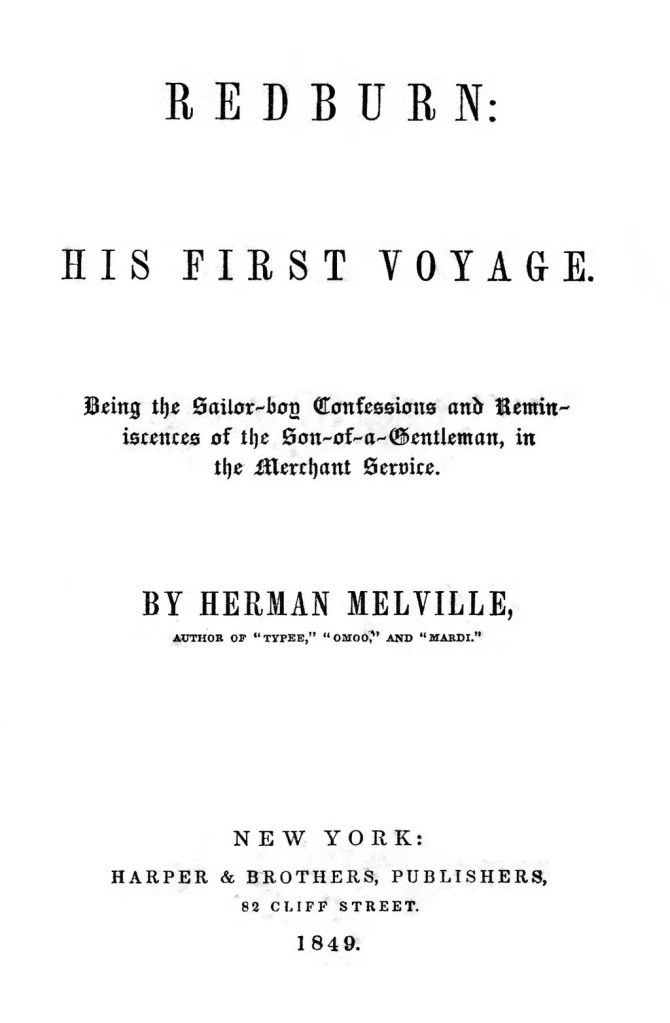
Then, I resolved despite having heard that it was a brutal slog, to read Moby-Dick, or The Whale. Contrary to rumor the novel proved endlessly entertaining and quite breezy despite its psychological depth and dense symbolism. I in fact had recently resolved to re-read it when I noticed Redburn, His First Voyage on the shelf and took it down on a whim. After a cursory skim of the first page I found myself fully engaged and could not put it down.
Redburn is a poor chap from a once wealthy and influential family. His father was a businessman engaged in international trade before the family went bankrupt, and young Redburn’s imagination was fired by journals and books about his father’s travels. As a result, he signed up as a novice sailor on a boat headed for Liverpool, and we accompany the young naif on his journey “there and back again.”
The cast of characters is large and each is ably portrayed with wit and charm. Redburn’s experiences are vividly and expertly recounted by Melville who of course was himself a similar young chap setting out on the sea at one point. I thought the book as good as anything by Dickens, in particular the scenes of squalor in Liverpool which brought to mind many pathetic and pitiable characters in the works of Charles D.
If you are considering testing the waters of Melville, but you are perhaps not ready for the full-on engagement of Moby-Dick, Redburn might be the place to start your voyage.
We moved to France in June 2022. I figured “hey, living in Europe we can really see Europe!” But we’d started a small business. Then, my wife added a non-profit organization. We hired a contractor to do some work, we did some work. The garden in itself is a full-time job.
After a year and half, we hadn’t really seen Europe. We saw some really spectacular France (all within a couple hours’ drive of out place): the Correze of course, Lot, the Dordogne… But we’d had little opportunity to get out and explore new places beyond France. Our three trips since arriving here had been to Tunisia when Patricia got a teaching gig for a week, and two trips back home to the USA.
Then, friends from the International School of Panama got in touch. They were teaching in Croatia and Italy and planned to meet up in Civezzano in the Dolomites. It gave us the excuse we needed to shut down operations for 10 days and hit the road.
First Stop: Turin
Statues of Augustus and his uncle/step dad Julius bookend the Palatine Gate.
I’d heard about Turin as a small child watching the old “In Search of…” TV series with Leonard Nimoy. They did an episode about the Shroud of Turin, and showed monks dutifully tending it in its glass case high up on an altar. There was even a re-enactment of a monk saving it from fire in the 14th century. We went to see the Shroud, but because it is old AF and fragile (and likely also because it has been conclusively proven a fiendishly clever medieval fraud designed to milk cash out of pilgrims and wealthy donors alike), it is not on display any more, but is stored in an enclosed box visible through a glass window with a replica on foam core mounted for the curious. The faithful still come in droves and genuflect, and though I did not actually see the Shroud I did score a truly tacky holographic post card.
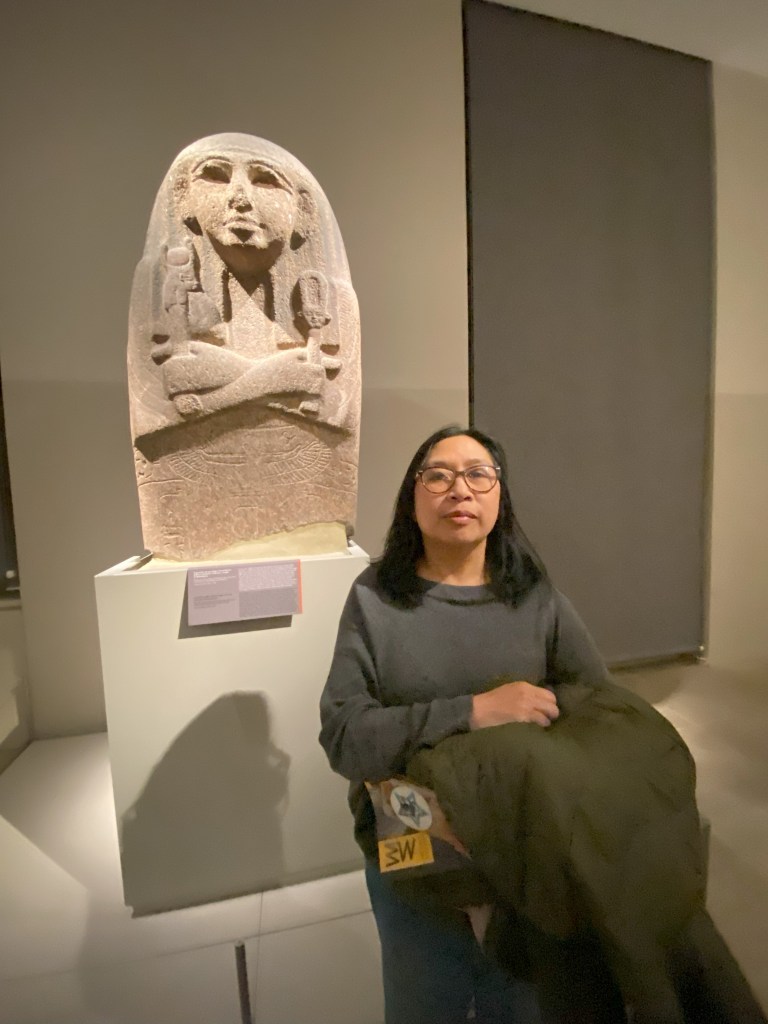
Just next to the cathedral housing the Shroud were some fab Roman ruins. Also nearby was an excellent outdoor market and an indoor multi-vendor restaurant space. Turin has many grand plazas and exquisite architecture spanning centuries and styles. It also has one of the greatest Egyptian museums outside Cairo.
We spent four hours exploring the magnificent Egyptian Museum in Turin.
Stop Two: Milan
We headed over to Milan where we were promptly stopped by the local police. They were very polite about detaining us by the side of the road for twenty minutes and carefully checking our French residence visa cards and passports.
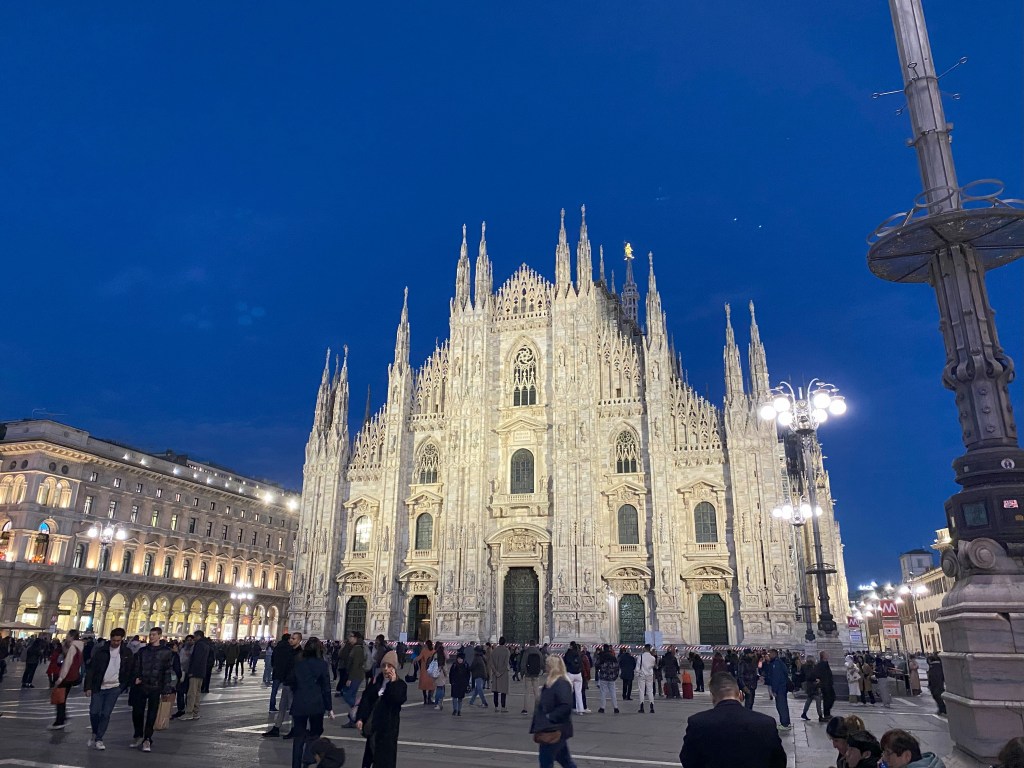
Nobody does outdoor public spaces like the Italians, with their marble paving stones and extraordinary buildings. Walking into the Piazzo del Duomo is quite an experience.
Piazza del Duomo, Milano
I’ve been visiting Europe since the early ’90s. Many things about travel there are far superior and more efficient than in the past. But one truly hateful change is the fact that access to these magnificent old structures is often via paid appointment. Gone are the days when tourists could wander into the Duomo and other nearby monuments with a Bedaeker’s in hand. Now you have to wait in a queue to purchase a ticket, or pre-book online, and travel guides have been replaced by Rick Steves videos and TripAdvisor.
But, totally worth it. I’m more of a Romanesque/Gothique guy, and the Duomo has been Baroqued to death. But it is spectacular and overwhelming. And you can ride a lift to the various roofs. Get up close and personal with those gargoyles!
Spectacular views of Milan and every square meter of the exterior of the Duomo is packed with luscious art. What’s not to like?
Milan is a bustling and vibrant modern city with all the restaurants. Because we live in remote rural France we often crave international foods we can no longer order for delivery–Indian, Thai, Mexican, Vietnamese, Ethiopian, etc. But you can get anything in Milan, and often a lot of food for under 12 euros. We had perhaps the best pizzas we ever tasted for lunch our second day and paid less than 23 euros.
Stop Three: Verona
I was a bit suspicious of Verona because of the whole Juliet’s House thing. Tourists waiting in line to touch the breast of a statue of a teenage girl who exists only in literature? Yeah, whatever. But we managed two days here without Romeo or Juliet interfering at all (I was curious about the museum in Juliet’s house–but we saw plenty of remarkable art in the Castelvecchio, the GAM, and at the Maffei Palace).
And, like Milan and Turin, the city Verona is itself a work of art. Every street and plaza in the old city is lovely. Check out the Roman Arena, stroll Piazza Bra, and head off in any direction at random. There are a handful of remarkable churches to see, in particular the Basilica of Zeno with its bronze doors and crypt to the African saint. I was terribly amused by the centuries of graffiti carved into the 13th century murals: “Hugo was here, 1453,” etc.
If you visit Trento, go to the Tourist Office by the Arena and immediately buy the Verona card, it is TOTALLY worth it if you plan to visit more than a couple museums or sites. We paid 35 euros each for the two-day card and it paid for itself and then some.
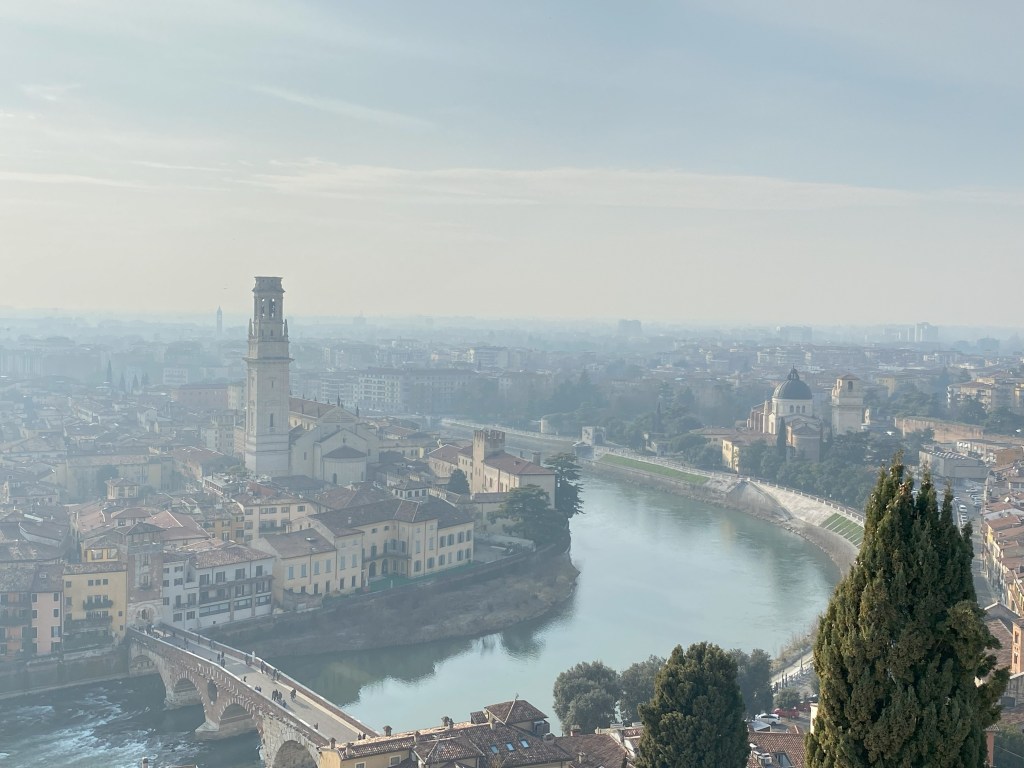
Ride the funicula up to Castel San Pietro for those money-shot pics. Even on a smoggy hazy global warming 70-degree February day it’s a great view of the city.
Stop Four: Trento/Civezzano
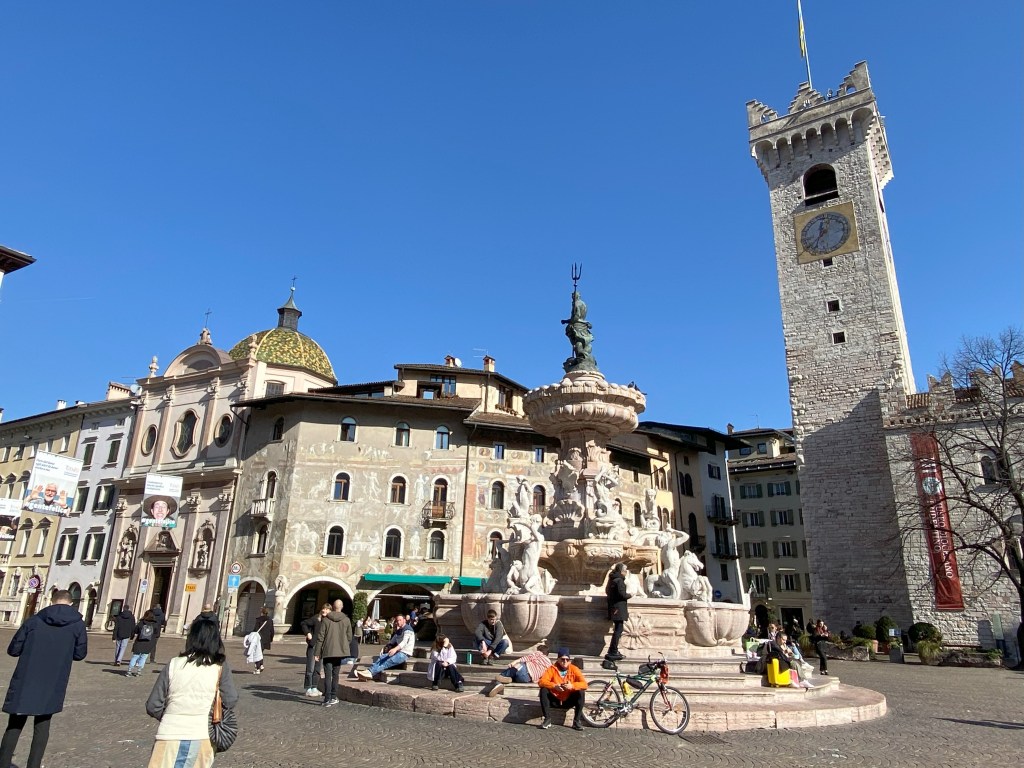
We toured a bit of Trento with friends from ISP in Panama. I said to Chris, who currently lives and teaches in Rome, “no one does public space like the Italians.” He said “it’s true–but good luck finding a park with trees!”
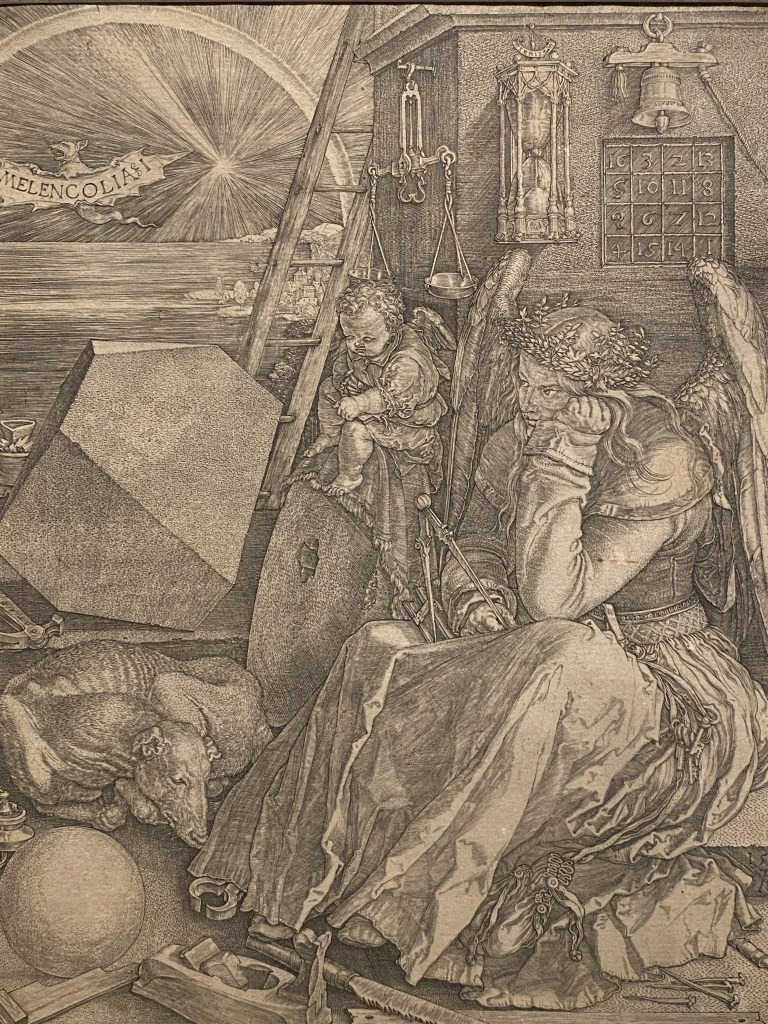
Civezzano, where we met friends and stayed for a couple nights, is a cute little town which functions as a base for skiers, but there was no snow on the surrounding peaks because of draughts and far warmer than typical winters. It has some nice old homes but not much else going on. On our way there we found the MART museum, which is a magnificent facility. And, we had the great luck to see an exhibition centered on melancholy featuring several engravings by Durer and Rembrandt, as well as more modern masters. There was also a massive show of current Chinese painting. The permanent holdings are substantial and definitely worth a stroll, even on aching 20,000 steps a day tourist feet.
Bonus: The MART museum accepts the Verona card for free admission!
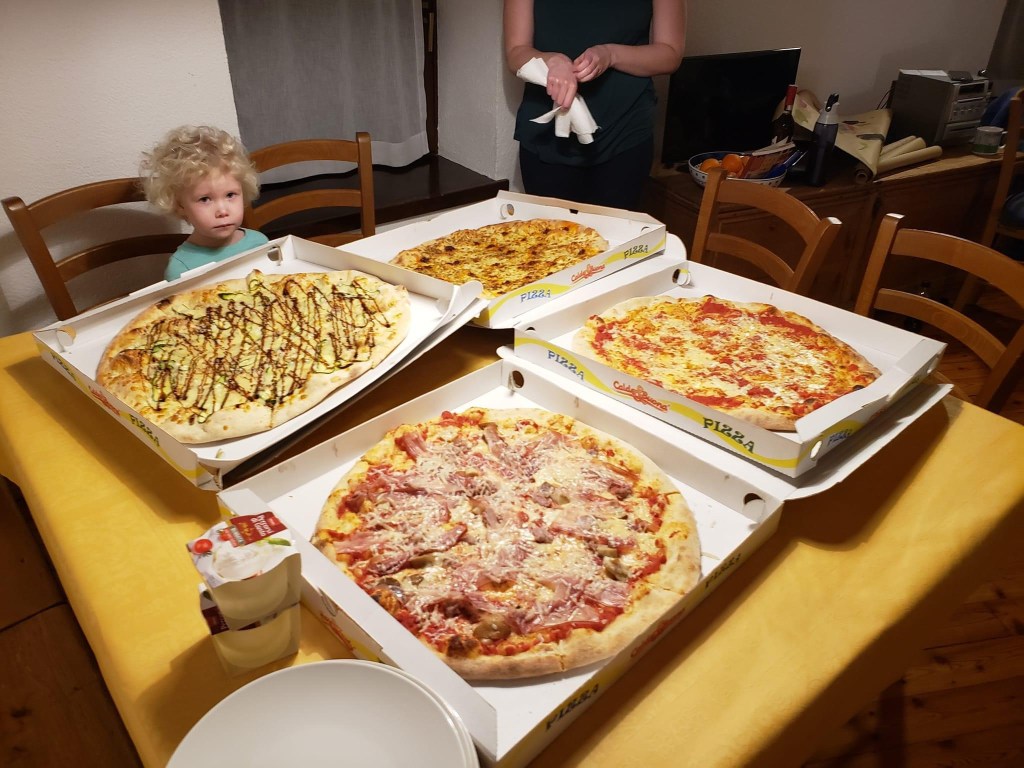
Civezzano has a tiny pizza joint which produces gigantic pizzas. Here is Harper wondering what the rest of us would eat.Truly a pleasure to get up close and personal with several Durer etchings at MART outside Trento
Stop 5: Bergamo Alto
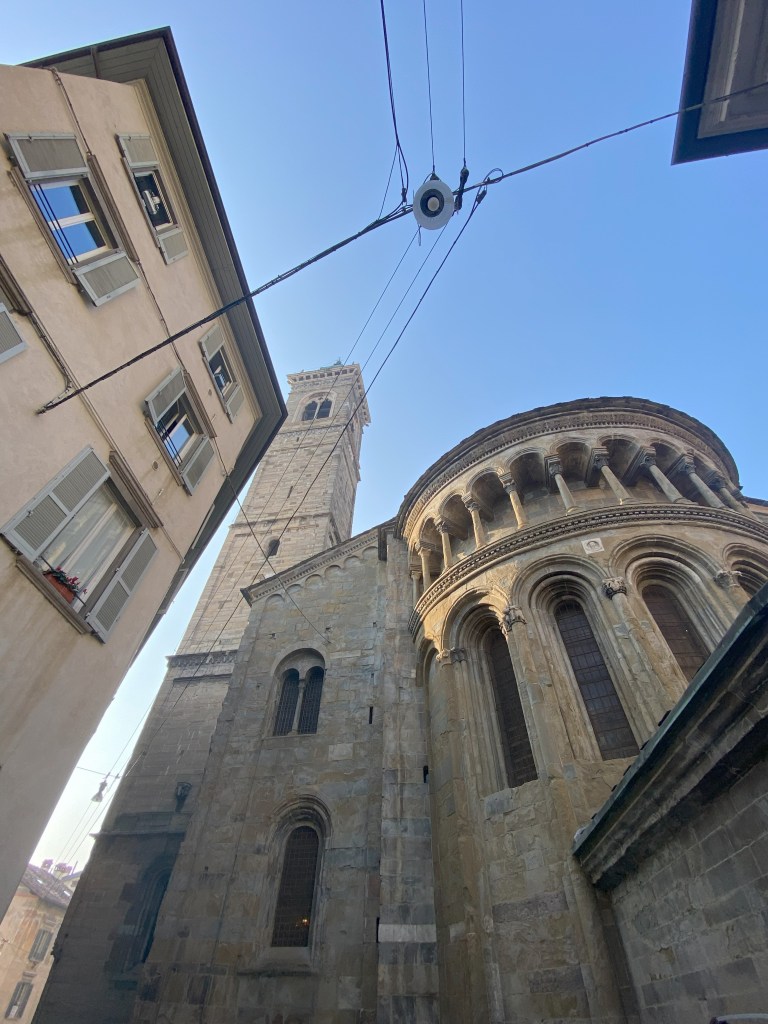
Perhaps the most walkable and warmest of the cities we visited. Magnificent shops and restaurants in centuries-old buildings, public art, more museums, more towers and churches.
Every corner of Bergamo Alto is a treat. Catch it in the late afternoon for that remarkable golden light.clever marketing to put the Hello Kitty and other cartoon shaped treats at child’s height



 Mysterium Coniunctionis