I saw Wings of Desire way back when Netflix used to mail DVDs in envelopes. Later I saw Paris, Texas. These are the Wenders films I heard about back when I was first exploring the renowned auteurs of cinema, and I’ve seen them both a few times. Recently I also saw The American Friend.
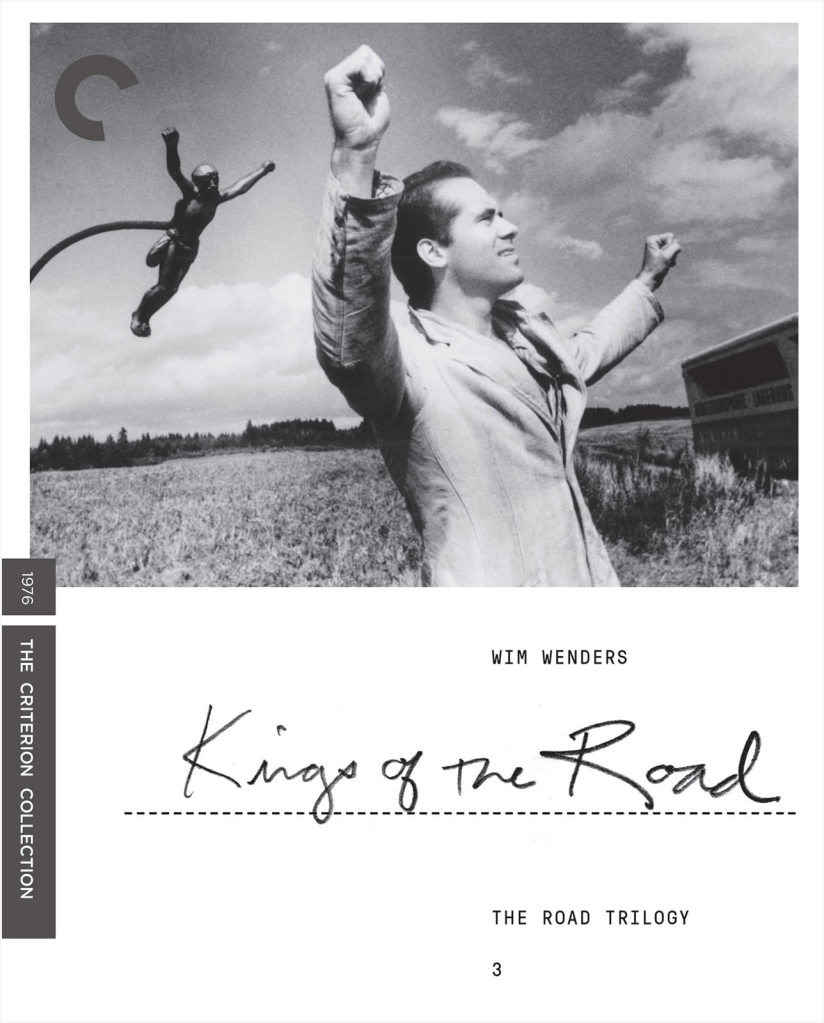
Kings of the Road is superior to the other Wenders films I’ve seen. It has the loose plotting and crazy energy of the superior Fellini films, but also the rich raw aesthetics of Herzog or Pasolini. Though it clocks in at nearly 3 hours in length, I found it breezy and entirely captivating on multiple levels.
The two main characters are perhaps not the best most noble people, but they are resilient and imaginative and do their best to be kind in a completely mad society. And though the narrative is loose and a bit naive there is some profound meaning in the dialogue and imagery. There is for example a subtle but inisistent critique of US influence in West Germany with as much context and as many exemplars as a good Tony Judt essay.
So it made me feel deep feels, it made me laugh, and it made me think. Someday I’ll be glad to revisit Im Lauf der Zeit.
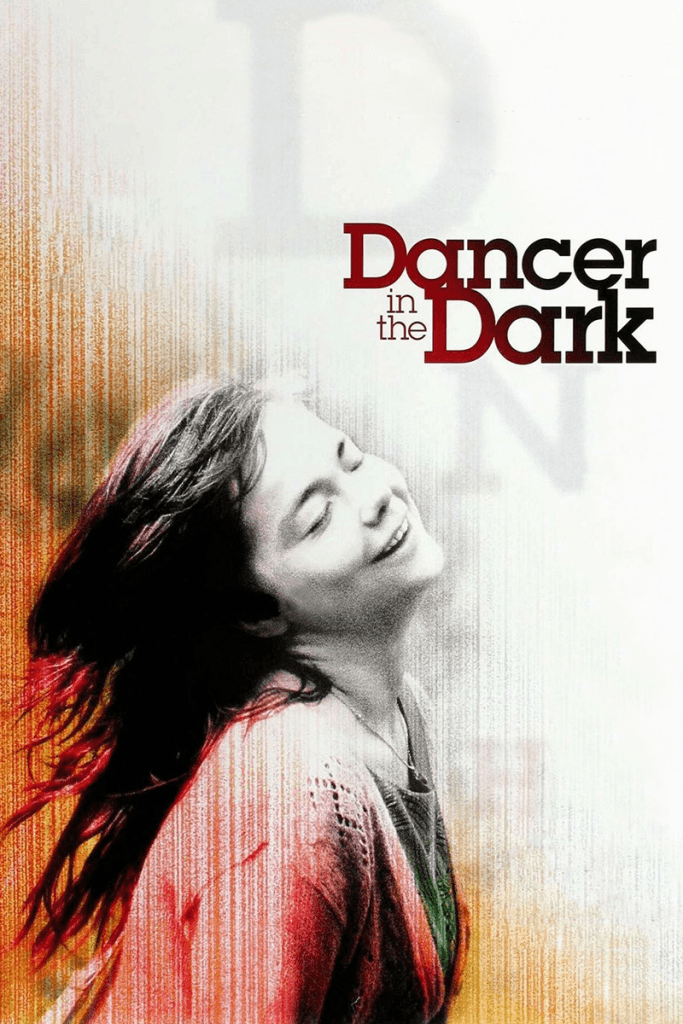
I’ve seen a few films by Lars von Trier, so had an idea what to expect. But Dancer in the Dark nonetheless snuck up on me.
It’s at the beginning a very sweet and melancholy story. Selma is an immigrant from the Eastern Block living in small-town 1950s America. She works full time in a factory and does other odd jobs to scrape by. She lives with her son in a trailer which she rents from a local police officer. The cop and his wife help her with her son while she is at work. Other people in town also care for and help Selma, including Catherine Deneuve.
Selma is dreamy and ethereal and is perfectly embodied by Björk who of course has some experience with those qualities. At the factory Selma gets in trouble because she gets distracted running an expensive and dangerous machine. Her distraction? Sounds in the factory result in a musical dance sequence in her head. Dancer in the Dark is a musical, and we see several of these sequences as the plot unfolds.
But this is a Lars von Trier film, so when the twisted and horrible occurs I was not surprised, but I had been lulled into a sort of fuzzy torpor by Björk’s magic. The turn at the core of the film took me unawares.
I’ll say no more lest I ruin it for you. I found the film wrenching and beautiful. My wife seemed mostly annoyed by it. It certainly differs in tone and mood from most musicals and sets out to subvert the genre. Selma, who is a huge fan of musicals, even says at one point something about musicals neve allowing terrible things to happen. But this is von Trier…if you like his stuff or if you are a fan of Björk this might be for you.
Back when television was beamed on signals through the air we could only receive perhaps five or six channels in my hometown of Stewartstown, Pennsylvania. The clearest channels were those from Baltimore 30 miles away and were nearly all VHF stations. The UHF dial had a few grainy and fuzzy and far-off stations, the clearest of which was channel 17, WPHL-TV out of Philadelphia. I had many opportunities as a very small child to watch Dr. Shock’s Mad Theater.
The movies shown were mostly terrible 1950s drive-in horror fare, with nuclear monsters attacking towns, guys in rubber suits menacing bikini-clad young women, skulls floating along on visible wires and screaming. But they were a pleasant diversion from the more actual horrors of small-town life in the 1970s. And some of the films actually had merit and stuck with me. A few examples: The Incredible Shrinking Man and his awful battle with a spider, Invasion of the Body Snatchers, and The Fly with Vincent Price.
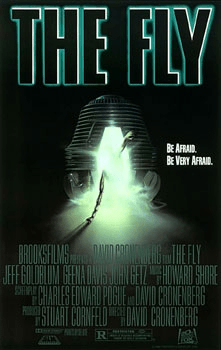
I remember going to see David Cronenberg’s remake of The Fly in a theater when it was first released. I enjoyed it so much that I rented other Cronenberg films on VHS at the local video stores. Interestingly at the dawning of my interest in cinema David Cronenberg was perhaps the genesis of my understanding that there were auteurs, visionary and stylistically interesting directors who made challenging, beautiful, disturbing, and instantly recognizable works of art.
I recently rewatched The Fly on a whim for the first time in 40 years. Of course I’ve seen many more movies and films since 1986, including those rated as the height of the art form. My tastes have tended to drift away from the horror genre, with a few exceptions. But The Fly holds up as entertainment. I think most 80s films are terrible, and people only continue to love them because of nostalgia, and when they revisit them they can’t help but reinhabit their 14 or 15 year old selves experiencing them for the first time. But The Fly has merit in the genre of prophetic sci-fi horror–be careful about your ambitions to unlock knowledge or create new technologies!
Jeff Goldblum is exceptional in his role as a sexy nerd, and still manages to charm after his transformation into a guy in a rubber suit menacing a beautiful lady. Geena Davis is great also, and the chemistry between these two actors really propels the film. John Getz is perfect as the sleazy ex-boyfriend who can’t take a hint. The look of the film remains crisp and slick, and is a precursor to the stylistic flair Cronenberg will develop in later gorgeously shot films like Dead Ringers, Naked Lunch, A Dangerous Method, Existenz, Eastern Promises, etc.
The Fly of course references many previous classic films, primarily Frankenstein, but also The Hunchback of Notre Dame, The Invisible Man, Dr. Jeckyl and Mr. Hyde, etc. Films where the heroes are monsters but are also all-too-human. One detail I’d missed previously occurs when the protagonists have their first overnight dalliance after Goldblum’s initial transformation. Geena Davis is asleep with her hair on the pillow and it is piled up in a column exactly like the hairdo on the Bride of Frankenstein. Made me chuckle.
Surprisingly the special effects hold up well. The computer used to power the teleportation device is likely a Commodore 64 encased in a giant metal box, but it still somehow looks futuristic, and the voice recognition to unlock its programs is a nice prophetic touch.
I’d recommend it if this is anywhere near your field of interest, and would recommend Cronenberg’s stuff to anyone interested in cinema as an art form. He’s worth exploring but the body horror is of course not always easy to endure. The Fly is perhaps my second favorite 80s horror remake–the premier example is of course is John Carpenter’s truly astonishing and completely nihilistic remake of The Thing, which is 1000 times better than E.T. the Extraterrestrial, which totally annhilated it at the box office, but which I now find unwatchable.
When David Lynch passed away recently I thought “How do I choose which of his films to re-watch?” It felt important to re-watch something and acknowledge the importance of his work in my life. But instead of selecting a Lynch film I watched Tarkovsky’s The Mirror for the first time. I’d seen Solaris, Adrei Rubilev, and The Sacrifice before and thought instead of re-watching something I’d challenge myself with something new.
I’m not sure what brought The Mirror to mind after Lynch died, but I couldn’t help but see the film through Lynch’s cinematic vocabulary. The nonlinear dreamy narrative structure, the inconsistent and often suspicious point of view, the beautifully mysterious and evocative imagery, the masterful painterly touches. As in Lynch’s films, one can’t be sure if what is on screen is real reality, or an internal reality-a dream, a memory, a delusion of one of the characters. Are those really ghosts which tell the young boy left alone to read a certain passage in a certain book? Is the room filled with cascading water an actual memory or event or symbolic or a dream? I’d often heard about The Mirror as an all-time masterpiece, and it proved true. It’s astounding and perturbing like most of Tarkovsky’s films. And, as with Lynch, not ‘getting it’ is part of the pleasure.
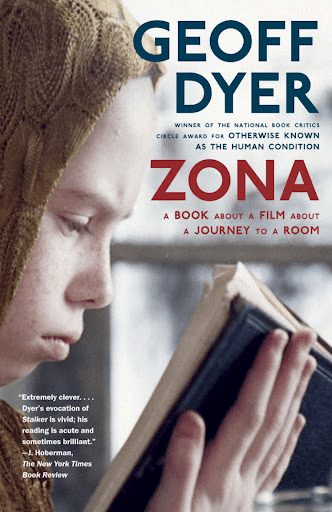
Back when I was gainfully employed with a steady income I would buy books willy-nilly. At some point along the way (perhaps after reading a couple Geoff Dyers in my early 40s) I purchased and downloaded Dyer’s Zona: A Book About a Film About a Journey to a Room. After seeing The Mirror I thought why not read this at last?
Of course Zona is about Tarkovsky’s film Stalker, not about The Mirror. But it’s also a long meditation on Tarkovsky and his style and his work, so the time was right.
Dyer re-watches Stalker while writing and goes through the film scene-by-scene, riffing on each sequence and making connections and interpretations and tying everything to his personal experience and to the various times he’s seen the film. He creates a sort of Talmud of the film. And of course this book has two prerequisites: an interest in Geoff Dyer and his riffing essays and some knowledge of and interest in the films of Tarkovsky, in particular Stalker. Though it had been some time since I’d seen Stalker I found it interesting how pwerfully the film came back to me through Dyer’s discussions. I learned a lot about Tarkovsky along the way, and about Geoff Dyer. And that’s what essays are for of course.
By the way, if you are interested in Tarkovsky, Mosfilms has made his works available on YouTube in pristine digital transfers and subtitled in English. In fact, all of Mosfilms catalogue is available and most certainly worth exploring.
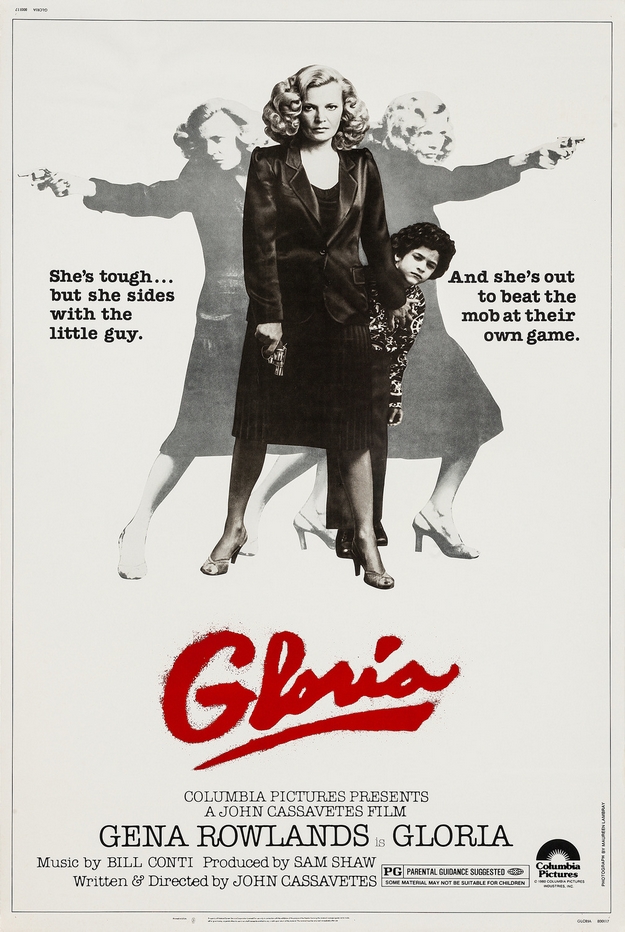
Gena Rowlands passed away in August of this year, and it struck me at the time that I’d only seen one film she’d made with Cassavetes: A Woman Under the Influence. I don’t remember much about it after nearly 30 years, other than bits of Rowland’s searing and uncomfortable portrayal of a woman completely falling apart, and the typically warm Peter Falk playing a jerk.
Saw Gloria last evening at a local film club and was impressed by its energy and inventiveness. The plot is ridiculously absurd–a mob accountant has turned informant and has a book recording the dirt about his employers and their businesses. Immediately before getting wacked by a team of goombahs with shotguns and bad suits his wife hands off their 6-year-old son to their neighbor Gloria, giving him the book and telling him to guard it.
What follows is two hours of deleriously entertaining action and farce. When presented with 6-year old Phil, Gloria quips that “I hate kids, and especially yours,” but given the seriousness of the situation she takes him in tow. After some initial rough going between Gloria and her young Puerto Rican charge (played with cute adroitness by John Adames) her maternal instinct is activated and Gloria becomes Dirty Harry, blowing away and confronting gangsters with aplomb and sassy attitude. Despite the silly plot and at times unintentional humor of the action, Rowlands commands the screen and is completely believable. At times she and Adames are like Gable and Davis in a screwball romantic comedy, and the gangsters are Keystone Cops. What fun!
Cassavetes’ use of cruddy late 70s New York is very appealing, and made me nostalgic for the gritty run-down town I used to visit into the late 80s before Times Square became tragically Disney-fied and antiseptic. The sappy and overwrought ending was delicious and there wasn’t a dry eye in the house.
I must further explore Cassavetes’ films and Rowlands’ catalog. There were some die-hard fans of their work, both French and English, at the showing last night, and their enthusiasm was infectious.
When Roma came out a few years back a twenty-something colleague said he spent the entire film bored and wondering when something would happen. I had a completely different reaction to that film, and thought it was a miracle how much happened in 2 hours and 15 minutes.
So, take this as a warning. Jeanne Dielman clocks in at over 3 hours, and if you prefer CGI action films or comedies this will absolutely not be the movie for you!
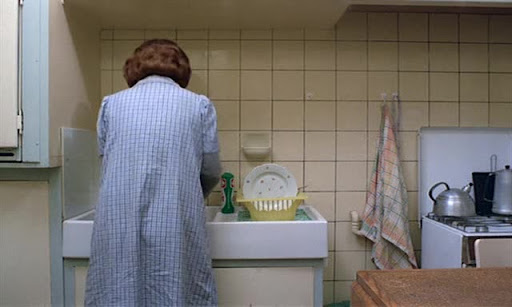
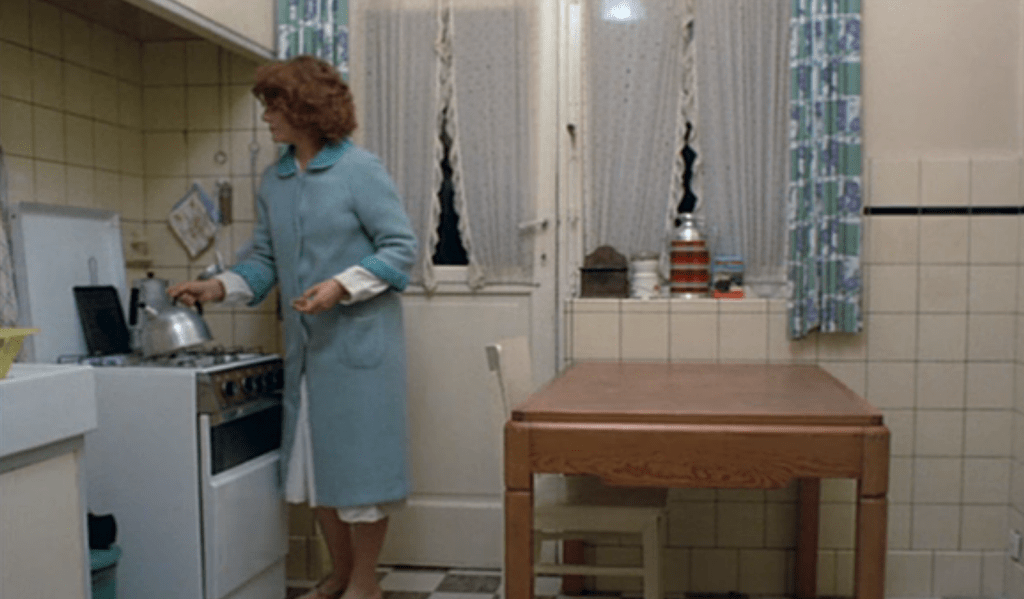
The first hour focuses on Jeanne Dielman in her daily routine. We watch the steps to her day and the way she manages tasks and it is evident from every scene that these are well-rehearsed and routine activities, and Jeanne is a marvel of efficiency. The way she folds, her fussy insistence on maintaining a tidy and immaculate living space for herself and her teenage son, her industrious and thrifty mannerisms–all reveal a woman enmeshed in the oppressive values of “woman’s work” and “mother’s duty.” She has honed and practiced her approach to preparing coffee, making dinner, cleaning, doing laundry, and converting her living room into a bedroom for her son each night, and the camera rarely moves as we watch Jeanne do her chores like an automaton. Which, of course, is what women even in wealthy “advanced” nations have often been reduced to in the past, and sadly movements like MAGA in the USA hope to bring back this state of affairs.
In the afternoons, between starting potatoes for her son’s dinner and awaiting his return from school, Jeanne has a small window of time where she takes clients as a prostitute. As a widow trying to maintain a bougie lifestyle for her son the implication is that she has no choice. Like all her tasks, there is an aloof practiced routine to these interactions. We only see the arrival of her client and his departure, and then the bathing and clean-up process Jeanne goes through after the visit. Then, her earnings are saved in a large soup tourine.
You may get restless watching Jeanne do the dishes for 20 minutes, or watching her bustle from room to room always closing doors and turning off switches and putting everything back where it belongs. But it is important to the film and its themes to see how Jeanne spends her day and how carefully her time is managed because on day 2 if you are watching closely you may notice things going awry very subtly. A dropped polish brush, a dropped spoon, potatoes overcooked and untidy hair. An undone button. These very subtle hints really add up and caused me a creeping anxiety. Jeanne is in absolute control of her activities and her life for a reason–because there is a burbling turmoil inside.
Her interactions with her son are quite frustrating to witness, for reasons you’ll understand if you see the film. Jeanne’s life even as a widow is wrapped up completely in satisfying male needs and making life easier or more pleasant for males. Only rarely do we witness Jeanne enjoying herself or experiencing a rich aesthetic moment–while knitting a sweater for her growing son, she becomes oh so quietly enraptured by a Beethoven piano sonata, and though she continues to work she is expressing some internal state, something trying to burst free.
When the coffee comes out wrong, when a missing button on her son’s coat proves impossible to replace, when a pair of scissors is not returned to its proper place–all these small details lead to an appalling finale full of resonance and open to interpretation. More viewings are required to piece together what actually transpires because though it’s quiet and subtle there are many small things happening in the last 15 minutes and I had oh so many questions.
So I can’t recommend it enough, but to endure it you have to be the sort who enjoys dense, beautifully edited and acted long-ass art films. It’s brilliant and revolutionary and tedious all at once. It jumped two years ago to number 1 on the BFI list of greatest films of all time. I might argue that there are better films, but I certainly see why it’s a powerful contender. I must explore more works by the director Chantal Akerman.
She lives on Quai Du Commerce–the film manages to critique women’s traditional roles as well as the economic system which relies on poorly compensated women’s labor
Typically during a debate or argument I maintain my cool, and rarely get emotional even when provoked by claims I find distasteful or offensive. But last Thursday at dinner with friends I totally went off the rails during a debate about covid and vaccines and mask requirements. Perhaps it was the full Blue Super Moon pulling tides in my brain and causing me to lose it and show my exasperation? Whatever the cause, I regretted my display–which included repeated interruptions and a contemptuous tone and several loud “that’s not true” interjections. This behavior was disrespectful and atypical of how I usually handle such situations: listen quietly, seek to understand, and respond out of interest and love.
I was arguing that mask mandates and stay-at-home orders were perfectly understandable given the circumstances. Even ancient civilizations knew that when the pestilence came around it was best stay indoors until it passed. In retrospect we can see that some covid restrictions were too severe and perhaps even ridiculous (I had to sit behind a thick plexiglass wall at a desk while masked, for example, with a classroom of masked students present and the other half at home on the internet–definitely overkill). As for vaccines, I was all for them, and the idea that vaccines based on more than 40 years of laboratory research were “rushed” and were killing more people than the disease set me off. And when one friend suggested that covid was a hoax and not really serious and that hospitals were never overrun I went into the stratosphere. I heard a lot of “they’re saying” and “they know” arguments to which I kept responding “WHO, WHO says, WHO knows?” The evidence almost always was a slickly produced YouTube video, or a politician referring to one.
A friend said “I’m surprised you of all people would take the side of government agencies and defend Big Pharma.” This was a good angle of attack, and hit hard. But like Noam Chomsky, I see that there is a move underfoot by oligarchs and major corporations to undermine trust in public institutions because these are the only remaining restraint on the power of super-wealthy amoral elites whose avarice and contempt for law and ethics is having profound and perhaps irreversible impacts on not only the social fabric but perhaps the survival of humanity as a species. And like Chomsky, I know that even a long time skeptic and critic of government can realize that public agencies at least somewhat responsive to the will of the masses are the only brake we have on the continued destruction of Earth for profit. Yes, agencies like the FDA and CDC have been corrupted by Big Pharma and Big Insurance, but this is a simple tweak to fix by law. If the corruption comes from corporations, why blame the government agencies? Instead blame those who pull the levers and clean up the agencies with regulations about conflict of interest and ethics requirements.
Do I share skepticism of gigantic corporations like Pfizer and Moderna making billions of dollars from mandated vaccines? Of course I do. I don’t think medicines or health care should be for profit at all. I also respect suspicions that the vaccine was rushed, and particularly understand the reluctance of many people of color to get the vaccine given the long and sordid history of medical “experimentation” and abuse by authorities. But there is a great deal of wholesale quackery disseminated on the internet–remember how vaccines would magnetize your blood and make keys stick to your body? And a lot of the goofiness is given a veneer of scientific respectability by doctors who create videos on YouTube and get click/view money for saying unproven outrageous things to scare people to death (so they rush out and buy herbal supplements to counteract mythical side effects).
But I think a more important and often ignored moral and ethical question is why do these companies get all their R&D and testing paid for by public money and then they get to take government funded drugs and vaccines, patent them, make enormous profits from them while paying executives and stockholders huge dividends, while in turn they don’t even pay taxes. THAT is the real problem, and Big Pharma is certainly content to have people debating whether or not Dr. Fauci is a lizard being from the Pleiades or whether sheep medicine is a valid treatment instead of “why is the system rigged this way?”
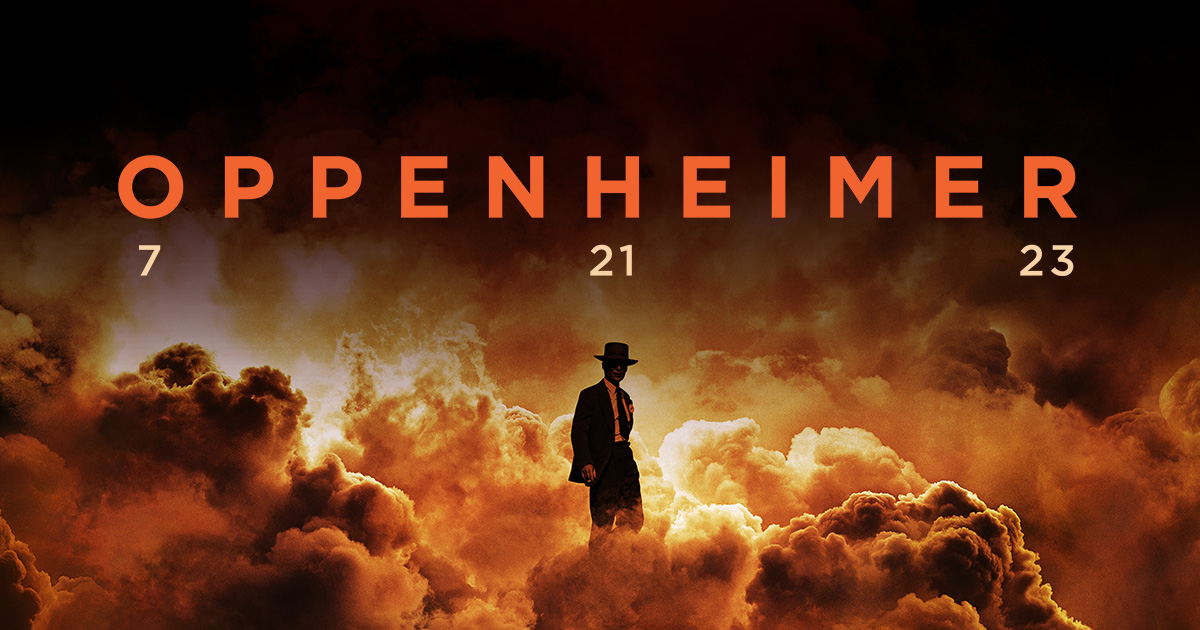
All of this is my roundabout introduction to having seen the Oppenheimer film. I thought it was a strong attempt to address a lot of the concerns raised in our discussion last Thursday about science and ethics and who decides what is right or wrong, etc. Should we get vaccines during a raging pandemic because scientists and government officials say so? Or, more in line with the themes of the film: Should we detonate a device which the government wants but which has a close to zero chance of igniting the atmosphere of the entire Earth?
Oppenheimer was of course a brilliant scientist, but he was also steeped in the humanities and was well-aware of the ethical considerations complicating his work on the Manhattan Project. The continual butchery on two fronts during World War II, the likelihood that Nazi scientists were themselves close to the bomb and could give Hitler an unspeakable weapon, the ongoing Holocaust–all of this provided enormous impetus to successfully construct a nuclear bomb and test it first. But Oppenheimer was also a literary-minded guy who’d read his John Donne and Bhagavad Gita. He was also a socialist flirting with communism and had profound doubts about what might become of the United States if it had this ultimate weapon. These doubts were of course later shared by President Eisenhower as he left office. And the film makes it clear that the second use of the bomb in Oppenheimer’s opinion was unnecessary overkill and was even more likely than the first to provoke a disastrous arms race–which proved correct. (Of course Paul Fussell would disagree that the 2nd bomb should not have been dropped on Japan.)
Oppenheimer is a massive film and will sap all your energies, but if you like dense character studies full of moral ambiguity and difficult ethical questions, you will dig it. In its scale and tone it’s reminiscent of Scorsese’s long films with their questions about ethics and violence (think Taxi Driver, or The Silence, or Raging Bull, or even Bringing Out the Dead). I think all the performances were excellent, and appreciated the use of a brief interaction between Einstein and Oppenheimer as a bookend to the plot. This is clearly Christopher Nolan taking his best shot at a Best Picture nod, and he might pull it off. There are of course problems with the film–after the excitement of the bomb build-up, it’s difficult to reset and endure the political persecution of Oppenheimer by right-wingers and professional rivals which goes on for another hour. But this part of the story also must be told. And yes, because everything else is thrown in, Nolan should have at least mentioned or shown what happened to the residents of New Mexico, largely Latino and Native American, before and after the tests, and though the horrors unleashed on Japanese civilians are suggested in a kind of panic attack hallucinatory sequence, I’m not sure it’s an adequate portrayal particularly given the thematic concerns of the film and its focus on the dilemmas navigated by Oppenheimer, et al.
One of my dinner conversation adversaries pointed out that we might not know the answers to many of our questions about covid and vaccines for many years. And, just like the atom bomb, Pandora’s Box has been opened and we live with the consequences.
Side note: nice to see Robert Downey Jr without a goofy super her0 costume!
Another side note:Twin Peaks The Return Episode 8 is still the pre-eminent cinematic exploration of the ethical questions around the explosion of the first bomb. In the Twin Peaks universe the explosion results in the birth of Bob, a demonic character who causes some chaos in the small town. Bob–Robert Oppenheimer? Or Bomb? Or, Bob’s Big Boy?
A further side note: I’ve recently been re-reading books which had a profound impact on me as a young person. One of these is a volume of science fiction stories edited by Harlan Ellison called Again, Dangerous Visions. I’d just read two stories in the volume which were not sci-fi, but rather fiction with science involved. These were by Bernard Wolfe. One was about a woman who takes her poofy expensive pure-bred dog to witness a test of napalm at a local military base. Her dog gets immolated in the test, which is so sad and terrifying for her and the other witnesses who fail to make the leap that this stuff will be dropped on actual human beings elsewhere. The other was about sleep experiments gone awry. But at any rate Wolfe’s accompanying essay excoriates sci-fi authors and the scientists they idolize. Further, he damns US-style hyper- capitalism and its “fawning upon scientists” while exploiting them and “their fake charisma.” He thought scientists exploited by capitalists were set to unleash profound and unforseable horrors on the world, and bemoaned the privileging of science over the humanities. Like Colin Wilson used to say, the “library faeries” will drop the reading material you need in your lap when you need it.
I’ve gone to the cinema for the first time here in France, and seen a wonderful Czech film from the 1960s, called Daisies in English and Les Petites Margarites in French.
I found it vastly entertaining, with a sort of relentless anarchic silliness propelling its basic storyline. Two disaffected young ladies decide to humiliate older men out for a roll in the hay, and they have a great time frolicking and pranking their way through the city and eventually the countryside.
The film’s use of color and prismatic effects, its clever montages and collage sequences, its peculiar cuts and crisp photography demonstrate a mastery of technique. Young director Věra Chytilová made a small miracle behind the Iron Curtain. Which, of course, was promptly banned.
While watching Daisies I had to wonder if John Waters saw this film–it features his sort of merciless energetic absurdity. There is a lot of food porn thrown in for good measure.
The film was shown in Uzerche at the Cinema Louis-Jouvet. The theater is sort of like Baltimore’s Charles with its art-house fare mixed in with big release horror and French and Hollywood releases. I had no trouble following the French subtitles except for the word vioc, which occurred twice, and apparently is argot for old dudes.
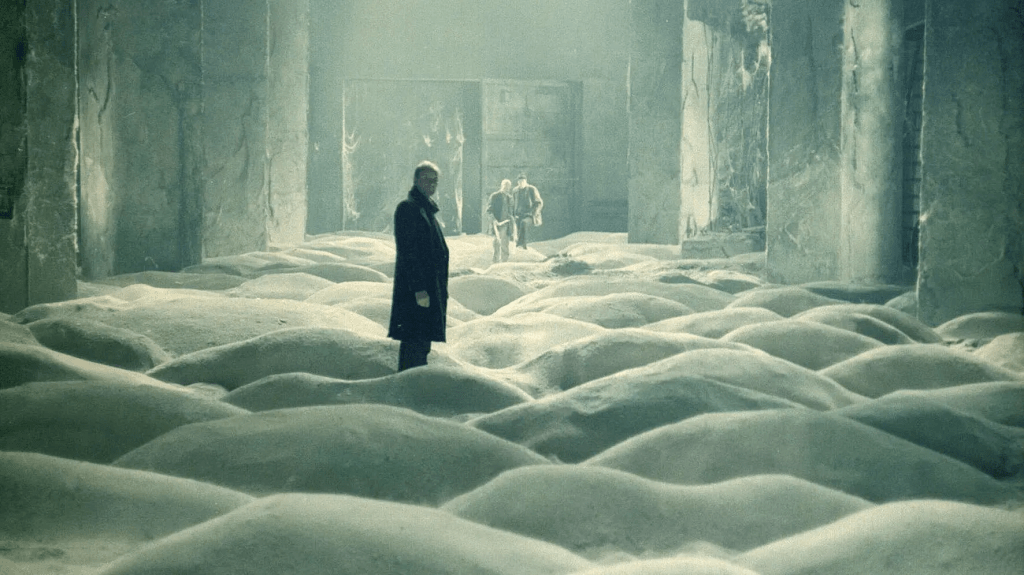
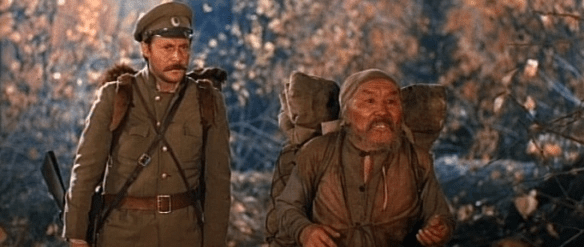
I’ve also watched Stalker on the MosFilm YouTube channel. They have several classic Soviet films and other arthouse fare available on high-quality streams with English subtitles. I was quite happy to note they had several Andrei Tarkovsky films I’d not seen.
Stalker puts the bleak in oblique. It is, like many of this maestro’s titles, a spiritual workout. You’ll feel like you spent a month in Gurdjieff’s labor program after slogging through nearly 3 hours in The Zone. It is harrowing and beautiful. Imagine Estragon, Pozzo, and Lucky no longer waiting for Godot but trying to find him/her/it/they instead.


 Mysterium Coniunctionis