I wanted to refresh my general knowledge of French history before focusing in detail on a few eras, regions, and personalities. A History of France seemed a good place to start. John Julius Norwich had written quite readable histories of Byzantium and European monarchs, and his father Duff Cooper was Churchill’s liason with the Free French during WW2, and later was Ambassador to France from the UK. I thought this book merited a try.
There is way too much history in this short and readable history. We start with Julius Ceasar and his campaigns in Gaul, and progress through 2000 years up to Charles DeGaulle. But this is a fun read, written by a lifelong Francophile, and it did what I hoped it would–reminded me of the proper sequencing of early monarchs and refreshed my knowledge of the 100 years war and 30 years war and the long deeply intertwined relationship of France and England. The cast of characters is immense of course, and Norwich is particularly good at bringing them to life, from Eleanor of Acquitaine and her sons to Joan of Arc to Napolean 3.
I must say that even immediately upon finishing the book I can’t differentiate all the King Louises and King Charleses. There are too many of them to remember. But Norwich brings them to life and situates them in the context of their times and analyzes their impact on the entirety of French and European history.
Like many English (and Americans) of his era he seems to truly admire but also to have not inconsiderable contempt for Charles de Gaulle. But a historian worth his or her salt can hold two contrary opinions in his or her mind at once and still manage to get the job done. I had to laugh out loud when De Gaulle tells Churchill that the French people regard him as a reincarnation of Joan of Arc, and Churchill says “we had to burn the first one.” History is so much fun, except when you have to live through it.
Back when I was young and energetic I spent a couple decades working a full-time job, a part-time job, and going to university full-time. At some point in this burst of insanity I was working in the Cook Library at Towson University, while teaching in the English Department, and still working at Borders Books & Music, while pursuing a degree in French Literature and also taking courses necessary to become a public school teacher. At that time I’d already earned a Bachelor’s Degree and a Master’s Degree–but it was never enough, LOL.
During that burst I took a really brilliant class with Dr. Lena Ampadu focused on literature in English coming out of post-colonial Africa, and also took a delicious class in French with Dr. Katia Sainson focused on postcolonial lit. So a couple decades later when an algorithm suggested Notre Dame du Nil on sale I purchased it while living in an oceanside apartment in a high-rise in Panama. I desperately wanted to improve my Spanish but also wanted to keep my French alive. Six years later I finally got around to reading it.
It was worth the wait. Ostensibly a memoir novel set in an all-girl’s school in Rwanda in the early 1970s, it is actually a densely layered critique of colonialism. Imagine Mean Girls if Franz Fanon dropped in as script advisor.
The French was not too difficult, and I needed to consult a dictionary only a few times each chapter. The characters are engaging and I found much of the novel quite interesting and at times hilarious. The girls at Notre Dame du Nil are all Rwandans who are being groomed for elite roles–they are daughters of wealthy merchant families, of diplomats, of government figures or military officers. Many come from small rural villages and of course “elite” grooming requires the learning of European languages, European traditions, European religion, European manners…The Europeans teaching in the school are hapless and ridiculous and deserve the mocking they receive. The Catholics in charge of the institution are just as bad. The school has as its setting one of the furthest away sources of the Nile river, hence the designation in the title. The bits about Rwandan culture, including a fascinating sequence when two students visit a rain-making shaman to purchase a love spell-were excellent. And the fishy Catholic priest in charge of the school who bestows nice garments on girls but only if they try them on in front of him? Classic.
One tangent of the plot involves a European man who lives on an old coffee plantation and has a bizarre theory that Tutsis are descended from Pharoahs–he abducts a student and then begins painting her and using her in a film he’s making. Another involves a visit to campus by the Queen of Belgium.
But the novel slowly simmers and builds a truly dark and disturbing undercurrent as the typical mean teen girl drama reveals roots deeply entwined in Hutu and Tutsi history, with absolutely catastrophic results. What at first seems like surly teen sniping eventually develops an undercurrent of tribal hatreds and it becomes clear that the parents of several students are encouraging the cataclysmic outcome. “It’s not lies, it’s politics,” says a ringleader who happens to be the daughter of the President of Rwanda. One student, who is half Tutsi and half Hutu, does her best to straddle two worlds and attempts to insinuate herself into the dominant group but redeems herself to a degree when the crisis comes.I shan’t say more to avoid spoilers.
Bou loves to play with our goats…but she has been for the past six months WAY too aggressive and powerful for them. They would try to play with her but inevitably Bou would crash into them and send them flying because despite being a little dog she is a bundle of muscle coming in at almost 30 lbs. And the goats are only 8 months old now—when Bou first started playing with them they were barely 9 weeks old. Typically Bou plays with dogs who are much larger, like our neighbor’s Lab/Mastiff mix or our friend’s bloodhound. When smaller dogs play with her Bou inevitably hammers them with a powerful shoulder shrug or head butt which sends them trembling and whimpering into their owner’s arms.
But our baby goats are growing and the male Cornichon now weighs only one kilo less Bou. As a result Bou recently learned a valuable lesson
Here is the vid:
Of course seeing this after the fact I’m deeply concerned about Bou’s hips and back—Frenchies have terrible problems and often require surgery. But it’s part of owning a Frenchie: she throws herself around like a lunatic every day, jumping off 6-foot high walls, propelling herself into orbit off the back of sofas and landing awkwardly, doing a vertical leap superior to that of Spud Webb and landing on her spine, chasing a ball and crashing into a hardwood bookcase at full speed. I wish that rather than filming Bou getting blasted into the stratosphere and crashing down I’d captured Corni’s victory dance. It was the most adorable thing to see him hopping back and forth and puffing out his chest at having bested his friend and rival for the first time. Now they play more as equals and it’s very cute.
I love how Bou immediately gets up after her chastening and goes after Corni anew–but as soon as he rears up she backs off. Makes me laugh every time.
Back over on the old blog, when I was a much more serious and consistent writer, and before Tweets and Instagrams and Tik Toks took over the internet, I used to record eerie and inexplicable events which happened in our house just outside Baltimore. Things started to go a bit haywire the final year we lived in there. I called the series Haint That a Shame for some reason which now eludes me, but presumably it was because my maternal grandma had used the word haint once to describe a ghost–I found this twisted form of the word haunt charming as a teen, and it stuck with me.
We moved downtown after ten years in that house and had only a few more strange happenings before things calmed down.
It’s been two and a half years since we bought the old mill in France which we currently inhabit. When the previous owner was showing us around before we bought the place he opened one old room with a skeleton key and referred to it as the chambre des fantômes. We had a brief exchange in French when he said this–I asked him if he’d had any experiences with ghosts and he said he was only joking about the room, which was an old machine shop filled with junk. But, he said, there had been some problems which he’d addressed by having an exorcism done on the building by a shaman (more about that another day).
At the end of February we adopted Bou-Bou, a 2.5 year old French Bulldog. Her previous owner had gotten a promotion at work and was unable to give Bou enough attention, so we bought her and have not once regretted the decision.
Before we met the dog we were told that she was the sweetest, most timid of creatures. When going for walks around town she would meet strangers and immediately roll over and display her stomach to everyone. When we went to visit her a couple times before adopting her, this was our experience–immediately she would shrink down and then flop over on her back with belly and neck displayed. This behavior continued the fist two months she lived with us, and when she was running free around our property she would unfailingly roll over when friends or strangers came by. As we run an hébergement we were quite happy to see this behavior. All spring and summer we have tourists in and out of our rental apartments and we of course wanted a happy dog who turned into a wiggly worm around strangers.
One day when we’d had the dog about two months, my wife went down to the 3rd floor of our building with Bou. That floor is unfinished and used to house several concrete spawning beds for trout. It’s basically an 85-meter-square empty space completely unfinished with some old radiators and debris and a bit of scaffolding off to the side. While my wife was doing some tidying she heard the dog rummaging around and then beginning to chew something. As anyone with a dog knows, you have to immediately check what the dog has in its mouth. Upon close examination, and following careful negotiations with our new pooch, Patricia discerned that Bou had found and started to chew the peculiar button pictured above. Somehow she had found it on the cement floor which had been swept clear earlier.
In French it reads Jamais ne dort–Aboie et mord, which translates in English to Never sleep–bark and bite. Pictured is a fierce-looking French bulldog with an angry red eye. On its collar is the ID number 214e-RR. When I searched this ID and the words french bulldog the top result on Google was a chat stream beginning with this description and a request for more info:
Définition de l’insigne
Le bouledogue régional jamais ne dort, aboie et mord. Dormez donc tranquilles braves Parisiens, les ouvrages d’art et les voies navigables de votre région sont bien gardés… Le réveil sera dur!
Sans nom de fabricant.
Le Colonel GEOFFROY prend le commandement du régiment à la mobilisation
Turns out 214e-RR was a regional regiment of the French army charged with protecting Paris, its art treasures, and its means of transport. Its commander during WW2 was Colonel Geoffroy (the French form of my first name). Nice bit of synchronicity there!
But most interestingly, and quite strangely…the very next day after she found this button and chewed it, Bou’s behavior changed dramatically. She barked at a person walking by, which shocked us as we’d never heard her bark or growl; her hackles were raised and she displayed a terrible fierce aspect wholly opposite to anything we’d seen before. She began charging and leaping at strangers and even friends when they knocked on the door. During tourist season we could no longer allow her to roam free around the property because she would charge ferociously at anyone, even people she’d met several times.
To this day she remains a fierce defender of the Moulin and its grounds and its inhabitants. Even daily visitors get the treatment, and sometimes if I walk into the house suddenly she’ll charge and leap at me! We have to keep her locked on the porch or on a lead now. Somehow the ferocious bulldog spirit of 214-RR has inhabited our little regimental commander and transformed her from a gentle and timid soul to a true and aggressive defender of her territory.
Cliff came ambling down Route de Gueret from the Brasserie, encumbered by three sacks and a backpack. We noticed him first because the dog stood to attention and her hackles rose, but Pat got there in time and the dog rolled over and showed her neck upon noting her lady’s displeasure. Cliff was allowed to approach with no danger to his ankles or eardrums.
As he got closer I realized who it must be. Cliff had contacted me weeks earlier via Google, where he found our website and sent me a message in French. From the grammar I could tell he was a confident speaker with a pretty good knowledge but was certainly not a native speaker, and after seeing his name I thought he must be a Yank or a Brit and I replied in English to the chat.
Cliff had requested lodging for two and a half months, he wasn’t sure when exactly, and he could only pay 25 euros per night because he was retired and on a budget. Of course that’s less than half of what we charge per night for our small studio rental! I told him I would need specific dates and that we already had bookings all over our spring calendar for both apartments, but I would send him some suggestions nearby. After a few back-and-forths via Google he said “well I’ll just come to Treignac around mid-April and we’ll figure it out.” I warned him that Treignac was out of the way and he should reconsider, and he replied that he’d been coming to France for 20 years, often simply showing up and finding a place to stay. His intention was to do so again. “I can camp in your garden if that’s OK.” Then I didn’t hear from him for a while and thought he’d given up.
I was immediately struck by Cliff’s age. I’d assumed he was early to mid 60s, but he’s actually 88 years old. To get to Treignac from his home in Kansas he’d flown to Texas, thence to London, thence to Paris, where he caught a train to Clermont-Ferrand, then a bus to Meymac, and in Meymac he hitch-hiked outside the Renault dealership without luck for several hours. Then he asked the Renault dealership for a piece of cardboard with which he made a sign. Immediately a woman picked him up and drove 26 km out of her way to bring him to town. Unable to find us via GPS she dropped him at the Brasserie next door, where the proprietors directed him to walk across the bridge. I’m almost 55 and that trip would exhaust me! While we had coffee in the kitchen our Frenchie Bou went out on the porch where we’d stowed Cliff’s bags, and a minute later she proudly marched through the kitchen with something in her mouth–an adult undergarment she’d pulled from his backpack pocket. Poor Cliff took this in stride and was more amused than mortified.
We had a bit of a scramble at first. We put Cliff up the first night but had guests checking into both apartments that weekend. So we moved him to a friend’s pilgrim hostile apartment for the following two nights, then back to us for two weeks. Now due to a previous reservation he’ll have to leave again, but we got him situated in a nice studio apartment in a rejuvenated vacation village at the top of town. They can accommodate his budget and host him for the next 2 months. He needed a spot where he could walk to town and to the grocery, and Domaine de Treignac fit the bill.
Cliff says he retired at 39 after making a mound of cash in the PR industry in Pittsburgh and NY and California, but then drank his money away. After sobering up, on $1200 a month social security he managed to save enough to do shoestring world travel a couple months a year by hitching and camping and relying on the kindness of strangers (one time he was adopted by a French actress and stayed at her place in Aix en Provence for two years).
Cliff has been everywhere and remembers dozens of small French villages, including many surrounding us in the Correze and Le Lot and in the Perigord and Dordogne. Of the villages we’ve both visited his memory is far more reliable than my own. He’s a vet who spent a few years in Seoul and when he told me he was an old Boy Scout I told him to help any ladies in town across the street. He said “I surely will, and right into my bed!”
We won’t make much money from Cliff’s stay because it’s been cold and he’s using the electric radiator. Even with the solar panels electric is very expensive. But it’s been amusing to hear his stories and see him each day and help him out with logistics. He’s always asking if he can do odd jobs or work in the garden, and when I say no he takes a stool and his kit into town to sketch and paint old houses and walls. Last night he emailed me a play he wrote about Marx, Carlyle, and Dickens.
On Friday December 15th I was riding high. We’d been to the Prefecture in Tulle the day before in order to retrieve our renewed visas–applying was a somewhat arduous process which took almost six months, and we were quite pleased to find our renewal was not only for one year, but for four.
We’d had a successful year with our gite rental business, and had also expanded to host several successful events including multiple concerts and a huge Christmas Festival. We were considering maybe getting away for a week to explore a new part of Europe to celebrate. All in all, our move to France appeared to be going quite well 1.5 years in.
We went to the Treignac Christmas market and ran into friends outside the Salle de Fete, and after a quick tour of the vendors decided to go to Cafe du Commerce for a quick coffee. As we made our loop around the market I’d had a strange kaleidescopic prism worm its way across the top of my left eye, after which I felt a bit out of sorts–a tad tired and grumpy. I chalked it up to being spent after so many days in a row of work and stress, and continued on my way.
At the Cafe we had a wide-ranging conversation about spirituality and shamanism and drugs and Jesuits and life on an Indian ashram. I’d continued to feel a bit out of sorts and then realized that I was having trouble forming words. I finished my point speaking to the Irishman to my left and remember thinking “well, just stop talking. Be polite and nod and smile, but take a rest from speaking.” I’d only had a coffee to drink, but felt as though I were intoxicated. I could see everyone and was able to follow the social niceties, nodding appropriately, smiling, laughing a few times, but I realized that the conversation had grown beyond my capacities to follow. My awareness, my conscient core, was shrinking rapidly. Everything grew dim, and the people around me were all faceless. I could only recognize their hair, it was too much to decode their faces. A friend across the table was speaking to me directly and I knew I was being addressed but had no idea what he was saying. He handed me his phone to show me something, I took it and mimed looking at it, and nodded, but could see nothing on the screen. I felt like I was becoming smaller and smaller, and yet my main concern was an adamant focus on not alarming anyone or causing some sort of scene.
I took out my own phone to occupy myself and found that I couldn’t read or understand its function. I leaned over to my wife and said something about “all these messages, I don’t understand them, who is messaging me” but I couldn’t hear what she was saying in reply and did not even know for sure if I’d spoken.
Another friend arrived and joined our group. I reached over and shook his hand and smiled but had no idea who he was. At this point I realized there was a dog at the table but I had no idea how it had got there, and then looking around I discovered that I didn’t know anyone’s names. I sat back down and my wife was saying something and clutching my arm and suddenly I snapped back to myself. She was saying “I’m taking you to the emergency room, you’ve had a stroke!”
My full awareness returned so suddenly and all at once that I responded indignantly “what are you talking about, I’m fine!” But as I stood to pay our bill I staggered a bit, and then could not summon the basic French to interact with the bartender. I managed to pay and walk out and the entire time my wife was hammering me about going to the Emergency Room, but I felt completely fine. I drove us home, where she kept telling me names of people I didn’t recognize at the bar, and I kept saying that either I didn’t know such a person or that they hadn’t been there. She got very frustrated with me and called our German friend who drove over to assess me himself. After he left thinking I was OK I drove us back to the friend’s house where we were staying while we babysat their hound dog. I fed the dog, let him out, and played with him, and then the entire episode came back to me. The confusion, the sense of shrinking awareness, the inability to follow or participate in a conversation, not recognizing familiar people.
I agreed to go to the ER in Tulle, and after explaining in French what had happened, was quickly taken in the back, given an EKG and an MRI and told that the results were normal/negative. I thought “Ok, no stroke, no aneurysm, I’ll be on my way!” But no, they took me upstairs, admitted me and kept me 8 days in the hospital.
It was our great honor to host Marco Lienhard and his student Mark as Taikoza performed in our garden by the river. We’ve known Marco for more than 15 years, and he and musicians touring with him often stayed at our home in Reservoir Hill in Baltimore. To have musicians of this caliber perform in our garden for an audience of 90 people was quite special.
In my introductory remarks (in clumsy French) I tried to express that we host these events to share our garden space with as many people as possible, and hope to curate events which allow artists and audiences to forge connections. We actually met a man who lives in Paris but has a second home in nearby Veix because of this concert. He is French-Vietnamese and is a huge Taiko hobbyist, collecting drums and doing workshops for young people. He was so thrilled that Marco and Taikoza were performing in the Correze that he offered the use of his larger drum, and helped Marco carry it down to the garden and set up. Connection forged!
This was the third garden concert we’ve hosted, and by far the largest. It was the first time we charged admission and were able to give the musicians money, and a local Japanese caterer made and sold lovely Bento boxes which added substantially to the event.
Also, for the first time, we had a substantial number of French attendees–the previous concerts attracted a few but those audiences consisted mostly of Anglo-Saxon expatriates.
The evening was a huge success and we received positive feedback across the board. Excited audience members interacted with Taikoza during and after the show and asked about the drums and several T-shirts and CDs were sold.
Marco also performed on the Shakuhachi. He is an internationally recognized master of the instrument.
I must, however, address some concerns shared the next day by a friend who attended. I’ll preface my response by noting that this is an important topic and that I’m happy to have this conversation.
Concern “White Europeans should not dress in Japanese clothes to do such a performance. This is like white dudes who play the didgeridoo barefoot and think they are woke when they are actually appropriating and exploiting another culture.”
My response In this era it is common to assume that any white person performing music which is not of European or North American origin is appropriating another’s culture. Marco is of Swiss German heritage and his student Mark is American, so I can understand this assumption, and again raising this concern is important.
BUT, it is vital before making snap judgments to at least look at Marco’s biography. A “white dude barefoot playing the didj” likely learned to play the instrument betwixt snapping bong hits and most probably did not travel to Australia to study with an indigenous musician, perhaps deserving a bit of contempt. But Marco went to Japan and learned and toured Japan for 18 years with a famous Taiko group. Further, he attained mastery of various Japanese flutes in the traditional manner by studying in Japan with Japanese masters. He speaks and reads fluent Japanese and is deeply passionate and knowledgeable about the culture and history of these instruments and the music. It is his life-long mission and his career to share his knowledge and expertise of these art forms and this culture. In Japan he tours regularly and is regarded as a master musician and he performs regularly with Japanese musicians and in front of Japanese audiences. Any concerns that he is exploiting another culture are easily dismissed by a glance at his resume. Marco is hardly exploiting these traditions–he is a recognized master of these traditions, and has been a highly regarded teaching artist of these forms for decades with audiences around the world.
As for the costumes, they are a requisite part of the performance, and to perform this music in Western clothes–t-shirts and sweat pants or even suits–would be deeply disrespectful to the tradition and could not be advertised as a Taiko performance. Were Marco to do so it would actually be cultural appropriation.
I asked a Japanese friend who lives in Treignac and who was in attendance if she was worried that Taikoza was exploiting Japanese culture. Her response was simple: “This was a beautiful and authentic performance of Japanese music. I know many Japanese who go to the West and study violin or piano for years, and who perform Beethoven and Mozart around the world in Western dress. This is not stealing another’s culture.”
While it is important to raise these issues and have these conversations, we must not rush to judgment. We also must be cautious not to confuse cultural appropriation with cultural exchange. Artists of different ethnicities, cultures, nationalities have always traded ideas and learned each others’ music and instruments and traditions. They take each others’ art forms and are inspired to create new and evolving forms. Taiko itself owes heavy debts to Chinese art forms, from which it borrowed heavily and eventually evolved. In our quest to avoid exploitation and further colonial degradation, we must not stifle genuine work to promote cultural forms and to share them.
You can find links to Marco’s recordings for sale here
After 13 months in France my confidence with the spoken tongue has developed reasonably well. I try to push myself to read French daily, to read literary French and also news media French. But I should listen more to the radio and watch television and films in French because my ear needs work–sometimes I simply don’t hear things correctly, and I need much more facility with he idioms and also the shortcuts French speakers use, their means of simplifying and contracting and making musical the language.
Also–I need to speak French more regularly with locals. I do speak to clients often but these are formal and simple interactions, well-rehearsed host-client stuff, typically very basic. Occasionally a client will have more complex questions, or will venture into questions about my origins or accent or how we ended up in remote rural France from the USA, and I’ll get to push my French a bit. Often I end up in these situations trying to remember the subjunctive form of a verb and stalling out. Nobody cares, however, about the subjunctive and I should simply throw the verb out in any form because the sense will be understood and that’s what matters more than grammatical exactitude and precision. I need the confidence to say something incorrectly rather than the confidence to speak fluently.
I was outside last week speaking to a gite client from England and a small white van pulled over. The driver said something to my guest but he did not understand, and waved me over. There was a woman at the passenger window nearest me. The driver asked from over her shoulder “Is there a store in this town which sells paint and paint supplies?”
I replied, in French, “Yes, there is a store called Brico, and it is about 800 meters up the road on the left at the circle.” The driver of the van looked at me and was a bit confused. Then I realized he had asked the question in SPANISH, not French, so I replied in Spanish as best I could and he smiled and waved and drove off.
It was a weird experience to understand his question and how to answer but to have not realized which language it was. For a moment I was in that zone where instead of thinking about language and response I was simply doing it. But in the wrong tongue!
Recently I’ve caught myself mixing Spanish into French again. At a local flea market yesterday a French woman asked how I was doing (“tous va bien?”) and I replied “Muy bien,” which made her laugh. I’ve also been saying “y” instead of “et” for and regularly–not sure why!
The quest for speaking and listening fluency I suppose will last as long as I’m here. I want to learn some German or Italian also to make things worse.
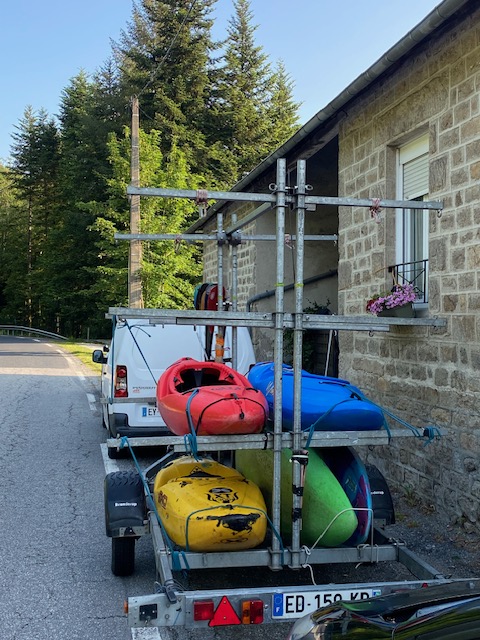
This weekend in Treignac there was a water sports festival. The local power company turned on the taps at the dam upriver from our house and let loose a torrent from Friday to Monday. Last year Treignac hosted the world kayaking championships, and does so regularly–but this year they hosted the championship trials. Our home is on a bend in the river and it was interesting to see how dramatically the water level and mood of the river changed behind our garden.
We signed up for a rafting excursion which started on the north end of town and wound around to the south end. Our total time in the raft was about 45 minutes.
My wife and I have rafted several times in the USA, and once on the border of Panama and Costa Rica. She got a group of friends together to join our team and after the typical safety gear and instruction period we were off.
Our guide was a bit adventurous. There is a small dam 300 meters upstream from our house which has a gentle ramp built in for kayaks and rafts. He told us “We are not going down the slide, we are going over the wall.” Quite exciting to take a 4-foot vertical plunge into churning foam!
The Barrage du Pisciculture at the end of our property–our rafting guide took us down over the wall!
It was lovely seeing our building from the water. The most tranquil part of the river floats around a slow bend which borders our garden and then goes under the Pont de la Brasserie, built in 1840. A friend was stationed at the wall to snap photos of us as we passed. Poor soul–she was originally a team member but fell and broke her arm a few days before the adventure and could not participate! We definitely owe her a bottle of wine for waiting so long at our place.
Photo by Kate Gratton, taken from our garden as we passed Moulin SAGE
I was pleasantly surprised by the course–I thought it would be rather tranquil and had no idea how choppy and full of attitude the water would be. There were a few really rugged spots of more than 100 meters and at least 3 substantial drops of class 3 or more. Fortunately our raft was equipped with foot straps or we would have lost crew members at different points. On one steep drop by a large outcropping we almost tipped over.
Photo by Barb Wigley, taken from her garden near the Vieux Pont, TreignacPhoto by Barb Wigley. “You two look like marauding Vikings in this one,” she wrote.
We got to pass under the medieval Vieux Pont in the center of town, and see the famous post card view of Treignac from a raft. My favorite spot however was seeing the Rocher de Folles from underneath. We’d done the hike to the outcropping previously, and got to see it from a different vantage.
It was quite an experience, and already we are looking forward to doing it again next year. Today is all about recovery after the strenuous workout–and also about cleaning up the gite apartment after a 5-man kayaking team checks out later this morning!
I’ve gone to the cinema for the first time here in France, and seen a wonderful Czech film from the 1960s, called Daisies in English and Les Petites Margarites in French.
I found it vastly entertaining, with a sort of relentless anarchic silliness propelling its basic storyline. Two disaffected young ladies decide to humiliate older men out for a roll in the hay, and they have a great time frolicking and pranking their way through the city and eventually the countryside.
The film’s use of color and prismatic effects, its clever montages and collage sequences, its peculiar cuts and crisp photography demonstrate a mastery of technique. Young director Věra Chytilová made a small miracle behind the Iron Curtain. Which, of course, was promptly banned.
While watching Daisies I had to wonder if John Waters saw this film–it features his sort of merciless energetic absurdity. There is a lot of food porn thrown in for good measure.
The film was shown in Uzerche at the Cinema Louis-Jouvet. The theater is sort of like Baltimore’s Charles with its art-house fare mixed in with big release horror and French and Hollywood releases. I had no trouble following the French subtitles except for the word vioc, which occurred twice, and apparently is argot for old dudes.
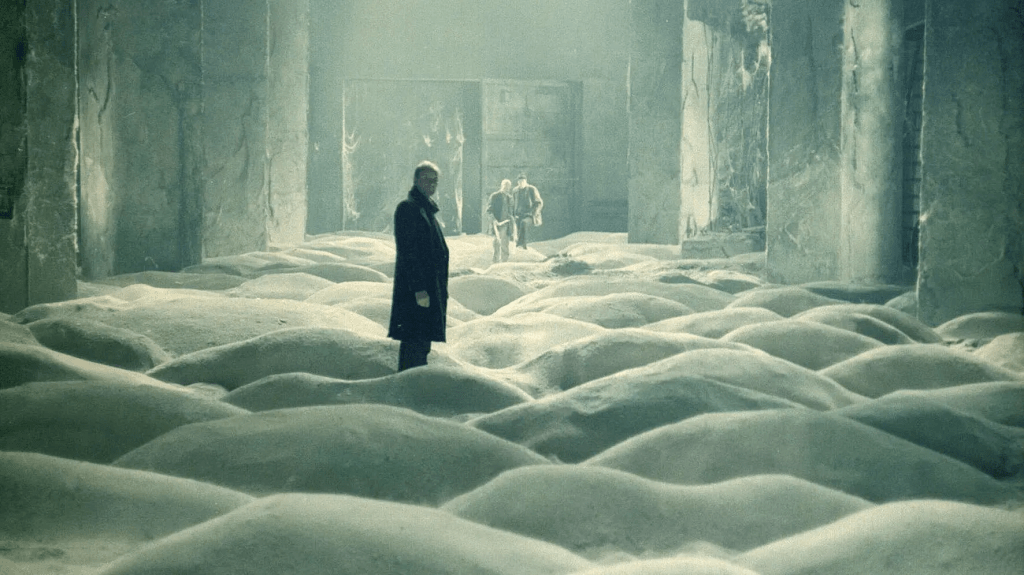
I’ve also watched Stalker on the MosFilm YouTube channel. They have several classic Soviet films and other arthouse fare available on high-quality streams with English subtitles. I was quite happy to note they had several Andrei Tarkovsky films I’d not seen.
Stalker puts the bleak in oblique. It is, like many of this maestro’s titles, a spiritual workout. You’ll feel like you spent a month in Gurdjieff’s labor program after slogging through nearly 3 hours in The Zone. It is harrowing and beautiful. Imagine Estragon, Pozzo, and Lucky no longer waiting for Godot but trying to find him/her/it/they instead.







 Mysterium Coniunctionis