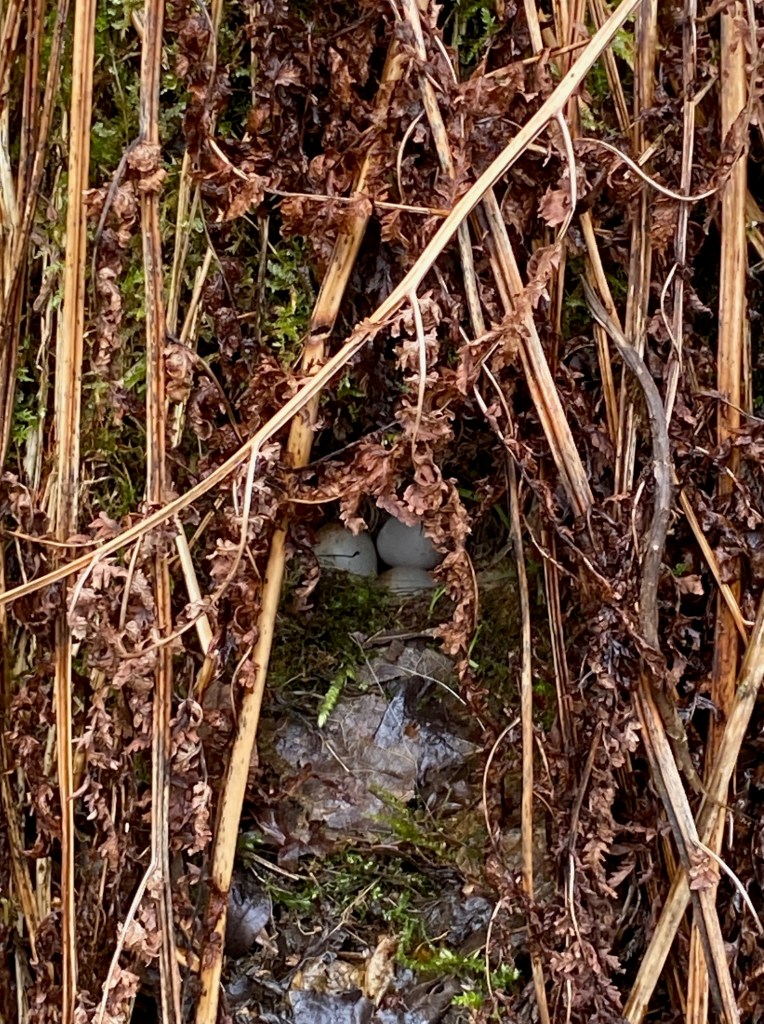
Back in the early spring I was cutting brambles and digging out weeds and noticed in the side of a steep hill on our property that there was a tiny bird nest.
Inside the nest were three very tiny eggs. In this part of France there is a law that one cannot cut hedges between March 15 and July 31 because of nesting birds, and I take this rule seriously. I pay attention to all the birds I see and like to observe breeding pairs and note where they hang out. This nest made me very happy because it was in the ground and easy to see when I walked up and down from the garden daily. The mother would often flit in and out as I worked nearby.
Last week I noted that the eggs had hatched, and I could see moving chicks in the nest. I didn’t stay to watch or examine because I didn’t want to cause anxiety in the mother, who I figured was close about and foraging. Again I was quite happy to see these babies and to think about nature and its small miracles. Often a trip to our garden is like an un-narrated David Attenborough special.
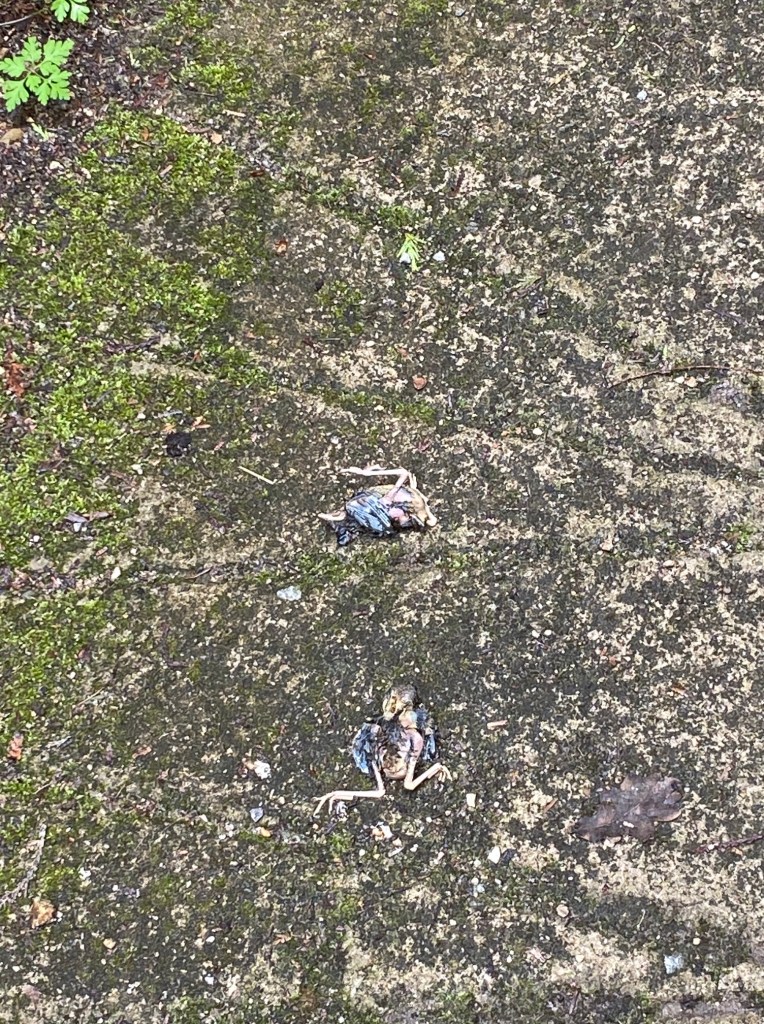
But shortly after I noticed the chicks had hatched, I found two of them on the cement path early in the morning.
I don’t know if they fell out, or were pulled out by a mammal, or if the mother had cast them out (which happens sometimes). I did hear and see a cat very early that morning on the other side of our building. One chick was completely gone, the other two were left behind.
How devastating! My entire day was colored by this discovery. I’d looked forward to seeing these little guys go through adolescence and thence into the world, ideally to return to our garden with mates to create future generations. I thought how cruel Mother Nature can be!
But of course Mother Nature is not cruel, she is indifferent and neutral. Can’t have yang without yin, after all.
I feel for the mother, who worked so hard! Hopefully she and her mate try again next year with more success.
Have you ever experienced the uncanny? That sudden intense feeling of detachment and dread when an occurrence doesn’t quite fit our rational ideas of what counts as possible or real? During these moments, one is thrust back to early childhood, when the world was imbued with magic and each object and event was a profound and inexplicable mystery.
I’ve had this type of experience many times. Here is the most recent.
My wife and I live in Panama. Panama had a merciless lock-down when COVID started. For nearly 6 months we were stuck in our tiny apartment in a high-rise on the coast in Panama City. I was allowed outside only for an hour a week based on the last digit of my ID card. We could not walk in hallways or stairwells in our apartment building. The city was cordoned off and split into neighborhoods with checkpoints everywhere. If you did not have a salvaconducto saying you were headed to work in an essential capacity for the functioning of society, the police could arrest you and fines were up to $1000.
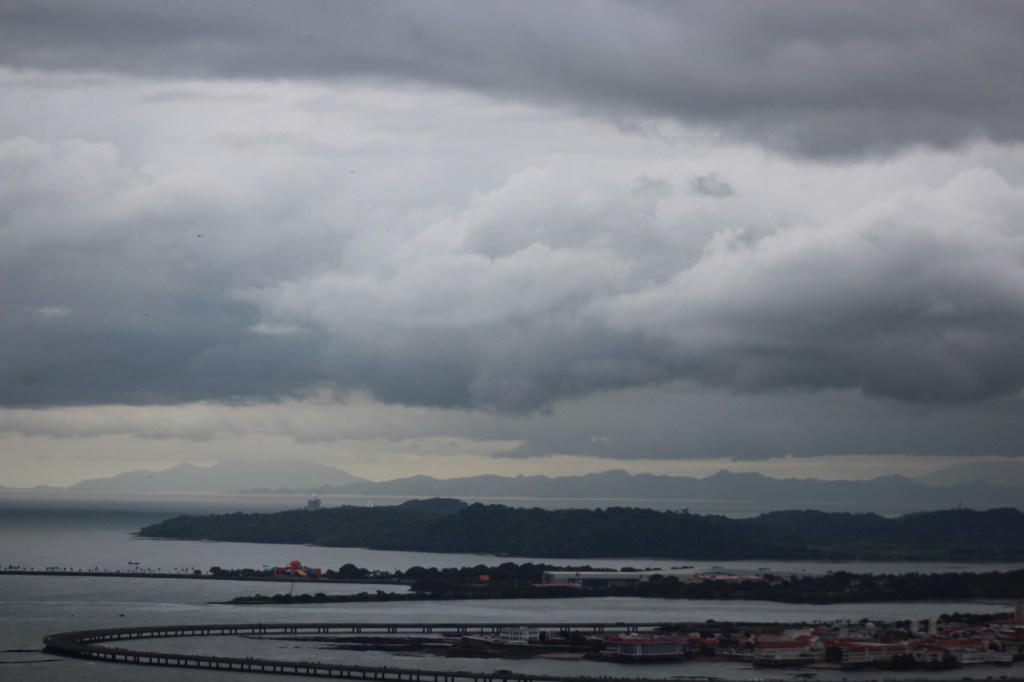
So, for 6 months we taught from and lived in our tiny place on the 54th floor above the sea. I spent hours on the balcony photographing random things because aside from reading and doing Tai Chi and fooling around and cooking, there was not much else to do.
Casco Viejo, the Amador Causeway, and the Canal from our 54th floor lockdown
When we finally escaped Panama City we did not have a salvaconducto. At the edge of Panama Province there was a police checkpoint where they were sending cars back into the City if the driver could not produce one. We lucked out because a pickup-truck with a bed full of workers pulled up at the other side along with a huge bus and the cops from our side of the checkpoint rushed over to the other side of the highway. I drove through without getting stopped.
Freedom! We drove 6 hours to Cambutal, which is super-remote and undedeveloped. It’s mostly farmland with a jungle down to the beach where a couple hotels and a few small housing developments and restaurants have sprung up. It’s on the Pacific side close to the border with Costa Rica. The beaches in Panama were all closed at the time because of COVID, but in Cambutal there are no police, so we could go to the beach and ride horses and go hiking with no problem.
We stayed in a small compound of cabins built by a young Dane over a couple years. I woke early in the morning one day, perhaps around 5:15, and decided to walk the 400 meters to the beach. My hope was to see sea turtles nesting, or perhaps even more luckily to witness a hatching. I’d seen several baby turtle trails in the sand the day before.
When I got to the beach there were no turtles. The sun was just emerging above the costal hills down to the left. The waves were a dark verdigris and pelicans were skimming the foamy crests looking for food. A young man–the local surf spotter–emerged from his wooden teepee on the beach and started texting the local surfing groups to let them know the conditions.
A few stray dogs I’d already befriended ran over and I played chase and fetch with them for a few minutes, then I decided to walk back to the cabin to see if the wife was awake.
As I walked along the road I felt a strong sensation of alert. My entire spine and in particular the back of my neck started tingling to the point almost of vibration. A mist had arisen from the trees and fields and was moving across the road. The birds which had been cacophonous moments before at dawn were suddenly silent.
Then, a regular and heavy clopping echoed along the road. At first I couldn’t place its origins, as the sound echoed from a hill to my left. Turning in the mist I looked behind me and the vapors parted. In the center of the road to my rear was a white horse, its head lowered menacingly, its eyes fixed intently on me. Its jaw was working as though at an invisible bit. It was one hundred or so meters away. When I turned to look it immediately picked up its pace.
I worked at a horse farm as a very young kid, aged 11 and 12. I know the behavior of horses, and feel fairly comfortable around them. This one wasn’t right. I am not one to panic around animals, even aggressive ones, but as soon as this mysterious apparition picked up its pace I bolted and ran full-tilt. The compound was just ahead and I figured I might have enough time to get inside and evade this creature which would be much faster than I.
I got through the gate at the compound as my pursuer reached me. Our cabin was immediately inside the entrance on the left, seated behind a tall hedge. I got to the hedge entry and behind it just as the horse reared and neighed. Its hooves crashed down through some yellow flowers bordering the hedge and not a meter behind me.
Then, winded, I watched through a gap in the hedge as the horse turned and returned to the road via the gate to continue on its way. Its muscular thighs trembled and shook and its mane was scraggly and covered in burrs as it swung its head around and grunted. I could hear its slow clopping long after it dissolved into the mist.
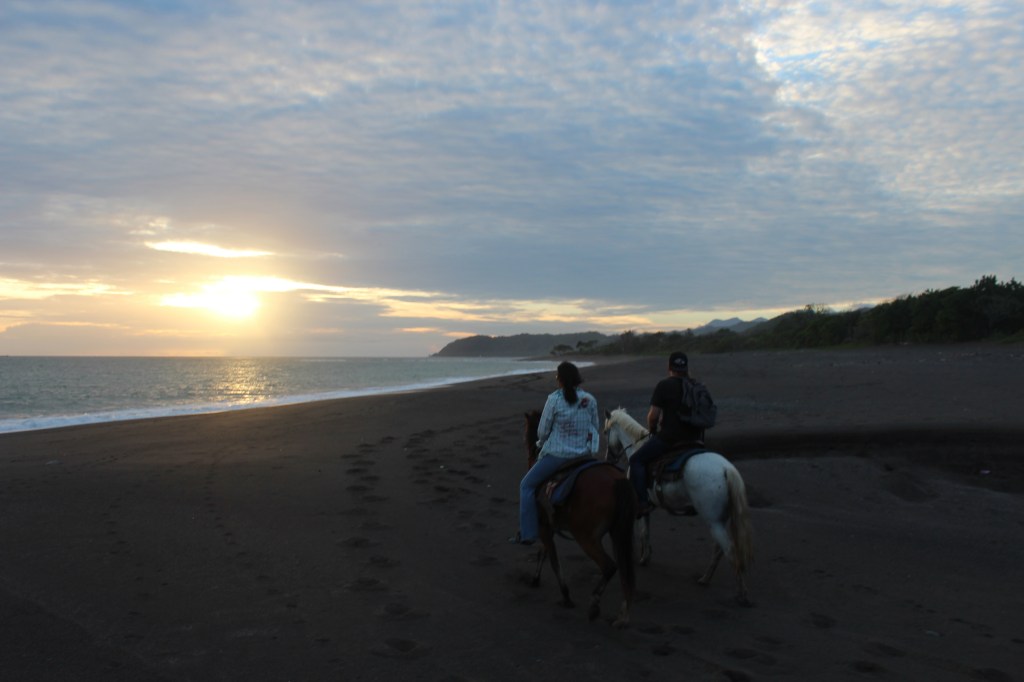
A bit more than a week later, my wife and I went on a horseback excursion to visit some old petroglyphs carved into ancient rocks. When our horses arrived I saw the one I was to use and thought: “oh, no!”
But it was a lovely day.
returning from our petroglyph excursion along the beach in Cambutal
Yesterday a psychoanalyst from Paris stopped by the Moulin. No, I did not have any sort of crisis requiring intervention by a professional. Rather, she is a board member of several local institutions and is looking for exhibition spaces. She was referred by another local business owner who is a good friend and a swell guy. On her list of wants:
a photographer’s dark room
a space to host an Aikido initiation ceremony
a space for a painting retreat
I showed her our various capacities and explained to her some of our limitations. We can host events like this but our spaces are not quite ‘finished’ and we are only in the process of adding a public restroom to our yoga studio area. She left quite impressed with our building despite its rough state and found it potentially suitable for several things.
We also have a family coming to scout out our garden as a wedding venue. All of this following a brief conversation at the new local coffee joint.
Possibilities swirl, and it’s nice for potential business to come our way without solicitation. But are we ready to host a wedding? Will we have the infrastructure ready? It’s in our business plan to eventually do these sorts of things, but are we allowed to do so under our current entrepreneurial visa, or are we limited to stage one of our plan, which is renting rooms to tourists? We have several things we need to do in order to get ready to do events like this seriously–but we have very limited resources and it will be slow and steady. We were fortunate to find a local contractor who likes to use found objects and recycled materials. He is building our restroom out of old doors and radiators and other stuff we found around the mill!
A final question: How much does one charge for any of these sorts of events? I haven’t the slightest, and we’ve not even really thought about it.
But suddenly we might be in a position where we have to figure it all out. That’s how things grow and happen.
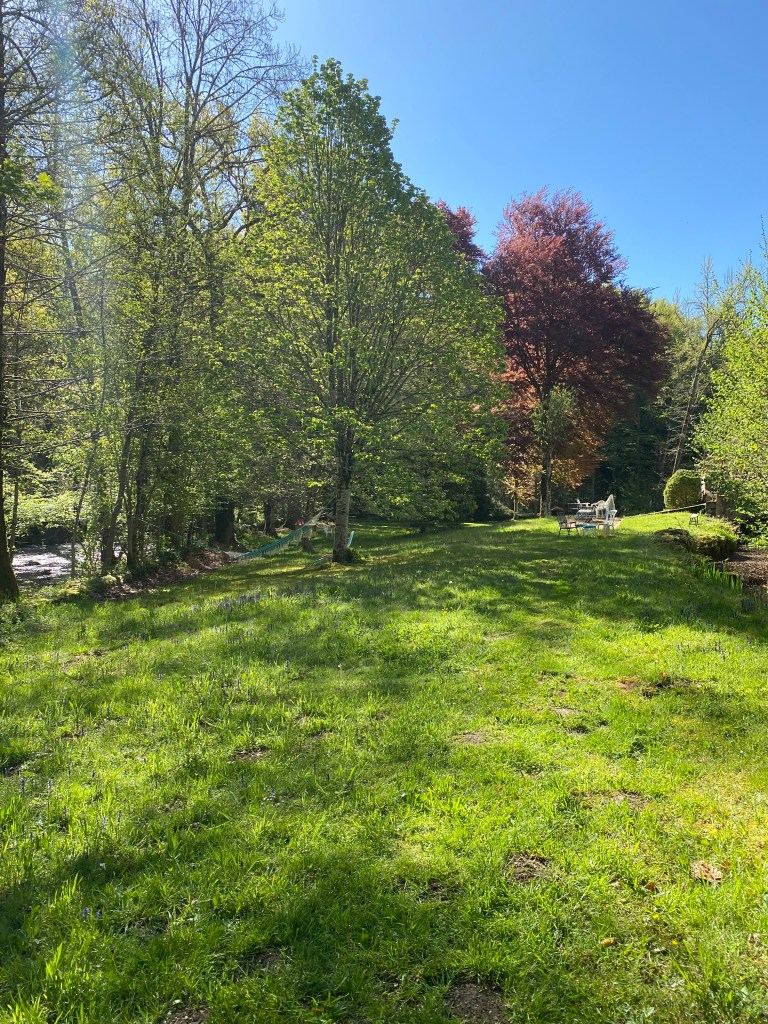
Our lawn from its north end–the Vezere River is to the left, and the canal from the days when our building was a mill runs along the right.
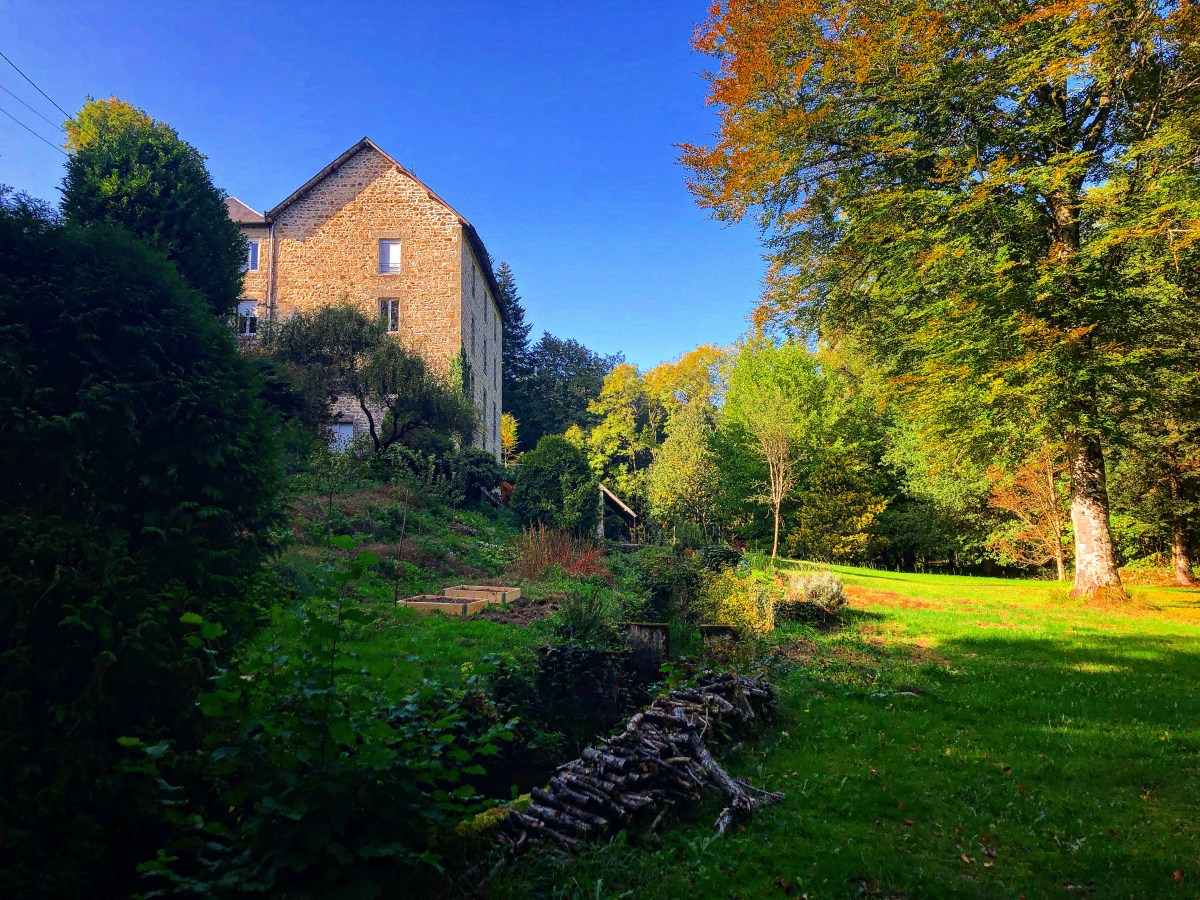
We have 1.6 hectares of land along the Vezere River in Correze. That’s almost exactly 4 acres for those of you across the pond. About 2 acres is a relatively flat lawn, the rest is on very steep hillside including a section of forest.
It takes about 2.5 hours to mow the “lawn” here, which is combination of moss, lichen, weeds, dandelions, and about five different types of grass.
Last Thursday I noted how the bees and butterflies were excitedly flitting around the wildflowers in our yard, and decided not to mow for a couple extra days. Then on Sunday my wife invited a half-dozen people over for an impromptu garden BBQ. It’s really hard for me, raised as I was in the USA, to have an “unkempt” lawn when there are guests over, and as tourist rental hosts, we often have guests!
In the USA, of course, the aesthetic expectations for lawn care are quite rigid. There must be a uniform coverage by one specie of grass, cut short and tended regularly. Any flowers or plants other than that specie of grass must be confined to carefully bordered beds or containers. If there is dandelion, or clover, or crabgrass, or anything else in the lawn, it must be pulled up by the roots or bombarded with chemicals to destroy it. I was indoctrinated as a young man into this way of seeing outdoor living space, and it’s hard to escape those expectations.
But those expectations have nearly eradicated many pollinators and bird populations.
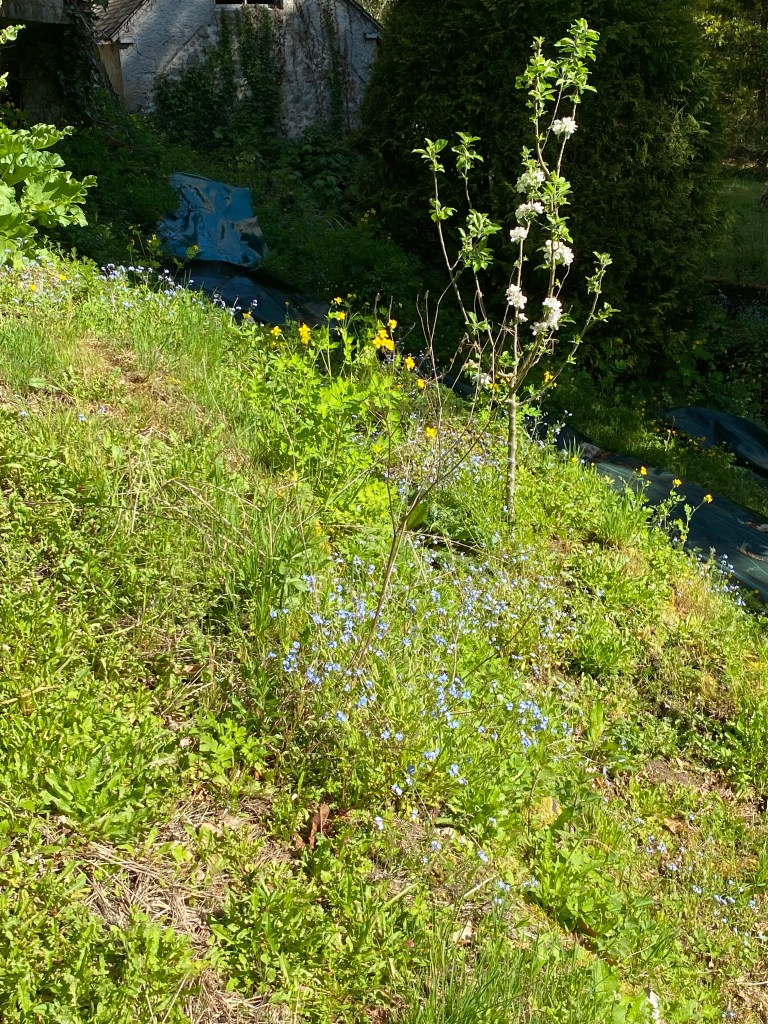
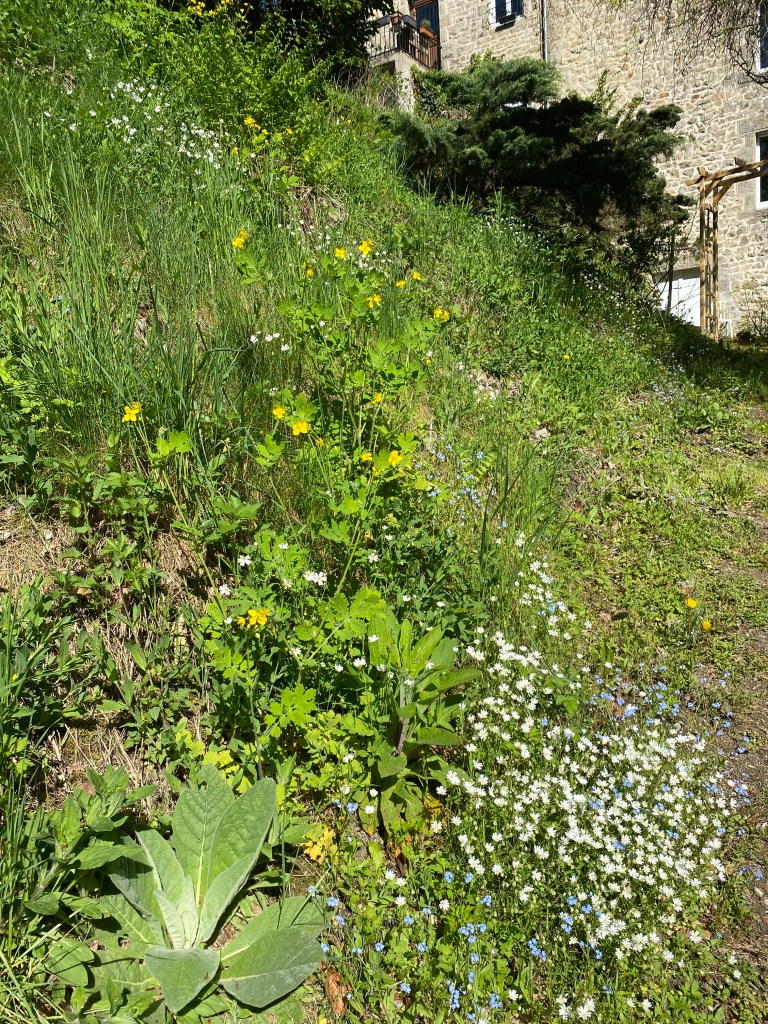
We have a three-tiered veg garden dug into one of the steep hills on our property. I’m allowing the spaces around the veg beds and fruit trees to go nuts.
Our guests at the BBQ were unconcerned that the grass was a bit overgrown and that there were wildflowers and dandelions everywhere. In fact, they marveled at the variety of butterflies and bees. They insisted that I should re-wild large parts of the lawn section of our garden. “Just cut a path around several islands of rewilded earth,” one suggested. Another said “We stopped mowing our lawn at our previous house in France and were amazed at what came up–it was quite lovely without any tending at all.”
So when I finally got around to mowing yesterday, I swerved around large clumps of wildflowers. I cut a few flat sections where we keep tables and chairs for guests, and left a patch of lawn appropriate for lounging on blankets or for a game of soccer/volleyball/what have you. I cut a meandering path around several large islands which I left natural. We will see what comes up.
The bees and butterflies were very happy with the decision. And, after having reduced 2.5 hours of mowing to about 35 minutes–so was I!
These steep hillsides on our property are very difficult to cut–but with all the wildflowers perhaps I should let them go feral?
We figured along with all the upsides of living in France and running a tourist rental biz that there would inevitably be problems. Our apartments are functional and comfy but they are not fancy, and we expect that at some point there will be plumbing and electrical problems, or leaky roofs, etc.
But our first major problem has been a spring insect infestation. Of course in a rural area one expects lots of bugs, and we’ve had in our apartment: flies, bees, beetles, spiders, and ants. But until this spring there hasn’t been a problem with bugs in the rentals. Since April, one of our rental apartments has been over-run with lady bugs (lady birds to our friends from the UK).
We’ve had several guests who stayed in the gite with the lady bugs running rampant–all of them have been super polite and understanding. I’ve been warning incoming guests that sometimes lady bugs enter the apartment and no one has backed out. One fisherman said they only bothered him when they landed on his tablet screen or his shoulders.
In early April there were HUNDREDS of lady bugs on the ceiling. It happened in our apartment as well. I really don’t mind–I sweep them up into a dustpan and release them outside whenever I see them. But my wife is the only human being in history who is terrified of ladybugs. She can’t abide them, and refuses to touch them, and tries to capture them with long-handled spoons, which is hilarious to watch. Whenever she sees one she becomes ferociously angry, despite having lived in the tropics for four years where insects all up in your grill is simply a fact of life.
So far our guests have been understanding. I told them I am reluctant to use chemicals or to call a professional because we are trying to be eco, and all our clients have been in accord with this, and one woman actually swept them herself and put them in our garden. “J’aime beaucoup les coccinelles!” she said.
I’ve tried several online folk remedies, but nothing works (vinegar, BTW, is always a remedy for everything–it does not, however, cover the pheromone trail which attracts lady bugs back inside). Now that the weather is warmer at night they seem to have stopped coming in–I hope that remains the case, because eventually someone is going to object to lady bugs all over the place on their vacation.
I suppose if one must endure an infestation in France, that having it be swarms of lady bugs is perhaps the best option. After all, at every local market there is some craftsperson selling ceramic lady bugs, hand-painted lady bug tiles, or embroidered lady bug pillows, or lady-bug t-shirts. They are black, red, orange, yellow, they eat aphids, and they are adorable!
Trying to choose a village in France to set up a small tourist rental biz was a challenging process. There were a lot of things to consider, we had very limited resources, we did hours of online research. All of that culminated in a three-week journey from Paris to Limoges and then all the way over to Marseille and back a couple summers ago.
There are literally hundreds of small towns in France which are charming and where houses are inexpensive. Many of these villages, however, are in decline. The businesses are closed, there are no young people, the tourists might drop by to see the local church or to do a hike, but they don’t stay or spend money. We visited a few dozen towns, some of which were magnificent and had exactly what we were looking for at very low prices.
But too often it was obvious that a town was fading irrevocably. Risking one’s life savings on a town without the potential to make a living was something we had to consider carefully.
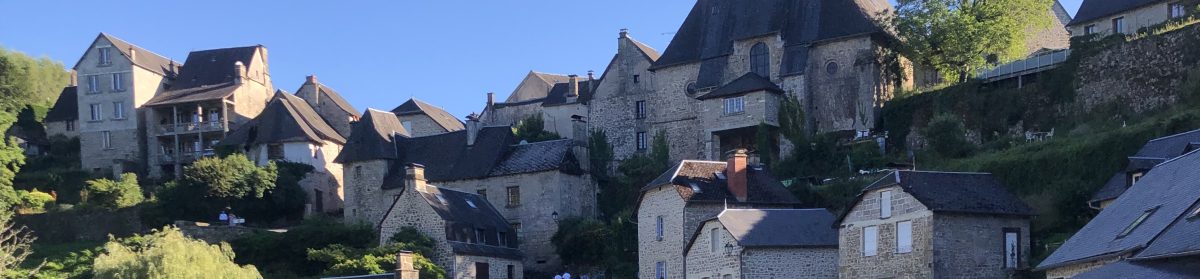
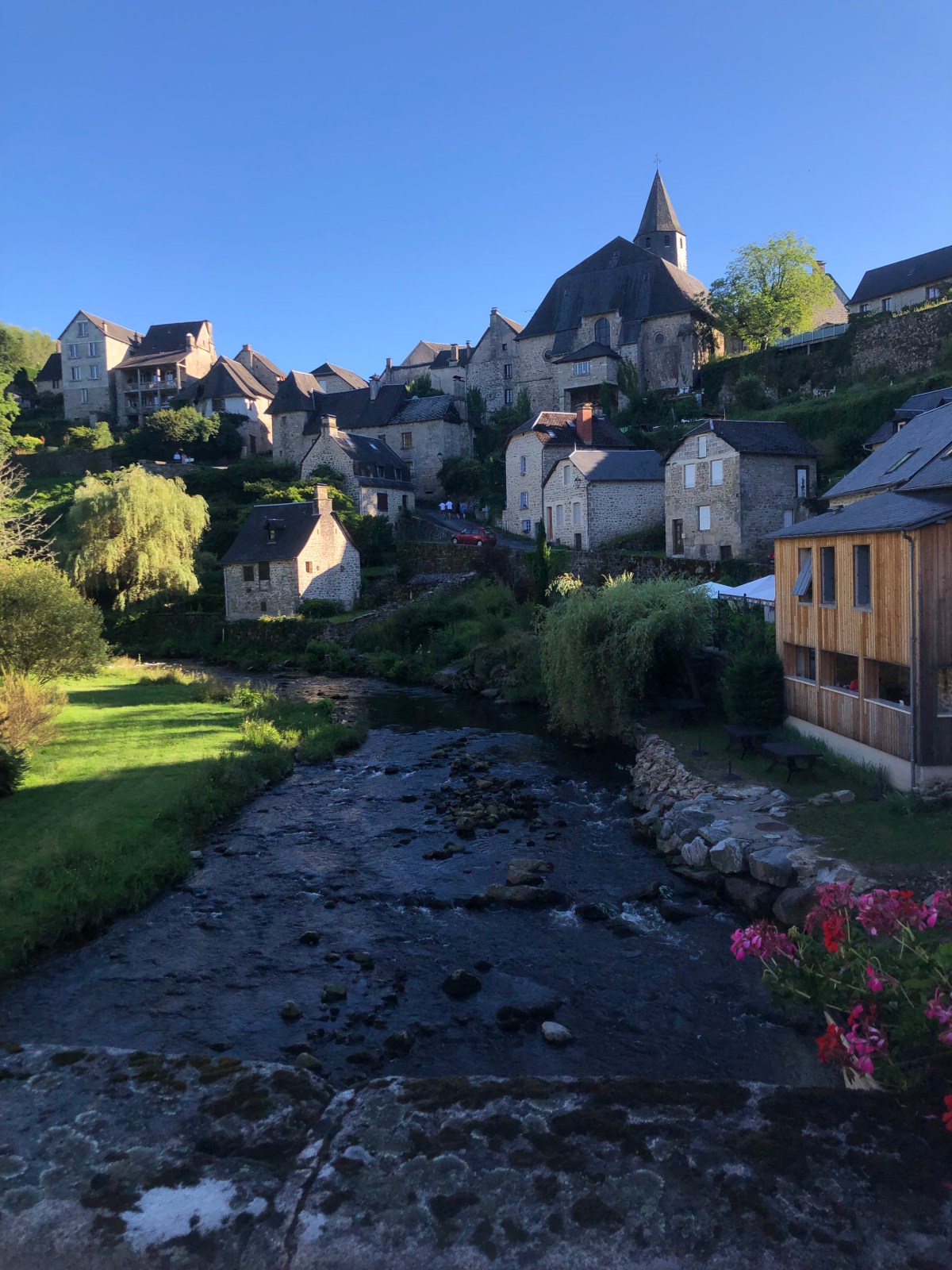
We hit Treignac twice on our initial visit. It checked off several boxes: A medieval town with layers of history, a charming natural setting with a river and lakes, forests and mountains, a modern supermarket and hardware store, some small local specialty shops, a nice expat community of folks from the UK, proximity to a few larger cities. And, most importantly, an outdoor sports infrastructure and a developed beach at a lake which attracts tourists from late spring into the fall. Treignac had an energy that was missing in many other similar towns across south central France. And the population had actually increased lately.
One quite pleasant surprise here has been a Tai Chi course. For $40 a year we get three 90-min classes a week, two focused on Tai Chi and one on Qi Gong. Fifteen years ago I took two years of Tai Chi in Baltimore and I’d continued practicing on my own ever since. Having the opportunity to learn a new form and practice with a highly skilled teacher was something I never expected to happen in a village of under 1300 people in rural France.
Our instructor is nearly 70 but looks and moves like a man in his early 40s. He studied with a master from China and has a certification from the French government as an instructor. He is a patient, funny, and serious practitioner and instructor and gives detailed personal feedback. I’ve been doing Tai Chi and mindfulness for a long time and he has broken my bad habits down and rebuilt my practice in just a few months.
I hope to learn the full Yang style form with Alain. So far we have completed and are fine-tuning part I, ‘The Earth.’ Next up is Part II, ‘Man.’
It’s been a huge adjustment going from 20 years teaching and having either a small yard or no yard to having a massive garden on multiple levels to maintain. Often the work is intense and as an oldie I get stiff and sore. Tai Chi and Qi Gong have been a huge help in keeping these old bones limber, and as I reconnect to the natural world a bit of Taoist philosophy and attentiveness to my body and its connection to the universe will continue to ease my aches and pains.
In the USA there is an unfortunately large group of people who are absolutely intolerant of anyone who speaks other than English. These people often get exasperated and even violent when they hear others speaking Spanish on the street, or when a shop or restaurant is playing the TV or radio in another tongue. Spanish of course was spoken in large areas of what is now the USA LONG before English…
But any American who has had the experience of living abroad in a place where English is not the primary language understands immediately how difficult and how taxing it is to become comfortable in another tongue.
We lived in Panama for four years. I never got my Spanish up to snuff while living there. We worked for an international school and all teaching and learning was required to happen in English, we gravitated socially to staff and expats who spoke English, we were in lockdown for almost an entire year during covid–there are lots of excuses I can make. On top of these reasons, the Spanish in Panama is quite ‘gummy’ and difficult for an untrained ear. Words are lopped off casually and crammed together. The pace is rapid but the articulation is laconic. It’s beautiful to listen to but challenging to comprehend. Nevertheless, I was able to navigate my way through basic conversations by the end, to feel confident in restaurants and shops, and I even got through a hospital admittance process when I had to get a hernia operation, totally in Spanish. But my Spanish remained at the level of an early elementary student’s.
When we travelled to Colombia or Mexico, however, I could comprehend the Spanish much more easily. Every consonant and syllable was carefully articulated. Riding in a hired car from Medellin to Guatape I had a 3-hour conversation with the driver. I noted his name was Alain which was not a Spanish but a French name, and he told me his mother was a fan of the French actor Alain Delon and his mysterious green eyes. I told Alain how much more easily I understood his Spanish than the Panamanian Spanish and he said ‘they speak that soft Caribbean Spanish over there.’ Others we encountered said that Panama was full of hicks and was regarded as the equivalent of Texas in Colombia, with its own peculiar language.
When we left Panama we flew directly to France and spent a couple nights in Toulouse to adjust to the time difference. French felt easy and after struggling for four years in Spanish I was immediately much more confident in a language I’d studied extensively as a young man. When we arrived at the house we were buying the owner had set it up so we could stay in the gite apartments for a couple days before settlement. He gave me long, detailed tours of the house and instructions about the systems and how things worked. Then, we went through the notary process and the purchase. I was surprised at how quickly French returned after 2 decades of under-use. But it was EXHAUSTING. I wasn’t thinking in French, I was translating in my head. I became so tired and frustrated after a few days that I wanted simply to sleep for a week.
But we had clients in one apartment the very first day–no rest for the weary!
I still have great difficulty listening to French radio or watching movies. I read much better than I hear! Subtitles for films are necessary but the colloquialisms and slang phrases are beyond my ken. I work on trying to improve daily by revisiting old text books I used before ( French for Reading currently is helping a lot). I also subscribe to and read a couple journals and try to go beyond the “quick tour” of apartments with clients and to engage in a bit of conversation with them. And: novels. Balzac you are killing me!
There are many people here in town who are native English speakers, most of whom have lived in France for more than a decade. The majority of them speak almost no French at all. An Australian friend who moved here last year got a phone call when we were out to dinner and immediately thrust his phone at me because the speaker was French–it was a real estate agent calling about a property he’d seen. When I handled this fairly simple phone transaction our Aussie mates thought I was some kind of wizard.
Most French people, even out here in the rural Correze, are quite patient with those who can’t speak French. I wish folks back home could be like that: don’t judge someone for not speaking your language. Be empathetic and compassionate with them. It’s really difficult to pick up another tongue. Try it and you’ll see.
It’s been a bit more than 10 months since we arrived in France. We quit our jobs and used 85% of our savings to buy an old mill in a small village in the Correze. We are “jobless,” in the sense that we’ve dropped out of the system which requires you to show up at a place of employment and subject yourself to the whims of an employer for huge swaths of your life.
But we are hardly “not working.” Today, for example, I weed whacked for two hours, I cut down scrub brush and overgrown ivy and dead trees for two hours, I prepared two rental apartments for overnight guests and greeted them and toured them around (in French). My wife and I carted barrows full of gravel down from the street level at our property to the garden where we intend to set up a glamping tent.
Tomorrow we will have to clean the apartments and do laundry and prep them for the next guests. We don’t make anywhere near the money we used to make when we had salaries–but we make enough. We own our property free and clear. We have solar panels. We have a basic and simple life, and I’m starting a vegetable garden. The goal is to have a business sufficient to live a simple and comfortable life without all the rat race BS we faced for decades in the USA. And 10 months in, we are doing so.
Whatever your dream is–whatever it is that you wish you could do, or hope to do someday–do it NOW. Stop buying into the culture that you must rent yourself to a corporation in order to be successful and happy. Get out of that mindset. It’s not easy. The visa renewal process and French taxes are driving me crazy! But–you can live by a river in an old mill in France (or wherever you want) for a fraction of the price of a condo in DC or NY or Vegas. Do it now!
We have two families of four staying over tonight. They had luck with the weather and spent their first few hours here in the garden exploring. They told me how cool our place was and they took many photos of our building and the river, and their kids ran around kicking a soccer ball and having a blast. That is all I need. I don’t need a big salary and retirement. I don’t need 65 hour work weeks and stress.
In my 20s and early 30s I read a great deal of Carl Jung’s work, often in a haphazard way, often without much comprehension. I got through the major tomes and even many works by other Jungian analysts and practitioners, but about one-third into the Mysterium Conjunctionis I petered out. At one point I went to a release party for Jung’s The Red Book in New York where there was an exhibition of his paintings. Although I excitedly bought my copy, it has languished on the shelf for 15 years, barely perused. I suppose I felt I was saturated enough by Jung and his thinking.
But suddenly on Monday evening I took down Volume 18 of the Bollingen Collected Works, The Symbolic Life. I’d purchased this years ago and shelved it.
Why the sudden renewed interest? On Monday my wife hosted a small dinner party for some friends who’d helped her with a project in our garden. We live currently in rural France in a small village. One of the guests was a young German woman who’s lived locally for most of her life. She is 30 and a mother and is marrying a young man who is not the father of her child (a complex love story).
In conversation we stumbled somehow on the topic of Jung-I believe because she’d seen my library?- and she was immediately interested to discuss Myers Briggs results. I shared that I was INTJ and she became quite excited to share a lot of her knowledge of Jung and how his ideas have been influential in her relationships. She stood at one point and lifted her shirt while pulling down her skirt a bit, revealing blue tattoos running from the dantian upward to between her breasts.
“Now I know why you are so secret, and so calm,” she says. “When your wife is hosting events you are never there until you are needed and suddenly you are there and then you disappear. It’s the INTJ!”
She shared how Jung has helped her use symbols and ritual to structure her life and function in relationships, and to communicate ideas she can’t put into words despite fluency in 3 languages.
In our 90 minute conversation about Jung and the structure and functions of consciousness in his theories I realized how soft my understanding had become over the years. I’d drifted completely from the ‘scientific’ Jung and was wholly saturated by the ‘mystic’ Jung.
Fortunately, the Tavistock Lectures, featured first in The Symbolic Life, offer a clear and summative refresher of Jung’s basic theories about the practice of analytical psychology and how consciousness functions. Also in Lecture 2 Jung discusses how Germans have a strongly differentiated thinking function whereas the French have a strongly differentiated feeling function, and this is why the French and Germans have historically been at odds. I wonder how my young friend would feel about this idea, being a German who moved to rural France at age 12 with a soul rooted in each place.




 Mysterium Coniunctionis