
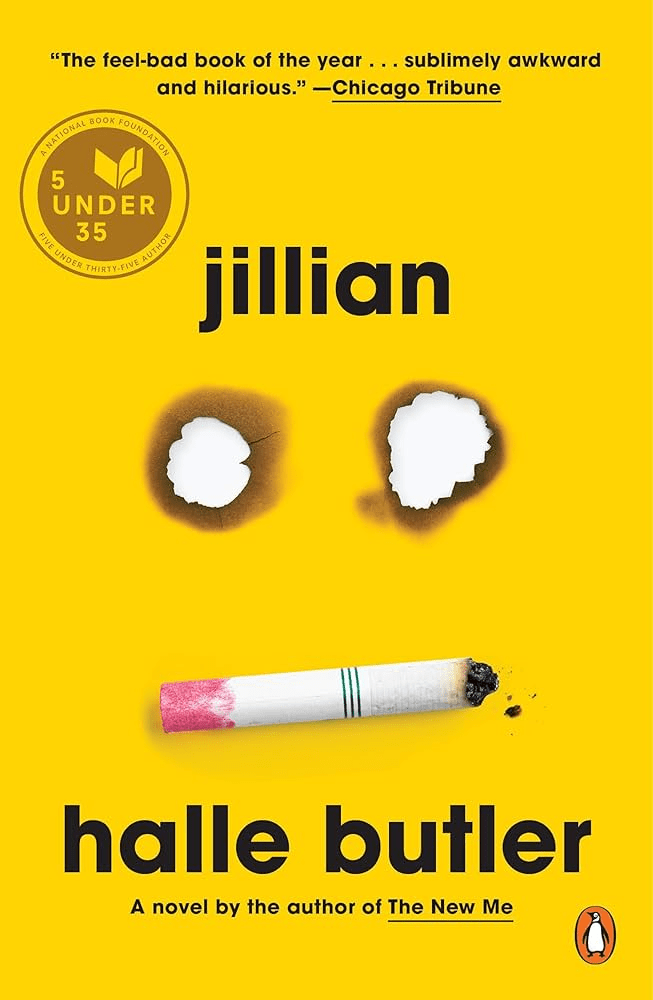
Jillian

This book is awful. When I write that I’m not speaking at all of the quality of the novel–it’s actually quite good and very entertaining. But everything about it is truly terrible. Jillian is a troublingly accurate record of life in the current late-stage neoliberal capitalist hellscape we all inhabit. As such, it’s an abyss of despair, a Nietszchean vortex, a singularly piercing examination of approaching Singularity. I laughed heartily reading it, and cringed each time I laughed, because ‘funny, not funny.’

The novel centers on two characters: Megan, a recent college grad who works in a gastroenterologist’s office. Her job is to look at images of people’s colons all day as she scans the images into their medical files. She is alienated from her labor, but also from her friends, from her boyfriend, from her family, from her society, and from herself. Marx wrote Grundrisse just for Megan. She sees how empty everything is and how difficult it will be to find meaning at all in a life doomed to this sort of work. As a result she gets smashed on canned American beer and smokes too many cigarettes while becoming more and more of an intolerable asshole. Megan is infuriated that nobody else can see how fake everything is and how their successes at their own fake shitty jobs are contemptible.

And then there is Jillian, Megan’s co-worker. Jillian is about a decade older than Megan and because unconsciously Megan sees herself becoming Jillian in ten years, still working at the doctor’s office, still cheerfully scanning poopy intestinal images, she starts to really loathe her coworker and herself. Half the novel is from Jillian’s point of view, half from Megan’s (with brief moments from the POV of a few other scattered characters, including Jillian’s son Adam and from a dog, a bird, a racoon).

Jillian is a total wreck, and drives on a suspended license because she is completely deluded about the state of her world and unable to face the realities of her situation. A single mom who got knocked up after hooking up at a club while high, she has discovered religion and has made a mess of that as well. After drifting thoughtlessly through a red light her car gets impounded, she is arrested and arraigned, and she has to rely on the kindness of a fellow church member to get her kid to daycare every day while she goes to the office. Megan sees through all of Jillian’s bullshit and it makes her totally crazy. She goes home and obsesses about Jillian to the point her boyfriend starts to get annoyed by this obsession.

Meanwhile Jillian has lied to her employer about her car and about an upcoming court date and about her fine for driving on an expired license. And to solve all her problems she adopts a dog because happy families have dogs, right? Then a painkiller addiction makes everything that much better.

In this novel we get to experience the collapse into despair of these miserably entwined people. And what makes it all worse is that Megan, despite being a terrible asshole, is actually correct about the people around her and the society she is in and about her prospects. And she is correct about Jillian and her thin cheerful veneer, the inevitable collapse of which affects not only herself but her child and her dog and Megan and the entire society they are trapped inside. And yet these are the sort of people churned out and crushed by America the Beautiful in the 21st century.
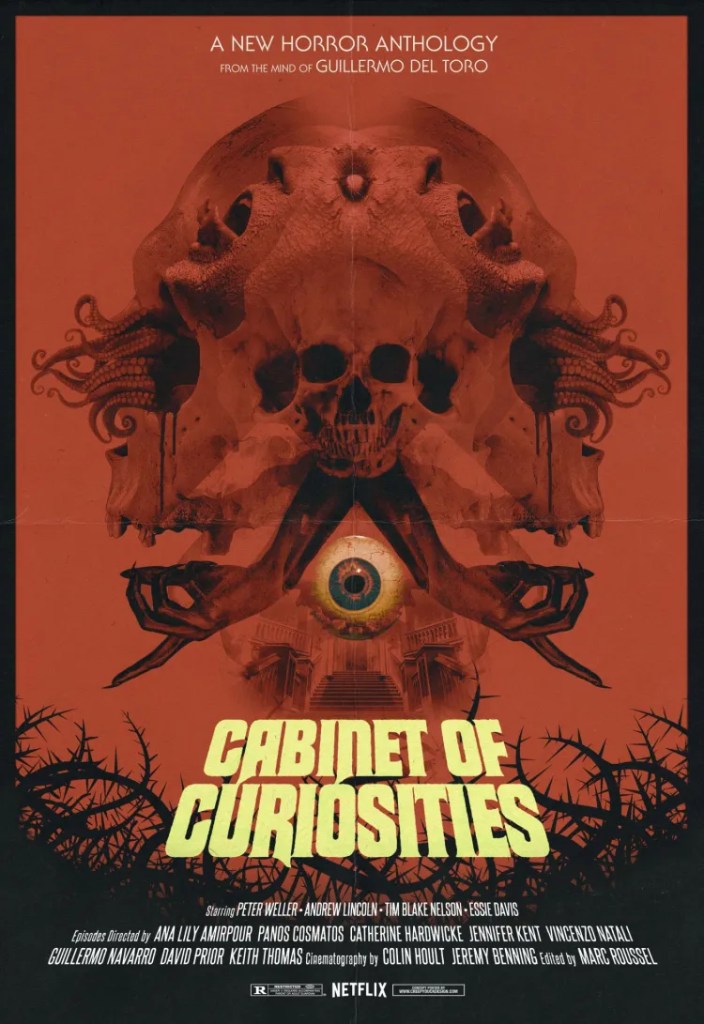
 

Cabinet of Curiosities

When I heard that Guillermo del Toro was producing a horror anthology for Netflix, I was intrigued and hopeful. He’s done some marvelous things, and some OK things–and typically even the not-so-exciting things he’s done are interesting and visually impressive.

I’m not one who typically binges streaming series, because I prefer to absorb an episode before adding another, but I watched 8 episodes of Cabinet of Curiosities in 6 days, which indicates an atypical level of excitement and appreciation.

Not all of the episodes are of the same quality or even really of the same genre–“horror” encapsulates many sub-genres, of course. The first episode is a typical Twilight Zone/Outer Limits morality play, featuring a monstrous protagonist whom karma appropriately dooms. But “Lot 36” is well-acted and well-produced and sets the tone for the series. It was certainly amusing to see Tim Blake Nelson play a villain.

Episode 2 “Graveyard Rats” is more of a cartoonish Evil Dead 2 goofy gore joyride which had my wife squirming and twisting on the couch as we watched together (she didn’t make it past this episode). This is gimmicky slapstick horror, red meat for the masses, but great fun.

The 3rd episode moves to a new level and differentiates del Toro’s series from previous televised anthology horror. You simply could not do what “The Autopsy” does on network TV, and even on most cable channels it would have been too much. I’ll not spoil it, but it’s as if X Files had hired Tom Savini to helm an episode, and F. Murray Abraham is legit in his role.

And then the art direction takes off into delightful and dazzling dimensions with episode 4. “The Outside” is Cronenberg body horror through the lens of early Tim Burton or Coen Bros. It’s hilarious, incisive social commentary, but also deeply disquieting and disgusting. At this point in the series I was sold that something new and profound for horror was happening.

Episode 5 takes H.P. Lovecraft source material and adds Crispin Glover. “Pickman’s Model” the story leaves a lot unsaid, and the re-write of the idea featured here fills in those ambiguities, but it is fantastically dark and there is none of the humor of previous episodes–this is gruesome, merciless cosmic horror. Again, the series reaches new heights and achieves a brutal, shocking finale.

Episode 6 “Dreams in the Witch-House” is another HPL story. I found it slightly less horrid than the previous, but still exceptionally well-crafted. It’s reminiscent of a John Carpenter film from the 70s or 80s (The Fog, for example).

I don’t know what to say about episode 7. “The Viewing” is simply beautiful, and viewing it is a pleasure all its own. There is a Solaris/Blade Runner sci-fi edge here, and the Boogie Nights feel and production quality is magical. I loved every second, and even when the plot falls thin the performances and the look of this episode again take the series to a new frontier. The ending is really only the beginning of the true horror.

The closing episode, “The Murmuring,” is simply beautiful. Mournful and elegiac, this is a classic haunting, where the spirits find a connection to the past experiences of a living protagonist and use her to their advantage. Other classic haunting films (The Shining, The Haunting, The Innocents) are referenced, but the atypical ending is unexpected and quite moving. The source material is a short story by del Toro, who also wrote “Graveyard Rats.”

If you are a fan of horror, whatever your sub-genre preferences, Cabinet of Curiosities has something for you. Prepare to have your spine tingled.

Happy Halloween!