
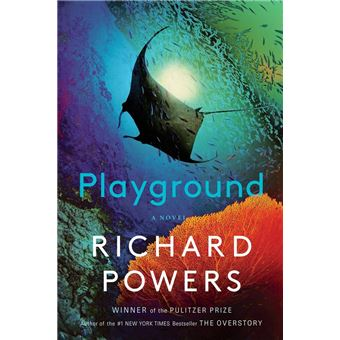
Playground

Richard Powers’ latest is another complex and tightly structured novel spanning nearly a century. There are two primary narrative strands woven together like a double helix, one first-person stream relayed by Todd Keane, an early social media and AI innovator from Chicago, and the other a third-person tale focused on Evelyn Beaulieu, a French Canadian whose father develops early deep diving technology and who becomes herself a famous deep sea explorer and renowned scientist. We jump back and forward a bit in time between these two strands as the characters each end up based in California for their work and eventually they find themselves meeting in Makatea, a tiny island in French Polynesia.

It is a credit to Powers’ strengths as a novelist that he can manage to hold all this together geographically and temporally. Despite the weight of its themes and its saturation with multiple branches of scientific inquiry, Playground manages to be a pure delight, an engaging and thoroughly breezy read.

Todd Keanes comes from wealth. His father is a hardscrabble financier and trader who builds a fortune. Todd ends up at the elite Jesuit private school from which his father graduated, and there he meets Rafi Young, a brilliant and militant young Black scholar and poet who won a scholarship endowed by Todd’s father. The first-person narration by Todd is our window on Rafi’s world–his tragic family situation, his financial struggles, his absolutely unique genius. The two challenge each other intellectually and play chess at first and then Go. It is their interest in games and gaming that give Todd the inspiration for his eventual social media platform Playground, which makes him a billionaire. Rafi’s burning creativity provides a lot of the ideation behind Todd’s innovations, and Rafi’s interest in a Russian philosopher who believed humans would inevitably discover or invent a technology of immortality is hugely influential on Todd’s eventual AI push. But as often happens to intense youthful friendships, Todd’s and Rafi’s falls apart as they head off on different paths–Todd to Silicon Valley, Rafi into graduate work in the Humanities. Rafi also meets and falls in love with a young artist from Makatea.

One of Todd’s earliest passions was the ocean, said passion first fired when he read a book by Evelyn Beaulieu called “Clearly it is Ocean.” Evelyn’s story begins when her father tests out a deep diving apparatus by putting her inside of it and throwing her into a deep pool at an engineering facility. After this she begins using his gear to explore the ocean and becomes many firsts: first woman accepted into an exclusive graduate oceanography program, first woman to join a months-long diving expedition, one of the first women to live in an underwater facility run by NASA. Like Jacques Cousteau, she is a lyrical documenter of the deep. And like Richard Attenborough, she sees in her lifetime the dire impact of humans on the environment and creatures she loves. We see her struggle with being a wife and a mother when her primary motive is her work, and how challenging it is to escape the traditional boundaries set on her gender by centuries of patriarchal thinking. It is one of Evelyne’s great realisations through her decades of diving and close observation that sea creatures spend a lot of time playing. Play recurs over and over as a major theme in the book, and for Evelyn and Todd their work is more play or a challenging game than it is drudgery.

I won’t go into the profound final fifth of the novel to avoid spoilers, but there are some surprises and interesting ambiguities. If you’re familiar with Ray Kurzweil a few strange and confounding discrepencies in the novel, nearly along the lines of magical realism, might become more clear. These involve the dates characters died, and whether they are actually alive in a traditional sense of being alive during parts of the story. Also, if you’ve read any Philip K. Dick, particularly the novel Ubik, you may grasp what is implied about some of the characters and indeed the setting of Playground’s climax. Also there are some Doctor Frankenstein allusions when we discover exactly to whom–or to what–Todd Keane has been narrating his tale.

There is some truly gorgeous writing about the ocean in this novel. One sequence about a cuttlefish is particularly lovely. It struck me as familiar, and sure enough Powers lists in his sources Peter Godfrey-Smith’s Other Minds as the genesis of that scene. I read the book a decade back, and can’t recommend it enough. I should also note that this novel is the second I’ve read lately featuring the astonishing development in AI and its ability to defeat the best human players of chess and Go, the first being Benjamin Labutut’s The Maniac. Sign of the times, I guess?

I’m also pleased to note that Playground features a female scientist, as did Powers’ previous masterpiece The Overstory. At a time when dark forces in the USA are insisting that women in leadership or highly skilled professional roles must be “DEI hires,” and that women should focus instead on birthing and raising children and stay at home, it is important that writers continue to show otherwise.
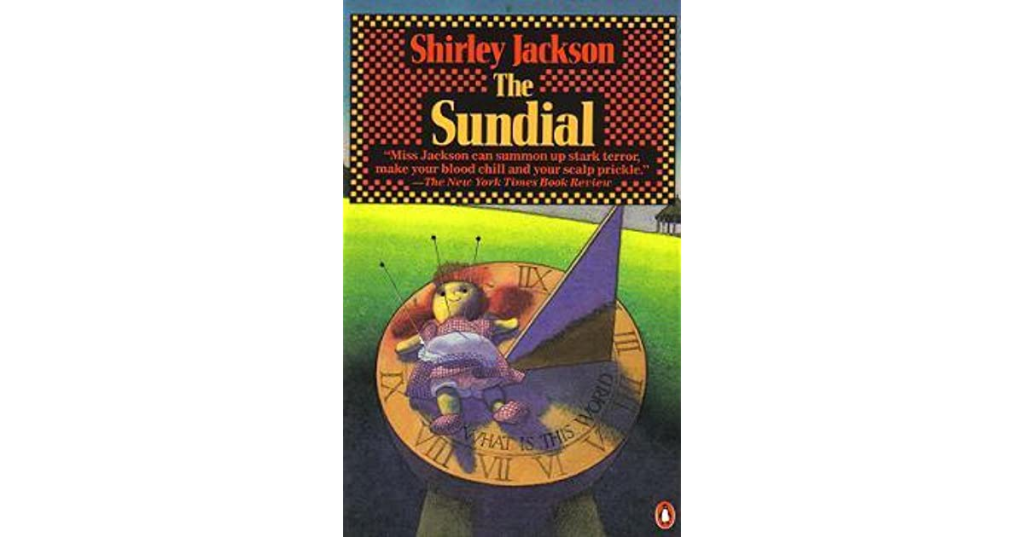
The Sundial

https://bookshop.org/widgets.js

Shirley Jackson has the distinction of having written the novel I’ve re-read the most. As of last January I’ve read The Haunting of Hill House seven times. I’ve also read many of her short stories and the lovely and mysterious novel We Have Always Lived in the Castle as well. But for some reason my 1990s paperback re-issue of The Sundial sat on several shelves in several houses for a few decades before I got around to it this week.

I suppose I needed to wait until the collapse of civilization in order to fully appreciate the book. We’ve had several near collapses since I purchased The Sundial–Y2K, the end of the Mayan Calendar, various planetary alignments, wars, pestilences, George W. Bush elected twice–but something about recent events conjures more serious reflection on the End Times than all those others.

The Sundial is focused on the coming End of the World–or, more exactly, how people respond when they genuinely believe the End is nigh. The setting is a genteel massive manse in a New England town, built a generation previously by some fabulously wealthy businessman and currently inhabited by his two children and his grandson’s widow and daughter. The children are Mr. Halloran, confined to a wheelchair and in evident decline, and his sister Aunt Fanny. Mr. Halloran’s wife is still around as well, and is suspected by the grandson’s widow and granddaughter of having murdered his son by pushing him down the stairs in order to secure her own inheritance of the house.

Aunt Fanny one early morning takes a walk around the gardens she’s known since childhood, becoming somehow lost and suffering a potent vision of her father telling her the end is nigh, but that those inside his house will be saved to repopulate the Earth. What ensues is pure hilarity. Fanny shares her vision and somehow it becomes doctrine with all those trapped inside. They will be Robinson Crusoes and Noahs and Adams and Eves, left stranded to rebuild and repopulate.

As in every Jackson novel the characters are all delightfully awful and are skewered by her sharp sensibilities. The dialogue is funnier and better and more sophisticated than anything in Dorothy Parker, the wit makes Evelyn Waugh seem amateurish, and Dickens himself would have been awed by Jackson’s ability to lampoon class differences so efficiently. What took him 5 or 6 hundred pages takes her much less than 3.

I note that as we pass from Pisces and into Aquarius that the old gods have all lined up to watch our current collapse. The Planet Parade of late February/early March this year showed them all coming back to witness our decline once again into rebirth and renewal, just as the change from Aries to Pisces saw the cratering of all the great Mediterranean civilizations and the birth of new orders. In Jackson’s novel the end doesn’t matter so much as the way people behave anticipating it. And just as she predicted, they behave shamelessly and hilariously so–Buckle up, folks!

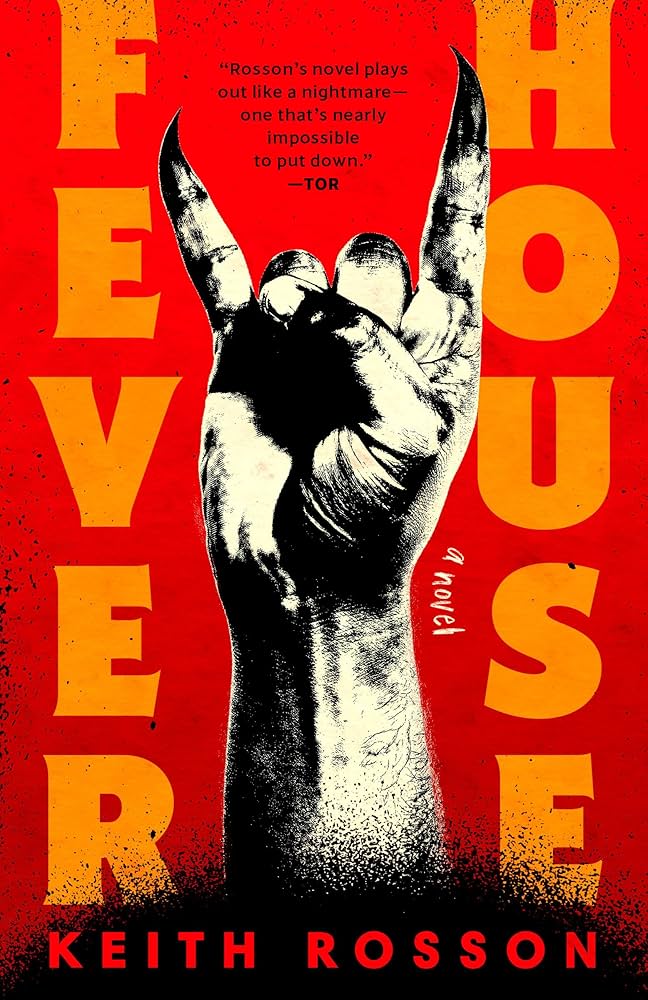
Fever House

Back before Halloween I bumped into a list of recommended recent horror–probably on the NYTimes website. Of the 7 or 8 titles listed I chose a couple to add to my To Read pile.

The first I read from the list was barely OK. Too derivative of a Stephen King novel, and too many clichés from current horror movies (unnatural smiling, kids crawling on the ceiling, animals behaving strangely like humans–yawn). The writing lacked King’s folksy warmth and humor as well, and was more like Tom Clancy’s stiff and uninteresting prose. The characters were not atypical of genre fiction–types rather than people, and the dialogue reminded me of the old Superfriends cartoons popular when I was a kid, where the superheroes would explain what they were doing while doing it as if the audience were too stupid to see what was happening (example: Aquaman would have circles shooting out of his forehead and would intone “I’m using my powers to summon fish friends,” and Superman would have red beams coming out of his eyes while saying “I’m using my infrared heat vision to burn the villain’s shoes off.”). I read Mean Spirited on a flight from Paris to the US and it whiled away the time, but I prefer more profound fare. The ending had an unexpected twist which nearly made it worth getting through.

But the second I read from the list was a knock-out. I’ve seen many zombie films, and have been an enthusiastic fan of the genre since I fist saw Romero’s initial trilogy back in the day. What I like about zombie stuff is how the genre moved from its racist origins to really incisive and often quite witty social commentary.

Fever House is the first zombie novel I’ve read–and it is excellent. There are actual fleshed-out and fully developed human beings involved, and I was on the edge of my seat as the familiar tropes of the zombie apocalypse were delivered with a new and clever backstory. I’d love to go into detail about the novel’s critiques of the hypercapitalist USA and its intelligence apparatus and the military industrial complex, but inevitably I would spoil the experience of finding out for yourself.

Rosson can write–which is atypical of authors in modern horror. Ramsey Campbell is by far the most literary and stylish current writer in the genre, but Rosson can craft sentences and structure a novel at an exceptionally high level. This book is a Slayer album redone as literary fiction. I burned through it in a day and half, and now must give myself a break from the walking dead before jumping into the second volume of the duology.