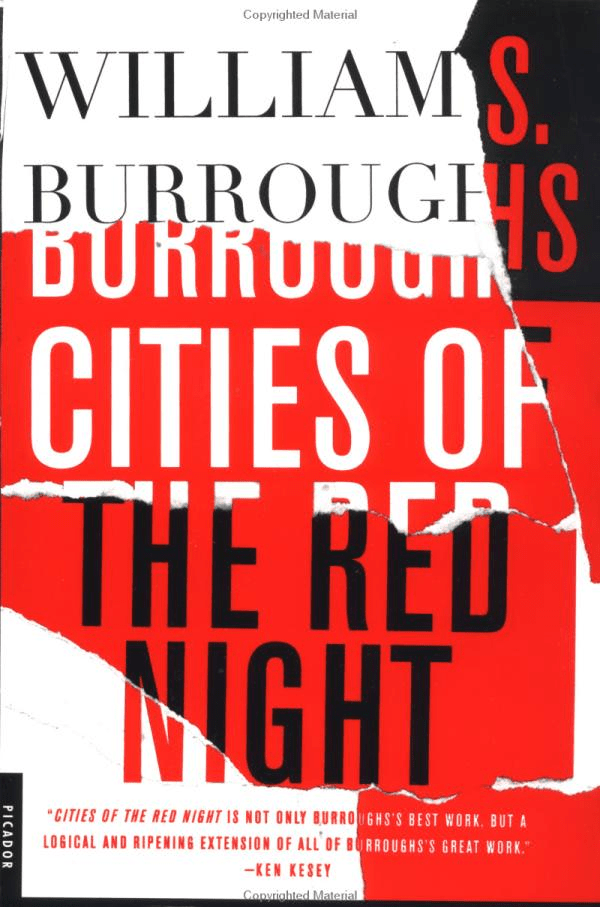
Cities of the Red Night

I’ve read a handful of Burroughs novels and also Casey Rae’s entertaining and informative William S. Burroughs and the Cult of Rock ‘n Roll. I think this is easily my favorite novel by the Beat icon. It is ridiculous, absurd, wholly pointless, unrepentently filthy, and a great deal of fun.

In Casey Rae’s examination of Burroughs I learned about his “cut-up” method of creation, splicing and collaging multiple texts and ideas together from disparate sources to forge something new. Cities of the Red Night samples deep cuts from across the 20th century: we get Crowley sex magic, pulp noir and sci-fi and horror, Mexican archaeology, chasms of time and ancient gods and civilizations borrowed from H.P. Lovecraft, political chicanary and revolutionary rhetoric, lots of guns and cannons and far-out weaponry, drugs, viruses, and oodles of hot gay sex featuring an asphyxiation fetish.

What is the novel about? Well, there is a doctor fighting a viral outbreak, and then a private dick investigating the disappearance of a young lad whose head ends up in a crate bound for Peru, a pirate revolution in Colombia and Panama, a war between humans and mutants in ancient vanished cities, conspiring conspirators doing conspiracies…it’s about so much it’s practically about nothing. Some of the characters shift from modern era New York to thousands of years ago and then to the jungles of 18th century South America before suddenly getting onto a starship in the distant future. At one point a main character wakes up in a rehab clinic and it appears the entire novel was a hallucination; but it might actually be that he could access actual reality in his comatose state and he’s only waking up into the shared illusion we call reality.

I mean it doesn’t matter what it means or if it means anything at all. Enjoy the ride!

I will note that I’ve likely read a couple thousand novels, and that this one has more ejaculations than all of the other novels I’ve read combined. And that includes a couple long books by the Marquis de Sade, so it’s an impressive number of money shots. So the novel could perhaps be classed as a sort of cartoonish pornography. Keep that in mind if you choose to read it.

Recent Reads

I’d read 100 Years of Solitude about 30 years ago and was absolutely flabbergasted by it. Immediately one of my life goals became “get your Spanish into adequate shape to read more Garcia Marquez but in the original language.” I managed to have some conversations with locals in Spanish on a couple trips to Colombia, but alas never got my skills up to reading novels.

So I caved in and read Love in the Time of Cholera in English. I was a bit concerned with the high bar set by the other novel that this would disappoint–quite the contrary. I think it’s superior. Where 100 Years is a bit of a “loose, baggy monster,” Cholera is fit and trim. The magical realism is dialed down substantially but not the magic of the description, characters, settings…such a dense and humid world to inhabit for too short a time. A rich, sweaty, mournfully sexy book. It truly captures the decayed glamor of old South American colonial cities and the rich mix of cultures and classes. Exquisite!

Aw, it’s nice to revisit those care free days of childhood–distant, aloof parents, perverse games, pointless wasted hours at school, the challenge of disposing of corpses…

Not sure how to categorize this one. A bit of Shirley Jackson’s We Have Always Lived in the Castle, a bit of Poe’s Fall of the House of Usher, a bit of 90s pornography.

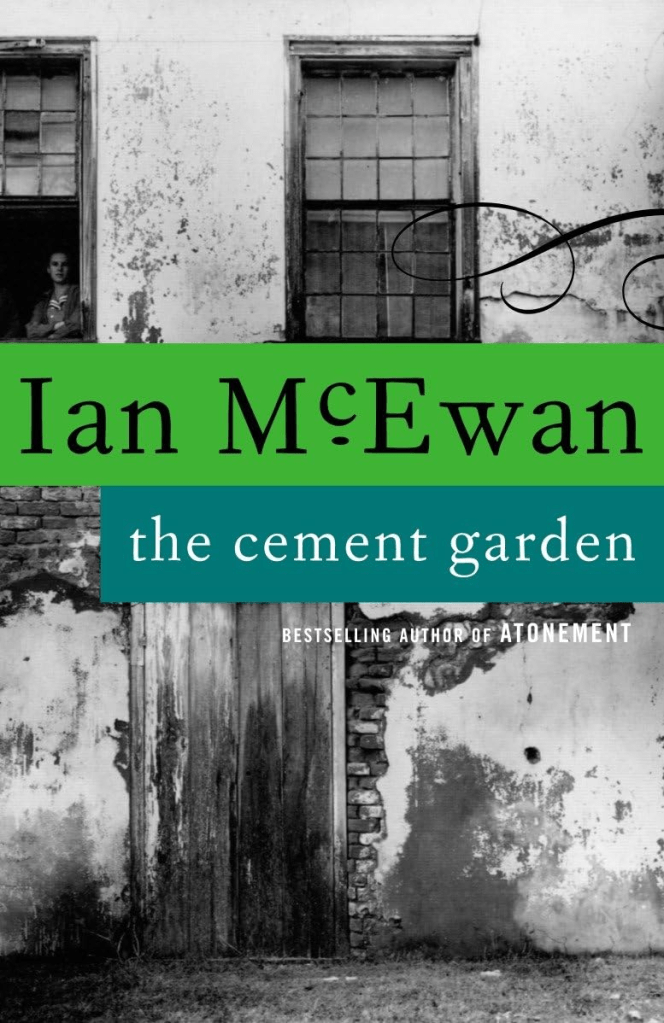
Four siblings are left alone in a strange castle-like house in the midst of an abandoned urban tower block development when their parents die in quick succession. Instead of the lush natural setting of Eden (or the isle from Lord of the Flies) they inhabit an unnatural cement garden, where only stinging nettles force their way up through cracked concrete to bake in the sun. Without the internet or even TV there is not much to do except go feral.

McKewan can write, and this short gloomfest is arresting and disturbing in equal measure. It probably says something about me to admit that I found it somewhat humorous, the way Rober Coover’s story The Babysitter is humorous. Kids left to their own devices act like adults–and are equally fucked up.

I recently read an article in the NY Review of Books about Ford Madox Ford. Had previously only read The Good Soldier, which is astonishingly good. Thought I should perhaps tackle another of his, but didn’t feel quite up to Parade’s End, which has sat its fat self on my shelves since 1994 without being opened.

So I decided to search the author’s name and pick up whatever book the owlgorithms first suggested. Owltimately it was The Brown Owl, which proved an entertaining little owlegory. Though written for kids it has a sophistication and wit about it which owlevates the book above mere “young adult” fiction.

Read earlier this year an analysis of the Arthurian myths by Emma Jung and Marie Louise von Franz, followed in short order by H is for Hawk. H is for Hawk is a memoir of dealing with the death of a parent while training a hawk and reading T H White’s memoir about training a hawk. All of this brought me round to the realization that I’d never read White’s Once and Future King novels. So I started with The Sword in the Stone. Didn’t much like it. Merlin is too ridiculous, the story is too silly, everything is far too cute. I can see why Disney made a film out it, because it’s tailor made for them.

Despite not enjoying the first volume, I plowed ahead into volume 2 of The Once and Future King. Didn’t like this one even less. Guess I’m too old. I prefer dour, profound old Tolkien to this stuff.

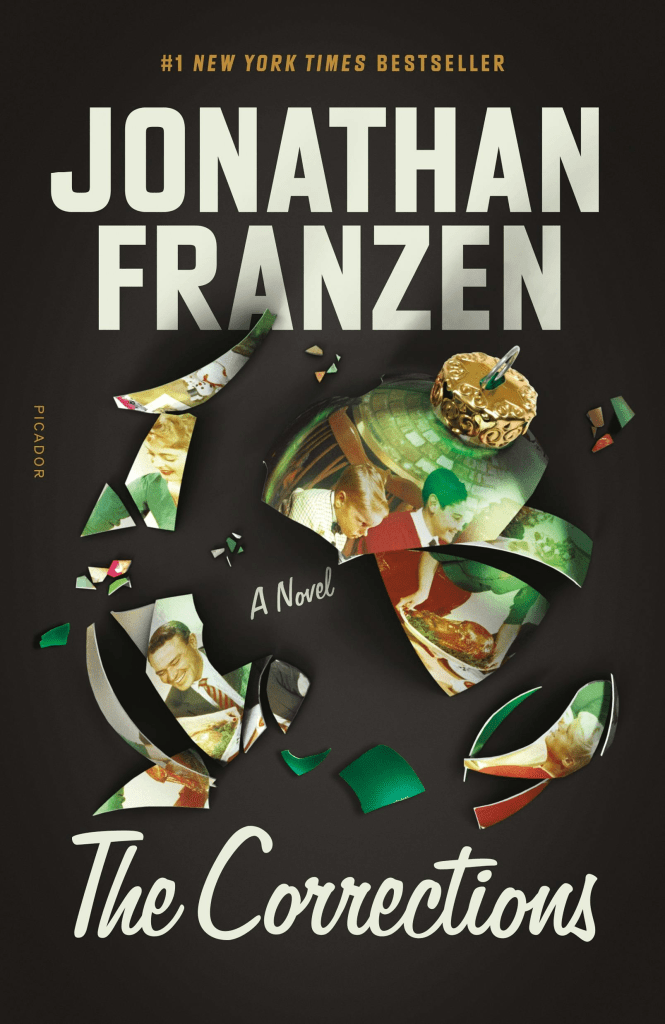
The Corrections

Here’s another novel from the recent NY Times List of “Greatest Books of the 21st Century.” It’s almost 600 pages long, and, given how weighty and dense and serious it is as a work of fiction I was surprised to find the writing quite breezy. I laughed heartily several times and regretted my decision 20-odd years ago to classify Jonathan Franzen as merely one of a crop of young writers at the time whose voices and themes and styles all seemed indistinguishable to me: Safran-Foer, Lethem, Chabon, Schteyngart, etc. I thoroughly enjoyed The Corrections.

I must however admit that the family at the center of the novel is deeply troubling. Most of the characters are eminently likeable and relatable–I found much in the family interactions which was all-too-familiar from my own experiences. And yet every character does hateful, despicable, awful things. Again, pretty typical of my experience not only of my own family but also of others I know well. This is where the sophistication of the book lies: documenting a time period in US/world history via the lives of a single midwestern family teetering on the brink of total and utter disarray and giving us a full picture of why across three generations. Franzen’s book shows us lovable people who we want to care for despite how truly terribly they behave–and given where American society has gone since its publication there is a bit of prescience in his vision. The entire nation these days feels like a dysfunctional family full of badly behaving people who are at heart decent and reasonable but whose unpredictable, selfish, and greedy behavior makes them despicable.

This morning I read an essay by Wallace Shawn in the NY Review of Books. The essay, called The End of a Village, will serve as the introduction to a newly re-issued book about the Vietnam War. Shawn was a college pal of the author Jonathan Schell, and manages to paint an evocative portrait of his friend and what he hoped to achieve through reporting on The Village of Ben Suc. Schell observed the complete and utter destruction of a peasant village by US forces, and tried to portray both the victims of this assault and the perpetrators with as much objectivity as he could muster. Having just finished The Corrections, I was struck when Shawn wrote this about Schell: “He generally seemed to like the military men he encountered. It’s just that what they were doing was appalling.”

This of course leads us to Hannah Arendt in The New Yorker 50-some years ago and her “banality of evil” (Wallace Shawn’s dad was managing editor of The New Yorker at the time). Shawn makes the connection, stating “If one accepts the idea that the ugliest of crimes can by perpetrated by people who aren’t ugly criminals, then the possibility seems to arise that even reasonably nice people might be at times involved in evil.”

The characters in The Corrections do horrible things as their family dangles by a frayed thread over the abyss of the 21st century. But at different parts of the novel, told from their different perspectives, I found myself rooting for each of them and caring deeply about their situations despite the decisions they made. And if individuals can do horrible things despite being “good” people, then so of course can societies and nations.

So we all make poor decisions and we all allow questionable motivations to drive us now and again. But how do we fix things after? When we go catastrophically awry and cause catastrophe, what is the means of repair? The word corrections has a lush ambiguity because the word has so many applications. A teacher corrects her student’s work. Parents correct their children (well, ideally). Some behavior is considered correct, and society drills us in the niceties of acceptable interactions. A captain who discovers her ship is off course will make corrections, a market which is overheated will face an inevitable correction. All of these senses of the word have a similar basis but different nuances. Every generation goes through a reaction to what was considered correct by the previous, now aging members of a family or civilization. So what is correct can be in flux, and those doing the correcting can be wrong or misled or mal-informed. When everything is called into question, when religion, government, the media, when public institutions previously held in high regard, when family itself all face skeptical and factual analysis and are thereby doubted and eventually shorn of their importance, and when much of the traditional underpinnings of a society and its very history are demonstrated as false and hypocritical, what is left? Where can we turn for guidance and support? How do we rebuild? I guess we’ll find out together.