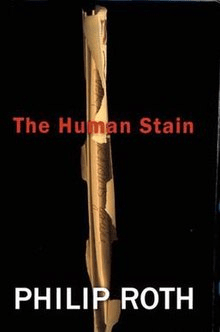
The Human Stain

I read a lot of Roth back in the ’90s, to the point where I found myself Zuckered out. When The Human Stain arrived I bought it in hardcover but never got around to reading it (my copy still has a “Borders Books 30% off sticker” on the cover, LOL). Recently the NY Times released their Best Books of the Century list; the novel’s inclusion sent me downstairs to dig it out.

The Human Stain is third in a trilogy of novels (the previous two are American Pastoral and I Married a Communist). There’s a twenty-some year gap between my readings of Volume 2 and Volume 3!

Roth is typically strong at recreating a time period of American political and cultural absurdities, which he’d done in the previous novels in the trilogy for earlier eras. As the title and timing of the novel might indicate, we’re in the era of Bill Clinton and Monica’s stained blue dress. What a terrible time to be alive and American! Moralizing hypocrites unbound, a sleazy and easily manipulated Chief Executive who fell for a honey trap even the bait didn’t understand, the rise of sensationalist and salacious cable ‘news’ coverage, etc. Out of that mess came an extreme and reactionary right-wing movement angry that Clinton out-triangulated them and co-opted their economic wish list to the point where he hammered through the final achievements of the Reagan Revolution. As the Democrats moved right wing economically the Republicans went wholly off the rails. A Democratic Party beholden to Wall St and corporate interests emerged, leaving the political left in the US nobody to support except for the occasional quaint New Deal Dem who got smoked in the primaries or a third-party candidate. What a joke all that was, and yet the consequences were dire and are yet to be resolved in the USA.

The Human Stain centers around (SPOILER ALERT) a Black academic who chose to pass for white and Jewish and pulled it off, who is fired from his position of Dean for using a racist expression while teaching at a small elite liberal arts college in the wilds of New England. But the slur was not necessarily a slur given its ambiguities and the context, and perhaps the firing was an unreasonable rush to judgment (Roth perceived the emerging phenomenon of cancel culture?). Nathan Zuckerman, who befriends the fired prof and former Dean central to the story, sets out to untangle the events leading up to the situation and to write a book.

My favorite Roth novels feature a manic, hilarious, and zesty narrator. If you’ve read Sabbath’s Theater or Portnoy’s Complaint you know what I mean. Those novels breeze by in a vortex of delicious voice, and the reader is ensconced enchantingly in the conscience of a pervert who participates vividly in experience and has things to think about. But this novel (like The Plot Against America) succeeds on its level of refined craft. It brings up big themes, big ideas, big hypocrisies, and the reader is forced to examine her own beliefs and assumptions.
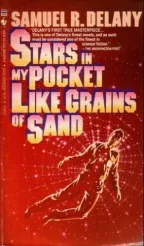
Stars in My Pocket Like Grains of Sand

I bought this Bantam mass market paperback at the B. Dalton Booksellers shop in Hunt Valley Mall, probably around 1985 or ’86. At the time I’d read a lot of sci-fi, horror, and fantasy but I was beginning to push out and explore other stuff. Not that the sci-fi, horror, and fantasy weren’t satisfying, but I wanted something else. The reason for this was due partially to reading a bit of Dickens, Shakespeare, Steinbeck, Harper Lee, William Golding, and Hemingway in school. What mostly made me crave more ‘literary’ fare was Samuel R. Delany and his novel Dhalgren.

Dhalgren is supposed to be a sci-fi novel, and it is, but it was actually the first absolutely confounding and densely packed work of serious artistic and philosophic intention (what would later be called a “Post-Modern novel”) that I’d ever read. I had a couple different jobs at the time and I used my money to buy records and books (I should have bought shares in Apple, but WTFK back then?). I was drawn to Dhalgren by its spectacular cover and its length–I’d recently finished a couple Dostoevsky novels and this one was like Bros. K long; and that first sentence!

to wound the autumnal city.

I went all-in. The plot? Simple. Guy walks around a post-apocalyptic urban hell-scape. Keeps a notebook, writes poetry. Gets laid a lot, men and women. There are parties and things are collapsed but people still host dinners in their apartments. But inside the text are other texts inserted in strange places, and featuring different events and characters and settings than the novel narrative itself. But, since these were also in the novel narrative, despite being kind of asides and or comments or edits or revisions or re-imaginings of the primary action, I assumed they must be important also. Were these excerpts from the protagonist’s notebook? Who knew for sure, but probably. At one point the narrator sees himself in the mirror and describes what he sees and what he describes is the author of the novel, and my mind just went soaring. I read all the Delany novels I could get–Babel-17, Nova, Triton, The Einstein Intersection. But then I got to the Tales of Neveryon series and couldn’t cut it. I saw Stars in My Pocket when it came out and bought it, thinking I’d read it in 1986 0r 1987. And now in France I pulled that same mass market off my bookshelves and read it after nearly 40 years. When was the last time I read a mass market paperback?! LOL the text is so tiny. And of course due to age the book was yellowed and crumbly despite being unread.

I really liked it a lot. There are similarities to Dhalgren and the novel has aged well. I mean here in the early 80s Delany has imagined the Web, and called it the Web, and there are many interesting questions raised about what constitutes gender and who is really male and female despite their genitalia, and there are difficulties with meaning and visual representation of language and how gestures and utterances between species and races become confused for multiple reasons. It’s a surprising series of accurate predictions of the near-future from the perspective of the 1980s but imagined FAR in the future. Again, like in Dhalgren, there is not much plot, but there is a lot of meat packed onto this skeleton. It starts off with a kind of reverse Frederick Douglass–a kid on the fringes who undergoes a treatment to render him “less anxious” and a bit incapacitated intellectually, knowing that following this treatment he will become a slave. But he undergoes the treatment and we join him as he is exploited but doesn’t really care because his brain has been altered. But a set of special finger rings attached to a Web database, provided by a female kidnapper who uses him for sex, give him a taste of what he’s missed and then the story takes off.

I’d recommend it, but not as the first Delany you read. Get to know him first!

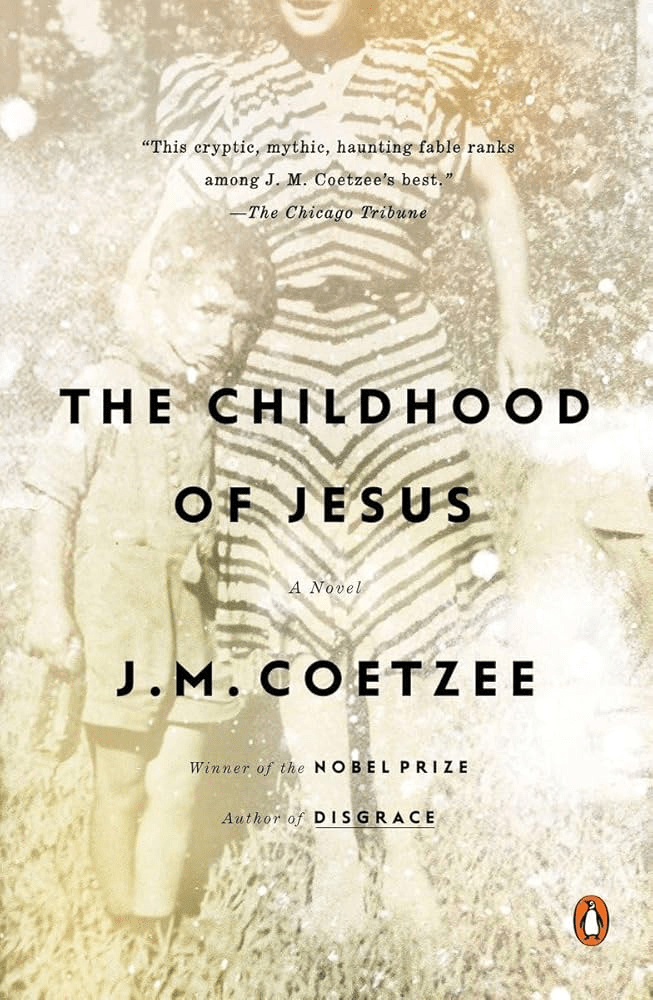
The Childhood of Jesus

Way back in the day–early ’90s–I was earning my first master’s degree at Temple U. Ostensibly a creative writing program, Temple also required some rather rigorous literary work. There was, for example, an enormous list of “books you should read before your 2 years here is up.” On that list were three books by Coetzee: Disgrace, The Life & Times of Michael K, and Waiting for the Barbarians. I was floored by these novels, how simple and elegant they seemed, but there was so much artful architecture supporting and obscuring dense layers of meaning. One of the courses I took assigned Coetzee alongside the short fiction of Nadime Gordimer.

And then, for more than 30 years, I kept my eye on Coetzee and often thought I should pick up something again–I even bought a couple of his novels and put them on the shelf. I think I bought The Childhood of Jesus more than 6 years ago before I finally read it. It was worth the wait.

When I had writerly aspirations as a youth and I’d get stuck in the glue trap of writer’s block, I’d think of a myth or fable or religious story I’d learned as a kid and re-tell it in a different time and setting. Coetzee’s novel reminded me of that useful trick as it retells the story of Christ’s early years but with migrants entering an unnamed Latin country to start a new life. The child David is of uncertain heritage and receives the name David from authorities in his new home. He is guarded by Simon, who took care of David after he lost a letter explaining his presence on a passenger boat, and who resolves to find David’s mother in their new land. Later on other familiar characters emerge but with different names: Ines is the virgin mother, Juan is the Baptist, Magdalene and Anne and other saints and apostles emerge, drop hints about their roles, and disappear.

David speaks and writes his own language, has his own ideas about how the world should work, and struggles with authority and limits on freedom. He learns to read from a child’s version of Don Quixote’s adventures, and cannot abide the idea that Quixote’s story is only in Quixote’s head, and that others around him see the same events in different and more mundane ways. He has mystical visions about numbers and their true meaning and sees people as tiny insects trying to be visible to him as he soars above the world. There are hints that Coetzee wants to underline the merging of early Christian thought and Greek philosophy and the knowledge and symbology of esoteric wisdom schools (for example, a Micky Mouse cartoon features Plato instead of Pluto as Micky’s canine companion). David’s revolutionary pedigree is underlined by his own dog’s name: Bolivar.

The expectations of the society in which David finds himself are too constraining and when the authorities determine he should be placed in a reform school the family of David flee to start a new life.

I enjoyed it so much that now I’m bound to read the rest of the Trilogy (or is it a Trinity?). Of course, it may take me another 30 years to get to the next volume.

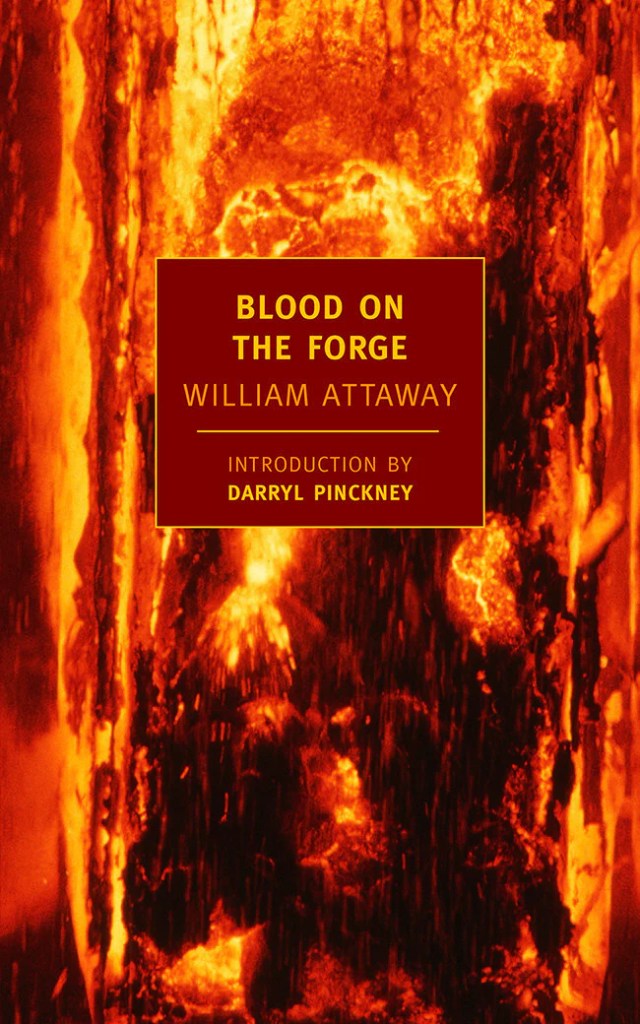
Blood on the Forge

Sometimes going through my own bookcases is like browsing a great used bookshop, and a volume pops out that I didn’t even know I’d purchased. Ironically, William Attaway’s Blood on the Forge was a book I was searching for several years ago without knowing it and I had it all along.

When I was a teacher in Baltimore City Public Schools I was imagining a Great Migration unit starting with an image exploration and analysis using Jacob Lawrence’s Migration series as a starter. It was a fave tactic of mine to start units with images and to teach kids how to make inferences, ask deep questions, interpret, connect to previous knowledge, make predictions, etc before even learning about the topic of the unit. I never wrote that unit, however, because the Lewis Museum in Baltimore had a show of Jacob Lawrence which included works featuring Toussaint L’Ouverture and John Brown and Frederick Douglass and Harriet Tubman. After seeing that show, because I already taught units about Brown and Douglass, I took the Jacob Lawrence idea and tacked it onto those units.

Another reason I decided not to create the Great Migration unit was because I didn’t have a meaty novel-length text to use. And yet I did have the perfect one–and didn’t realize it until I lived in rural France in the 2nd year of not being a teacher. Oh well. There is probably a bit too much prostitution in the novel for 8th graders anyhow!

William Attaway is unfortunately not well-known, though he had a profound cultural impact. Until I read his novel and its fine introduction by Darryl Pinckney I was unaware that Attaway wrote the “Banana Boat Song” for his friend Harry Belafonte. He also influenced Richard Wright and Ralph Ellison, who both knew him and read this searing white-hot novel. (Side note: Darryl Pinckney has a fine article in the current NYRB about the Harlem Renaissance, and Attaway was apparently an indifferent and bored school student until he read a poem by Langston Hughes and found out that Hughes was Black, at which point he devoted himself to writing).

So, Blood on the Forge–talk about going forth and forging in the smithy of his soul the uncreated conscience of his race! This is an incredibly vital document of an important era in US history, the great movement of Black laborers from the South to Northern cities as the industrial revolution took off. Attaway, who was a middle-class son of a teacher and doctor who himself migrated as a child from Mississippi to Chicago, weaves in all the complex societal strands into a short elegant and harrowing story. You’ve got urban/rural, White/Black (Slav/Irish), union/scab, capitalist/socialist, agrarian/industrial, modern/traditional. There is enormous violence and powerful interests interfere in everything to protect what they regard as theirs, and the fates of three sharecropper brothers who are recruited and taken north to Pennsylvania to the steel mills herald prophetically the racial and class tensions to come. HIGHLY recommended.

To A Mountain in Tibet

A friend kindly leant me this. I often refuse to borrow books because I like to read my own copy and put it on a bookshelf for decades after. But I’d read and really enjoyed Shadow of the Silk Road, and I’m a (very) small business owner trying to live more frugally than when I was a lavishly funded public school teacher in the USA (LOL). So I accepted it (and three other excellent books she kindly offered).

Ostensibly, this is a travel book, and it does indeed recount a truly remarkable voyage to a particularly special and demanding destination. But this is actually a book about grief, and it’s the best book about grief I’ve read since Joan Didion’s The Year of Magical Thinking. Though the family members grieved by Thubron are present for less than 10 pages of the 220 in the book, they haunt its passages about Nepal and Tibet like the dakini spirits he describes.

Of course there is no better country than Tibet in which to devote a mournful pilgrimage and to explore loss and impermanence. Turbron describes the destruction by artillery of several ancient monasteries and the smashing of others by hand during the Cultural Revolution. He meets many people who have their own griefs about family and displacement and the Himalayas become a resonator for sorrow. Many practitioners of Tibetan Buddhism have been displaced by state terror or official exile. And yet the Hindu and Bon and Buddhist pilgrims still come and do their circuits of Mount Kailas. Thurbron does his as well, but finds little comfort in the astonishing myth-enshrouded terrain, birthplace of the Earth and abode of the gods and demons for several religions.

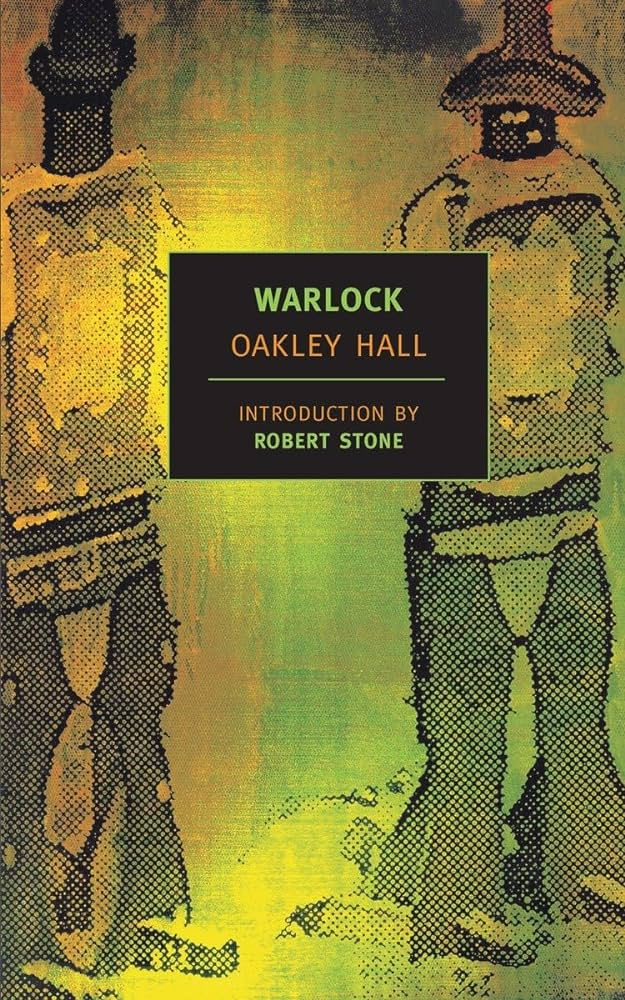
Warlock by Oakley Hall

I adore the NYRB re-issues–high quality paperbacks with great cover design and kick-ass introductions

When it comes to fiction genres, I’ve got my faves. As a young dude those were horror, sci-fi, and fantasy. Over the years I drifted away from all of these only to check in now and again on the hot new thang. Occasionally I’ve dabbled in mystery/thriller stuff, but never have I been a reader of Westerns (unless one includes Cormac McCarthy in that category).

I bought a remaindered copy of Warlock probably 20 years back and only just pulled it down off the shelf. Glad I did, because it’s a banger! Like Clint Eastwood’s Unforgiven it’s a rather sophisticated deconstruction of the myths associated with the American West and gunslingers and cowboys. The hero of the story has a morally ambiguous past and when hired to be Marshall of Warlock struggles with the ethics of his situation. Is he a murderer for hire, or a representative of law and order? What is a government other than an agency dictating behavior via the threat extreme violence? Can citizens have a sense of peace and freedom without a killer to back up those ideals? How is a hired gun who kills to keep the peace different from a blackguard who kills to take money from a stagecoach?

The novel features some historical figures and also transposes mythic characters from the OK Corral into thinly disguised avatars. There are IWW prototypes working the mines and rebelling against brutal treatment, there are cross-border skirmishes between cattle rustlers in the US and Mexico, there are Apaches, there is the US Cavalry and a half-crazed senile general. Whores, saloon keepers, merchants, deputies, judges, and rugged outlaws eek out a living in a land where law is dictated by force and mob rule. There is the outlaw turned deputy who, like the hero, tries to do the right thing but cannot always navigate the complexities of the myriad relationships and power struggles. And there is revenge; a LOT of revenge.

The novel surprised me often by subverting standard genre tropes familiar from TV and film. The writing was elegant and Oakley Hall created engaging and multifaceted characters and situated them in an intricately detailed setting.

My one critique involves a love scene which descends into bodice-ripper cliché. But overall I thought Warlock was excellent and it pulled me inevitably to its satisfying conclusion. Thomas Pynchon called it one of America’s greatest novels–it’s certainly better than anything he wrote (excepting perhaps The Crying of Lot 49).