
Sula

Sula is a magnificent read, a short novel but a richly realized world. We spend almost a century in Bottom, the Black neighborhood of Medallion, Ohio. Two families entwine in the narrative–one-legged Eva Peace serves as matriarch of one. She manages a thriving bungalow of sorts, a chaotic and haphazard structure akin to the Winchester House in complexity. There are family members, hangers-on, boarders, mountain people, addicts, crooks, working people and feral kids in the Peace home. Eva’s daughter Hannah raises her kids amidst the tumult. One of her kids is Sula.

The other family is Helene Wright’s–Helene was raised by her grandmother. Her mother was a prostitute in New Orleans and granny pulled her out of that drama and brought her up. Helene’s household is calm and organized and there is a sheen of middle class respectability. Her daughter Nel is raised in a tidy and peaceful environment and has adopted the virtues and social mores of the community.

Sula and Nel become best friends. Sula is adamant that she will never be bound in any way by the constraints of her community or its judgments and expectations. She will be free and her self will be unimpeded in its development and evolution by anyone or anything. Nel on the other hand is willing to tow the line and to do what’s right. They have a relationship where one is centripital and the other centrifugal, forces working together to flesh out a beautiful and adventurous childhood.

I recall a scene in Henry James’s The Turn of the Screw when well-mannered Flora is playing in the dirt and makes sexually suggestive gestures with sticks–shortly afterward the Governess has her first encounter with the apparition of Miss Jessel. There’s a similar scene in Sula where Sula and Nel are playing in the dirt and digging holes and burying things in the holes and the girls are frustrated and dis-satisfied in their game but manage somehow to conjure up a horrible event in an almost magical ritual. The reactions of each girl to this event have lasting impacts on the course of their lives.

Eventually Nel does what one is supposed to do in Bottom; she gets married and starts a family and focuses her energies on her children, her husband, and their home. On the day of Nel’s wedding Sula leaves town for ten years. When she returns she will be judged and scape-goated for the sins of her town and its inhabitants.

But what are morals and virtues if they simply hide hypocrisy? What are the consequences to true human freedom when small-town values are oppressive and retrograde? Sula, through her refusal to conform and to follow the niceties, becomes for Bottom an easy target for projection–she absorbs all the guilt and hostility and judgments of the town’s inhabitants. But is Nel really superior to Sula morally? What does genuine friendship entail? What are the costs of motherhood and are they compatible with true freedom? Is a life sacrificed for the benefit of others a worthy life? Bottom learns a lot about itself through Sula’s sad fate, and pays a heavy karmic debt.
La Place

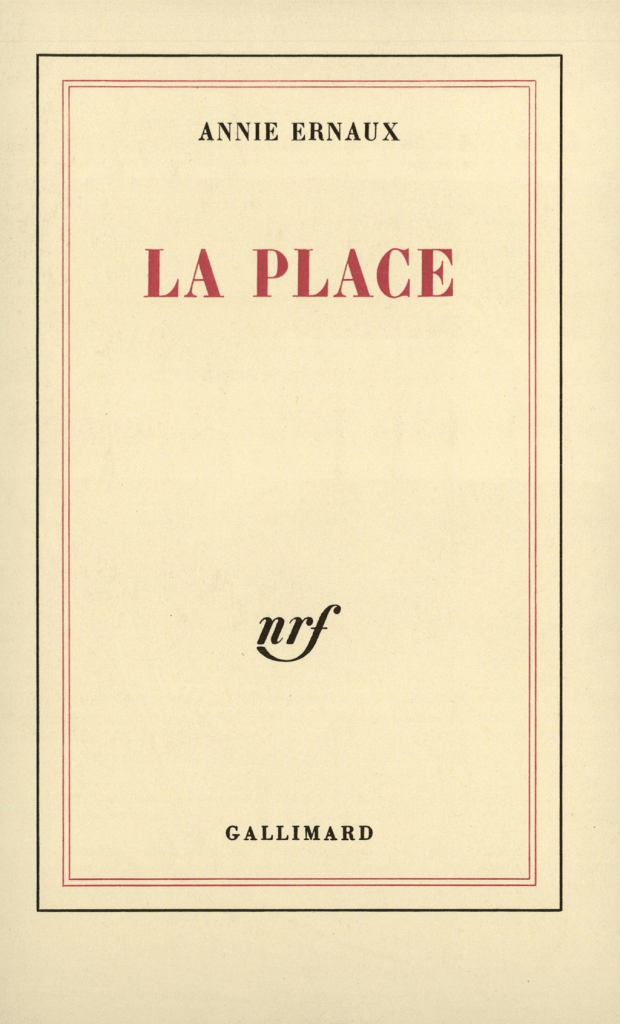
I’ve not been pushing myself to read French lately, and it is absolutely vital that I continue to work on the language so that I sound less like an adolescent speaking when I interact with locals here in the Correze and particularly with business clients who arrive from cities like Toulouse, Bourdeaux, and Lyon. When Ernaux won the Nobel Prize in 2022 I picked up a couple of her books, one of which was La Place.

Surprisingly the French is quite clear and simple-stylistically I’d compare Ernaux’s writing to Hemingway, with crisp, short declarative sentences. Technically La Place is a novel, but it is also a memoir or autobiographical novel, and her style is very objective and is comparable to Joan Didion’s dispassionate journalism. I was pleased to only need a dictionary a couple dozen times throughout, and mostly for colloquial phrases.

The idea for the novel arose when Ernaux was processing the death of her father, and focuses on him and her family in a small town in Normandy through WW2 and into the 1970s. Her father was raised working on a farm with a quite limited education and his parents were not literate. Through his hard work and survival of the war to working in a factory and rising through the ranks and eventually buying and running a small cafe/epicerie with his wife we can see how the family pulled itself up from poverty to a comfortable middle-class existence. Ernaux’s descriptions of her family’s sensitivity to class and how they tried to hide their rural hick upbringing in front of clients by changing their speech and feigning a more sophisticated vernacular were quite touching. Reflecting on the difficulties her parents faced and her father’s challenges in particular was obviously difficult for Ernaux but she never wavers from her stylistic choices to keep her emotions out of the prose. Sometimes what she describes or recounts make her involvement and her feelings evident, however–there are photographs she finds and events she narrates which are dense with the weight of emotional memory.

Ernaux’s father is never called by his name, only by “him” or “he.” He is adamant that Ernaux continue her education but at the same time he can’t resist pointing out that her life in books is not the real life he lives with his hands in the dirt of the garden or in the till of his business. He is however enormously proud of her accomplishments when she becomes a professor and moves away to start a family of her own. Ernaux winning the Nobel Prize is even more remarkable given the family history recounted here. I look forward to reading more of her work.

The Childhood of Jesus

Way back in the day–early ’90s–I was earning my first master’s degree at Temple U. Ostensibly a creative writing program, Temple also required some rather rigorous literary work. There was, for example, an enormous list of “books you should read before your 2 years here is up.” On that list were three books by Coetzee: Disgrace, The Life & Times of Michael K, and Waiting for the Barbarians. I was floored by these novels, how simple and elegant they seemed, but there was so much artful architecture supporting and obscuring dense layers of meaning. One of the courses I took assigned Coetzee alongside the short fiction of Nadime Gordimer.

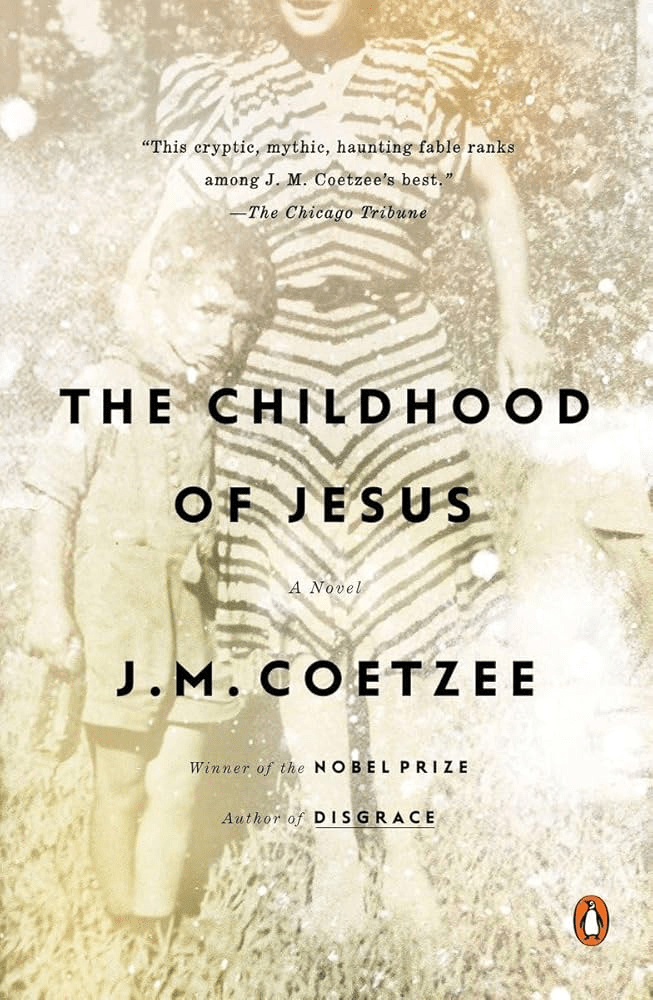
And then, for more than 30 years, I kept my eye on Coetzee and often thought I should pick up something again–I even bought a couple of his novels and put them on the shelf. I think I bought The Childhood of Jesus more than 6 years ago before I finally read it. It was worth the wait.

When I had writerly aspirations as a youth and I’d get stuck in the glue trap of writer’s block, I’d think of a myth or fable or religious story I’d learned as a kid and re-tell it in a different time and setting. Coetzee’s novel reminded me of that useful trick as it retells the story of Christ’s early years but with migrants entering an unnamed Latin country to start a new life. The child David is of uncertain heritage and receives the name David from authorities in his new home. He is guarded by Simon, who took care of David after he lost a letter explaining his presence on a passenger boat, and who resolves to find David’s mother in their new land. Later on other familiar characters emerge but with different names: Ines is the virgin mother, Juan is the Baptist, Magdalene and Anne and other saints and apostles emerge, drop hints about their roles, and disappear.

David speaks and writes his own language, has his own ideas about how the world should work, and struggles with authority and limits on freedom. He learns to read from a child’s version of Don Quixote’s adventures, and cannot abide the idea that Quixote’s story is only in Quixote’s head, and that others around him see the same events in different and more mundane ways. He has mystical visions about numbers and their true meaning and sees people as tiny insects trying to be visible to him as he soars above the world. There are hints that Coetzee wants to underline the merging of early Christian thought and Greek philosophy and the knowledge and symbology of esoteric wisdom schools (for example, a Micky Mouse cartoon features Plato instead of Pluto as Micky’s canine companion). David’s revolutionary pedigree is underlined by his own dog’s name: Bolivar.

The expectations of the society in which David finds himself are too constraining and when the authorities determine he should be placed in a reform school the family of David flee to start a new life.

I enjoyed it so much that now I’m bound to read the rest of the Trilogy (or is it a Trinity?). Of course, it may take me another 30 years to get to the next volume.