Recent Reads

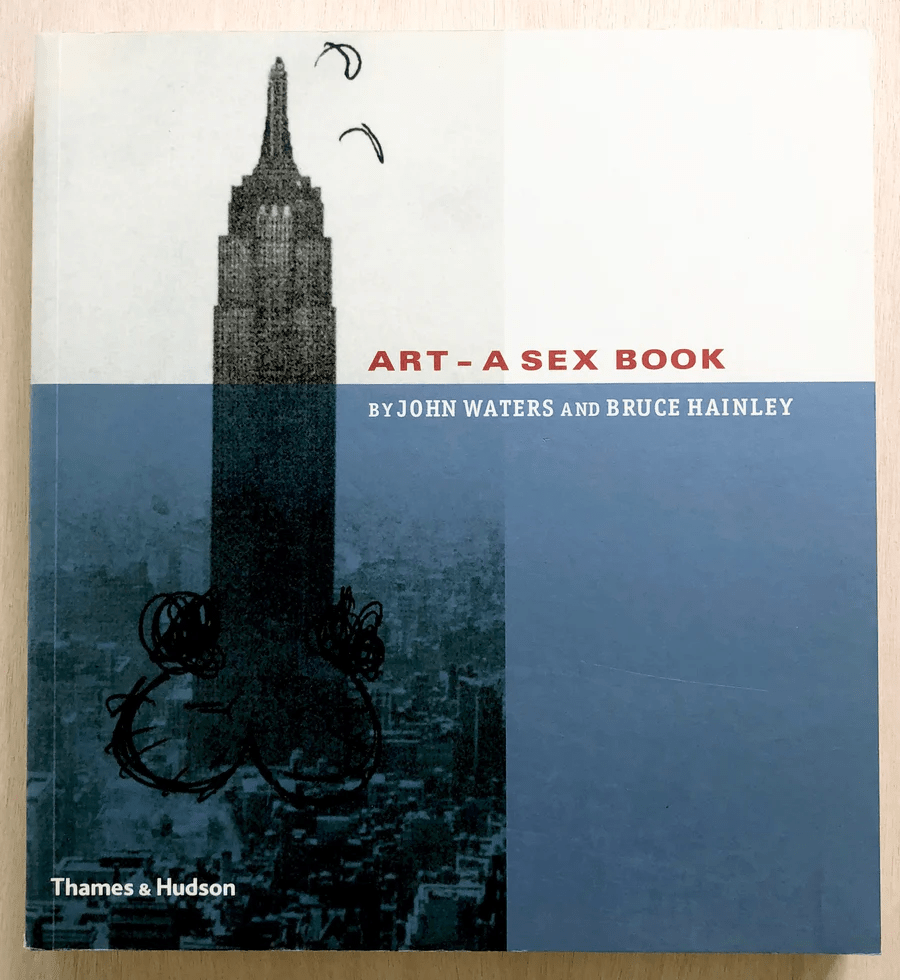
Art: A Sex Book by John Waters and Bruce Hainley

I bought a few copies of this when we had one of several book signings with John Waters at the old Borders Books & Music 043 in Towson. I gave three of them as gifts over the years and still have two signed copies. Probably have a box full of other stuff signed by John as well–DVDs, VHS tapes, other books.

It’s funny to think of an edgy and completely trashy Baltimore film-maker forging a side identity as a collector and modern art sophisticate well-regarded in New York and Paris. But nothing is surprising in John Waters’ career. A few years ago when we were home in the USA it was great fun to browse his substantial and surprising personal collection donated to the Baltimore Museum of Art. Shortly thereafter the museum dedicated a new public restroom in his honor.

After having Art: A Sex Book for more than two decades I finally got around to reading it. I’d looked at the art before but had never tackled the text. The conversations between Waters and his co-exhibitor Bruce Hainley are astute and clever and often as filthy as anything overheard in a high school cafeteria. I laughed out loud several times.

At the end of the book are 20-some artist responses to a list of provocative questions. These range from the silly to the sublime.

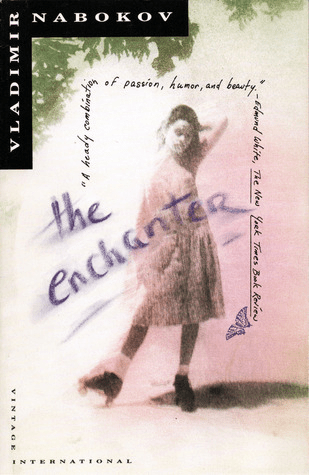
The Enchanter by Vladimir Nabokov

When I was first in grad school in Philadelphia in the early 90s we had a list of novels we were required to read outside of our coursework to ensure we had sufficiently deep knowledge of literature and its icons. On the list were two or three Nabokovs. I read at the time either Pale Fire or Ada, or Ardor–can’t remember which. All I recall from the book is a childhood with lots of butterflies and glimmering grass and trees and lazy summer days. And a sexy sibling or cousin? But the prose was dope. And, of course, I read Lolita.

When I found a stack of Nabokov on my bookshelf I took down The Enchanter knowing nothing about it. A quick read of the prologue and I discovered it was not really a novel at all but rather a novella and that the book was mostly prologue and afterward. The prologue discussed the history of the story and the afterward, by Vladimir’s son and translator, was about the challenges of translating some surreal and salacious images from Russian to English.

The Enchanter turns out to be Nabokov’s first examination and expression of the idea which later became Lolita. His son in the afterward explains the experience of reading The Enchanter as being trapped inside the mind of a sick criminal for 70-odd pages. The entire story is about a man who lusts after a 12-year-old girl and who marries her repulsive mother simply in order to rape the child. So, basically the same idea as Lolita, but without the polish. Humbert Humbert is a disgusting pervert but he’s got style and pinache, and discusses his quarry like a sophisticate who knows cheeses and fine wines. Lolita, despite its criminal main character and dark situation, has a sense of humor. The Enchanter has Nabokov’s delicious prose and characterization but I found the experience of reading it less than enchanting–mostly interesting as a curious sort of literary archaeology rather than as an actual good story. BUT the narrator gets his comeuppance in a satisfying way.

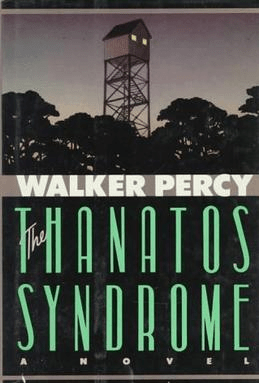
The Thanatos Syndrome by Walker Percy

Way back in the late 1980s I took a course called Psychology and Literature. It was taught by the miraculously brilliant and completely weird Dr. Benjamin McKulik (who I discussed on Gayle Danley’s Classy Podcast a few years back). One of the novels we read in that course was The Second Coming by Walker Percy. I recall being fascinated by a female character in that book who had schizophrenic episodes and who spoke in punning sentences full of double-entendres and layered with multiple potential meanings. I have no recollection of buying Percy’s The Thanatos Syndrome but figure at some point I saw it cheap in a used bookshop and bought it on the strength of the other.

There’s a lot to detest in this book. The narrator’s terrible Louisianna genteel racism and anti-semitism, his painfully neanderthal politics, the absolutely retrograde and bafflingly naive conservative sexuality (doggy-style sex is apparently evidence of a psychological problem and/or brain syndrome, and so is oral sex?). Vivid descriptions of pedophilia uncovered by the hero make stretches of the book truly troubling to get through. But I found myself pulled along nonetheless by the narrative, which is like a Robert Ludlum or Tom Clancy thriller written by a much more literary prose stylist.

The plot is completely ridiculous but at the same time believable–a bunch of hacks funded by the Federal government decide to dump chemicals in the water supply which revert people to “lower” primate behaviors because they hope the local crime rate will go down and math scores will go up due to savant capacities developed by those who drink from the tainted taps. Success! Just like flouride in the water saves teeth, their chemical brew from a local nuclear reactor coolant tower works as intended. A psychiatrist recently released from prison for hawking prescription drugs to truck drivers has about five interactions with people in his town and immediately suspects something is up from their speech patterns and changes in their sexual behavior. His wife suddenly becomes good at bridge and wants doggy-style and oral sex for the first time ever, so there must be a neurological syndrome in town! What is the cause? Well, our intrepid doctor finds out with the help of a weird cast of Southern Gothic characters including a kissing cousin, a mentally ill Catholic priest and wanna-be Nazi who lives in a fire spotting tower, and an uncle who wins duck-call competitions.

Nearly a decade ago the first season of True Detective aired on HBO. I thought it was an absolute hoot and a great example of prestige TV with compelling acting in a gritty setting and a peculiar Lovecraftian underbelly. There are several interesting plot and setting overlaps between that season’s arc and this weird AF novel. I wonder if the show’s writers knew Walker Percy’s last book?

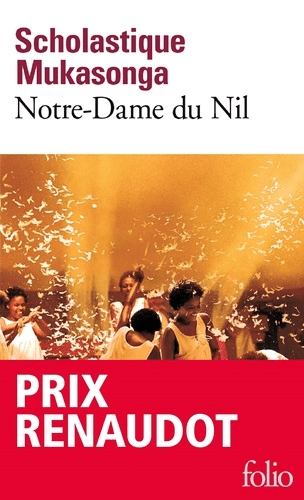
Notre Dame du Nil

Back when I was young and energetic I spent a couple decades working a full-time job, a part-time job, and going to university full-time. At some point in this burst of insanity I was working in the Cook Library at Towson University, while teaching in the English Department, and still working at Borders Books & Music, while pursuing a degree in French Literature and also taking courses necessary to become a public school teacher. At that time I’d already earned a Bachelor’s Degree and a Master’s Degree–but it was never enough, LOL.

During that burst I took a really brilliant class with Dr. Lena Ampadu focused on literature in English coming out of post-colonial Africa, and also took a delicious class in French with Dr. Katia Sainson focused on postcolonial lit. So a couple decades later when an algorithm suggested Notre Dame du Nil on sale I purchased it while living in an oceanside apartment in a high-rise in Panama. I desperately wanted to improve my Spanish but also wanted to keep my French alive. Six years later I finally got around to reading it.

It was worth the wait. Ostensibly a memoir novel set in an all-girl’s school in Rwanda in the early 1970s, it is actually a densely layered critique of colonialism. Imagine Mean Girls if Franz Fanon dropped in as script advisor.

The French was not too difficult, and I needed to consult a dictionary only a few times each chapter. The characters are engaging and I found much of the novel quite interesting and at times hilarious. The girls at Notre Dame du Nil are all Rwandans who are being groomed for elite roles–they are daughters of wealthy merchant families, of diplomats, of government figures or military officers. Many come from small rural villages and of course “elite” grooming requires the learning of European languages, European traditions, European religion, European manners…The Europeans teaching in the school are hapless and ridiculous and deserve the mocking they receive. The Catholics in charge of the institution are just as bad. The school has as its setting one of the furthest away sources of the Nile river, hence the designation in the title. The bits about Rwandan culture, including a fascinating sequence when two students visit a rain-making shaman to purchase a love spell-were excellent. And the fishy Catholic priest in charge of the school who bestows nice garments on girls but only if they try them on in front of him? Classic.

One tangent of the plot involves a European man who lives on an old coffee plantation and has a bizarre theory that Tutsis are descended from Pharoahs–he abducts a student and then begins painting her and using her in a film he’s making. Another involves a visit to campus by the Queen of Belgium.

But the novel slowly simmers and builds a truly dark and disturbing undercurrent as the typical mean teen girl drama reveals roots deeply entwined in Hutu and Tutsi history, with absolutely catastrophic results. What at first seems like surly teen sniping eventually develops an undercurrent of tribal hatreds and it becomes clear that the parents of several students are encouraging the cataclysmic outcome. “It’s not lies, it’s politics,” says a ringleader who happens to be the daughter of the President of Rwanda. One student, who is half Tutsi and half Hutu, does her best to straddle two worlds and attempts to insinuate herself into the dominant group but redeems herself to a degree when the crisis comes.I shan’t say more to avoid spoilers.

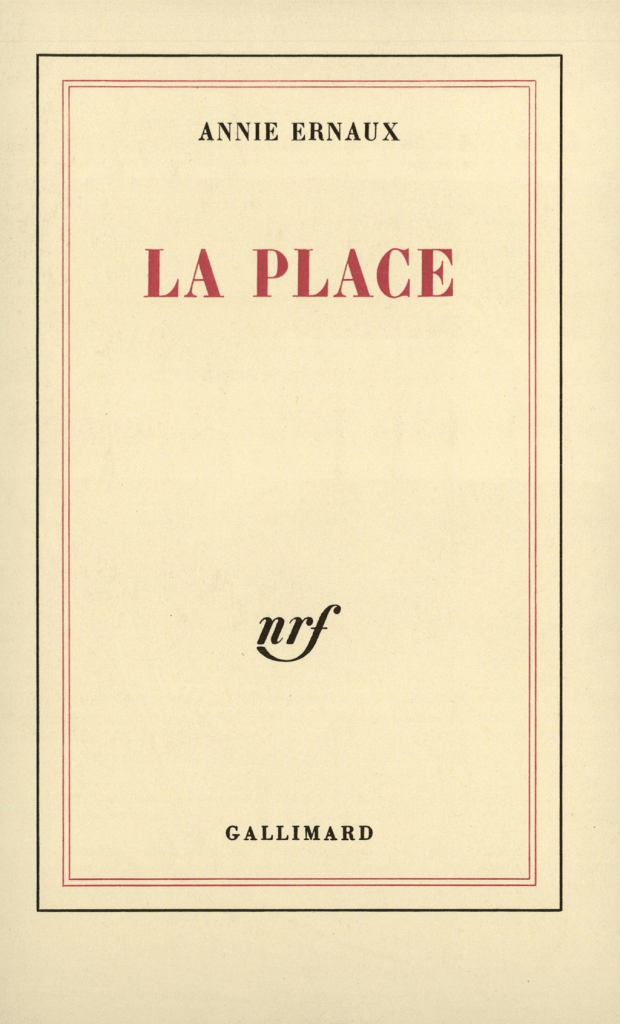
La Place

I’ve not been pushing myself to read French lately, and it is absolutely vital that I continue to work on the language so that I sound less like an adolescent speaking when I interact with locals here in the Correze and particularly with business clients who arrive from cities like Toulouse, Bourdeaux, and Lyon. When Ernaux won the Nobel Prize in 2022 I picked up a couple of her books, one of which was La Place.

Surprisingly the French is quite clear and simple-stylistically I’d compare Ernaux’s writing to Hemingway, with crisp, short declarative sentences. Technically La Place is a novel, but it is also a memoir or autobiographical novel, and her style is very objective and is comparable to Joan Didion’s dispassionate journalism. I was pleased to only need a dictionary a couple dozen times throughout, and mostly for colloquial phrases.

The idea for the novel arose when Ernaux was processing the death of her father, and focuses on him and her family in a small town in Normandy through WW2 and into the 1970s. Her father was raised working on a farm with a quite limited education and his parents were not literate. Through his hard work and survival of the war to working in a factory and rising through the ranks and eventually buying and running a small cafe/epicerie with his wife we can see how the family pulled itself up from poverty to a comfortable middle-class existence. Ernaux’s descriptions of her family’s sensitivity to class and how they tried to hide their rural hick upbringing in front of clients by changing their speech and feigning a more sophisticated vernacular were quite touching. Reflecting on the difficulties her parents faced and her father’s challenges in particular was obviously difficult for Ernaux but she never wavers from her stylistic choices to keep her emotions out of the prose. Sometimes what she describes or recounts make her involvement and her feelings evident, however–there are photographs she finds and events she narrates which are dense with the weight of emotional memory.

Ernaux’s father is never called by his name, only by “him” or “he.” He is adamant that Ernaux continue her education but at the same time he can’t resist pointing out that her life in books is not the real life he lives with his hands in the dirt of the garden or in the till of his business. He is however enormously proud of her accomplishments when she becomes a professor and moves away to start a family of her own. Ernaux winning the Nobel Prize is even more remarkable given the family history recounted here. I look forward to reading more of her work.

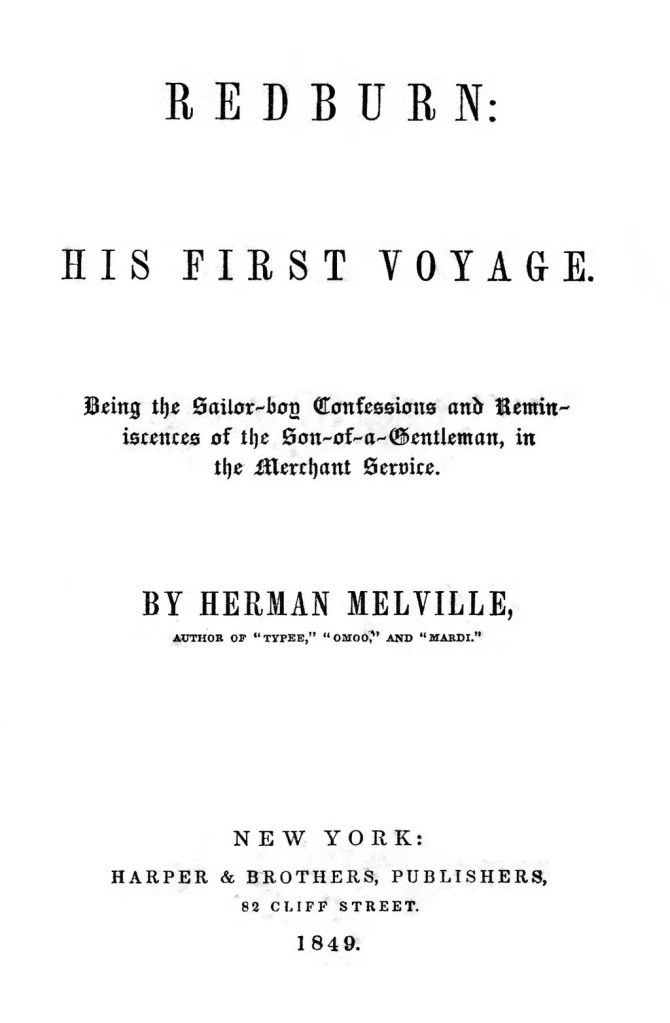
Redburn, His First Voyage

Melville first entered my consciousness the way much of history and culture did when I was a wee tot–via cartoons. I think my first encounter was a Tom and Jerry cartoon featuring Moby Dick but renamed Dicky Moe? And of course I likely encountered the film version directed by John Huston in a butchered and pan-and-scanned version on television.

I did not read Melville until much later. I recall in 8th or 9th grade English class that there were twin girls whose grandparents owned a sailboat, and that after a summer floating around the Chesapeake Bay the girls returned, one having read Omoo and the other Typee while sailing. They dutifully presented book reports to the class with accompanying illustrations. I remember one of the twins declaring in her report that Melville was mostly known during his lifetime for writing adventure novels, but that later he morphed into a creator of SERIOUS LITERATURE.

As an undergrad at Loyola College in Baltimore I was assigned Billy Budd, Sailor and I thoroughly enjoyed it. We had a most excellent discussion of its merits and its Biblical allusions in class, but also a rowdy debate about the ethics of military justice and Billy Budd’s sad fate. Then in grad school I was assigned Bartleby, the Scrivener. I was confounded by that tale, and saw immediately the SERIOUS LITERATURE of which Melville was capable. I reread Billy Budd and Bartleby several times and eventually taught both stories to Freshmen and Juniors in different courses at Towson University.

Then, I resolved despite having heard that it was a brutal slog, to read Moby-Dick, or The Whale. Contrary to rumor the novel proved endlessly entertaining and quite breezy despite its psychological depth and dense symbolism. I in fact had recently resolved to re-read it when I noticed Redburn, His First Voyage on the shelf and took it down on a whim. After a cursory skim of the first page I found myself fully engaged and could not put it down.

Redburn is a poor chap from a once wealthy and influential family. His father was a businessman engaged in international trade before the family went bankrupt, and young Redburn’s imagination was fired by journals and books about his father’s travels. As a result, he signed up as a novice sailor on a boat headed for Liverpool, and we accompany the young naif on his journey “there and back again.”

The cast of characters is large and each is ably portrayed with wit and charm. Redburn’s experiences are vividly and expertly recounted by Melville who of course was himself a similar young chap setting out on the sea at one point. I thought the book as good as anything by Dickens, in particular the scenes of squalor in Liverpool which brought to mind many pathetic and pitiable characters in the works of Charles D.

If you are considering testing the waters of Melville, but you are perhaps not ready for the full-on engagement of Moby-Dick, Redburn might be the place to start your voyage.

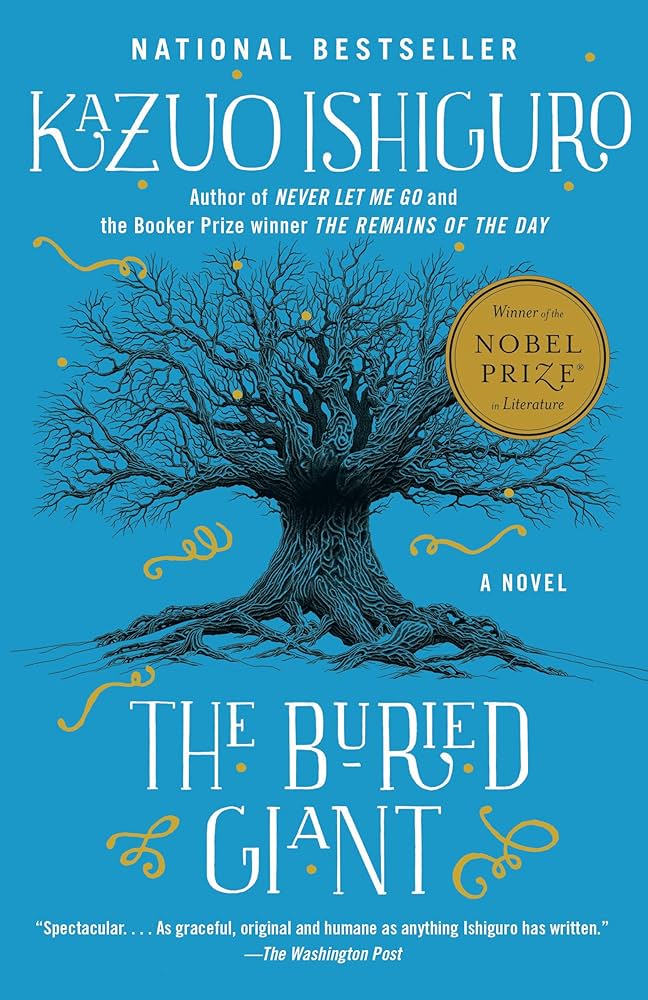
The Buried Giant

Somewhere in the books of Colin Wilson I recall him mentioning the phenomenon of “library faeries.” These creatures mysteriously put books into your path at just the right moment. As I was reading Emma Jung’s analysis of the Arthurian legends I stumbled upon Ishiguro’s The Buried Giant. I won’t really explain why or how as doing so might destroy the reader’s discovery, but this small novel inhabits and extends somewhat the Arthurian universe.

I’d read and loved three previous novels by Ishiguro, most recently Klara and the Sun, which hammered me with its profoundly sad portrait of an exploited lab-created being. Easily the best novel of its kind since the original masterpiece by Mary Shelley!

Here Ishiguro tries his hand at fable and fantasy. We meet an elderly couple named Axl and Beatrice, who live in a warren community and suffer a hardscrabble existence. They decide to make a journey to a nearby village to visit their son. On their journey they realize that something is mysteriously preventing clear memories of their past–and they realize this problem is universal. Britons and Saxons live together in an unstable harmony following the Battle of Badon and its associated slaughters. The couple encounter a Saxon knight named Wistan and a young boy who has been bit by an ogre and outcast from his home village. This band of adventurers sets upon on a quest, but each has an individual agenda which is hidden in the misty haze which drapes the land in a spell of forgetfulness.

Like in his previous novel The Remains of the Day, Ishiguro explores here how revisiting the past has consequences. Axl and Beatrice have been happy together despite their harsh life. The Saxons and Britons have coexisted in peace. Their quest may disrupt what cloaks the memories of all, with dire consequences. As glimpses of what lies buried emerge, Axl and Beatrice begin to worry: Should the past remain forgotten, or must it be rediscovered and dealt with?

The Boatman warns them, to no avail.

I loved this little allegory a great deal, and continue to admire how Ishiguro writes such ostensibly clear and simple novels which have layers and layers of elaborate meaning. Check it out!

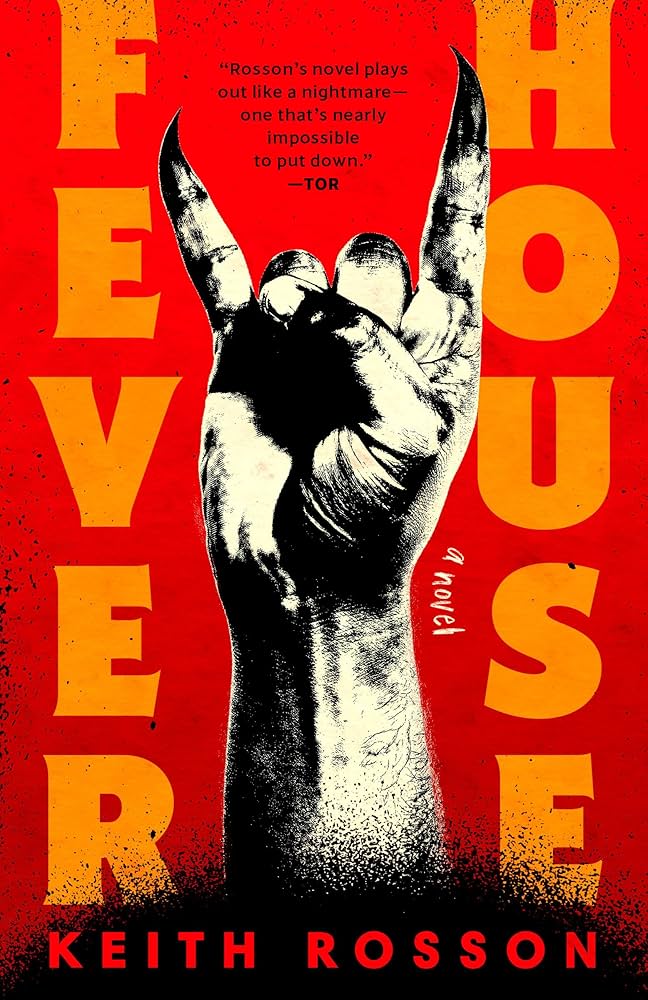
Fever House

Back before Halloween I bumped into a list of recommended recent horror–probably on the NYTimes website. Of the 7 or 8 titles listed I chose a couple to add to my To Read pile.

The first I read from the list was barely OK. Too derivative of a Stephen King novel, and too many clichés from current horror movies (unnatural smiling, kids crawling on the ceiling, animals behaving strangely like humans–yawn). The writing lacked King’s folksy warmth and humor as well, and was more like Tom Clancy’s stiff and uninteresting prose. The characters were not atypical of genre fiction–types rather than people, and the dialogue reminded me of the old Superfriends cartoons popular when I was a kid, where the superheroes would explain what they were doing while doing it as if the audience were too stupid to see what was happening (example: Aquaman would have circles shooting out of his forehead and would intone “I’m using my powers to summon fish friends,” and Superman would have red beams coming out of his eyes while saying “I’m using my infrared heat vision to burn the villain’s shoes off.”). I read Mean Spirited on a flight from Paris to the US and it whiled away the time, but I prefer more profound fare. The ending had an unexpected twist which nearly made it worth getting through.

But the second I read from the list was a knock-out. I’ve seen many zombie films, and have been an enthusiastic fan of the genre since I fist saw Romero’s initial trilogy back in the day. What I like about zombie stuff is how the genre moved from its racist origins to really incisive and often quite witty social commentary.

Fever House is the first zombie novel I’ve read–and it is excellent. There are actual fleshed-out and fully developed human beings involved, and I was on the edge of my seat as the familiar tropes of the zombie apocalypse were delivered with a new and clever backstory. I’d love to go into detail about the novel’s critiques of the hypercapitalist USA and its intelligence apparatus and the military industrial complex, but inevitably I would spoil the experience of finding out for yourself.

Rosson can write–which is atypical of authors in modern horror. Ramsey Campbell is by far the most literary and stylish current writer in the genre, but Rosson can craft sentences and structure a novel at an exceptionally high level. This book is a Slayer album redone as literary fiction. I burned through it in a day and half, and now must give myself a break from the walking dead before jumping into the second volume of the duology.