
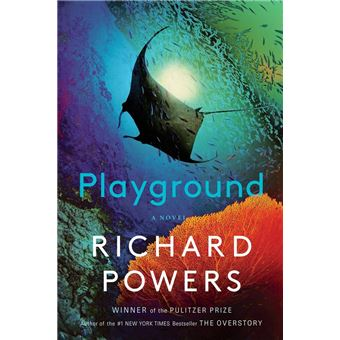
Richard Powers’ latest is another complex and tightly structured novel spanning nearly a century. There are two primary narrative strands woven together like a double helix, one first-person stream relayed by Todd Keane, an early social media and AI innovator from Chicago, and the other a third-person tale focused on Evelyn Beaulieu, a French Canadian whose father develops early deep diving technology and who becomes herself a famous deep sea explorer and renowned scientist. We jump back and forward a bit in time between these two strands as the characters each end up based in California for their work and eventually they find themselves meeting in Makatea, a tiny island in French Polynesia.
It is a credit to Powers’ strengths as a novelist that he can manage to hold all this together geographically and temporally. Despite the weight of its themes and its saturation with multiple branches of scientific inquiry, Playground manages to be a pure delight, an engaging and thoroughly breezy read.
Todd Keanes comes from wealth. His father is a hardscrabble financier and trader who builds a fortune. Todd ends up at the elite Jesuit private school from which his father graduated, and there he meets Rafi Young, a brilliant and militant young Black scholar and poet who won a scholarship endowed by Todd’s father. The first-person narration by Todd is our window on Rafi’s world–his tragic family situation, his financial struggles, his absolutely unique genius. The two challenge each other intellectually and play chess at first and then Go. It is their interest in games and gaming that give Todd the inspiration for his eventual social media platform Playground, which makes him a billionaire. Rafi’s burning creativity provides a lot of the ideation behind Todd’s innovations, and Rafi’s interest in a Russian philosopher who believed humans would inevitably discover or invent a technology of immortality is hugely influential on Todd’s eventual AI push. But as often happens to intense youthful friendships, Todd’s and Rafi’s falls apart as they head off on different paths–Todd to Silicon Valley, Rafi into graduate work in the Humanities. Rafi also meets and falls in love with a young artist from Makatea.
One of Todd’s earliest passions was the ocean, said passion first fired when he read a book by Evelyn Beaulieu called “Clearly it is Ocean.” Evelyn’s story begins when her father tests out a deep diving apparatus by putting her inside of it and throwing her into a deep pool at an engineering facility. After this she begins using his gear to explore the ocean and becomes many firsts: first woman accepted into an exclusive graduate oceanography program, first woman to join a months-long diving expedition, one of the first women to live in an underwater facility run by NASA. Like Jacques Cousteau, she is a lyrical documenter of the deep. And like Richard Attenborough, she sees in her lifetime the dire impact of humans on the environment and creatures she loves. We see her struggle with being a wife and a mother when her primary motive is her work, and how challenging it is to escape the traditional boundaries set on her gender by centuries of patriarchal thinking. It is one of Evelyne’s great realisations through her decades of diving and close observation that sea creatures spend a lot of time playing. Play recurs over and over as a major theme in the book, and for Evelyn and Todd their work is more play or a challenging game than it is drudgery.
I won’t go into the profound final fifth of the novel to avoid spoilers, but there are some surprises and interesting ambiguities. If you’re familiar with Ray Kurzweil a few strange and confounding discrepencies in the novel, nearly along the lines of magical realism, might become more clear. These involve the dates characters died, and whether they are actually alive in a traditional sense of being alive during parts of the story. Also, if you’ve read any Philip K. Dick, particularly the novel Ubik, you may grasp what is implied about some of the characters and indeed the setting of Playground’s climax. Also there are some Doctor Frankenstein allusions when we discover exactly to whom–or to what–Todd Keane has been narrating his tale.
There is some truly gorgeous writing about the ocean in this novel. One sequence about a cuttlefish is particularly lovely. It struck me as familiar, and sure enough Powers lists in his sources Peter Godfrey-Smith’s Other Minds as the genesis of that scene. I read the book a decade back, and can’t recommend it enough. I should also note that this novel is the second I’ve read lately featuring the astonishing development in AI and its ability to defeat the best human players of chess and Go, the first being Benjamin Labutut’s The Maniac. Sign of the times, I guess?
I’m also pleased to note that Playground features a female scientist, as did Powers’ previous masterpiece The Overstory. At a time when dark forces in the USA are insisting that women in leadership or highly skilled professional roles must be “DEI hires,” and that women should focus instead on birthing and raising children and stay at home, it is important that writers continue to show otherwise.
 Mysterium Coniunctionis