
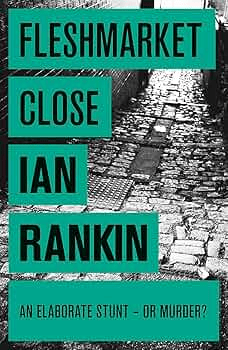
We were sitting at the local watering hole a few weeks back and mentioned to friends from the UK that we were going to visit Edinburgh this summer for the first time. Immediately one said “Oh, you must read Ian Rankin before you go. I’ll lend you a couple!” Sure enough a day or two later her significant other dropped off two novels at our front door on his way home from work. Fast service!
I’ve not read many detective novels or police procedurals or mysteries–I’ve dabbled in noir now and again, and did read the first Simenon Maigret novel in French last year. But I figured it would be an interesting way to get a taste of Edinburgh in advance without relying on Rick Steves for once, so I dived right into Fleshmarket Close.
I was a bit concerned to begin reading a series at about volume 23 or 24, but the novel stands alone quite well. The detective central to the story is John Rebus, who is being pushed aside by his superiors and sent off to pasture in a shoddy department in a squalid neighborhood. Rebus is an attractive type, familiar from the genre–a gutsy guy, tough-minded, unsophisticated in his tastes and not academically inclined, but eclectic. He likes an enormous variety of niche music from jazz and folk to punk and techno. He likes a pint and a malt perhaps too much, and has an ex-wife and estranged daughter who probably featured prominently in earlier volumes. He’s read Dostoevsky. He tends to intuit things other detectives miss, and instead of thinking linearly about a crime he builds up a huge amount of context and finds all sorts of intricate leads to trace. This frustrates his superiors but he gets results.
In Fleshmarket Close the murder of an immigrant leads to a thriving underworld of criminality involving drugs, Irish milita, human trafficking, slumlords, racism, salacious and carnivalesque right-wing media, celebrity lawyers, and pornography. Rebus and his younger partner Siobhan Clark eventually piece together a vast conspiracy. It’s quite satisfying, and Edinbugh is a character in the story just as much as Baltimore is a character in The Wire. In fact, this novel has some substantial similarities to The Wire Season 2. And, I’d note, Edinburgh as portrayed in this novel has some similarities to Baltimore.
It’s fun to see Detective Rebus struggling with “woke” culture as it began to accelerate, and to note his adapting to “new” tech like laptops and mobile phones and DNA tests. And of course it’s interesting to read a pre-Brexit UK novel which shows a lot of the media agitation which led to anti-immigrant and anti-EU sentiment. Rebus comes from Polish immigrant stock himself and he is not pleased by where he sees Scotland and the UK headed. I’d certainly recommend this to fans of the genre, who might perhaps prefer to start with the first novel instead of one of the last? But also to those who don’t really read this sort of novel as an interesting look at the dark underbelly of a famous tourist destination.
 Mysterium Coniunctionis