
Recent Reads

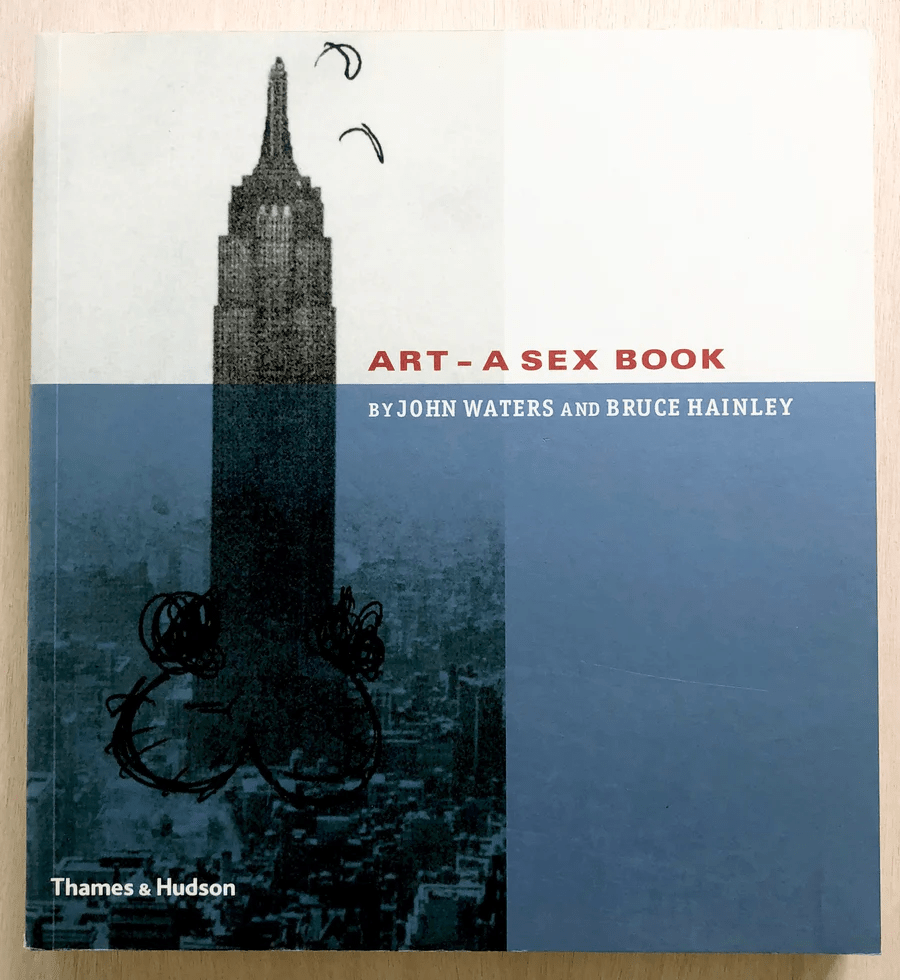
Art: A Sex Book by John Waters and Bruce Hainley

I bought a few copies of this when we had one of several book signings with John Waters at the old Borders Books & Music 043 in Towson. I gave three of them as gifts over the years and still have two signed copies. Probably have a box full of other stuff signed by John as well–DVDs, VHS tapes, other books.

It’s funny to think of an edgy and completely trashy Baltimore film-maker forging a side identity as a collector and modern art sophisticate well-regarded in New York and Paris. But nothing is surprising in John Waters’ career. A few years ago when we were home in the USA it was great fun to browse his substantial and surprising personal collection donated to the Baltimore Museum of Art. Shortly thereafter the museum dedicated a new public restroom in his honor.

After having Art: A Sex Book for more than two decades I finally got around to reading it. I’d looked at the art before but had never tackled the text. The conversations between Waters and his co-exhibitor Bruce Hainley are astute and clever and often as filthy as anything overheard in a high school cafeteria. I laughed out loud several times.

At the end of the book are 20-some artist responses to a list of provocative questions. These range from the silly to the sublime.
The Enchanter by Vladimir Nabokov

When I was first in grad school in Philadelphia in the early 90s we had a list of novels we were required to read outside of our coursework to ensure we had sufficiently deep knowledge of literature and its icons. On the list were two or three Nabokovs. I read at the time either Pale Fire or Ada, or Ardor–can’t remember which. All I recall from the book is a childhood with lots of butterflies and glimmering grass and trees and lazy summer days. And a sexy sibling or cousin? But the prose was dope. And, of course, I read Lolita.

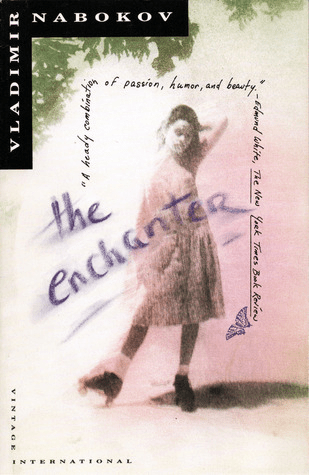
When I found a stack of Nabokov on my bookshelf I took down The Enchanter knowing nothing about it. A quick read of the prologue and I discovered it was not really a novel at all but rather a novella and that the book was mostly prologue and afterward. The prologue discussed the history of the story and the afterward, by Vladimir’s son and translator, was about the challenges of translating some surreal and salacious images from Russian to English.

The Enchanter turns out to be Nabokov’s first examination and expression of the idea which later became Lolita. His son in the afterward explains the experience of reading The Enchanter as being trapped inside the mind of a sick criminal for 70-odd pages. The entire story is about a man who lusts after a 12-year-old girl and who marries her repulsive mother simply in order to rape the child. So, basically the same idea as Lolita, but without the polish. Humbert Humbert is a disgusting pervert but he’s got style and pinache, and discusses his quarry like a sophisticate who knows cheeses and fine wines. Lolita, despite its criminal main character and dark situation, has a sense of humor. The Enchanter has Nabokov’s delicious prose and characterization but I found the experience of reading it less than enchanting–mostly interesting as a curious sort of literary archaeology rather than as an actual good story. BUT the narrator gets his comeuppance in a satisfying way.
The Thanatos Syndrome by Walker Percy

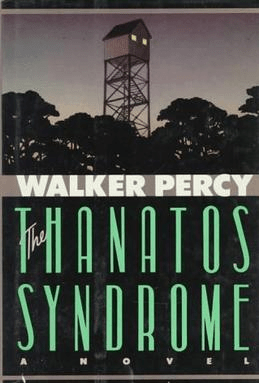
Way back in the late 1980s I took a course called Psychology and Literature. It was taught by the miraculously brilliant and completely weird Dr. Benjamin McKulik (who I discussed on Gayle Danley’s Classy Podcast a few years back). One of the novels we read in that course was The Second Coming by Walker Percy. I recall being fascinated by a female character in that book who had schizophrenic episodes and who spoke in punning sentences full of double-entendres and layered with multiple potential meanings. I have no recollection of buying Percy’s The Thanatos Syndrome but figure at some point I saw it cheap in a used bookshop and bought it on the strength of the other.

There’s a lot to detest in this book. The narrator’s terrible Louisianna genteel racism and anti-semitism, his painfully neanderthal politics, the absolutely retrograde and bafflingly naive conservative sexuality (doggy-style sex is apparently evidence of a psychological problem and/or brain syndrome, and so is oral sex?). Vivid descriptions of pedophilia uncovered by the hero make stretches of the book truly troubling to get through. But I found myself pulled along nonetheless by the narrative, which is like a Robert Ludlum or Tom Clancy thriller written by a much more literary prose stylist.

The plot is completely ridiculous but at the same time believable–a bunch of hacks funded by the Federal government decide to dump chemicals in the water supply which revert people to “lower” primate behaviors because they hope the local crime rate will go down and math scores will go up due to savant capacities developed by those who drink from the tainted taps. Success! Just like flouride in the water saves teeth, their chemical brew from a local nuclear reactor coolant tower works as intended. A psychiatrist recently released from prison for hawking prescription drugs to truck drivers has about five interactions with people in his town and immediately suspects something is up from their speech patterns and changes in their sexual behavior. His wife suddenly becomes good at bridge and wants doggy-style and oral sex for the first time ever, so there must be a neurological syndrome in town! What is the cause? Well, our intrepid doctor finds out with the help of a weird cast of Southern Gothic characters including a kissing cousin, a mentally ill Catholic priest and wanna-be Nazi who lives in a fire spotting tower, and an uncle who wins duck-call competitions.

Nearly a decade ago the first season of True Detective aired on HBO. I thought it was an absolute hoot and a great example of prestige TV with compelling acting in a gritty setting and a peculiar Lovecraftian underbelly. There are several interesting plot and setting overlaps between that season’s arc and this weird AF novel. I wonder if the show’s writers knew Walker Percy’s last book?
The Grail Legend

Since my mid-teens when I first encountered Modern Man in Search of a Soul and Man and His Symbols, I’ve been interested in Jung and Jungians. In my 20s I worked my way through Jung’s major works, up to a brief attempt at Mysterium Conjunctionis, which defeated me, and like Finnegan’s Wake has resisted any further attempts at reading.

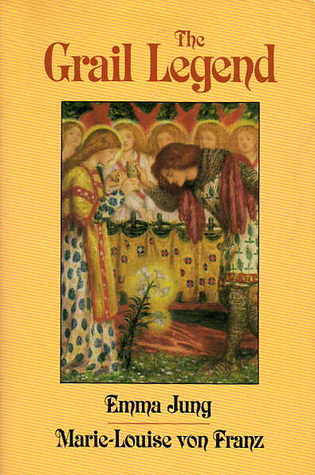
I’d read recently H is for Hawk, which was an interesting memoir about a young woman who deals with the loss of her father by training a goshawk–and in her book Helen MacDonald repeatedly refers to T.H. White’s own book about training a goshawk. T.H. White, of course, was the author of The Once and Future King series about Arthur and the Knights of the Round Table, and I considered reading those novels for the first time but don’t have them on the shelf. I did, however, have Emma Jung’s analysis of the Grail Legend and picked that up instead.

Emma Jung was Jung’s wife and collaborator, and was a sophisticated analyst as well. Her book is introduced by another long-time associate of Jung’s, Marie-Louise von Franz, who edited and finished the work after Emma Jung died.

As is often the case with books by Jung or Jungians, this is a challenging read, and it presumes a familiarity with Jung’s work and in particular his book Aion.

It is Emma Jung’s contention that the Grail Legend is an attempt by the collective unconscious of pagan Europe to adapt to and internalize Christianity. From our home here in the Correze I can very quickly visit several fountains which were originally pagan sacred sites but which were renamed in the 4th or 5th century for Christian saints and turned into Christian sacred sites. There is a lovely one here in Treignac designated The Fountain of St Meen. Also easily accessible nearby are several ancient crosses, dropped by monks on pagan sacred sites in order to Christianize the locals. One of my faves is La Croix en Haute in Lestards.

Christianity of course was an import to Europe from the Middle East, and its doctrines and rituals struck local residents as strange and alien. But over time as society became structured by converted local nobles and local monastaries and abbeys, pagans had little choice but to adopt themselves to the new religion. But the heavily patriarchal belief system with its dogma of sin and repentence and featuring a hostility towards women, magic, sex and nature was hard to swallow for locals who had their own beliefs almost completely at odds with the Christian worldview.

And so a new series of myths and legends erupted in order to compensate for and make more comprehensible the tenets of this new faith. Emma Jung documents carefully how the writers who first codified the Grail legend took material from widely dispersed pagan legends from as far afield as Wales, Ireland, Syria, Persia, and old Saxony. French poets and troubadors and English poets and historians and German poets all began singing and composing verse about Arthur and his knights and their quest for the Grail.

The Grail is typically understood as a cup which at one time held the blood of Christ captured at his crucifiction–but Jung shows that some stories present the grail as a plate or serving dish. It has the power to heal or destroy, and it exists in a hidden realm in an alternate reality accessible only to those pure enough to find it.

Associated symbols are analyzed and discussed in detail. The Fisher King is linked to the Piscean Age, the sudden eruption of the cult of the Virgin to compensate for a lack of the feminine in doctinaire Catholicism is described, connections between the Grail stories and other concurrent trends (Cathar and Templar beliefs, for example) are established and illuminated.

The focus of the work is Percival and his adventures. His family ties to the Fisher King and back through time to Joseph of Arimethea is examined through a Jungian lens.

Jung at Heart

In my 20s and early 30s I read a great deal of Carl Jung’s work, often in a haphazard way, often without much comprehension. I got through the major tomes and even many works by other Jungian analysts and practitioners, but about one-third into the Mysterium Conjunctionis I petered out. At one point I went to a release party for Jung’s The Red Book in New York where there was an exhibition of his paintings. Although I excitedly bought my copy, it has languished on the shelf for 15 years, barely perused. I suppose I felt I was saturated enough by Jung and his thinking.

But suddenly on Monday evening I took down Volume 18 of the Bollingen Collected Works, The Symbolic Life. I’d purchased this years ago and shelved it.

Why the sudden renewed interest? On Monday my wife hosted a small dinner party for some friends who’d helped her with a project in our garden. We live currently in rural France in a small village. One of the guests was a young German woman who’s lived locally for most of her life. She is 30 and a mother and is marrying a young man who is not the father of her child (a complex love story).

In conversation we stumbled somehow on the topic of Jung-I believe because she’d seen my library?- and she was immediately interested to discuss Myers Briggs results. I shared that I was INTJ and she became quite excited to share a lot of her knowledge of Jung and how his ideas have been influential in her relationships. She stood at one point and lifted her shirt while pulling down her skirt a bit, revealing blue tattoos running from the dantian upward to between her breasts.

“Now I know why you are so secret, and so calm,” she says. “When your wife is hosting events you are never there until you are needed and suddenly you are there and then you disappear. It’s the INTJ!”

She shared how Jung has helped her use symbols and ritual to structure her life and function in relationships, and to communicate ideas she can’t put into words despite fluency in 3 languages.

In our 90 minute conversation about Jung and the structure and functions of consciousness in his theories I realized how soft my understanding had become over the years. I’d drifted completely from the ‘scientific’ Jung and was wholly saturated by the ‘mystic’ Jung.

Fortunately, the Tavistock Lectures, featured first in The Symbolic Life, offer a clear and summative refresher of Jung’s basic theories about the practice of analytical psychology and how consciousness functions. Also in Lecture 2 Jung discusses how Germans have a strongly differentiated thinking function whereas the French have a strongly differentiated feeling function, and this is why the French and Germans have historically been at odds. I wonder how my young friend would feel about this idea, being a German who moved to rural France at age 12 with a soul rooted in each place.