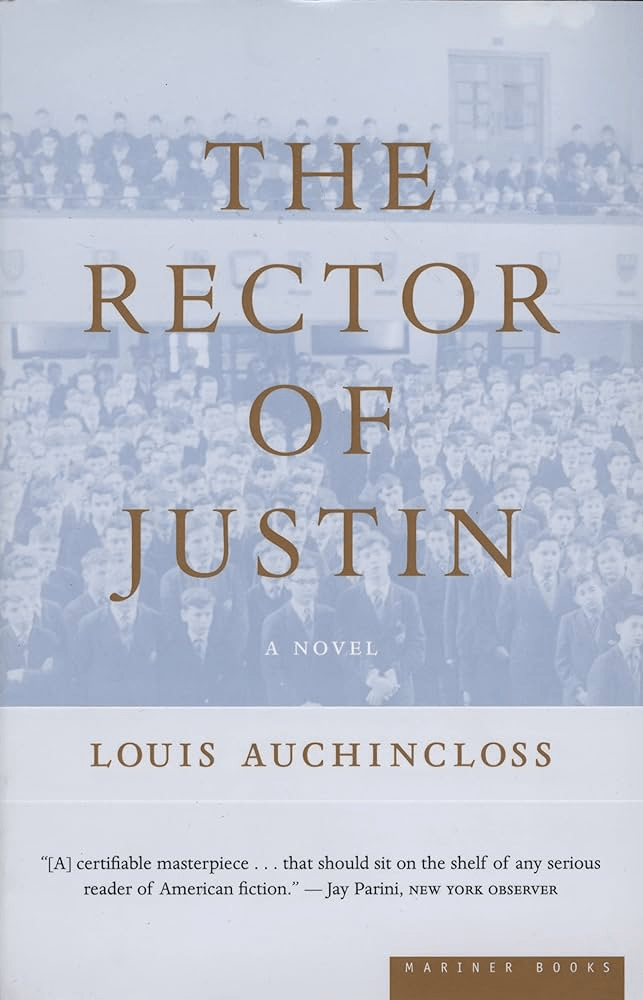
Brian Aspinwall becomes at age 27 a teacher at a prestigious private boys’ school in New England. He is recruited suddenly in 1939 to fill in for a master who has gone off to Canada to enlist in the RAF. It is primarily through Brian’s diary that we learn about the school Justin Martyr and its famous founder Reverend Francis Prescott. Immediately Aspinwall is awestruck by Prescott and comes to admire him and his accomplishments. He seeks to understand what makes Prescott and his world-class upper crust school tick, and The Rector of Justin takes off.
Aspinwall seems surprised to learn that Prescott is an intellectual and a progressive given the focus on sports, strict discipline, and religious tradition at the school. But many more surprises await. As the novel unspools we learn from other sources who come into Aspinwall’s orbit. Eventually Aspinwall is given files and documents by others and he takes on the task of possibly writing Prescott’s biography.
The book is breezy and warmly inviting, despite its substantial and ethically weighty themes. I found it an absolute pleasure. The characters are all interesting, and in particular the Rector himself. There are hints that Justin Martyr was founded out of some dark repressed desires. The WASP identity of the school proves problematic later on as Prescott has an epiphany about the kind of people running the board at his school, and the true values of the wealthy and influential class who send their kids to Justin Martyr. I could in fact trace many of the concerns Reverend Prescott has about his students and their morals down to the ethical catastrophe in current US politics.
Because the novel is from the 60s but set in the 30s and 40s we get groovy stuff intellectuals were into at the time, like Freud. The novel is saturated by Henry James but is not as dense and soupy as The Master’s.
I’d previously read only one other novel by Auchincloss–The Book Class. I remember quite liking that one but nothing about it has stuck with me after 3 decades. I do recall that both novels were given to me by Dan Bouchard in a box of remainders in perhaps ’94? I still have one more book by Auchincloss on the shelf–a collection of short fiction. I look forward to it.
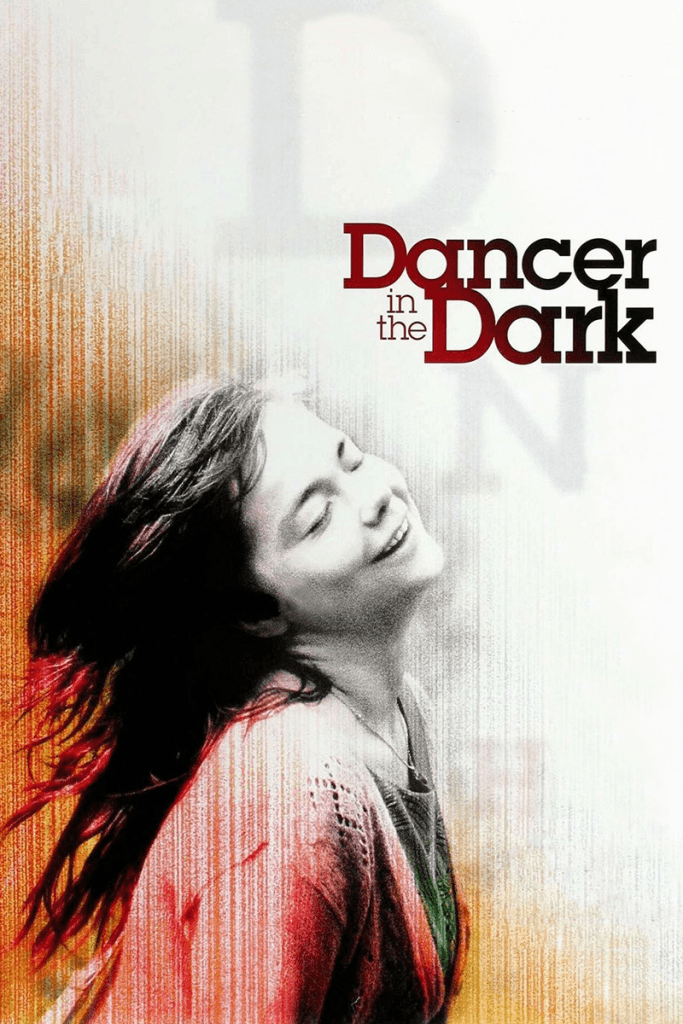
I’ve seen a few films by Lars von Trier, so had an idea what to expect. But Dancer in the Dark nonetheless snuck up on me.
It’s at the beginning a very sweet and melancholy story. Selma is an immigrant from the Eastern Block living in small-town 1950s America. She works full time in a factory and does other odd jobs to scrape by. She lives with her son in a trailer which she rents from a local police officer. The cop and his wife help her with her son while she is at work. Other people in town also care for and help Selma, including Catherine Deneuve.
Selma is dreamy and ethereal and is perfectly embodied by Björk who of course has some experience with those qualities. At the factory Selma gets in trouble because she gets distracted running an expensive and dangerous machine. Her distraction? Sounds in the factory result in a musical dance sequence in her head. Dancer in the Dark is a musical, and we see several of these sequences as the plot unfolds.
But this is a Lars von Trier film, so when the twisted and horrible occurs I was not surprised, but I had been lulled into a sort of fuzzy torpor by Björk’s magic. The turn at the core of the film took me unawares.
I’ll say no more lest I ruin it for you. I found the film wrenching and beautiful. My wife seemed mostly annoyed by it. It certainly differs in tone and mood from most musicals and sets out to subvert the genre. Selma, who is a huge fan of musicals, even says at one point something about musicals neve allowing terrible things to happen. But this is von Trier…if you like his stuff or if you are a fan of Björk this might be for you.
These past two months have been a bit exhausting. We’ve hosted an open mic night with a full band, a harp concert, several workshops and a dance performance, as well as the usual run of weekly classes and ateliers. All of this on top of the two rental apartments ramping up into tourist season, the crush of garden maintenance, a quick five-day vacation in Spain AND working at the local street food festival, electrical and plumbing challenges, renovations, etc, etc.
We’ve also adopted a French bulldog, two baby goats, and four songbirds. I’ve put in at least 50 hours on fencing alone over the past three months–building the goat enclosure, then expanding it, adapting it as needed, and repairing it several times as the goats found weaknesses and pushed through.
And with all this work going on I’ve allowed some major milestones to pass unacknowledged here.
The Milestones
As of June 2024 it has been 6 years since we moved out of the USA. We left behind an elaborate social calendar, a Victorian rowhome filled with art and objects, political and business connections, the best next-door neighbors ever, our pet dove Godzilla (RIP), and a city with which we were infinitely familiar, where we’d carefully developed an intricate network of deep involvements over the years. And, of course we left behind beloved family members and dear friends.
But, I regret nothing. All of the challenges and myriad difficulties of being voluntary immigrants were worth the sacrifices. I was looking for a new push, a new means of developing skills and becoming a stronger and better version of myself, and moving abroad definitely pushed all my faculties to the brink on multiple occasions. I often thought about involuntary immigrants, those who have no choice but to migrate, and considered how my difficulties paled in comparison (while the privileges granted by my paleness greased many wheels for us). Our experiences in Panama–living in luxurious high-rises by the ocean, pushing ourselves professionally in a completely different environment than the Baltimore City Public School System at a swank international school, making friendships with locals and other expats from around the world, going routinely to beaches on two oceans, going into the mountains, rainforests, cloud forests, jungles, seeing wild animals, getting the most out of our crippled Spanish–we loved it all. Further, there is nothing more liberating (after the trauma subsides) of getting rid of all the stuff Americans accumulate over decades. So many possessions! It was a lot to let go but we learned how to do that.
As of the first half of June 2024 we’ve lived in France for 2 years. Our French expat experience has been much different from the Panamanian, and for beyond the expected reasons of climate, geography, culture, history, language, as well as living in a decolonized nation versus living in a former colonial power. In Panama we had jobs and an employer with lawyers and an HR department who handled the heavy lifting for us. For the move to France we did much of our own heavy lifting, with the help of an excellent hand-holding service based in Paris. And we had no employer, instead we started our own business, which I suppose counts as another milestone (In June 2024 we marked the two year anniversary of not working for The Manand became ‘self-employed‘).
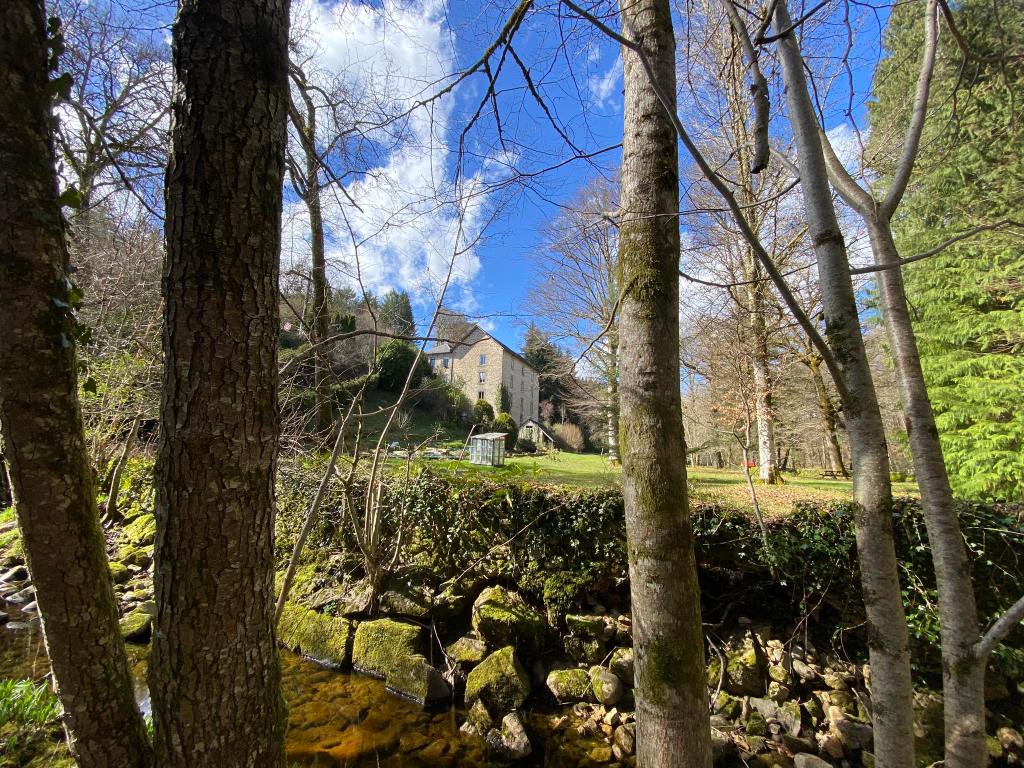
Our humble abode from an island in the Vezere River: Moulin Sage
We are loving the Correze region of France. The village of Treignac has proved to be everything we hoped when we chose it after touring dozens of small medieval towns across France as we researched moving here. Many people in and around Treignac have helped and supported us as we work toward our goal of creating an event space/concert venue/professional development center/arts and crafts atelier/pop-up cafe/retreat center/eco resort/organic farm/anarchist commune/naturalist resort/vinyard/exposition space. Yeah, we live in a run-down apartment in a largely decrepit old factory building, but it’s the best life! People come here for concerts and shit, which amuses me no end (our first concert was a gathering of about 30 people to hear ellen cherry). People we need seem to arise by magic at the exact moment we need them–could we host yoga classes here? A yoga teacher appears. Can we find a contractor willing to use recycled or repurposed materials found in the mill to create new useful spaces? Tom puts a home-made flier in our mailbox. It’s been a blast, and quite exhausting at times. But it’s different working hard for yourselves and your clients and not for somebody else.
We earn about 8% of the income we had when we had jobs. But our stress and anxiety is way down, and we can afford to live a quality life here on a small income.
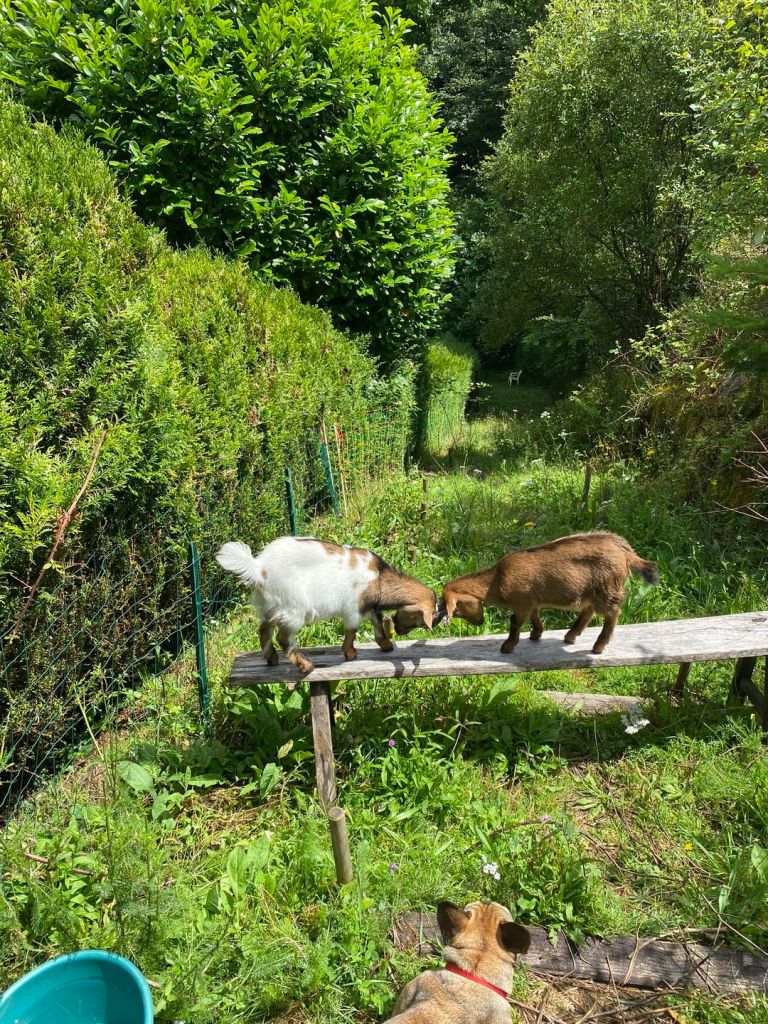
Our growing menagerie of small mammals: Cornichon, Capri, and Bou-Bou the Frenchie
On May 13th, I turned 55 years old
So being in my mid-fifties is pretty much the same as every other age I’ve been. Differences? My collection of unguents and gels has grown, my toes suddenly look like my grandfather’s toes, and I go to bed before 10pm every day. 85% of the time I feel physically like I’m in my early 30s–in fact, due to Tai Chi I often feel more limber than I did back then. But the other 15% of the time is where mid-fifties life gets interesting: 5% of the time I feel exactly my age, 5% of the time I feel like I’m in my 70s, and the last 5% of the time I’m stiff and sore and feel at least 90 years old. I can do renovation projects and work in the garden cutting and stacking and digging like a maniac no problem, and then get injured standing up from the couch or opening a pickle jar.
The biggest realization over the first half of this decade? Shut the fuck up. Keep your opinions to yourself, listen to what others have to say and shut the fuck up. Don’t participate in or encourage gossip of any kind. Petty annoyances and grievances? Let that shit go. This is the time to work on the inner self and start preparing for the next stages. What books to read, what books to re-read, what places to visit or revisit?–all of these questions become more delicate and nuanced. Typically American dudes live to be 75. Maybe I’ll get there, maybe not–maybe I’ll go beyond? But it’s time to start considering the fact that you’ve got a couple strong decades left, and how to spend them is a key consideration.
As of June 11, 2024, we’ve been married 30 years. How does this happen? In the blink of an eye we’ve been married 30 years. It really seems like our 20th anniversary party was just a few years ago. It’s been a true pleasure seeing my wife bloom since we moved abroad–unfettered by an employer she’s just madly arranging events and ateliers and adding more and more artists and craftspeople and creatives to her roster. But as my Baltimore 8th graders used to say, “she do too much.” Sometimes I get completely wiped out trying to run logistics and preparing for all the gazillion things she’s got going on, and yet she continues adding more and trying more. We have this amazing piece of garden and an old stone building and sometimes I’d like to rest on my laurels and set a spell in a hammock by the river. Patricia tells me “you have to schedule some days off when you’re self-employed or you’ll burn out,” and then she adds two more retreats and another workshop to the calendar and buys some massive thing on FB Marketplace that I have heft downstairs. But it’s all about the love, and there’s nobody I’d rather spend 24/7 with as a business partner and life partner and lover and animal co-parent. She is a dynamo with a world-changing mission and has no interest in slowing down a bit, and I could not be luckier to see it all up close.
When Roma came out a few years back a twenty-something colleague said he spent the entire film bored and wondering when something would happen. I had a completely different reaction to that film, and thought it was a miracle how much happened in 2 hours and 15 minutes.
So, take this as a warning. Jeanne Dielman clocks in at over 3 hours, and if you prefer CGI action films or comedies this will absolutely not be the movie for you!
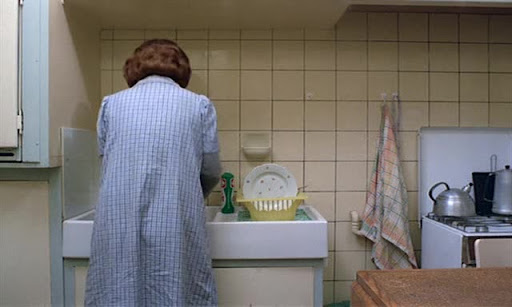
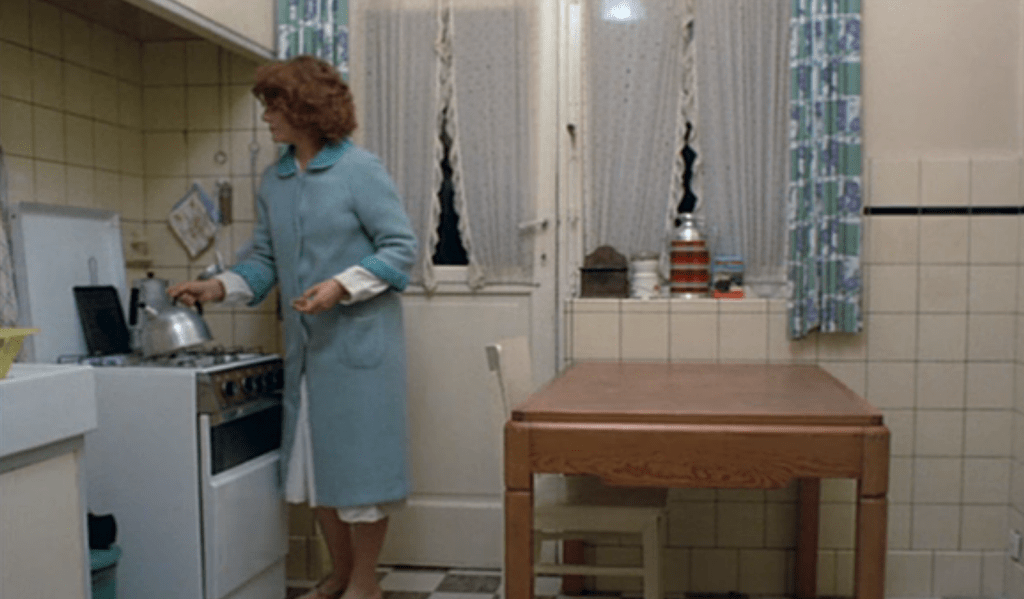
The first hour focuses on Jeanne Dielman in her daily routine. We watch the steps to her day and the way she manages tasks and it is evident from every scene that these are well-rehearsed and routine activities, and Jeanne is a marvel of efficiency. The way she folds, her fussy insistence on maintaining a tidy and immaculate living space for herself and her teenage son, her industrious and thrifty mannerisms–all reveal a woman enmeshed in the oppressive values of “woman’s work” and “mother’s duty.” She has honed and practiced her approach to preparing coffee, making dinner, cleaning, doing laundry, and converting her living room into a bedroom for her son each night, and the camera rarely moves as we watch Jeanne do her chores like an automaton. Which, of course, is what women even in wealthy “advanced” nations have often been reduced to in the past, and sadly movements like MAGA in the USA hope to bring back this state of affairs.
In the afternoons, between starting potatoes for her son’s dinner and awaiting his return from school, Jeanne has a small window of time where she takes clients as a prostitute. As a widow trying to maintain a bougie lifestyle for her son the implication is that she has no choice. Like all her tasks, there is an aloof practiced routine to these interactions. We only see the arrival of her client and his departure, and then the bathing and clean-up process Jeanne goes through after the visit. Then, her earnings are saved in a large soup tourine.
You may get restless watching Jeanne do the dishes for 20 minutes, or watching her bustle from room to room always closing doors and turning off switches and putting everything back where it belongs. But it is important to the film and its themes to see how Jeanne spends her day and how carefully her time is managed because on day 2 if you are watching closely you may notice things going awry very subtly. A dropped polish brush, a dropped spoon, potatoes overcooked and untidy hair. An undone button. These very subtle hints really add up and caused me a creeping anxiety. Jeanne is in absolute control of her activities and her life for a reason–because there is a burbling turmoil inside.
Her interactions with her son are quite frustrating to witness, for reasons you’ll understand if you see the film. Jeanne’s life even as a widow is wrapped up completely in satisfying male needs and making life easier or more pleasant for males. Only rarely do we witness Jeanne enjoying herself or experiencing a rich aesthetic moment–while knitting a sweater for her growing son, she becomes oh so quietly enraptured by a Beethoven piano sonata, and though she continues to work she is expressing some internal state, something trying to burst free.
When the coffee comes out wrong, when a missing button on her son’s coat proves impossible to replace, when a pair of scissors is not returned to its proper place–all these small details lead to an appalling finale full of resonance and open to interpretation. More viewings are required to piece together what actually transpires because though it’s quiet and subtle there are many small things happening in the last 15 minutes and I had oh so many questions.
So I can’t recommend it enough, but to endure it you have to be the sort who enjoys dense, beautifully edited and acted long-ass art films. It’s brilliant and revolutionary and tedious all at once. It jumped two years ago to number 1 on the BFI list of greatest films of all time. I might argue that there are better films, but I certainly see why it’s a powerful contender. I must explore more works by the director Chantal Akerman.
She lives on Quai Du Commerce–the film manages to critique women’s traditional roles as well as the economic system which relies on poorly compensated women’s labor

 Mysterium Coniunctionis