Recent Reads

I’d read 100 Years of Solitude about 30 years ago and was absolutely flabbergasted by it. Immediately one of my life goals became “get your Spanish into adequate shape to read more Garcia Marquez but in the original language.” I managed to have some conversations with locals in Spanish on a couple trips to Colombia, but alas never got my skills up to reading novels.

So I caved in and read Love in the Time of Cholera in English. I was a bit concerned with the high bar set by the other novel that this would disappoint–quite the contrary. I think it’s superior. Where 100 Years is a bit of a “loose, baggy monster,” Cholera is fit and trim. The magical realism is dialed down substantially but not the magic of the description, characters, settings…such a dense and humid world to inhabit for too short a time. A rich, sweaty, mournfully sexy book. It truly captures the decayed glamor of old South American colonial cities and the rich mix of cultures and classes. Exquisite!
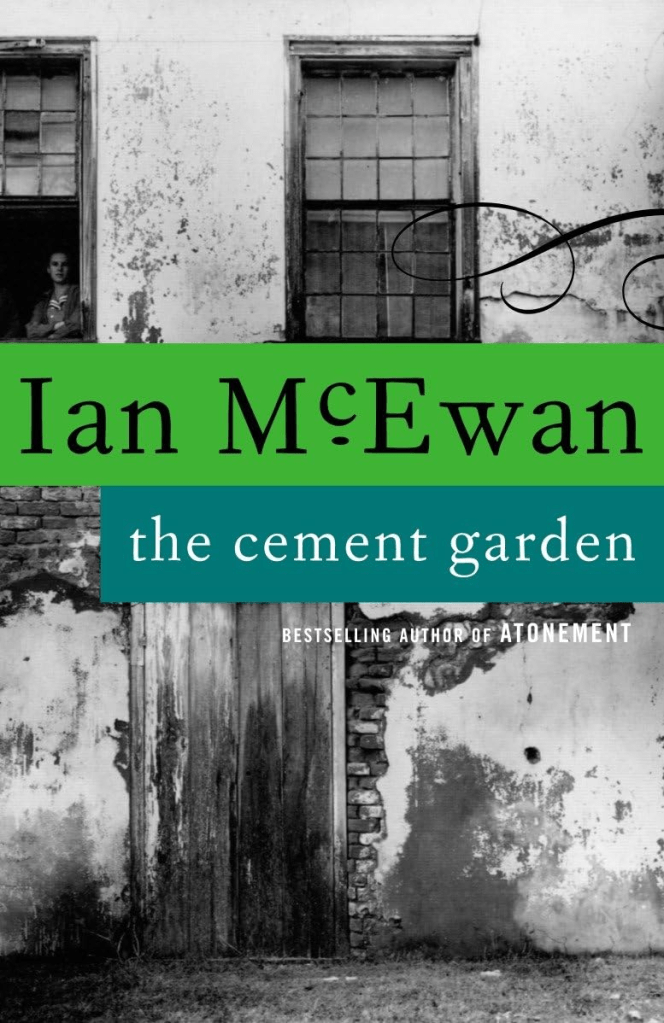
Aw, it’s nice to revisit those care free days of childhood–distant, aloof parents, perverse games, pointless wasted hours at school, the challenge of disposing of corpses…

Not sure how to categorize this one. A bit of Shirley Jackson’s We Have Always Lived in the Castle, a bit of Poe’s Fall of the House of Usher, a bit of 90s pornography.

Four siblings are left alone in a strange castle-like house in the midst of an abandoned urban tower block development when their parents die in quick succession. Instead of the lush natural setting of Eden (or the isle from Lord of the Flies) they inhabit an unnatural cement garden, where only stinging nettles force their way up through cracked concrete to bake in the sun. Without the internet or even TV there is not much to do except go feral.

McKewan can write, and this short gloomfest is arresting and disturbing in equal measure. It probably says something about me to admit that I found it somewhat humorous, the way Rober Coover’s story The Babysitter is humorous. Kids left to their own devices act like adults–and are equally fucked up.
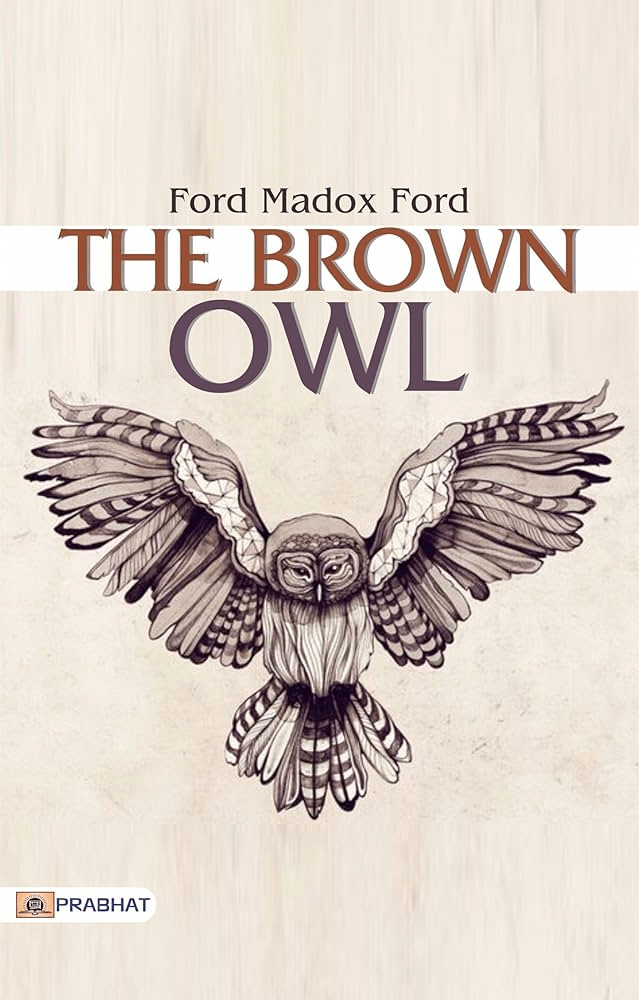
I recently read an article in the NY Review of Books about Ford Madox Ford. Had previously only read The Good Soldier, which is astonishingly good. Thought I should perhaps tackle another of his, but didn’t feel quite up to Parade’s End, which has sat its fat self on my shelves since 1994 without being opened.

So I decided to search the author’s name and pick up whatever book the owlgorithms first suggested. Owltimately it was The Brown Owl, which proved an entertaining little owlegory. Though written for kids it has a sophistication and wit about it which owlevates the book above mere “young adult” fiction.

Read earlier this year an analysis of the Arthurian myths by Emma Jung and Marie Louise von Franz, followed in short order by H is for Hawk. H is for Hawk is a memoir of dealing with the death of a parent while training a hawk and reading T H White’s memoir about training a hawk. All of this brought me round to the realization that I’d never read White’s Once and Future King novels. So I started with The Sword in the Stone. Didn’t much like it. Merlin is too ridiculous, the story is too silly, everything is far too cute. I can see why Disney made a film out it, because it’s tailor made for them.

Despite not enjoying the first volume, I plowed ahead into volume 2 of The Once and Future King. Didn’t like this one even less. Guess I’m too old. I prefer dour, profound old Tolkien to this stuff.
Fleshmarket Close

We were sitting at the local watering hole a few weeks back and mentioned to friends from the UK that we were going to visit Edinburgh this summer for the first time. Immediately one said “Oh, you must read Ian Rankin before you go. I’ll lend you a couple!” Sure enough a day or two later her significant other dropped off two novels at our front door on his way home from work. Fast service!

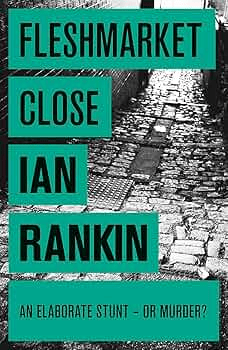
I’ve not read many detective novels or police procedurals or mysteries–I’ve dabbled in noir now and again, and did read the first Simenon Maigret novel in French last year. But I figured it would be an interesting way to get a taste of Edinburgh in advance without relying on Rick Steves for once, so I dived right into Fleshmarket Close.

I was a bit concerned to begin reading a series at about volume 23 or 24, but the novel stands alone quite well. The detective central to the story is John Rebus, who is being pushed aside by his superiors and sent off to pasture in a shoddy department in a squalid neighborhood. Rebus is an attractive type, familiar from the genre–a gutsy guy, tough-minded, unsophisticated in his tastes and not academically inclined, but eclectic. He likes an enormous variety of niche music from jazz and folk to punk and techno. He likes a pint and a malt perhaps too much, and has an ex-wife and estranged daughter who probably featured prominently in earlier volumes. He’s read Dostoevsky. He tends to intuit things other detectives miss, and instead of thinking linearly about a crime he builds up a huge amount of context and finds all sorts of intricate leads to trace. This frustrates his superiors but he gets results.

In Fleshmarket Close the murder of an immigrant leads to a thriving underworld of criminality involving drugs, Irish milita, human trafficking, slumlords, racism, salacious and carnivalesque right-wing media, celebrity lawyers, and pornography. Rebus and his younger partner Siobhan Clark eventually piece together a vast conspiracy. It’s quite satisfying, and Edinbugh is a character in the story just as much as Baltimore is a character in The Wire. In fact, this novel has some substantial similarities to The Wire Season 2. And, I’d note, Edinburgh as portrayed in this novel has some similarities to Baltimore.

It’s fun to see Detective Rebus struggling with “woke” culture as it began to accelerate, and to note his adapting to “new” tech like laptops and mobile phones and DNA tests. And of course it’s interesting to read a pre-Brexit UK novel which shows a lot of the media agitation which led to anti-immigrant and anti-EU sentiment. Rebus comes from Polish immigrant stock himself and he is not pleased by where he sees Scotland and the UK headed. I’d certainly recommend this to fans of the genre, who might perhaps prefer to start with the first novel instead of one of the last? But also to those who don’t really read this sort of novel as an interesting look at the dark underbelly of a famous tourist destination.

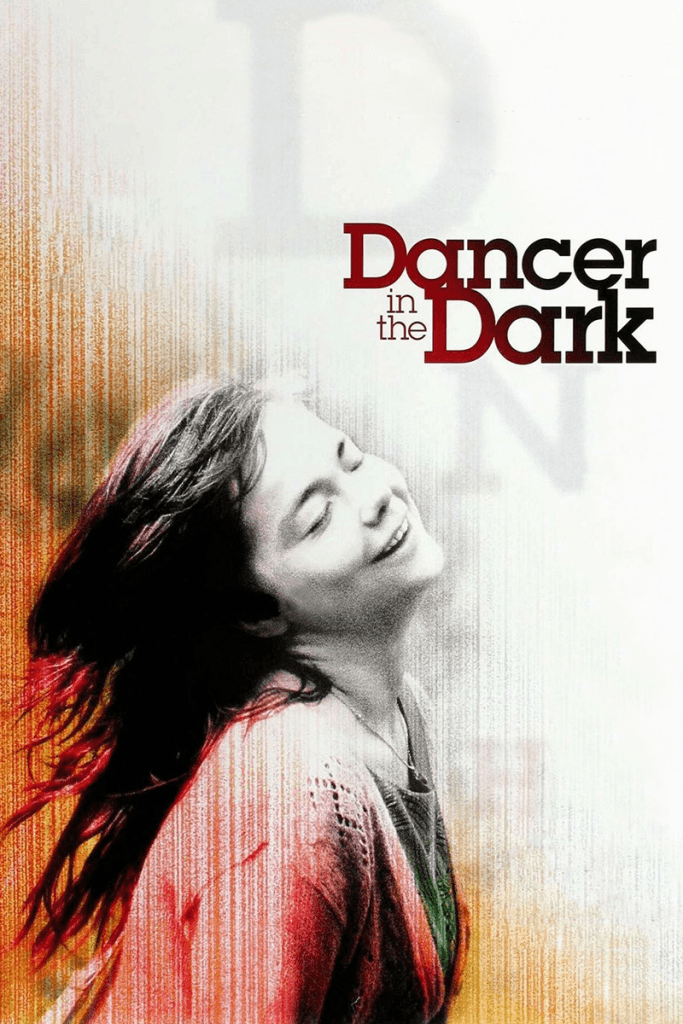
Dancer in the Dark

I’ve seen a few films by Lars von Trier, so had an idea what to expect. But Dancer in the Dark nonetheless snuck up on me.

It’s at the beginning a very sweet and melancholy story. Selma is an immigrant from the Eastern Block living in small-town 1950s America. She works full time in a factory and does other odd jobs to scrape by. She lives with her son in a trailer which she rents from a local police officer. The cop and his wife help her with her son while she is at work. Other people in town also care for and help Selma, including Catherine Deneuve.

Selma is dreamy and ethereal and is perfectly embodied by Björk who of course has some experience with those qualities. At the factory Selma gets in trouble because she gets distracted running an expensive and dangerous machine. Her distraction? Sounds in the factory result in a musical dance sequence in her head. Dancer in the Dark is a musical, and we see several of these sequences as the plot unfolds.

But this is a Lars von Trier film, so when the twisted and horrible occurs I was not surprised, but I had been lulled into a sort of fuzzy torpor by Björk’s magic. The turn at the core of the film took me unawares.

I’ll say no more lest I ruin it for you. I found the film wrenching and beautiful. My wife seemed mostly annoyed by it. It certainly differs in tone and mood from most musicals and sets out to subvert the genre. Selma, who is a huge fan of musicals, even says at one point something about musicals neve allowing terrible things to happen. But this is von Trier…if you like his stuff or if you are a fan of Björk this might be for you.

The Fly

Back when television was beamed on signals through the air we could only receive perhaps five or six channels in my hometown of Stewartstown, Pennsylvania. The clearest channels were those from Baltimore 30 miles away and were nearly all VHF stations. The UHF dial had a few grainy and fuzzy and far-off stations, the clearest of which was channel 17, WPHL-TV out of Philadelphia. I had many opportunities as a very small child to watch Dr. Shock’s Mad Theater.

The movies shown were mostly terrible 1950s drive-in horror fare, with nuclear monsters attacking towns, guys in rubber suits menacing bikini-clad young women, skulls floating along on visible wires and screaming. But they were a pleasant diversion from the more actual horrors of small-town life in the 1970s. And some of the films actually had merit and stuck with me. A few examples: The Incredible Shrinking Man and his awful battle with a spider, Invasion of the Body Snatchers, and The Fly with Vincent Price.

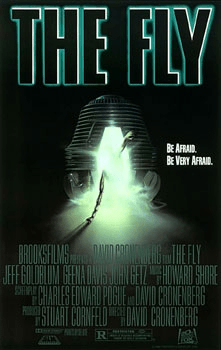
I remember going to see David Cronenberg’s remake of The Fly in a theater when it was first released. I enjoyed it so much that I rented other Cronenberg films on VHS at the local video stores. Interestingly at the dawning of my interest in cinema David Cronenberg was perhaps the genesis of my understanding that there were auteurs, visionary and stylistically interesting directors who made challenging, beautiful, disturbing, and instantly recognizable works of art.

I recently rewatched The Fly on a whim for the first time in 40 years. Of course I’ve seen many more movies and films since 1986, including those rated as the height of the art form. My tastes have tended to drift away from the horror genre, with a few exceptions. But The Fly holds up as entertainment. I think most 80s films are terrible, and people only continue to love them because of nostalgia, and when they revisit them they can’t help but reinhabit their 14 or 15 year old selves experiencing them for the first time. But The Fly has merit in the genre of prophetic sci-fi horror–be careful about your ambitions to unlock knowledge or create new technologies!

Jeff Goldblum is exceptional in his role as a sexy nerd, and still manages to charm after his transformation into a guy in a rubber suit menacing a beautiful lady. Geena Davis is great also, and the chemistry between these two actors really propels the film. John Getz is perfect as the sleazy ex-boyfriend who can’t take a hint. The look of the film remains crisp and slick, and is a precursor to the stylistic flair Cronenberg will develop in later gorgeously shot films like Dead Ringers, Naked Lunch, A Dangerous Method, Existenz, Eastern Promises, etc.

The Fly of course references many previous classic films, primarily Frankenstein, but also The Hunchback of Notre Dame, The Invisible Man, Dr. Jeckyl and Mr.
Hyde
, etc. Films where the heroes are monsters but are also all-too-human. One detail I’d missed previously occurs when the protagonists have their first overnight dalliance after Goldblum’s initial transformation. Geena Davis is asleep with her hair on the pillow and it is piled up in a column exactly like the hairdo on the Bride of Frankenstein. Made me chuckle.

Surprisingly the special effects hold up well. The computer used to power the teleportation device is likely a Commodore 64 encased in a giant metal box, but it still somehow looks futuristic, and the voice recognition to unlock its programs is a nice prophetic touch.

I’d recommend it if this is anywhere near your field of interest, and would recommend Cronenberg’s stuff to anyone interested in cinema as an art form. He’s worth exploring but the body horror is of course not always easy to endure. The Fly is perhaps my second favorite 80s horror remake–the premier example is of course is John Carpenter’s truly astonishing and completely nihilistic remake of The Thing, which is 1000 times better than E.T. the Extraterrestrial, which totally annhilated it at the box office, but which I now find unwatchable.