
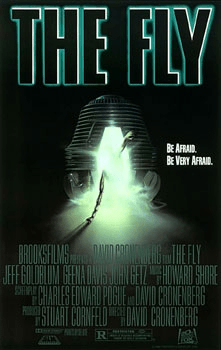
Back when television was beamed on signals through the air we could only receive perhaps five or six channels in my hometown of Stewartstown, Pennsylvania. The clearest channels were those from Baltimore 30 miles away and were nearly all VHF stations. The UHF dial had a few grainy and fuzzy and far-off stations, the clearest of which was channel 17, WPHL-TV out of Philadelphia. I had many opportunities as a very small child to watch Dr. Shock’s Mad Theater.
The movies shown were mostly terrible 1950s drive-in horror fare, with nuclear monsters attacking towns, guys in rubber suits menacing bikini-clad young women, skulls floating along on visible wires and screaming. But they were a pleasant diversion from the more actual horrors of small-town life in the 1970s. And some of the films actually had merit and stuck with me. A few examples: The Incredible Shrinking Man and his awful battle with a spider, Invasion of the Body Snatchers, and The Fly with Vincent Price.
I remember going to see David Cronenberg’s remake of The Fly in a theater when it was first released. I enjoyed it so much that I rented other Cronenberg films on VHS at the local video stores. Interestingly at the dawning of my interest in cinema David Cronenberg was perhaps the genesis of my understanding that there were auteurs, visionary and stylistically interesting directors who made challenging, beautiful, disturbing, and instantly recognizable works of art.
I recently rewatched The Fly on a whim for the first time in 40 years. Of course I’ve seen many more movies and films since 1986, including those rated as the height of the art form. My tastes have tended to drift away from the horror genre, with a few exceptions. But The Fly holds up as entertainment. I think most 80s films are terrible, and people only continue to love them because of nostalgia, and when they revisit them they can’t help but reinhabit their 14 or 15 year old selves experiencing them for the first time. But The Fly has merit in the genre of prophetic sci-fi horror–be careful about your ambitions to unlock knowledge or create new technologies!
Jeff Goldblum is exceptional in his role as a sexy nerd, and still manages to charm after his transformation into a guy in a rubber suit menacing a beautiful lady. Geena Davis is great also, and the chemistry between these two actors really propels the film. John Getz is perfect as the sleazy ex-boyfriend who can’t take a hint. The look of the film remains crisp and slick, and is a precursor to the stylistic flair Cronenberg will develop in later gorgeously shot films like Dead Ringers, Naked Lunch, A Dangerous Method, Existenz, Eastern Promises, etc.
The Fly of course references many previous classic films, primarily Frankenstein, but also The Hunchback of Notre Dame, The Invisible Man, Dr. Jeckyl and Mr.
Hyde, etc. Films where the heroes are monsters but are also all-too-human. One detail I’d missed previously occurs when the protagonists have their first overnight dalliance after Goldblum’s initial transformation. Geena Davis is asleep with her hair on the pillow and it is piled up in a column exactly like the hairdo on the Bride of Frankenstein. Made me chuckle.
Surprisingly the special effects hold up well. The computer used to power the teleportation device is likely a Commodore 64 encased in a giant metal box, but it still somehow looks futuristic, and the voice recognition to unlock its programs is a nice prophetic touch.
I’d recommend it if this is anywhere near your field of interest, and would recommend Cronenberg’s stuff to anyone interested in cinema as an art form. He’s worth exploring but the body horror is of course not always easy to endure. The Fly is perhaps my second favorite 80s horror remake–the premier example is of course is John Carpenter’s truly astonishing and completely nihilistic remake of The Thing, which is 1000 times better than E.T. the Extraterrestrial, which totally annhilated it at the box office, but which I now find unwatchable.
 Mysterium Coniunctionis