
Melville first entered my consciousness the way much of history and culture did when I was a wee tot–via cartoons. I think my first encounter was a Tom and Jerry cartoon featuring Moby Dick but renamed Dicky Moe? And of course I likely encountered the film version directed by John Huston in a butchered and pan-and-scanned version on television.
I did not read Melville until much later. I recall in 8th or 9th grade English class that there were twin girls whose grandparents owned a sailboat, and that after a summer floating around the Chesapeake Bay the girls returned, one having read Omoo and the other Typee while sailing. They dutifully presented book reports to the class with accompanying illustrations. I remember one of the twins declaring in her report that Melville was mostly known during his lifetime for writing adventure novels, but that later he morphed into a creator of SERIOUS LITERATURE.
As an undergrad at Loyola College in Baltimore I was assigned Billy Budd, Sailor and I thoroughly enjoyed it. We had a most excellent discussion of its merits and its Biblical allusions in class, but also a rowdy debate about the ethics of military justice and Billy Budd’s sad fate. Then in grad school I was assigned Bartleby, the Scrivener. I was confounded by that tale, and saw immediately the SERIOUS LITERATURE of which Melville was capable. I reread Billy Budd and Bartleby several times and eventually taught both stories to Freshmen and Juniors in different courses at Towson University.
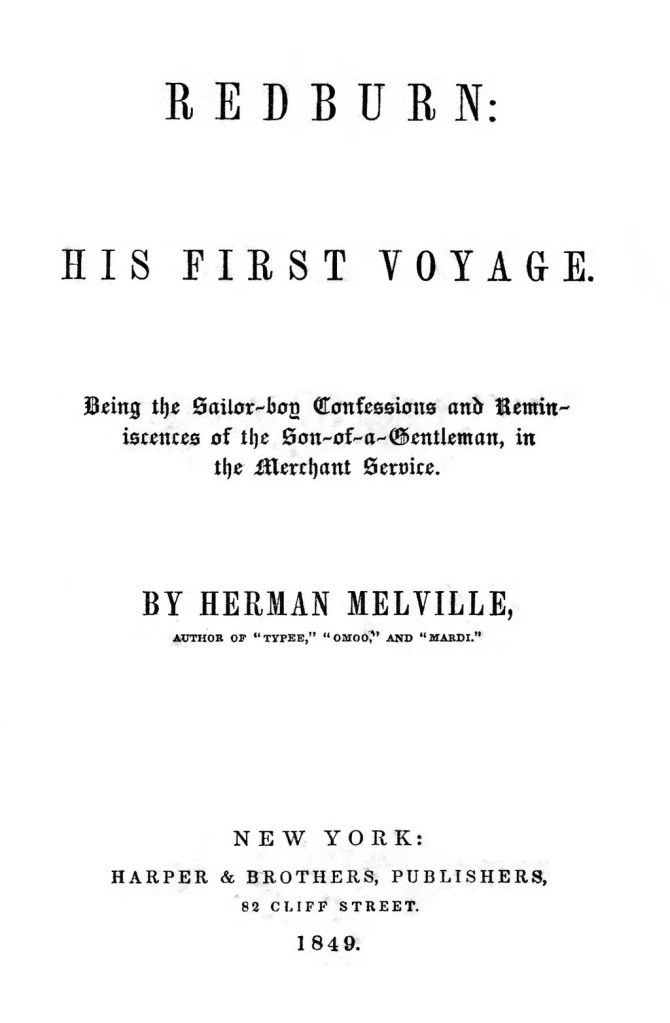
Then, I resolved despite having heard that it was a brutal slog, to read Moby-Dick, or The Whale. Contrary to rumor the novel proved endlessly entertaining and quite breezy despite its psychological depth and dense symbolism. I in fact had recently resolved to re-read it when I noticed Redburn, His First Voyage on the shelf and took it down on a whim. After a cursory skim of the first page I found myself fully engaged and could not put it down.
Redburn is a poor chap from a once wealthy and influential family. His father was a businessman engaged in international trade before the family went bankrupt, and young Redburn’s imagination was fired by journals and books about his father’s travels. As a result, he signed up as a novice sailor on a boat headed for Liverpool, and we accompany the young naif on his journey “there and back again.”
The cast of characters is large and each is ably portrayed with wit and charm. Redburn’s experiences are vividly and expertly recounted by Melville who of course was himself a similar young chap setting out on the sea at one point. I thought the book as good as anything by Dickens, in particular the scenes of squalor in Liverpool which brought to mind many pathetic and pitiable characters in the works of Charles D.
If you are considering testing the waters of Melville, but you are perhaps not ready for the full-on engagement of Moby-Dick, Redburn might be the place to start your voyage.
 Mysterium Coniunctionis