
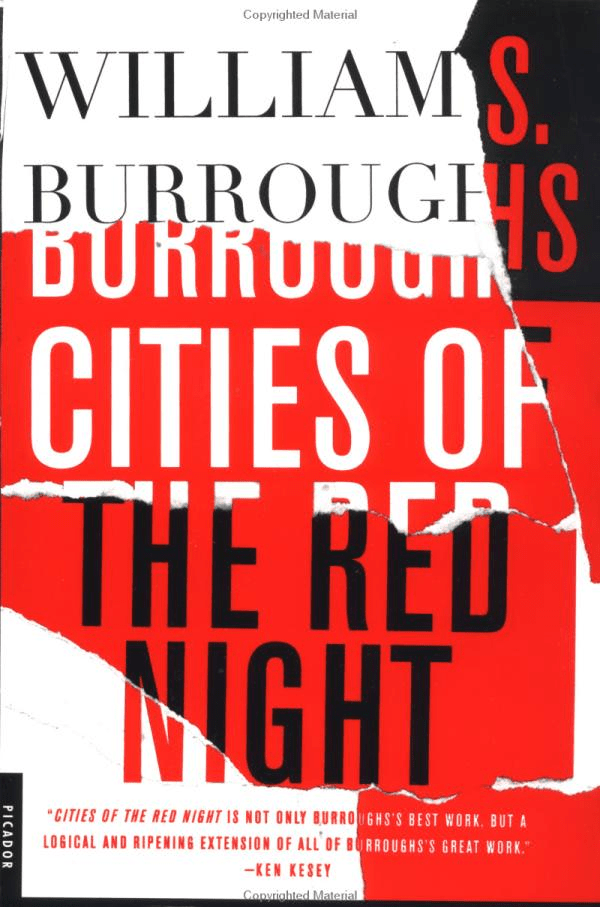
Cities of the Red Night

I’ve read a handful of Burroughs novels and also Casey Rae’s entertaining and informative William S. Burroughs and the Cult of Rock ‘n Roll. I think this is easily my favorite novel by the Beat icon. It is ridiculous, absurd, wholly pointless, unrepentently filthy, and a great deal of fun.

In Casey Rae’s examination of Burroughs I learned about his “cut-up” method of creation, splicing and collaging multiple texts and ideas together from disparate sources to forge something new. Cities of the Red Night samples deep cuts from across the 20th century: we get Crowley sex magic, pulp noir and sci-fi and horror, Mexican archaeology, chasms of time and ancient gods and civilizations borrowed from H.P. Lovecraft, political chicanary and revolutionary rhetoric, lots of guns and cannons and far-out weaponry, drugs, viruses, and oodles of hot gay sex featuring an asphyxiation fetish.

What is the novel about? Well, there is a doctor fighting a viral outbreak, and then a private dick investigating the disappearance of a young lad whose head ends up in a crate bound for Peru, a pirate revolution in Colombia and Panama, a war between humans and mutants in ancient vanished cities, conspiring conspirators doing conspiracies…it’s about so much it’s practically about nothing. Some of the characters shift from modern era New York to thousands of years ago and then to the jungles of 18th century South America before suddenly getting onto a starship in the distant future. At one point a main character wakes up in a rehab clinic and it appears the entire novel was a hallucination; but it might actually be that he could access actual reality in his comatose state and he’s only waking up into the shared illusion we call reality.

I mean it doesn’t matter what it means or if it means anything at all. Enjoy the ride!

I will note that I’ve likely read a couple thousand novels, and that this one has more ejaculations than all of the other novels I’ve read combined. And that includes a couple long books by the Marquis de Sade, so it’s an impressive number of money shots. So the novel could perhaps be classed as a sort of cartoonish pornography. Keep that in mind if you choose to read it.
The Human Stain

I read a lot of Roth back in the ’90s, to the point where I found myself Zuckered out. When The Human Stain arrived I bought it in hardcover but never got around to reading it (my copy still has a “Borders Books 30% off sticker” on the cover, LOL). Recently the NY Times released their Best Books of the Century list; the novel’s inclusion sent me downstairs to dig it out.

The Human Stain is third in a trilogy of novels (the previous two are American Pastoral and I Married a Communist). There’s a twenty-some year gap between my readings of Volume 2 and Volume 3!

Roth is typically strong at recreating a time period of American political and cultural absurdities, which he’d done in the previous novels in the trilogy for earlier eras. As the title and timing of the novel might indicate, we’re in the era of Bill Clinton and Monica’s stained blue dress. What a terrible time to be alive and American! Moralizing hypocrites unbound, a sleazy and easily manipulated Chief Executive who fell for a honey trap even the bait didn’t understand, the rise of sensationalist and salacious cable ‘news’ coverage, etc. Out of that mess came an extreme and reactionary right-wing movement angry that Clinton out-triangulated them and co-opted their economic wish list to the point where he hammered through the final achievements of the Reagan Revolution. As the Democrats moved right wing economically the Republicans went wholly off the rails. A Democratic Party beholden to Wall St and corporate interests emerged, leaving the political left in the US nobody to support except for the occasional quaint New Deal Dem who got smoked in the primaries or a third-party candidate. What a joke all that was, and yet the consequences were dire and are yet to be resolved in the USA.

The Human Stain centers around (SPOILER ALERT) a Black academic who chose to pass for white and Jewish and pulled it off, who is fired from his position of Dean for using a racist expression while teaching at a small elite liberal arts college in the wilds of New England. But the slur was not necessarily a slur given its ambiguities and the context, and perhaps the firing was an unreasonable rush to judgment (Roth perceived the emerging phenomenon of cancel culture?). Nathan Zuckerman, who befriends the fired prof and former Dean central to the story, sets out to untangle the events leading up to the situation and to write a book.

My favorite Roth novels feature a manic, hilarious, and zesty narrator. If you’ve read Sabbath’s Theater or Portnoy’s Complaint you know what I mean. Those novels breeze by in a vortex of delicious voice, and the reader is ensconced enchantingly in the conscience of a pervert who participates vividly in experience and has things to think about. But this novel (like The Plot Against America) succeeds on its level of refined craft. It brings up big themes, big ideas, big hypocrisies, and the reader is forced to examine her own beliefs and assumptions.

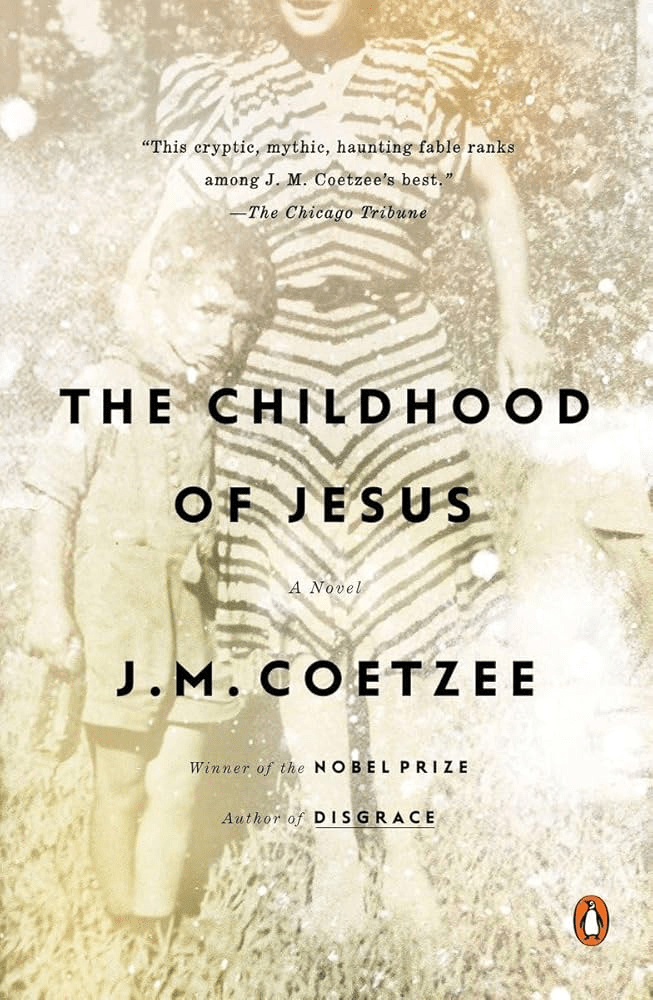
The Childhood of Jesus

Way back in the day–early ’90s–I was earning my first master’s degree at Temple U. Ostensibly a creative writing program, Temple also required some rather rigorous literary work. There was, for example, an enormous list of “books you should read before your 2 years here is up.” On that list were three books by Coetzee: Disgrace, The Life & Times of Michael K, and Waiting for the Barbarians. I was floored by these novels, how simple and elegant they seemed, but there was so much artful architecture supporting and obscuring dense layers of meaning. One of the courses I took assigned Coetzee alongside the short fiction of Nadime Gordimer.

And then, for more than 30 years, I kept my eye on Coetzee and often thought I should pick up something again–I even bought a couple of his novels and put them on the shelf. I think I bought The Childhood of Jesus more than 6 years ago before I finally read it. It was worth the wait.

When I had writerly aspirations as a youth and I’d get stuck in the glue trap of writer’s block, I’d think of a myth or fable or religious story I’d learned as a kid and re-tell it in a different time and setting. Coetzee’s novel reminded me of that useful trick as it retells the story of Christ’s early years but with migrants entering an unnamed Latin country to start a new life. The child David is of uncertain heritage and receives the name David from authorities in his new home. He is guarded by Simon, who took care of David after he lost a letter explaining his presence on a passenger boat, and who resolves to find David’s mother in their new land. Later on other familiar characters emerge but with different names: Ines is the virgin mother, Juan is the Baptist, Magdalene and Anne and other saints and apostles emerge, drop hints about their roles, and disappear.

David speaks and writes his own language, has his own ideas about how the world should work, and struggles with authority and limits on freedom. He learns to read from a child’s version of Don Quixote’s adventures, and cannot abide the idea that Quixote’s story is only in Quixote’s head, and that others around him see the same events in different and more mundane ways. He has mystical visions about numbers and their true meaning and sees people as tiny insects trying to be visible to him as he soars above the world. There are hints that Coetzee wants to underline the merging of early Christian thought and Greek philosophy and the knowledge and symbology of esoteric wisdom schools (for example, a Micky Mouse cartoon features Plato instead of Pluto as Micky’s canine companion). David’s revolutionary pedigree is underlined by his own dog’s name: Bolivar.

The expectations of the society in which David finds himself are too constraining and when the authorities determine he should be placed in a reform school the family of David flee to start a new life.

I enjoyed it so much that now I’m bound to read the rest of the Trilogy (or is it a Trinity?). Of course, it may take me another 30 years to get to the next volume.