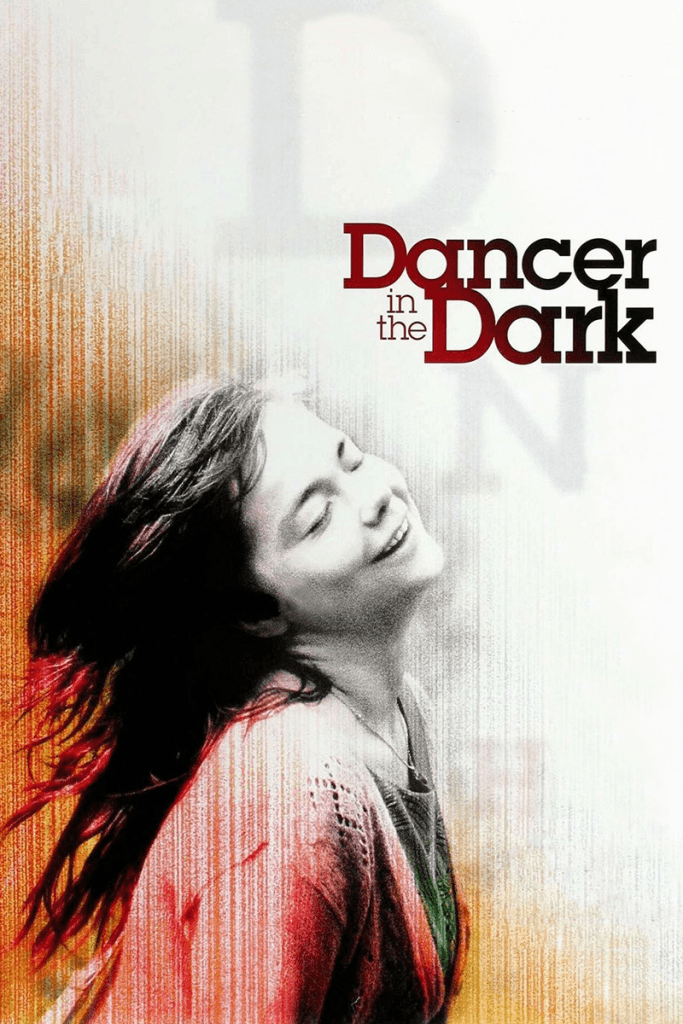
I’ve seen a few films by Lars von Trier, so had an idea what to expect. But Dancer in the Dark nonetheless snuck up on me.
It’s at the beginning a very sweet and melancholy story. Selma is an immigrant from the Eastern Block living in small-town 1950s America. She works full time in a factory and does other odd jobs to scrape by. She lives with her son in a trailer which she rents from a local police officer. The cop and his wife help her with her son while she is at work. Other people in town also care for and help Selma, including Catherine Deneuve.
Selma is dreamy and ethereal and is perfectly embodied by Björk who of course has some experience with those qualities. At the factory Selma gets in trouble because she gets distracted running an expensive and dangerous machine. Her distraction? Sounds in the factory result in a musical dance sequence in her head. Dancer in the Dark is a musical, and we see several of these sequences as the plot unfolds.
But this is a Lars von Trier film, so when the twisted and horrible occurs I was not surprised, but I had been lulled into a sort of fuzzy torpor by Björk’s magic. The turn at the core of the film took me unawares.
I’ll say no more lest I ruin it for you. I found the film wrenching and beautiful. My wife seemed mostly annoyed by it. It certainly differs in tone and mood from most musicals and sets out to subvert the genre. Selma, who is a huge fan of musicals, even says at one point something about musicals neve allowing terrible things to happen. But this is von Trier…if you like his stuff or if you are a fan of Björk this might be for you.
Back when television was beamed on signals through the air we could only receive perhaps five or six channels in my hometown of Stewartstown, Pennsylvania. The clearest channels were those from Baltimore 30 miles away and were nearly all VHF stations. The UHF dial had a few grainy and fuzzy and far-off stations, the clearest of which was channel 17, WPHL-TV out of Philadelphia. I had many opportunities as a very small child to watch Dr. Shock’s Mad Theater.
The movies shown were mostly terrible 1950s drive-in horror fare, with nuclear monsters attacking towns, guys in rubber suits menacing bikini-clad young women, skulls floating along on visible wires and screaming. But they were a pleasant diversion from the more actual horrors of small-town life in the 1970s. And some of the films actually had merit and stuck with me. A few examples: The Incredible Shrinking Man and his awful battle with a spider, Invasion of the Body Snatchers, and The Fly with Vincent Price.
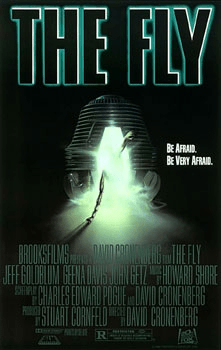
I remember going to see David Cronenberg’s remake of The Fly in a theater when it was first released. I enjoyed it so much that I rented other Cronenberg films on VHS at the local video stores. Interestingly at the dawning of my interest in cinema David Cronenberg was perhaps the genesis of my understanding that there were auteurs, visionary and stylistically interesting directors who made challenging, beautiful, disturbing, and instantly recognizable works of art.
I recently rewatched The Fly on a whim for the first time in 40 years. Of course I’ve seen many more movies and films since 1986, including those rated as the height of the art form. My tastes have tended to drift away from the horror genre, with a few exceptions. But The Fly holds up as entertainment. I think most 80s films are terrible, and people only continue to love them because of nostalgia, and when they revisit them they can’t help but reinhabit their 14 or 15 year old selves experiencing them for the first time. But The Fly has merit in the genre of prophetic sci-fi horror–be careful about your ambitions to unlock knowledge or create new technologies!
Jeff Goldblum is exceptional in his role as a sexy nerd, and still manages to charm after his transformation into a guy in a rubber suit menacing a beautiful lady. Geena Davis is great also, and the chemistry between these two actors really propels the film. John Getz is perfect as the sleazy ex-boyfriend who can’t take a hint. The look of the film remains crisp and slick, and is a precursor to the stylistic flair Cronenberg will develop in later gorgeously shot films like Dead Ringers, Naked Lunch, A Dangerous Method, Existenz, Eastern Promises, etc.
The Fly of course references many previous classic films, primarily Frankenstein, but also The Hunchback of Notre Dame, The Invisible Man, Dr. Jeckyl and Mr. Hyde, etc. Films where the heroes are monsters but are also all-too-human. One detail I’d missed previously occurs when the protagonists have their first overnight dalliance after Goldblum’s initial transformation. Geena Davis is asleep with her hair on the pillow and it is piled up in a column exactly like the hairdo on the Bride of Frankenstein. Made me chuckle.
Surprisingly the special effects hold up well. The computer used to power the teleportation device is likely a Commodore 64 encased in a giant metal box, but it still somehow looks futuristic, and the voice recognition to unlock its programs is a nice prophetic touch.
I’d recommend it if this is anywhere near your field of interest, and would recommend Cronenberg’s stuff to anyone interested in cinema as an art form. He’s worth exploring but the body horror is of course not always easy to endure. The Fly is perhaps my second favorite 80s horror remake–the premier example is of course is John Carpenter’s truly astonishing and completely nihilistic remake of The Thing, which is 1000 times better than E.T. the Extraterrestrial, which totally annhilated it at the box office, but which I now find unwatchable.
When David Lynch passed away recently I thought “How do I choose which of his films to re-watch?” It felt important to re-watch something and acknowledge the importance of his work in my life. But instead of selecting a Lynch film I watched Tarkovsky’s The Mirror for the first time. I’d seen Solaris, Adrei Rubilev, and The Sacrifice before and thought instead of re-watching something I’d challenge myself with something new.
I’m not sure what brought The Mirror to mind after Lynch died, but I couldn’t help but see the film through Lynch’s cinematic vocabulary. The nonlinear dreamy narrative structure, the inconsistent and often suspicious point of view, the beautifully mysterious and evocative imagery, the masterful painterly touches. As in Lynch’s films, one can’t be sure if what is on screen is real reality, or an internal reality-a dream, a memory, a delusion of one of the characters. Are those really ghosts which tell the young boy left alone to read a certain passage in a certain book? Is the room filled with cascading water an actual memory or event or symbolic or a dream? I’d often heard about The Mirror as an all-time masterpiece, and it proved true. It’s astounding and perturbing like most of Tarkovsky’s films. And, as with Lynch, not ‘getting it’ is part of the pleasure.
Back when I was gainfully employed with a steady income I would buy books willy-nilly. At some point along the way (perhaps after reading a couple Geoff Dyers in my early 40s) I purchased and downloaded Dyer’s Zona: A Book About a Film About a Journey to a Room. After seeing The Mirror I thought why not read this at last?
Of course Zona is about Tarkovsky’s film Stalker, not about The Mirror. But it’s also a long meditation on Tarkovsky and his style and his work, so the time was right.
Dyer re-watches Stalker while writing and goes through the film scene-by-scene, riffing on each sequence and making connections and interpretations and tying everything to his personal experience and to the various times he’s seen the film. He creates a sort of Talmud of the film. And of course this book has two prerequisites: an interest in Geoff Dyer and his riffing essays and some knowledge of and interest in the films of Tarkovsky, in particular Stalker. Though it had been some time since I’d seen Stalker I found it interesting how pwerfully the film came back to me through Dyer’s discussions. I learned a lot about Tarkovsky along the way, and about Geoff Dyer. And that’s what essays are for of course.
By the way, if you are interested in Tarkovsky, Mosfilms has made his works available on YouTube in pristine digital transfers and subtitled in English. In fact, all of Mosfilms catalogue is available and most certainly worth exploring.
I’ve been going back through the physical library and pulling down unread volumes lately. In the last six months four of those have been novels by Philip Roth.
Roth wrote Everyman shortly before killing off his alter-ego Nathan Zuckerman in Exit Ghost. I think Everyman is a superior novel and a more beautiful meditation on mortality and death than Exit Ghost.
The novel opens with the death of the main character, who remains unnamed throughout the story. We attend his funeral with some family and some former lovers, and then we are inside the mind of the dead man as he projects backward in time. I believe this is only the second novel I’ve read where the entire story is told from the point of view of a dead dude, the other being The Living End by the delightful Stanley Elkin.
The narrator worked in the ad biz but always wanted to be a painter. We see his triumphs and failures and his major regrets. We meet his children and his three wives and some of his lovers. We encounter his parents and siblings, and the theme which ties everything together is decay and death and their inevitability. Hence the title Everyman, because no one escapes death, and as a result the book is basically about all of us. Perhaps we get to buzz back through and revisit our time here after we go to our final rest? It’s a comforting thought.
There is a beautiful scene where the narrator visits his parents’ graves in a dilapidated cemetery in an unsafe part of New Jersey before going in for a surgery he does not survive. He meets the gravedigger and there is a beautiful moment between the two men, one whose living is digging holes for the dead, and one who is about to die. The scene’s got “Alas, poor Yorick” chops.
Roth was a substantial artist and a chronicler of the USA in the decades leading up to its decline into irrelevance and buffoonery. He confronted his end with dignity and continued to work until his final moments. I am grateful to have his novels as a roadmap to my own final decades.
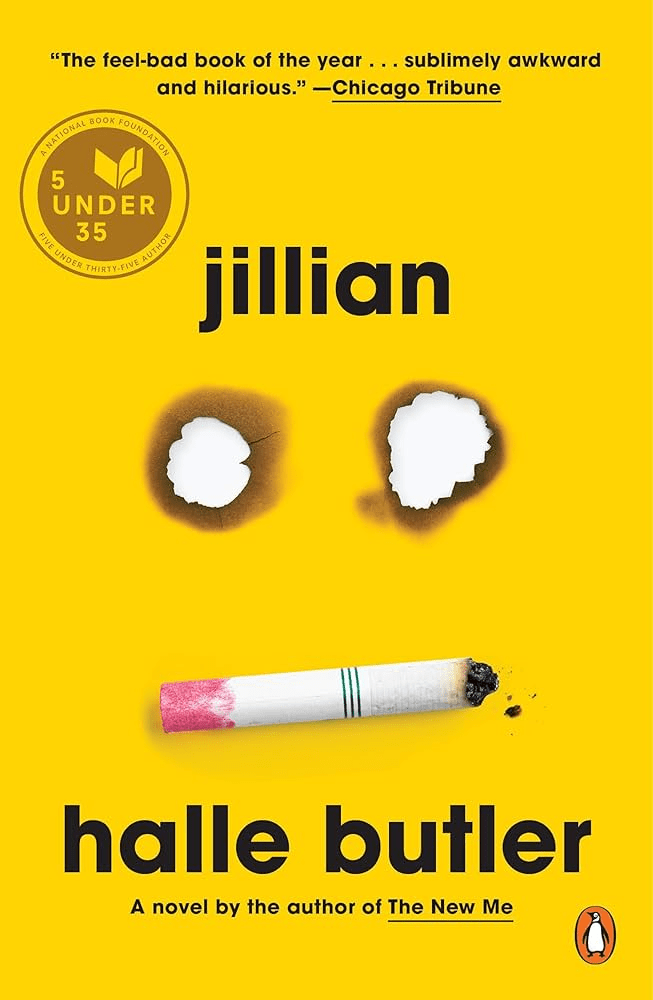
This book is awful. When I write that I’m not speaking at all of the quality of the novel–it’s actually quite good and very entertaining. But everything about it is truly terrible. Jillian is a troublingly accurate record of life in the current late-stage neoliberal capitalist hellscape we all inhabit. As such, it’s an abyss of despair, a Nietszchean vortex, a singularly piercing examination of approaching Singularity. I laughed heartily reading it, and cringed each time I laughed, because ‘funny, not funny.’
The novel centers on two characters: Megan, a recent college grad who works in a gastroenterologist’s office. Her job is to look at images of people’s colons all day as she scans the images into their medical files. She is alienated from her labor, but also from her friends, from her boyfriend, from her family, from her society, and from herself. Marx wrote Grundrisse just for Megan. She sees how empty everything is and how difficult it will be to find meaning at all in a life doomed to this sort of work. As a result she gets smashed on canned American beer and smokes too many cigarettes while becoming more and more of an intolerable asshole. Megan is infuriated that nobody else can see how fake everything is and how their successes at their own fake shitty jobs are contemptible.
And then there is Jillian, Megan’s co-worker. Jillian is about a decade older than Megan and because unconsciously Megan sees herself becoming Jillian in ten years, still working at the doctor’s office, still cheerfully scanning poopy intestinal images, she starts to really loathe her coworker and herself. Half the novel is from Jillian’s point of view, half from Megan’s (with brief moments from the POV of a few other scattered characters, including Jillian’s son Adam and from a dog, a bird, a racoon).
Jillian is a total wreck, and drives on a suspended license because she is completely deluded about the state of her world and unable to face the realities of her situation. A single mom who got knocked up after hooking up at a club while high, she has discovered religion and has made a mess of that as well. After drifting thoughtlessly through a red light her car gets impounded, she is arrested and arraigned, and she has to rely on the kindness of a fellow church member to get her kid to daycare every day while she goes to the office. Megan sees through all of Jillian’s bullshit and it makes her totally crazy. She goes home and obsesses about Jillian to the point her boyfriend starts to get annoyed by this obsession.
Meanwhile Jillian has lied to her employer about her car and about an upcoming court date and about her fine for driving on an expired license. And to solve all her problems she adopts a dog because happy families have dogs, right? Then a painkiller addiction makes everything that much better.
In this novel we get to experience the collapse into despair of these miserably entwined people. And what makes it all worse is that Megan, despite being a terrible asshole, is actually correct about the people around her and the society she is in and about her prospects. And she is correct about Jillian and her thin cheerful veneer, the inevitable collapse of which affects not only herself but her child and her dog and Megan and the entire society they are trapped inside. And yet these are the sort of people churned out and crushed by America the Beautiful in the 21st century.
Back when I was young and energetic I spent a couple decades working a full-time job, a part-time job, and going to university full-time. At some point in this burst of insanity I was working in the Cook Library at Towson University, while teaching in the English Department, and still working at Borders Books & Music, while pursuing a degree in French Literature and also taking courses necessary to become a public school teacher. At that time I’d already earned a Bachelor’s Degree and a Master’s Degree–but it was never enough, LOL.
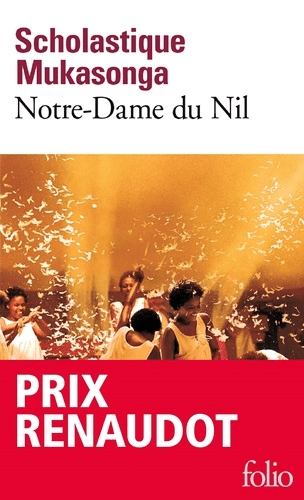
During that burst I took a really brilliant class with Dr. Lena Ampadu focused on literature in English coming out of post-colonial Africa, and also took a delicious class in French with Dr. Katia Sainson focused on postcolonial lit. So a couple decades later when an algorithm suggested Notre Dame du Nil on sale I purchased it while living in an oceanside apartment in a high-rise in Panama. I desperately wanted to improve my Spanish but also wanted to keep my French alive. Six years later I finally got around to reading it.
It was worth the wait. Ostensibly a memoir novel set in an all-girl’s school in Rwanda in the early 1970s, it is actually a densely layered critique of colonialism. Imagine Mean Girls if Franz Fanon dropped in as script advisor.
The French was not too difficult, and I needed to consult a dictionary only a few times each chapter. The characters are engaging and I found much of the novel quite interesting and at times hilarious. The girls at Notre Dame du Nil are all Rwandans who are being groomed for elite roles–they are daughters of wealthy merchant families, of diplomats, of government figures or military officers. Many come from small rural villages and of course “elite” grooming requires the learning of European languages, European traditions, European religion, European manners…The Europeans teaching in the school are hapless and ridiculous and deserve the mocking they receive. The Catholics in charge of the institution are just as bad. The school has as its setting one of the furthest away sources of the Nile river, hence the designation in the title. The bits about Rwandan culture, including a fascinating sequence when two students visit a rain-making shaman to purchase a love spell-were excellent. And the fishy Catholic priest in charge of the school who bestows nice garments on girls but only if they try them on in front of him? Classic.
One tangent of the plot involves a European man who lives on an old coffee plantation and has a bizarre theory that Tutsis are descended from Pharoahs–he abducts a student and then begins painting her and using her in a film he’s making. Another involves a visit to campus by the Queen of Belgium.
But the novel slowly simmers and builds a truly dark and disturbing undercurrent as the typical mean teen girl drama reveals roots deeply entwined in Hutu and Tutsi history, with absolutely catastrophic results. What at first seems like surly teen sniping eventually develops an undercurrent of tribal hatreds and it becomes clear that the parents of several students are encouraging the cataclysmic outcome. “It’s not lies, it’s politics,” says a ringleader who happens to be the daughter of the President of Rwanda. One student, who is half Tutsi and half Hutu, does her best to straddle two worlds and attempts to insinuate herself into the dominant group but redeems herself to a degree when the crisis comes.I shan’t say more to avoid spoilers.


 Mysterium Coniunctionis