
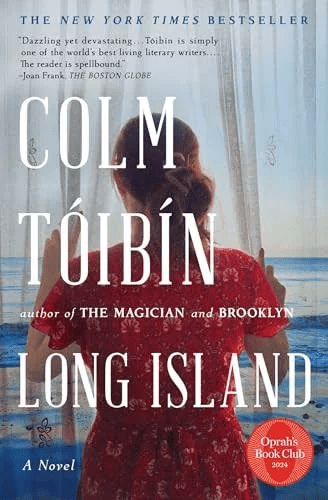
I’ve been struggling all year to finish books. I’m currently engaged in about 2 dozen different books, some substantially. But so far in 2026 I’d only finished one. Desperate for a quick read, I remembered I had Long Island by Colm Toibin available.
Toibin has written and spoken about Henry James with depth and sophistication. He of course wrote a delicious novel about James called The Master. As a prose stylist, Toibin is far from James and those labyrinthine Laocoon-esque sentences. But thematically he is a direct descendant. The characters and events in Long Island could have been written by James around the era of The Awkward Age or What Maisie Knew (but Long island would have been merely a novella to James). Of primary concern in the novel is Eilis and her family and a sudden disruption which launches her on a return to Ireland after 20 years in New York.
Eilis has every reason to be happy with her current circumstance, but her husband has betrayed her and has not committed to accept her terms for a continuation of their life together. Back in Ireland for her mother’s 80th birthday, she becomes a chaos agent and derails the lives of several former acquaintences in a cool, non-chalant manner. But she must be forgiven, for she knows not what she does, or the consequences of her actions, because everyone is too concerned by appearances and impressions to be honest with each other.
In James’s novels, the Americans in Europe were often innocent naifs, manipulated victims of far more sophisticated Italians, French, or English from ancient families and fortunes. Here it’s rather the opposite, where a dazzling Irish girl who’s built a life in New York returns to wreak havoc amongst the small-town yokels. This is a quiet novel and very interior to the concerns of a handful of characters, but I found myself falling deeply for all of them, and felt terribly the potential for catastrophe as the plot unfolded. I was, as I typically am when reading Toibin, totally absorbed.
 Mysterium Coniunctionis