Jillian

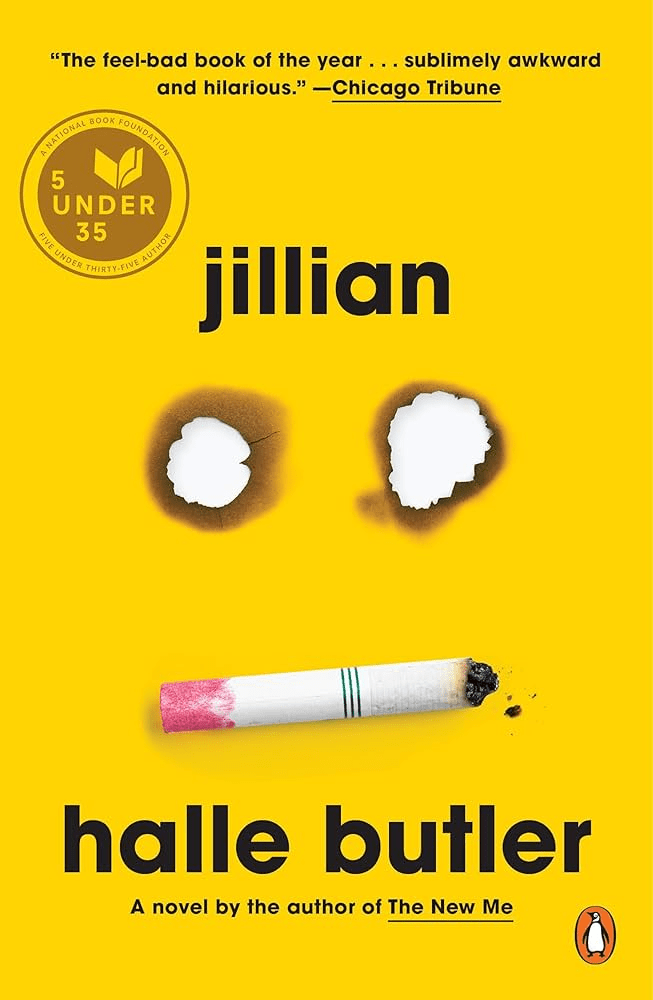
This book is awful. When I write that I’m not speaking at all of the quality of the novel–it’s actually quite good and very entertaining. But everything about it is truly terrible. Jillian is a troublingly accurate record of life in the current late-stage neoliberal capitalist hellscape we all inhabit. As such, it’s an abyss of despair, a Nietszchean vortex, a singularly piercing examination of approaching Singularity. I laughed heartily reading it, and cringed each time I laughed, because ‘funny, not funny.’

The novel centers on two characters: Megan, a recent college grad who works in a gastroenterologist’s office. Her job is to look at images of people’s colons all day as she scans the images into their medical files. She is alienated from her labor, but also from her friends, from her boyfriend, from her family, from her society, and from herself. Marx wrote Grundrisse just for Megan. She sees how empty everything is and how difficult it will be to find meaning at all in a life doomed to this sort of work. As a result she gets smashed on canned American beer and smokes too many cigarettes while becoming more and more of an intolerable asshole. Megan is infuriated that nobody else can see how fake everything is and how their successes at their own fake shitty jobs are contemptible.

And then there is Jillian, Megan’s co-worker. Jillian is about a decade older than Megan and because unconsciously Megan sees herself becoming Jillian in ten years, still working at the doctor’s office, still cheerfully scanning poopy intestinal images, she starts to really loathe her coworker and herself. Half the novel is from Jillian’s point of view, half from Megan’s (with brief moments from the POV of a few other scattered characters, including Jillian’s son Adam and from a dog, a bird, a racoon).

Jillian is a total wreck, and drives on a suspended license because she is completely deluded about the state of her world and unable to face the realities of her situation. A single mom who got knocked up after hooking up at a club while high, she has discovered religion and has made a mess of that as well. After drifting thoughtlessly through a red light her car gets impounded, she is arrested and arraigned, and she has to rely on the kindness of a fellow church member to get her kid to daycare every day while she goes to the office. Megan sees through all of Jillian’s bullshit and it makes her totally crazy. She goes home and obsesses about Jillian to the point her boyfriend starts to get annoyed by this obsession.

Meanwhile Jillian has lied to her employer about her car and about an upcoming court date and about her fine for driving on an expired license. And to solve all her problems she adopts a dog because happy families have dogs, right? Then a painkiller addiction makes everything that much better.

In this novel we get to experience the collapse into despair of these miserably entwined people. And what makes it all worse is that Megan, despite being a terrible asshole, is actually correct about the people around her and the society she is in and about her prospects. And she is correct about Jillian and her thin cheerful veneer, the inevitable collapse of which affects not only herself but her child and her dog and Megan and the entire society they are trapped inside. And yet these are the sort of people churned out and crushed by America the Beautiful in the 21st century.


Notre Dame du Nil

Back when I was young and energetic I spent a couple decades working a full-time job, a part-time job, and going to university full-time. At some point in this burst of insanity I was working in the Cook Library at Towson University, while teaching in the English Department, and still working at Borders Books & Music, while pursuing a degree in French Literature and also taking courses necessary to become a public school teacher. At that time I’d already earned a Bachelor’s Degree and a Master’s Degree–but it was never enough, LOL.

During that burst I took a really brilliant class with Dr. Lena Ampadu focused on literature in English coming out of post-colonial Africa, and also took a delicious class in French with Dr. Katia Sainson focused on postcolonial lit. So a couple decades later when an algorithm suggested Notre Dame du Nil on sale I purchased it while living in an oceanside apartment in a high-rise in Panama. I desperately wanted to improve my Spanish but also wanted to keep my French alive. Six years later I finally got around to reading it.

It was worth the wait. Ostensibly a memoir novel set in an all-girl’s school in Rwanda in the early 1970s, it is actually a densely layered critique of colonialism. Imagine Mean Girls if Franz Fanon dropped in as script advisor.

The French was not too difficult, and I needed to consult a dictionary only a few times each chapter. The characters are engaging and I found much of the novel quite interesting and at times hilarious. The girls at Notre Dame du Nil are all Rwandans who are being groomed for elite roles–they are daughters of wealthy merchant families, of diplomats, of government figures or military officers. Many come from small rural villages and of course “elite” grooming requires the learning of European languages, European traditions, European religion, European manners…The Europeans teaching in the school are hapless and ridiculous and deserve the mocking they receive. The Catholics in charge of the institution are just as bad. The school has as its setting one of the furthest away sources of the Nile river, hence the designation in the title. The bits about Rwandan culture, including a fascinating sequence when two students visit a rain-making shaman to purchase a love spell-were excellent. And the fishy Catholic priest in charge of the school who bestows nice garments on girls but only if they try them on in front of him? Classic.

One tangent of the plot involves a European man who lives on an old coffee plantation and has a bizarre theory that Tutsis are descended from Pharoahs–he abducts a student and then begins painting her and using her in a film he’s making. Another involves a visit to campus by the Queen of Belgium.

But the novel slowly simmers and builds a truly dark and disturbing undercurrent as the typical mean teen girl drama reveals roots deeply entwined in Hutu and Tutsi history, with absolutely catastrophic results. What at first seems like surly teen sniping eventually develops an undercurrent of tribal hatreds and it becomes clear that the parents of several students are encouraging the cataclysmic outcome. “It’s not lies, it’s politics,” says a ringleader who happens to be the daughter of the President of Rwanda. One student, who is half Tutsi and half Hutu, does her best to straddle two worlds and attempts to insinuate herself into the dominant group but redeems herself to a degree when the crisis comes.I shan’t say more to avoid spoilers.

La Place

I’ve not been pushing myself to read French lately, and it is absolutely vital that I continue to work on the language so that I sound less like an adolescent speaking when I interact with locals here in the Correze and particularly with business clients who arrive from cities like Toulouse, Bourdeaux, and Lyon. When Ernaux won the Nobel Prize in 2022 I picked up a couple of her books, one of which was La Place.

Surprisingly the French is quite clear and simple-stylistically I’d compare Ernaux’s writing to Hemingway, with crisp, short declarative sentences. Technically La Place is a novel, but it is also a memoir or autobiographical novel, and her style is very objective and is comparable to Joan Didion’s dispassionate journalism. I was pleased to only need a dictionary a couple dozen times throughout, and mostly for colloquial phrases.

The idea for the novel arose when Ernaux was processing the death of her father, and focuses on him and her family in a small town in Normandy through WW2 and into the 1970s. Her father was raised working on a farm with a quite limited education and his parents were not literate. Through his hard work and survival of the war to working in a factory and rising through the ranks and eventually buying and running a small cafe/epicerie with his wife we can see how the family pulled itself up from poverty to a comfortable middle-class existence. Ernaux’s descriptions of her family’s sensitivity to class and how they tried to hide their rural hick upbringing in front of clients by changing their speech and feigning a more sophisticated vernacular were quite touching. Reflecting on the difficulties her parents faced and her father’s challenges in particular was obviously difficult for Ernaux but she never wavers from her stylistic choices to keep her emotions out of the prose. Sometimes what she describes or recounts make her involvement and her feelings evident, however–there are photographs she finds and events she narrates which are dense with the weight of emotional memory.

Ernaux’s father is never called by his name, only by “him” or “he.” He is adamant that Ernaux continue her education but at the same time he can’t resist pointing out that her life in books is not the real life he lives with his hands in the dirt of the garden or in the till of his business. He is however enormously proud of her accomplishments when she becomes a professor and moves away to start a family of her own. Ernaux winning the Nobel Prize is even more remarkable given the family history recounted here. I look forward to reading more of her work.

Redburn, His First Voyage

Melville first entered my consciousness the way much of history and culture did when I was a wee tot–via cartoons. I think my first encounter was a Tom and Jerry cartoon featuring Moby Dick but renamed Dicky Moe? And of course I likely encountered the film version directed by John Huston in a butchered and pan-and-scanned version on television.

I did not read Melville until much later. I recall in 8th or 9th grade English class that there were twin girls whose grandparents owned a sailboat, and that after a summer floating around the Chesapeake Bay the girls returned, one having read Omoo and the other Typee while sailing. They dutifully presented book reports to the class with accompanying illustrations. I remember one of the twins declaring in her report that Melville was mostly known during his lifetime for writing adventure novels, but that later he morphed into a creator of SERIOUS LITERATURE.

As an undergrad at Loyola College in Baltimore I was assigned Billy Budd, Sailor and I thoroughly enjoyed it. We had a most excellent discussion of its merits and its Biblical allusions in class, but also a rowdy debate about the ethics of military justice and Billy Budd’s sad fate. Then in grad school I was assigned Bartleby, the Scrivener. I was confounded by that tale, and saw immediately the SERIOUS LITERATURE of which Melville was capable. I reread Billy Budd and Bartleby several times and eventually taught both stories to Freshmen and Juniors in different courses at Towson University.

Then, I resolved despite having heard that it was a brutal slog, to read Moby-Dick, or The Whale. Contrary to rumor the novel proved endlessly entertaining and quite breezy despite its psychological depth and dense symbolism. I in fact had recently resolved to re-read it when I noticed Redburn, His First Voyage on the shelf and took it down on a whim. After a cursory skim of the first page I found myself fully engaged and could not put it down.

Redburn is a poor chap from a once wealthy and influential family. His father was a businessman engaged in international trade before the family went bankrupt, and young Redburn’s imagination was fired by journals and books about his father’s travels. As a result, he signed up as a novice sailor on a boat headed for Liverpool, and we accompany the young naif on his journey “there and back again.”

The cast of characters is large and each is ably portrayed with wit and charm. Redburn’s experiences are vividly and expertly recounted by Melville who of course was himself a similar young chap setting out on the sea at one point. I thought the book as good as anything by Dickens, in particular the scenes of squalor in Liverpool which brought to mind many pathetic and pitiable characters in the works of Charles D.

If you are considering testing the waters of Melville, but you are perhaps not ready for the full-on engagement of Moby-Dick, Redburn might be the place to start your voyage.

…the merciless encounter between the no-longers and the not-yets

I made another trip down to the public events space in our building where most of my books are currently housed and pulled a half-dozen unread titles off the shelves. The book I intended to read first I placed on the coffee table, then went off to complete some errands and returned to find my wife 10 pages in and engrossed. So I grabbed another off the pile.

Exit Ghost is the last of Roth’s Zuckerman novels. Nathan has lost his mojo literally after a bout with prostate cancer. Impotent and incontinent, he has retreated to the Berkshires and lived in isolation for 11 years–part of this history was recounted in The Human Stain. While living in his cabin by a swampy pond Zuckerman has focused entirely on his work and further cemented his reputation as a literary master. He doesn’t watch the news, doesn’t read the paper, doesn’t use the internet–he’s become completely detached from the world. But the promise of a medical procedure which might fix his urinary incontinence draws him back to the New York he’d abandoned. A chance encounter with a woman he knew briefly decades before, compounded by the mistake of buying the current New York Review of Books and seeing an intriguing advert in the the Classifieds section threatens to involve Zuckerman in a literary controversy involving his favorite writer. After more than a decade out of the game, Zuckerman finds himself unwillingly pulled back into an imbroglio.

Like Ishiguro’s The Buried Giant, Exit Ghost is an exploration of history and memory. What should be recorded for posterity, and what can remain unsaid and unmemorialized? Who is a reliable recorder of events? How fallable exactly is memory and how biased? And as one ages, these questions become more immediate and profound.

Nathan Zuckerman of course served as the fictional alter-ego to Roth through several novels across several decades. The early works were full of intense and zesty voice and delighted in experience and the savors of life. The later works develop in craft and profundity and seriousness and serve as powerful documents and indictments of various eras in US political and cultural history.

Exit Ghost is not Roth at the height of his powers. He is putting to rest and tying up the world his alter-ego inhabits, and giving us a glimpse of his own writerly process along the way, as Zuckerman notes his own rapidly failing memory and tries desperately to record his conversations and then to create fictional dialogues using them. An author renowned for his breathless writing about sex and desire finds himself droopily noodling around young women he can no longer seduce because of his age and decaying physique.

I enjoyed the novel a great deal mostly because I could see a lot of myself in its pages. I’ve stopped reading news almost entirely after a life devoted to being informed. I’ve become cantankerous about the internet and social media and refuse to use AI programs (though I’m aware AI is now powering and manipulating other platforms I’ve used for years). I live in an old factory in a rural area and hope to have time at some point to do more reading and writing and serious study. After decades of glorious city living I find cities exhausting for more than a day or two, and prefer a quiet sedate life to the continuous glamor of going out multiple times a week. Hopefully I avoid the other problems Zuckerman experiences, but as my mother says when I tell her about knee or neck or back problems: “All of that just gets worse.”

Another enjoyable aspect of the novel is to read Zuckerman/Roth thinking about writers who were important: Dostoevsky, Hardy, the Bronte sisters, Conrad, Plimpton, Mailer. Zuckerman and some older characters bemoan the state of the world for mercilessly finding fault with Faulkner and Hemingway and banishing their work from the canon for personal failings. Young characters are keen to find those faults in previous generations and expose their sins. Zuckerman exits an exasperated ghost indeed.

The Buried Giant

Somewhere in the books of Colin Wilson I recall him mentioning the phenomenon of “library faeries.” These creatures mysteriously put books into your path at just the right moment. As I was reading Emma Jung’s analysis of the Arthurian legends I stumbled upon Ishiguro’s The Buried Giant. I won’t really explain why or how as doing so might destroy the reader’s discovery, but this small novel inhabits and extends somewhat the Arthurian universe.

I’d read and loved three previous novels by Ishiguro, most recently Klara and the Sun, which hammered me with its profoundly sad portrait of an exploited lab-created being. Easily the best novel of its kind since the original masterpiece by Mary Shelley!

Here Ishiguro tries his hand at fable and fantasy. We meet an elderly couple named Axl and Beatrice, who live in a warren community and suffer a hardscrabble existence. They decide to make a journey to a nearby village to visit their son. On their journey they realize that something is mysteriously preventing clear memories of their past–and they realize this problem is universal. Britons and Saxons live together in an unstable harmony following the Battle of Badon and its associated slaughters. The couple encounter a Saxon knight named Wistan and a young boy who has been bit by an ogre and outcast from his home village. This band of adventurers sets upon on a quest, but each has an individual agenda which is hidden in the misty haze which drapes the land in a spell of forgetfulness.

Like in his previous novel The Remains of the Day, Ishiguro explores here how revisiting the past has consequences. Axl and Beatrice have been happy together despite their harsh life. The Saxons and Britons have coexisted in peace. Their quest may disrupt what cloaks the memories of all, with dire consequences. As glimpses of what lies buried emerge, Axl and Beatrice begin to worry: Should the past remain forgotten, or must it be rediscovered and dealt with?

The Boatman warns them, to no avail.

I loved this little allegory a great deal, and continue to admire how Ishiguro writes such ostensibly clear and simple novels which have layers and layers of elaborate meaning. Check it out!

The Grail Legend

Since my mid-teens when I first encountered Modern Man in Search of a Soul and Man and His Symbols, I’ve been interested in Jung and Jungians. In my 20s I worked my way through Jung’s major works, up to a brief attempt at Mysterium Conjunctionis, which defeated me, and like Finnegan’s Wake has resisted any further attempts at reading.

I’d read recently H is for Hawk, which was an interesting memoir about a young woman who deals with the loss of her father by training a goshawk–and in her book Helen MacDonald repeatedly refers to T.H. White’s own book about training a goshawk. T.H. White, of course, was the author of The Once and Future King series about Arthur and the Knights of the Round Table, and I considered reading those novels for the first time but don’t have them on the shelf. I did, however, have Emma Jung’s analysis of the Grail Legend and picked that up instead.

Emma Jung was Jung’s wife and collaborator, and was a sophisticated analyst as well. Her book is introduced by another long-time associate of Jung’s, Marie-Louise von Franz, who edited and finished the work after Emma Jung died.

As is often the case with books by Jung or Jungians, this is a challenging read, and it presumes a familiarity with Jung’s work and in particular his book Aion.

It is Emma Jung’s contention that the Grail Legend is an attempt by the collective unconscious of pagan Europe to adapt to and internalize Christianity. From our home here in the Correze I can very quickly visit several fountains which were originally pagan sacred sites but which were renamed in the 4th or 5th century for Christian saints and turned into Christian sacred sites. There is a lovely one here in Treignac designated The Fountain of St Meen. Also easily accessible nearby are several ancient crosses, dropped by monks on pagan sacred sites in order to Christianize the locals. One of my faves is La Croix en Haute in Lestards.

Christianity of course was an import to Europe from the Middle East, and its doctrines and rituals struck local residents as strange and alien. But over time as society became structured by converted local nobles and local monastaries and abbeys, pagans had little choice but to adopt themselves to the new religion. But the heavily patriarchal belief system with its dogma of sin and repentence and featuring a hostility towards women, magic, sex and nature was hard to swallow for locals who had their own beliefs almost completely at odds with the Christian worldview.

And so a new series of myths and legends erupted in order to compensate for and make more comprehensible the tenets of this new faith. Emma Jung documents carefully how the writers who first codified the Grail legend took material from widely dispersed pagan legends from as far afield as Wales, Ireland, Syria, Persia, and old Saxony. French poets and troubadors and English poets and historians and German poets all began singing and composing verse about Arthur and his knights and their quest for the Grail.

The Grail is typically understood as a cup which at one time held the blood of Christ captured at his crucifiction–but Jung shows that some stories present the grail as a plate or serving dish. It has the power to heal or destroy, and it exists in a hidden realm in an alternate reality accessible only to those pure enough to find it.

Associated symbols are analyzed and discussed in detail. The Fisher King is linked to the Piscean Age, the sudden eruption of the cult of the Virgin to compensate for a lack of the feminine in doctinaire Catholicism is described, connections between the Grail stories and other concurrent trends (Cathar and Templar beliefs, for example) are established and illuminated.

The focus of the work is Percival and his adventures. His family ties to the Fisher King and back through time to Joseph of Arimethea is examined through a Jungian lens.

Fever House

Back before Halloween I bumped into a list of recommended recent horror–probably on the NYTimes website. Of the 7 or 8 titles listed I chose a couple to add to my To Read pile.

The first I read from the list was barely OK. Too derivative of a Stephen King novel, and too many clichés from current horror movies (unnatural smiling, kids crawling on the ceiling, animals behaving strangely like humans–yawn). The writing lacked King’s folksy warmth and humor as well, and was more like Tom Clancy’s stiff and uninteresting prose. The characters were not atypical of genre fiction–types rather than people, and the dialogue reminded me of the old Superfriends cartoons popular when I was a kid, where the superheroes would explain what they were doing while doing it as if the audience were too stupid to see what was happening (example: Aquaman would have circles shooting out of his forehead and would intone “I’m using my powers to summon fish friends,” and Superman would have red beams coming out of his eyes while saying “I’m using my infrared heat vision to burn the villain’s shoes off.”). I read Mean Spirited on a flight from Paris to the US and it whiled away the time, but I prefer more profound fare. The ending had an unexpected twist which nearly made it worth getting through.

But the second I read from the list was a knock-out. I’ve seen many zombie films, and have been an enthusiastic fan of the genre since I fist saw Romero’s initial trilogy back in the day. What I like about zombie stuff is how the genre moved from its racist origins to really incisive and often quite witty social commentary.

Fever House is the first zombie novel I’ve read–and it is excellent. There are actual fleshed-out and fully developed human beings involved, and I was on the edge of my seat as the familiar tropes of the zombie apocalypse were delivered with a new and clever backstory. I’d love to go into detail about the novel’s critiques of the hypercapitalist USA and its intelligence apparatus and the military industrial complex, but inevitably I would spoil the experience of finding out for yourself.

Rosson can write–which is atypical of authors in modern horror. Ramsey Campbell is by far the most literary and stylish current writer in the genre, but Rosson can craft sentences and structure a novel at an exceptionally high level. This book is a Slayer album redone as literary fiction. I burned through it in a day and half, and now must give myself a break from the walking dead before jumping into the second volume of the duology.

Gloria

Gena Rowlands passed away in August of this year, and it struck me at the time that I’d only seen one film she’d made with Cassavetes: A Woman Under the Influence. I don’t remember much about it after nearly 30 years, other than bits of Rowland’s searing and uncomfortable portrayal of a woman completely falling apart, and the typically warm Peter Falk playing a jerk.

Saw Gloria last evening at a local film club and was impressed by its energy and inventiveness. The plot is ridiculously absurd–a mob accountant has turned informant and has a book recording the dirt about his employers and their businesses. Immediately before getting wacked by a team of goombahs with shotguns and bad suits his wife hands off their 6-year-old son to their neighbor Gloria, giving him the book and telling him to guard it.

What follows is two hours of deleriously entertaining action and farce. When presented with 6-year old Phil, Gloria quips that “I hate kids, and especially yours,” but given the seriousness of the situation she takes him in tow. After some initial rough going between Gloria and her young Puerto Rican charge (played with cute adroitness by John Adames) her maternal instinct is activated and Gloria becomes Dirty Harry, blowing away and confronting gangsters with aplomb and sassy attitude. Despite the silly plot and at times unintentional humor of the action, Rowlands commands the screen and is completely believable. At times she and Adames are like Gable and Davis in a screwball romantic comedy, and the gangsters are Keystone Cops. What fun!

Cassavetes’ use of cruddy late 70s New York is very appealing, and made me nostalgic for the gritty run-down town I used to visit into the late 80s before Times Square became tragically Disney-fied and antiseptic. The sappy and overwrought ending was delicious and there wasn’t a dry eye in the house.

I must further explore Cassavetes’ films and Rowlands’ catalog. There were some die-hard fans of their work, both French and English, at the showing last night, and their enthusiasm was infectious.

Bou learns a lesson

Bou loves to play with our goats…but she has been for the past six months WAY too aggressive and powerful for them. They would try to play with her but inevitably Bou would crash into them and send them flying because despite being a little dog she is a bundle of muscle coming in at almost 30 lbs. And the goats are only 8 months old now—when Bou first started playing with them they were barely 9 weeks old. Typically Bou plays with dogs who are much larger, like our neighbor’s Lab/Mastiff mix or our friend’s bloodhound. When smaller dogs play with her Bou inevitably hammers them with a powerful shoulder shrug or head butt which sends them trembling and whimpering into their owner’s arms.

But our baby goats are growing and the male Cornichon now weighs only one kilo less Bou. As a result Bou recently learned a valuable lesson

Here is the vid:

Of course seeing this after the fact I’m deeply concerned about Bou’s hips and back—Frenchies have terrible problems and often require surgery. But it’s part of owning a Frenchie: she throws herself around like a lunatic every day, jumping off 6-foot high walls, propelling herself into orbit off the back of sofas and landing awkwardly, doing a vertical leap superior to that of Spud Webb and landing on her spine, chasing a ball and crashing into a hardwood bookcase at full speed. I wish that rather than filming Bou getting blasted into the stratosphere and crashing down I’d captured Corni’s victory dance. It was the most adorable thing to see him hopping back and forth and puffing out his chest at having bested his friend and rival for the first time. Now they play more as equals and it’s very cute.

I love how Bou immediately gets up after her chastening and goes after Corni anew–but as soon as he rears up she backs off. Makes me laugh every time.