The Rector of Justin

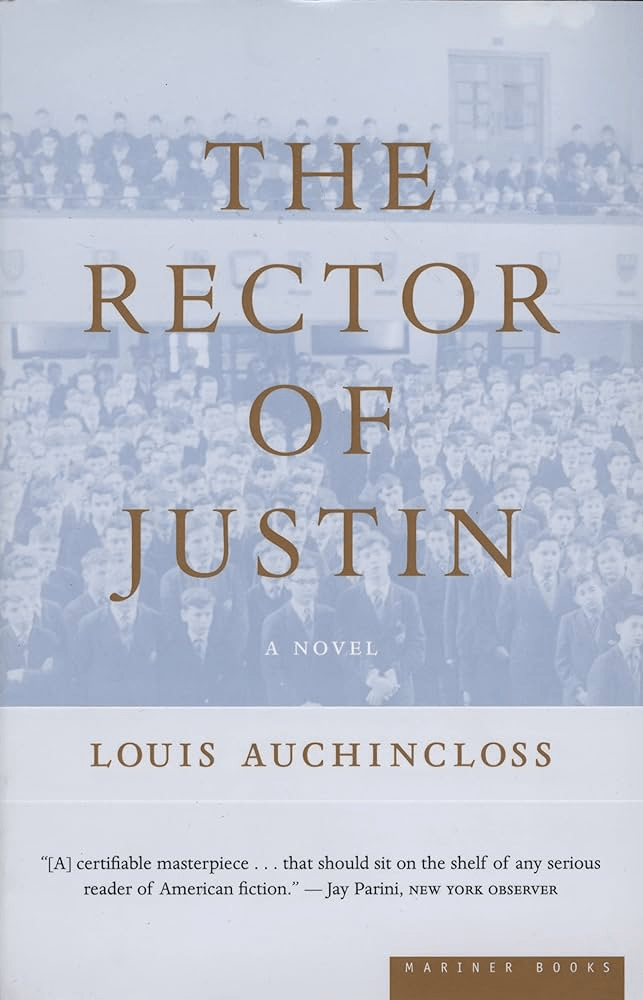
Brian Aspinwall becomes at age 27 a teacher at a prestigious private boys’ school in New England. He is recruited suddenly in 1939 to fill in for a master who has gone off to Canada to enlist in the RAF. It is primarily through Brian’s diary that we learn about the school Justin Martyr and its famous founder Reverend Francis Prescott. Immediately Aspinwall is awestruck by Prescott and comes to admire him and his accomplishments. He seeks to understand what makes Prescott and his world-class upper crust school tick, and The Rector of Justin takes off.

Aspinwall seems surprised to learn that Prescott is an intellectual and a progressive given the focus on sports, strict discipline, and religious tradition at the school. But many more surprises await. As the novel unspools we learn from other sources who come into Aspinwall’s orbit. Eventually Aspinwall is given files and documents by others and he takes on the task of possibly writing Prescott’s biography.

The book is breezy and warmly inviting, despite its substantial and ethically weighty themes. I found it an absolute pleasure. The characters are all interesting, and in particular the Rector himself. There are hints that Justin Martyr was founded out of some dark repressed desires. The WASP identity of the school proves problematic later on as Prescott has an epiphany about the kind of people running the board at his school, and the true values of the wealthy and influential class who send their kids to Justin Martyr. I could in fact trace many of the concerns Reverend Prescott has about his students and their morals down to the ethical catastrophe in current US politics.

Because the novel is from the 60s but set in the 30s and 40s we get groovy stuff intellectuals were into at the time, like Freud. The novel is saturated by Henry James but is not as dense and soupy as The Master’s.

I’d previously read only one other novel by Auchincloss–The Book Class. I remember quite liking that one but nothing about it has stuck with me after 3 decades. I do recall that both novels were given to me by Dan Bouchard in a box of remainders in perhaps ’94? I still have one more book by Auchincloss on the shelf–a collection of short fiction. I look forward to it.
Sula

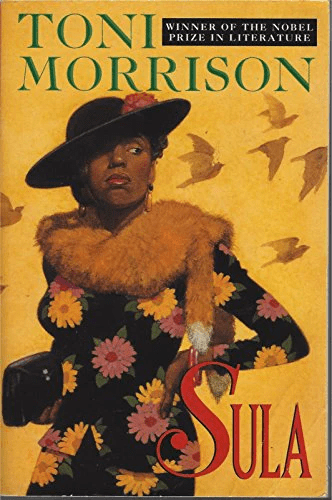
Sula is a magnificent read, a short novel but a richly realized world. We spend almost a century in Bottom, the Black neighborhood of Medallion, Ohio. Two families entwine in the narrative–one-legged Eva Peace serves as matriarch of one. She manages a thriving bungalow of sorts, a chaotic and haphazard structure akin to the Winchester House in complexity. There are family members, hangers-on, boarders, mountain people, addicts, crooks, working people and feral kids in the Peace home. Eva’s daughter Hannah raises her kids amidst the tumult. One of her kids is Sula.

The other family is Helene Wright’s–Helene was raised by her grandmother. Her mother was a prostitute in New Orleans and granny pulled her out of that drama and brought her up. Helene’s household is calm and organized and there is a sheen of middle class respectability. Her daughter Nel is raised in a tidy and peaceful environment and has adopted the virtues and social mores of the community.

Sula and Nel become best friends. Sula is adamant that she will never be bound in any way by the constraints of her community or its judgments and expectations. She will be free and her self will be unimpeded in its development and evolution by anyone or anything. Nel on the other hand is willing to tow the line and to do what’s right. They have a relationship where one is centripital and the other centrifugal, forces working together to flesh out a beautiful and adventurous childhood.

I recall a scene in Henry James’s The Turn of the Screw when well-mannered Flora is playing in the dirt and makes sexually suggestive gestures with sticks–shortly afterward the Governess has her first encounter with the apparition of Miss Jessel. There’s a similar scene in Sula where Sula and Nel are playing in the dirt and digging holes and burying things in the holes and the girls are frustrated and dis-satisfied in their game but manage somehow to conjure up a horrible event in an almost magical ritual. The reactions of each girl to this event have lasting impacts on the course of their lives.

Eventually Nel does what one is supposed to do in Bottom; she gets married and starts a family and focuses her energies on her children, her husband, and their home. On the day of Nel’s wedding Sula leaves town for ten years. When she returns she will be judged and scape-goated for the sins of her town and its inhabitants.

But what are morals and virtues if they simply hide hypocrisy? What are the consequences to true human freedom when small-town values are oppressive and retrograde? Sula, through her refusal to conform and to follow the niceties, becomes for Bottom an easy target for projection–she absorbs all the guilt and hostility and judgments of the town’s inhabitants. But is Nel really superior to Sula morally? What does genuine friendship entail? What are the costs of motherhood and are they compatible with true freedom? Is a life sacrificed for the benefit of others a worthy life? Bottom learns a lot about itself through Sula’s sad fate, and pays a heavy karmic debt.

Recent Reads

I’d read 100 Years of Solitude about 30 years ago and was absolutely flabbergasted by it. Immediately one of my life goals became “get your Spanish into adequate shape to read more Garcia Marquez but in the original language.” I managed to have some conversations with locals in Spanish on a couple trips to Colombia, but alas never got my skills up to reading novels.

So I caved in and read Love in the Time of Cholera in English. I was a bit concerned with the high bar set by the other novel that this would disappoint–quite the contrary. I think it’s superior. Where 100 Years is a bit of a “loose, baggy monster,” Cholera is fit and trim. The magical realism is dialed down substantially but not the magic of the description, characters, settings…such a dense and humid world to inhabit for too short a time. A rich, sweaty, mournfully sexy book. It truly captures the decayed glamor of old South American colonial cities and the rich mix of cultures and classes. Exquisite!

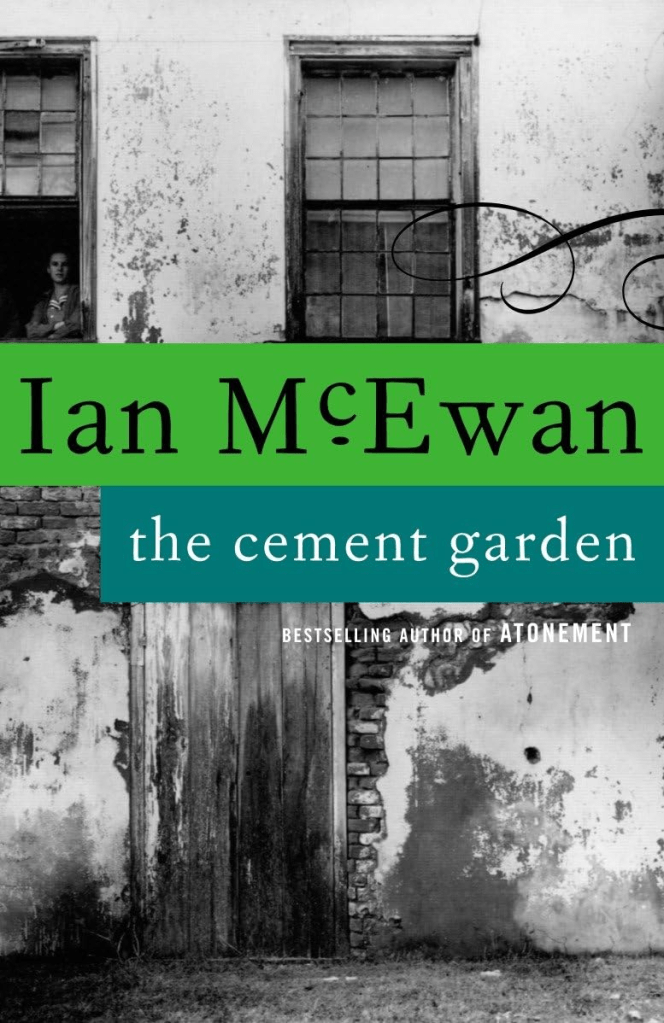
Aw, it’s nice to revisit those care free days of childhood–distant, aloof parents, perverse games, pointless wasted hours at school, the challenge of disposing of corpses…

Not sure how to categorize this one. A bit of Shirley Jackson’s We Have Always Lived in the Castle, a bit of Poe’s Fall of the House of Usher, a bit of 90s pornography.

Four siblings are left alone in a strange castle-like house in the midst of an abandoned urban tower block development when their parents die in quick succession. Instead of the lush natural setting of Eden (or the isle from Lord of the Flies) they inhabit an unnatural cement garden, where only stinging nettles force their way up through cracked concrete to bake in the sun. Without the internet or even TV there is not much to do except go feral.

McKewan can write, and this short gloomfest is arresting and disturbing in equal measure. It probably says something about me to admit that I found it somewhat humorous, the way Rober Coover’s story The Babysitter is humorous. Kids left to their own devices act like adults–and are equally fucked up.

I recently read an article in the NY Review of Books about Ford Madox Ford. Had previously only read The Good Soldier, which is astonishingly good. Thought I should perhaps tackle another of his, but didn’t feel quite up to Parade’s End, which has sat its fat self on my shelves since 1994 without being opened.

So I decided to search the author’s name and pick up whatever book the owlgorithms first suggested. Owltimately it was The Brown Owl, which proved an entertaining little owlegory. Though written for kids it has a sophistication and wit about it which owlevates the book above mere “young adult” fiction.

Read earlier this year an analysis of the Arthurian myths by Emma Jung and Marie Louise von Franz, followed in short order by H is for Hawk. H is for Hawk is a memoir of dealing with the death of a parent while training a hawk and reading T H White’s memoir about training a hawk. All of this brought me round to the realization that I’d never read White’s Once and Future King novels. So I started with The Sword in the Stone. Didn’t much like it. Merlin is too ridiculous, the story is too silly, everything is far too cute. I can see why Disney made a film out it, because it’s tailor made for them.

Despite not enjoying the first volume, I plowed ahead into volume 2 of The Once and Future King. Didn’t like this one even less. Guess I’m too old. I prefer dour, profound old Tolkien to this stuff.

Exit Music

John Rebus is close to retirement. In fact, only days away from turning in his warrant card. A dissident Russian poet is found bludgeoned to death and Rebus and his partner Siobhan Clarke are off to find the killer. As a result they explore the underworld of early 21st century global politics. Big banks are in collusion with Labor and Nationalist politicians and local gangsters to milk Russian oligarchs of their cash. Scotland is aching for independence and the oligarchs find it an attractive place to avoid possibly drinking radioactive tea or falling mysteriously from a high window onto a Moscow street.

Rebus wonders what counts as corruption and illegality when the entire economic and political system is shady. As he tries to unravel the case he ponders his own ethically questionable past doings and wonders if he’ll simply spend retirement in the pub gradually softening himself with malt.

Another murder complicates things. Rebus and Clarke are now no longer detectives in a local precinct police squad; they are George Smileys working in the shadows to uncover an international conspiracy.

Or perhaps not? Maybe there is less there there than appearances suggest. As they work the case Rebus begins the process of handing the reins over to Siobhan as much as possible. She is at once frustrated by his tactics and deeply saddened to be losing his wisdom and experience, but finds herself ready to take over the team.

I jumped into this 17-novel series at book 15 and only read that one and the final volume, but enjoyed them thoroughly. Good pop lit with a cracking plot and sufficient depth and complexity to keep me intrigued. The characters are not one-dimensional types but are fully fleshed out. And Mr. Rankin can indeed write a good sentence. If detective novels and police procedurals are your thing you might want to read these.

Everyman

I’ve been going back through the physical library and pulling down unread volumes lately. In the last six months four of those have been novels by Philip Roth.

Roth wrote Everyman shortly before killing off his alter-ego Nathan Zuckerman in Exit Ghost. I think Everyman is a superior novel and a more beautiful meditation on mortality and death than Exit Ghost.

The novel opens with the death of the main character, who remains unnamed throughout the story. We attend his funeral with some family and some former lovers, and then we are inside the mind of the dead man as he projects backward in time. I believe this is only the second novel I’ve read where the entire story is told from the point of view of a dead dude, the other being The Living End by the delightful Stanley Elkin.

The narrator worked in the ad biz but always wanted to be a painter. We see his triumphs and failures and his major regrets. We meet his children and his three wives and some of his lovers. We encounter his parents and siblings, and the theme which ties everything together is decay and death and their inevitability. Hence the title Everyman, because no one escapes death, and as a result the book is basically about all of us. Perhaps we get to buzz back through and revisit our time here after we go to our final rest? It’s a comforting thought.

There is a beautiful scene where the narrator visits his parents’ graves in a dilapidated cemetery in an unsafe part of New Jersey before going in for a surgery he does not survive. He meets the gravedigger and there is a beautiful moment between the two men, one whose living is digging holes for the dead, and one who is about to die. The scene’s got “Alas, poor Yorick” chops.

Roth was a substantial artist and a chronicler of the USA in the decades leading up to its decline into irrelevance and buffoonery. He confronted his end with dignity and continued to work until his final moments. I am grateful to have his novels as a roadmap to my own final decades.


Notre Dame du Nil

Back when I was young and energetic I spent a couple decades working a full-time job, a part-time job, and going to university full-time. At some point in this burst of insanity I was working in the Cook Library at Towson University, while teaching in the English Department, and still working at Borders Books & Music, while pursuing a degree in French Literature and also taking courses necessary to become a public school teacher. At that time I’d already earned a Bachelor’s Degree and a Master’s Degree–but it was never enough, LOL.

During that burst I took a really brilliant class with Dr. Lena Ampadu focused on literature in English coming out of post-colonial Africa, and also took a delicious class in French with Dr. Katia Sainson focused on postcolonial lit. So a couple decades later when an algorithm suggested Notre Dame du Nil on sale I purchased it while living in an oceanside apartment in a high-rise in Panama. I desperately wanted to improve my Spanish but also wanted to keep my French alive. Six years later I finally got around to reading it.

It was worth the wait. Ostensibly a memoir novel set in an all-girl’s school in Rwanda in the early 1970s, it is actually a densely layered critique of colonialism. Imagine Mean Girls if Franz Fanon dropped in as script advisor.

The French was not too difficult, and I needed to consult a dictionary only a few times each chapter. The characters are engaging and I found much of the novel quite interesting and at times hilarious. The girls at Notre Dame du Nil are all Rwandans who are being groomed for elite roles–they are daughters of wealthy merchant families, of diplomats, of government figures or military officers. Many come from small rural villages and of course “elite” grooming requires the learning of European languages, European traditions, European religion, European manners…The Europeans teaching in the school are hapless and ridiculous and deserve the mocking they receive. The Catholics in charge of the institution are just as bad. The school has as its setting one of the furthest away sources of the Nile river, hence the designation in the title. The bits about Rwandan culture, including a fascinating sequence when two students visit a rain-making shaman to purchase a love spell-were excellent. And the fishy Catholic priest in charge of the school who bestows nice garments on girls but only if they try them on in front of him? Classic.

One tangent of the plot involves a European man who lives on an old coffee plantation and has a bizarre theory that Tutsis are descended from Pharoahs–he abducts a student and then begins painting her and using her in a film he’s making. Another involves a visit to campus by the Queen of Belgium.

But the novel slowly simmers and builds a truly dark and disturbing undercurrent as the typical mean teen girl drama reveals roots deeply entwined in Hutu and Tutsi history, with absolutely catastrophic results. What at first seems like surly teen sniping eventually develops an undercurrent of tribal hatreds and it becomes clear that the parents of several students are encouraging the cataclysmic outcome. “It’s not lies, it’s politics,” says a ringleader who happens to be the daughter of the President of Rwanda. One student, who is half Tutsi and half Hutu, does her best to straddle two worlds and attempts to insinuate herself into the dominant group but redeems herself to a degree when the crisis comes.I shan’t say more to avoid spoilers.

La Place

I’ve not been pushing myself to read French lately, and it is absolutely vital that I continue to work on the language so that I sound less like an adolescent speaking when I interact with locals here in the Correze and particularly with business clients who arrive from cities like Toulouse, Bourdeaux, and Lyon. When Ernaux won the Nobel Prize in 2022 I picked up a couple of her books, one of which was La Place.

Surprisingly the French is quite clear and simple-stylistically I’d compare Ernaux’s writing to Hemingway, with crisp, short declarative sentences. Technically La Place is a novel, but it is also a memoir or autobiographical novel, and her style is very objective and is comparable to Joan Didion’s dispassionate journalism. I was pleased to only need a dictionary a couple dozen times throughout, and mostly for colloquial phrases.

The idea for the novel arose when Ernaux was processing the death of her father, and focuses on him and her family in a small town in Normandy through WW2 and into the 1970s. Her father was raised working on a farm with a quite limited education and his parents were not literate. Through his hard work and survival of the war to working in a factory and rising through the ranks and eventually buying and running a small cafe/epicerie with his wife we can see how the family pulled itself up from poverty to a comfortable middle-class existence. Ernaux’s descriptions of her family’s sensitivity to class and how they tried to hide their rural hick upbringing in front of clients by changing their speech and feigning a more sophisticated vernacular were quite touching. Reflecting on the difficulties her parents faced and her father’s challenges in particular was obviously difficult for Ernaux but she never wavers from her stylistic choices to keep her emotions out of the prose. Sometimes what she describes or recounts make her involvement and her feelings evident, however–there are photographs she finds and events she narrates which are dense with the weight of emotional memory.

Ernaux’s father is never called by his name, only by “him” or “he.” He is adamant that Ernaux continue her education but at the same time he can’t resist pointing out that her life in books is not the real life he lives with his hands in the dirt of the garden or in the till of his business. He is however enormously proud of her accomplishments when she becomes a professor and moves away to start a family of her own. Ernaux winning the Nobel Prize is even more remarkable given the family history recounted here. I look forward to reading more of her work.

Redburn, His First Voyage

Melville first entered my consciousness the way much of history and culture did when I was a wee tot–via cartoons. I think my first encounter was a Tom and Jerry cartoon featuring Moby Dick but renamed Dicky Moe? And of course I likely encountered the film version directed by John Huston in a butchered and pan-and-scanned version on television.

I did not read Melville until much later. I recall in 8th or 9th grade English class that there were twin girls whose grandparents owned a sailboat, and that after a summer floating around the Chesapeake Bay the girls returned, one having read Omoo and the other Typee while sailing. They dutifully presented book reports to the class with accompanying illustrations. I remember one of the twins declaring in her report that Melville was mostly known during his lifetime for writing adventure novels, but that later he morphed into a creator of SERIOUS LITERATURE.

As an undergrad at Loyola College in Baltimore I was assigned Billy Budd, Sailor and I thoroughly enjoyed it. We had a most excellent discussion of its merits and its Biblical allusions in class, but also a rowdy debate about the ethics of military justice and Billy Budd’s sad fate. Then in grad school I was assigned Bartleby, the Scrivener. I was confounded by that tale, and saw immediately the SERIOUS LITERATURE of which Melville was capable. I reread Billy Budd and Bartleby several times and eventually taught both stories to Freshmen and Juniors in different courses at Towson University.

Then, I resolved despite having heard that it was a brutal slog, to read Moby-Dick, or The Whale. Contrary to rumor the novel proved endlessly entertaining and quite breezy despite its psychological depth and dense symbolism. I in fact had recently resolved to re-read it when I noticed Redburn, His First Voyage on the shelf and took it down on a whim. After a cursory skim of the first page I found myself fully engaged and could not put it down.

Redburn is a poor chap from a once wealthy and influential family. His father was a businessman engaged in international trade before the family went bankrupt, and young Redburn’s imagination was fired by journals and books about his father’s travels. As a result, he signed up as a novice sailor on a boat headed for Liverpool, and we accompany the young naif on his journey “there and back again.”

The cast of characters is large and each is ably portrayed with wit and charm. Redburn’s experiences are vividly and expertly recounted by Melville who of course was himself a similar young chap setting out on the sea at one point. I thought the book as good as anything by Dickens, in particular the scenes of squalor in Liverpool which brought to mind many pathetic and pitiable characters in the works of Charles D.

If you are considering testing the waters of Melville, but you are perhaps not ready for the full-on engagement of Moby-Dick, Redburn might be the place to start your voyage.

The Buried Giant

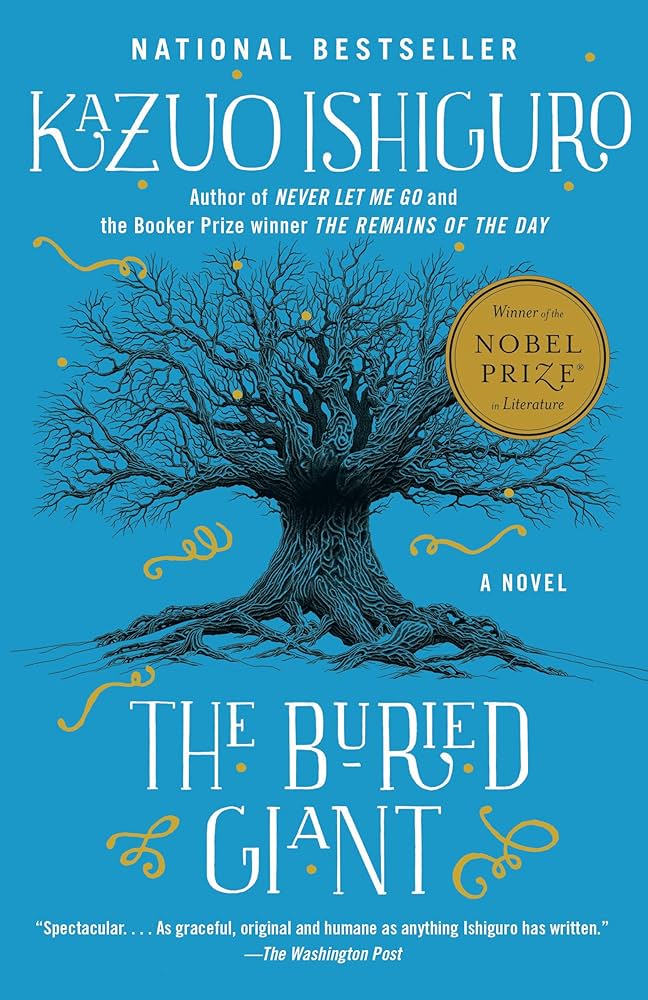
Somewhere in the books of Colin Wilson I recall him mentioning the phenomenon of “library faeries.” These creatures mysteriously put books into your path at just the right moment. As I was reading Emma Jung’s analysis of the Arthurian legends I stumbled upon Ishiguro’s The Buried Giant. I won’t really explain why or how as doing so might destroy the reader’s discovery, but this small novel inhabits and extends somewhat the Arthurian universe.

I’d read and loved three previous novels by Ishiguro, most recently Klara and the Sun, which hammered me with its profoundly sad portrait of an exploited lab-created being. Easily the best novel of its kind since the original masterpiece by Mary Shelley!

Here Ishiguro tries his hand at fable and fantasy. We meet an elderly couple named Axl and Beatrice, who live in a warren community and suffer a hardscrabble existence. They decide to make a journey to a nearby village to visit their son. On their journey they realize that something is mysteriously preventing clear memories of their past–and they realize this problem is universal. Britons and Saxons live together in an unstable harmony following the Battle of Badon and its associated slaughters. The couple encounter a Saxon knight named Wistan and a young boy who has been bit by an ogre and outcast from his home village. This band of adventurers sets upon on a quest, but each has an individual agenda which is hidden in the misty haze which drapes the land in a spell of forgetfulness.

Like in his previous novel The Remains of the Day, Ishiguro explores here how revisiting the past has consequences. Axl and Beatrice have been happy together despite their harsh life. The Saxons and Britons have coexisted in peace. Their quest may disrupt what cloaks the memories of all, with dire consequences. As glimpses of what lies buried emerge, Axl and Beatrice begin to worry: Should the past remain forgotten, or must it be rediscovered and dealt with?

The Boatman warns them, to no avail.

I loved this little allegory a great deal, and continue to admire how Ishiguro writes such ostensibly clear and simple novels which have layers and layers of elaborate meaning. Check it out!

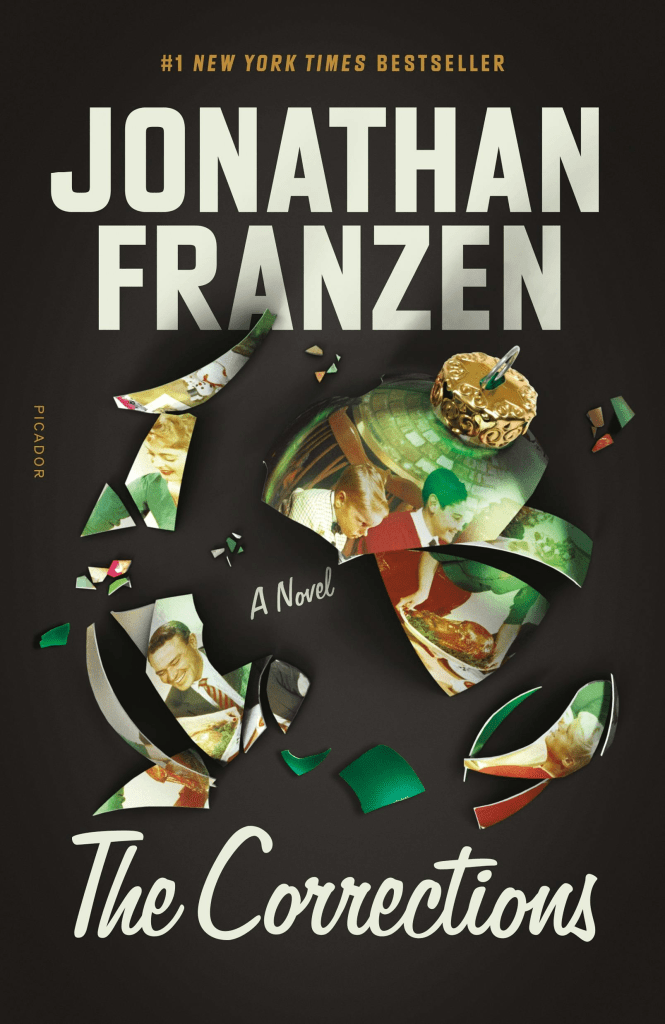
The Corrections

Here’s another novel from the recent NY Times List of “Greatest Books of the 21st Century.” It’s almost 600 pages long, and, given how weighty and dense and serious it is as a work of fiction I was surprised to find the writing quite breezy. I laughed heartily several times and regretted my decision 20-odd years ago to classify Jonathan Franzen as merely one of a crop of young writers at the time whose voices and themes and styles all seemed indistinguishable to me: Safran-Foer, Lethem, Chabon, Schteyngart, etc. I thoroughly enjoyed The Corrections.

I must however admit that the family at the center of the novel is deeply troubling. Most of the characters are eminently likeable and relatable–I found much in the family interactions which was all-too-familiar from my own experiences. And yet every character does hateful, despicable, awful things. Again, pretty typical of my experience not only of my own family but also of others I know well. This is where the sophistication of the book lies: documenting a time period in US/world history via the lives of a single midwestern family teetering on the brink of total and utter disarray and giving us a full picture of why across three generations. Franzen’s book shows us lovable people who we want to care for despite how truly terribly they behave–and given where American society has gone since its publication there is a bit of prescience in his vision. The entire nation these days feels like a dysfunctional family full of badly behaving people who are at heart decent and reasonable but whose unpredictable, selfish, and greedy behavior makes them despicable.

This morning I read an essay by Wallace Shawn in the NY Review of Books. The essay, called The End of a Village, will serve as the introduction to a newly re-issued book about the Vietnam War. Shawn was a college pal of the author Jonathan Schell, and manages to paint an evocative portrait of his friend and what he hoped to achieve through reporting on The Village of Ben Suc. Schell observed the complete and utter destruction of a peasant village by US forces, and tried to portray both the victims of this assault and the perpetrators with as much objectivity as he could muster. Having just finished The Corrections, I was struck when Shawn wrote this about Schell: “He generally seemed to like the military men he encountered. It’s just that what they were doing was appalling.”

This of course leads us to Hannah Arendt in The New Yorker 50-some years ago and her “banality of evil” (Wallace Shawn’s dad was managing editor of The New Yorker at the time). Shawn makes the connection, stating “If one accepts the idea that the ugliest of crimes can by perpetrated by people who aren’t ugly criminals, then the possibility seems to arise that even reasonably nice people might be at times involved in evil.”

The characters in The Corrections do horrible things as their family dangles by a frayed thread over the abyss of the 21st century. But at different parts of the novel, told from their different perspectives, I found myself rooting for each of them and caring deeply about their situations despite the decisions they made. And if individuals can do horrible things despite being “good” people, then so of course can societies and nations.

So we all make poor decisions and we all allow questionable motivations to drive us now and again. But how do we fix things after? When we go catastrophically awry and cause catastrophe, what is the means of repair? The word corrections has a lush ambiguity because the word has so many applications. A teacher corrects her student’s work. Parents correct their children (well, ideally). Some behavior is considered correct, and society drills us in the niceties of acceptable interactions. A captain who discovers her ship is off course will make corrections, a market which is overheated will face an inevitable correction. All of these senses of the word have a similar basis but different nuances. Every generation goes through a reaction to what was considered correct by the previous, now aging members of a family or civilization. So what is correct can be in flux, and those doing the correcting can be wrong or misled or mal-informed. When everything is called into question, when religion, government, the media, when public institutions previously held in high regard, when family itself all face skeptical and factual analysis and are thereby doubted and eventually shorn of their importance, and when much of the traditional underpinnings of a society and its very history are demonstrated as false and hypocritical, what is left? Where can we turn for guidance and support? How do we rebuild? I guess we’ll find out together.