
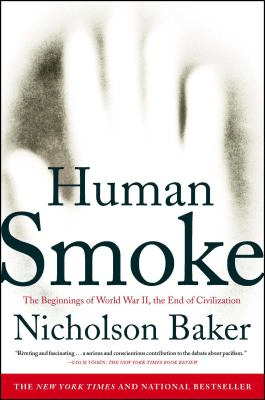
Human Smoke is by the novelist Nicholson Baker, who has written some very touching and outrageously silly books which I’ve enjoyed tremendously. But Human Smoke is not a novel, it’s a sort of experiment in collage, cobbling together diary entries, letters, news reports, and speeches from dozens of sources leading up to and during World War II and the Holocaust. Unlike his novels this work is not touching or silly. It is deeply troubling.
I’m familiar with only two comparable works. One is Baker’s other non-fiction experminet, called Baseless, which focused on the Korean War. In that book Baker investigated the possibility that the US had covertly employed biological weapons against civilians and soldiers during the conflict, and kept a sort of personal journal of his process, his reactions to government secrecy, what it was still possible to find out, and what was likely down the memory hole. Another work similar to Human Smoke is Charles Reznikoff’s Holocaust, a work of poetry created through the artful rearrangement of fragments from witness testimony at the trials of Nazis. I used Reznikoff’s text when I taught Hitler’s rise to power and the Holocaust to public school students.
I’ve read a few dozen books about the second World War, and about Nazi Germany, and about Hitler and the Nazis, about Churchill and FDR, and probably also a few hundred articles along the way. On top of that are the countless documentaries, television shows, news reports, literary works, memoirs, and feature films, etc. Human Smoke is troubling because I learned new things which made me uncomfortable. I had to question my own assumptions that I had the narrative straight, that I knew that story pretty deeply for an amateur who was not a trained historian and yet who had the heavy responsibility to teach it to young people and guide them as they explored the topic. Of course I like when I have to challenge my assumptions–that’s the entire point of the reading life.
I’d long questioned and critiqued what I was taught in high school about US involvement in the war. I was taught that the US intervened to stop the Holocaust and save Jews, and that the US military won the war. Previously I’d known that this was not true and was largely propaganda instead of history. The Soviets defeated the Nazis in Europe, with help from the US. 4 out of 5 Nazis killed by the Allies were killed by the Soviets, and overwhelmingly the Soviets did the heavy lifting and endured the heaviest losses. The US of course did the hard work in Africa and in Italy, and paid a huge cost in Normandy. They did all the ghastly work in the Pacific as well. I don’t minimize the losses or the sacrifice of the United States in the war. But we were outright lied to about why the US intervened when I was a teenager. We were also misinformed about the USSR and its role.
Human Smoke reveals things about Roosevelt and Churchill and their schemes and their tactics which are extremely distasteful. Some of them I knew before, others were grotesque revelations. At a time when heroes are needed badly in the West, you won’t find them here. Again we are confronted with the problem long presented in the western democracies–there are no good guys in power, only somewhat less bad guys. The pacifists are the only worthy ones in this book.

 Mysterium Coniunctionis