I first encountered Tony Judt’s writing in the NYRB back in the early 00s. He caused a stir with an article fiercely critical of Israel as a Jewish ethnostate and called for a single-state solution with equal rights for Jewish and Arab inhabitants. For a decade plus I read him regularly in the NYRB and in a few other outlets. Along with fellow historians Timothy Snyder and Timothy Garton Ash I came to appreciate Judt’s appraisals of events from the USA to Europe and the Middle East. He was diagnosed with ALS but continued writing for a while, and published several memoir essays before his passing.
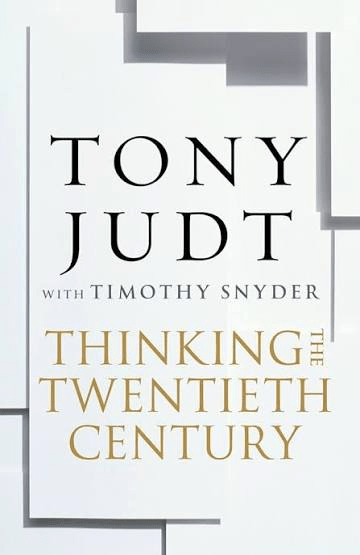
Timothy Snyder is one of the sharpest critics of what is happening now in the USA, as that nation is stripped of parts and looted by a cabal of immoral tech tychoons, petroleum overlords, big pharma pushers, agrobiz schemers, war profiteers, and barely literate pedophilic opportunist/real estate conmen/human trafficking specialists. This series of conversations was quite enlightening and entertaining. I had planned to read Judt’s Postwar first, but chose Thinking the Twentieth Century instead–perhaps I wanted to get a sense of Judt’s methodology and concerns before reading his magnum opus?
My fave bits of the book involve Judt demonstrating his intellectual and ethical evolutions over an academic lifetime devoted to history and its analysis. He grew up in a firmly Marxist family with Marxist sympathies but eventually came to disavow communism. He developed an enthusiasm for Zionism at one point (in part because of time spent on a socialist kibbutz) and spent two years in the IDF, serving in the occupied Golan Heights. But the Zionist enterprise became distasteful to him as the moral rot at its core (colonialism, ethnic cleansing, and increasing apartheid violence) became increasingly apparent and insupportable. His historical interests moved from a focus on France to Europe more generally and then to Eastern Europe in particular as that part of the world became open to western academics and scholars. It is in part his gift as a historian to write history about events and movements in which he was an active participant. This is key to understanding the 20th century.
Along the way there are delicious bits of memoir, as two rather important figures of the last two decades discuss the role of history and historians, and how history should be taught and to what purposes. Judt also was highly concerned with “hyphenated history” focused primarily on specific historically marginalized groups, and thought that this teaching and focus should come AFTER a serious grounding in some sort of narrative history. Students in his view should all be taught the same or similar history and then given means of digging deep into critiques of that history.
Judt discusses at several points the concerning rise of the far right in Europe but thought the US was impervious to this because of the strength of its institutions, its enormous size and incredible diversity. LOL. Only a few years after his death that all proved untrue. There are some surprising bits at the end of the Afterward about the “victory of liberalism” despite the darkness and violence of the previous century. A decade after Judt and Snyder’s appraisals of the 20th century parts of it seem as silly as Fukuyama’s The End of History (though Judt does posit that the two decades after the fall of the Soviet Untion were wasted and ruined by Clinton and particularly by Bush 2).
As this book shows, history and its underpinnings are complex. Predicting the future using the past and present is a fool’s errand. A few things are got wrong in retrospect but the book is quite valuable and belongs on the bookshelf of anyone interested in history or the humanities.