
I’d thought as a long-time fan of horror that I was at least aware of all the classics of the genre. Until a few months ago I’d never heard of Thomas Tryon’s The Other, and what I read about it intrigued me sufficiently that when I was able to score a digital version for under 2 bucks I jumped at the chance. The novel was quite an unpleasant surprise.
There’s something particularly disturbing about a child who is pure evil. And when it’s a twin the creepiness is dialed up a few notches.
Niles and Holland Perry lead a bucolic life on a rural estate in New England. They play together and put on dramatic shows and do magic tricks. There’s something off about Holland however; he is more than mischievous, and his behavior descends from adolescent rabble-rousing to cruel and reprehensible acts. Their grandmother Ada is a Russian immigrant who fled the Bolsheviks. She tells them folk tales and bits of family lore from the old country–and introduces them to The Game, which is a sort of hypnotic regression wherein the observer becomes entangled mystically with the observed. Needless to say, The Game comes to have dire consequences for the boys.
Tryon has skills. He writes elegant and sophisticated prose. I’d place him based on this one novel right up with Shirley Jackson and M. R. James as a writer of literary merit beyond genre category. The structure of the novel has a few layers of narrative, and it took a bit of sussing out to realize the clever and unreliable games Tryon was playing. Very Turn of the Screw trickiness afoot here.
But despite its merits as a work of literature, this is still a horror novel, and it delivers the goods. I didn’t see The Twist until it came, which was a great surprise, and I was floored by the utterly appalling climax.
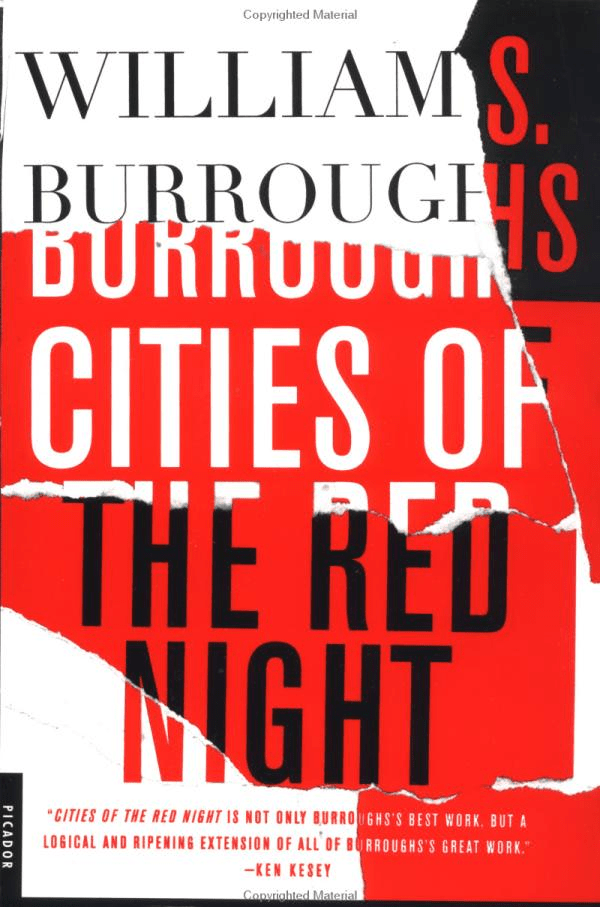
I’ve read a handful of Burroughs novels and also Casey Rae’s entertaining and informative William S. Burroughs and the Cult of Rock ‘n Roll. I think this is easily my favorite novel by the Beat icon. It is ridiculous, absurd, wholly pointless, unrepentently filthy, and a great deal of fun.
In Casey Rae’s examination of Burroughs I learned about his “cut-up” method of creation, splicing and collaging multiple texts and ideas together from disparate sources to forge something new. Cities of the Red Night samples deep cuts from across the 20th century: we get Crowley sex magic, pulp noir and sci-fi and horror, Mexican archaeology, chasms of time and ancient gods and civilizations borrowed from H.P. Lovecraft, political chicanary and revolutionary rhetoric, lots of guns and cannons and far-out weaponry, drugs, viruses, and oodles of hot gay sex featuring an asphyxiation fetish.
What is the novel about? Well, there is a doctor fighting a viral outbreak, and then a private dick investigating the disappearance of a young lad whose head ends up in a crate bound for Peru, a pirate revolution in Colombia and Panama, a war between humans and mutants in ancient vanished cities, conspiring conspirators doing conspiracies…it’s about so much it’s practically about nothing. Some of the characters shift from modern era New York to thousands of years ago and then to the jungles of 18th century South America before suddenly getting onto a starship in the distant future. At one point a main character wakes up in a rehab clinic and it appears the entire novel was a hallucination; but it might actually be that he could access actual reality in his comatose state and he’s only waking up into the shared illusion we call reality.
I mean it doesn’t matter what it means or if it means anything at all. Enjoy the ride!
I will note that I’ve likely read a couple thousand novels, and that this one has more ejaculations than all of the other novels I’ve read combined. And that includes a couple long books by the Marquis de Sade, so it’s an impressive number of money shots. So the novel could perhaps be classed as a sort of cartoonish pornography. Keep that in mind if you choose to read it.
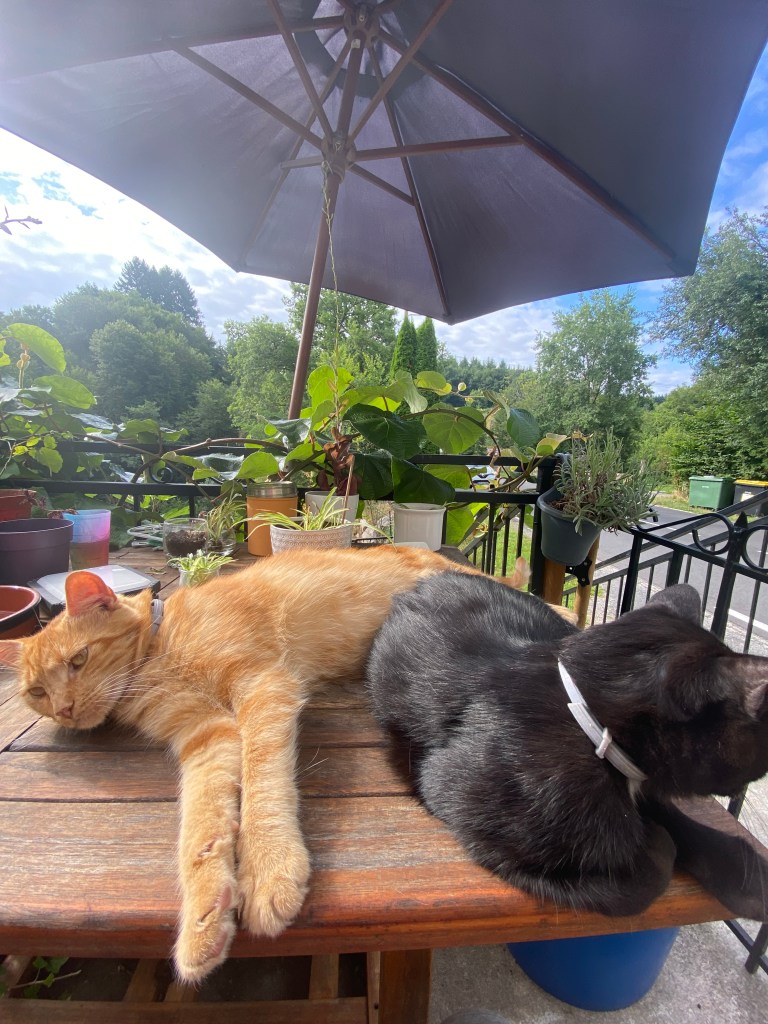
Woke a bit before 6 am this morning. Drank coffee outside on the porch and read an essay in Harper’s by Lydia Davis. She’s an author I’ve encountered many times in journals and magazines, and I’m pretty sure I have a story collection or two of hers somewhere? At any rate she’s writing about observation and the compulsion to write about her observations. She’s got a singular style and voice in her fiction and non-fiction, and does a lot of translation from the French–in fact I’m sure I read an essay by her about French translation at some point. I’m distracted while reading and observing our two cats who are climbing on me one minute, then chasing lizards the next. Lydia Davis is observing cows in her essay, and while I’m reading I hear a horrible guttural stegasaurus groan which I can assume is one of our goats even though it’s a new sound. The male has climbed along a narrow ledge atop a wall which has a metal chain-link fence built into it, at the top of which is a kiwi vine. While standing stretched out full length on his hind hooves to nibble kiwi leaves his hooves slipped off the wall. I rush over to find him being strangled by the kiwi vines with his horns stuck in the fence. I free his horns as he re-positions his hooves on the wall and immediately he is contentedly munching kiwi leaves again as if nothing happened.
At about 8 am guests who’ve rented one of our gite appartements–The Studio–check out. They are two cyclists off to their next destination after a one-night stay in Treignac. I pause my reading to strip down the bed and turnover the apartment for the next guests. Just as I finish hanging the clean sheets and towels from the washer our next guests arrive. They’ve rented The Loft gite for a daytime sleep-over as they are driveing some horrid 24-hour route. They check in at 8:05 and are planning to leave at 5pm. I wonder if they are actually going to sleep or if they are going to fuck. It’s our first overday stay as opposed to overnight stay. And, to complictate things we have a check-in in the same apartment 45 minutes after they are planning to leave. Things will be tight. We are used to it, however, as business has been brisk this year since January.
After checking in the new guests I hear the guttural scream again, and the male goat is once more dangling in the air with his throat tangled in kiwi vines. I free him once more.
I sit again and finish the Lydia Davis piece and then polish off the rest of the magazine. I realize I rarely write about day-to-day stuff anymore the way I used to on a previous and much more successful blog. Has my Muse deserted me? Have I lost interest? On the desk in my office is a pile of language books I put out back in February–I was adamant that I was going to do a daily study/writing routine and that immediately fell apart. Perhaps I’ll get it back together in the fall after tourist season quiets down.
Sula is a magnificent read, a short novel but a richly realized world. We spend almost a century in Bottom, the Black neighborhood of Medallion, Ohio. Two families entwine in the narrative–one-legged Eva Peace serves as matriarch of one. She manages a thriving bungalow of sorts, a chaotic and haphazard structure akin to the Winchester House in complexity. There are family members, hangers-on, boarders, mountain people, addicts, crooks, working people and feral kids in the Peace home. Eva’s daughter Hannah raises her kids amidst the tumult. One of her kids is Sula.
The other family is Helene Wright’s–Helene was raised by her grandmother. Her mother was a prostitute in New Orleans and granny pulled her out of that drama and brought her up. Helene’s household is calm and organized and there is a sheen of middle class respectability. Her daughter Nel is raised in a tidy and peaceful environment and has adopted the virtues and social mores of the community.
Sula and Nel become best friends. Sula is adamant that she will never be bound in any way by the constraints of her community or its judgments and expectations. She will be free and her self will be unimpeded in its development and evolution by anyone or anything. Nel on the other hand is willing to tow the line and to do what’s right. They have a relationship where one is centripital and the other centrifugal, forces working together to flesh out a beautiful and adventurous childhood.
I recall a scene in Henry James’s The Turn of the Screw when well-mannered Flora is playing in the dirt and makes sexually suggestive gestures with sticks–shortly afterward the Governess has her first encounter with the apparition of Miss Jessel. There’s a similar scene in Sula where Sula and Nel are playing in the dirt and digging holes and burying things in the holes and the girls are frustrated and dis-satisfied in their game but manage somehow to conjure up a horrible event in an almost magical ritual. The reactions of each girl to this event have lasting impacts on the course of their lives.
Eventually Nel does what one is supposed to do in Bottom; she gets married and starts a family and focuses her energies on her children, her husband, and their home. On the day of Nel’s wedding Sula leaves town for ten years. When she returns she will be judged and scape-goated for the sins of her town and its inhabitants.
But what are morals and virtues if they simply hide hypocrisy? What are the consequences to true human freedom when small-town values are oppressive and retrograde? Sula, through her refusal to conform and to follow the niceties, becomes for Bottom an easy target for projection–she absorbs all the guilt and hostility and judgments of the town’s inhabitants. But is Nel really superior to Sula morally? What does genuine friendship entail? What are the costs of motherhood and are they compatible with true freedom? Is a life sacrificed for the benefit of others a worthy life? Bottom learns a lot about itself through Sula’s sad fate, and pays a heavy karmic debt.
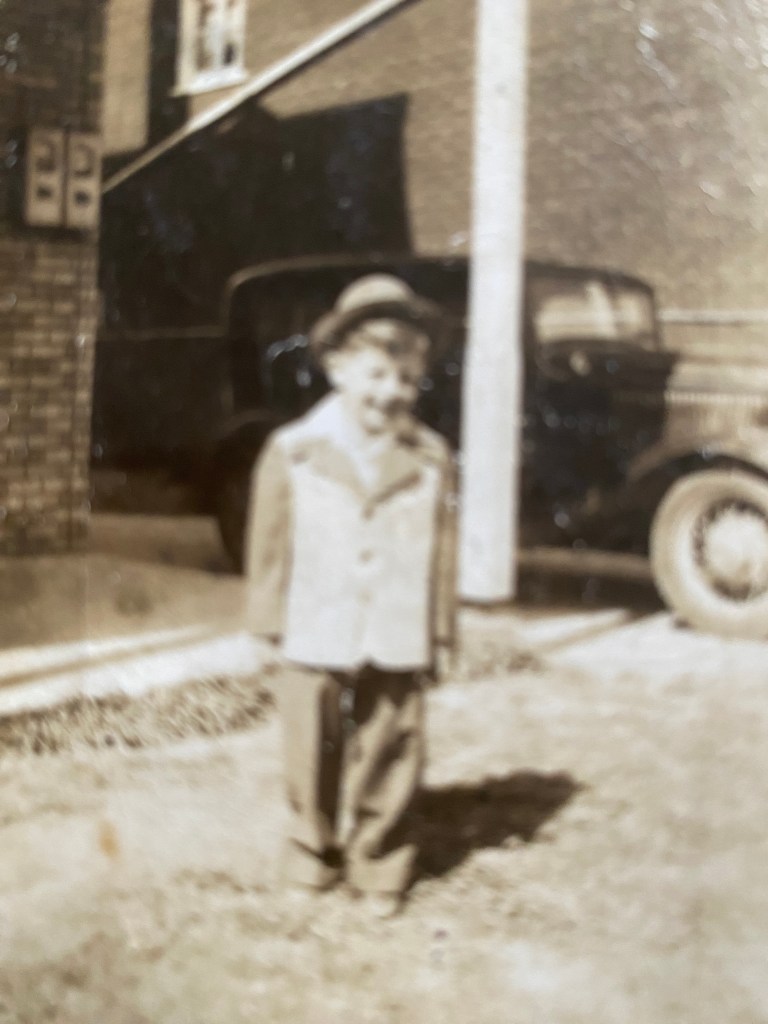
The reverse of this tiny sepia-toned photograph reads “Paul Godfrey Easter 1949 Stewartstown, PA.” It was originally written in pencil but was later partially fleshed out in ink. The handwriting I immediately recognize as that of Mary Godfrey, my paternal grandmother. I’ve no recollection of how I came into possession of this photograph, but after moving to France it fell out of a book as I was unboxing and shelving stuff we’d had shipped from the USA. It’s possible Paul himself sent it. He used to mail me strange messages including Garfield or Far Side clippings from the newspaper and hand-scrawled notes on old receipts. Once he sent me a Polaroid of a woman he was then involved with–she was nude and far younger than he. He’d scrawled “daily vitamin pill” on the photo. I don’t know the name of the young woman but I heard later that she took Paul’s ATM card and emptied his bank account. A bit later Paul became unhoused.
On June 1st at 8:45 pm Paul Godfrey died in hospice care in Gettysburg PA, the town where I was born in 1969. He’d had a stroke a few weeks earlier which left him a bit weak on the left side. He was institutionalized to undergo rehab but refused to participate, refused food and water, and went into a rapid decline. Eventually staff gave up trying to engage him and instead medicated him against the pain of starvation. He was 80.
Paul Benjamin Godfrey was my biological father. Your inclination might be to offer sympathy in this circumstance; that’s kind and considerate but wholly unnecessary. We weren’t close, and were in fact estranged from one another for decades. I think we spoke a half-dozen times in 35 years. My younger sister heroically assisted him his last few years and had visited him in hospice without getting much response. I, on the other hand, had almost entirely excised him from my life quite some time ago. Due to the staid dictum don’t speak ill of the dead, I’ll refrain from cataloging the reasons here. I’ll simply state that my mother gathered our belongings into a few trash bags and left his house after calling the police one night in the 1970s, my sister and I in tow. She wanted the police there as she fled in case Paul showed up. He worked night shift and we escaped to shelter in a good samaritan’s house for a couple weeks before moving into the home of my maternal grandparents. Later, there was a brief attempt at reconciliation which failed and divorce procedings were engaged. I was 7 years old, my sister 5.
My sister asked if I’d write an obituary. I could barely come up with 500 words. It says something that a man of 56 years could know so little about his father’s life that minimal details were tough to scrape together into a brief narrative. But such was our relationship, or lack of.
There will come a time when I have more to write about Paul Godfrey. For now, however I’ll remain silent and allow that photo from 1949 to be my memory of him. It was taken 20 years before my birth, and it’s a very cute and charming photo of a presumably loveable little chap. May the conditions and torments which caused that young child to become the man I knew be laid to rest.
It’s been two years since Martin Amis died at age 73, so I figured it was about time I read something of his. He was, after all, one of those writers I was supposed to read back in the ’80s and ’90s, as the conventional wisdom droned on about him capturing the zeitgeist of that time. Somehow I just never got around to reading his novels, though I did see the film version of The Zone of Interest last year.
I had on my shelves The Information, l which I’d received in 1995 when I was running the Literature section of the long-defunct Borders Books & Music just north of Baltimore City. It was a signed first US edition, distributed to promote the work and encourage those of us hand-selling novels to read it and recommend it, and apparently I can get about $50 for it on Abebooks. When we had Christopher Hitchens for an in-store event and discussion of The Missionary Position, I should have asked Hitch about this novel and whether it was worth holding onto and eventually reading. Hitch, like Amis, smoked himself to death, and Martin did his eulogy.
The Information is a seething spite-filled cess pit of self-loathing. The main character Richard Tull is a thinly disguised caricature of Amis himself, and is a most unpleasant bloke to be around for 500 pages. Tull is a pretentious novelist and writes unreadable overly complex books no one cares to understand which pile up unpublished in his study. Meanwhile his best friend Gwyn Barry writes noxious and silly tripe which becomes globally successful and makes him a mint and a celebrity. While Richard is a complete failure who drinks and smokes himself to annhilation, Gwyn is continuously interviewed and photographed and consulted about his opinions. Because Richard regards himself as superior intellectually and artistically to his far more successful friend, he decides to get revenge on Gwyn through a series of demented schemes involving shady underworld stereotypes. All of the schemes however fail and end up bouncing back on their initiator.
All of the characters in this novel are hateful and despicable. Women mostly exist in the book to serve the needs of men and don’t have much depth. The plot is a complete farce and this writer whose works so tapped into the zeitgeist of his time seems now to be as dated as his father Kingsley.
But the prose is gorgeous, scintillatingly so. There are passages of the most delicious and sparkling disdain gloriously served up with malevolent humor. This entire novel encapsulates what it’s like to be an upper-crust twit who feels superior to everyone. It lags in parts and in others is uproariously hilarious and brilliant. As a failure, it’s a rather good one. I might be inclined 20 years from now to pick up another of his books.
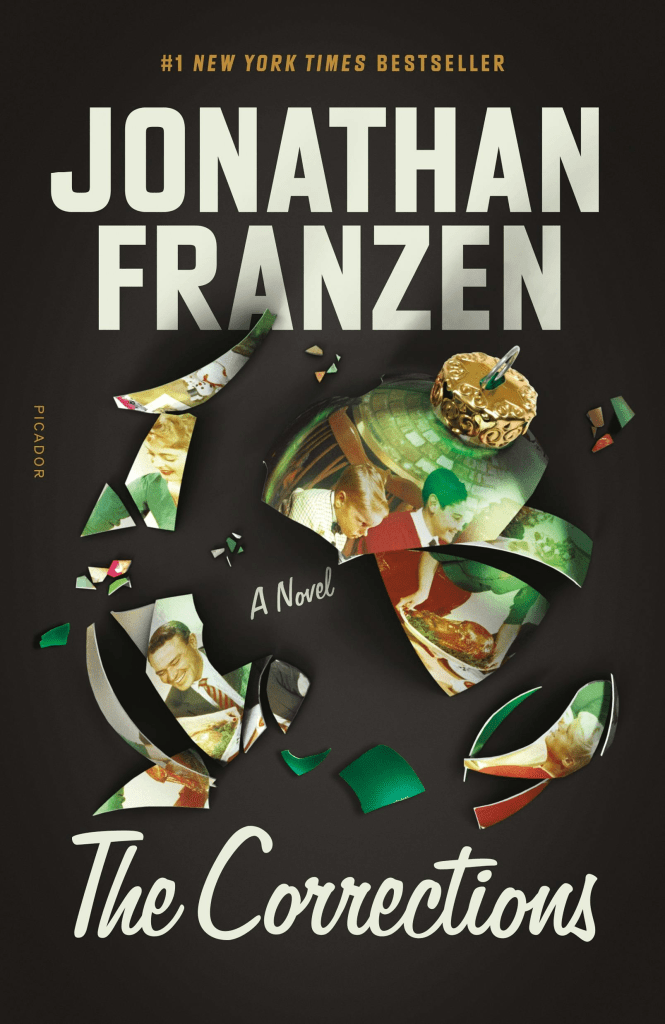
Here’s another novel from the recent NY Times List of “Greatest Books of the 21st Century.” It’s almost 600 pages long, and, given how weighty and dense and serious it is as a work of fiction I was surprised to find the writing quite breezy. I laughed heartily several times and regretted my decision 20-odd years ago to classify Jonathan Franzen as merely one of a crop of young writers at the time whose voices and themes and styles all seemed indistinguishable to me: Safran-Foer, Lethem, Chabon, Schteyngart, etc. I thoroughly enjoyed The Corrections.
I must however admit that the family at the center of the novel is deeply troubling. Most of the characters are eminently likeable and relatable–I found much in the family interactions which was all-too-familiar from my own experiences. And yet every character does hateful, despicable, awful things. Again, pretty typical of my experience not only of my own family but also of others I know well. This is where the sophistication of the book lies: documenting a time period in US/world history via the lives of a single midwestern family teetering on the brink of total and utter disarray and giving us a full picture of why across three generations. Franzen’s book shows us lovable people who we want to care for despite how truly terribly they behave–and given where American society has gone since its publication there is a bit of prescience in his vision. The entire nation these days feels like a dysfunctional family full of badly behaving people who are at heart decent and reasonable but whose unpredictable, selfish, and greedy behavior makes them despicable.
This morning I read an essay by Wallace Shawn in the NY Review of Books. The essay, called The End of a Village, will serve as the introduction to a newly re-issued book about the Vietnam War. Shawn was a college pal of the author Jonathan Schell, and manages to paint an evocative portrait of his friend and what he hoped to achieve through reporting on The Village of Ben Suc. Schell observed the complete and utter destruction of a peasant village by US forces, and tried to portray both the victims of this assault and the perpetrators with as much objectivity as he could muster. Having just finished The Corrections, I was struck when Shawn wrote this about Schell: “He generally seemed to like the military men he encountered. It’s just that what they were doing was appalling.”
This of course leads us to Hannah Arendt in The New Yorker 50-some years ago and her “banality of evil” (Wallace Shawn’s dad was managing editor of The New Yorker at the time). Shawn makes the connection, stating “If one accepts the idea that the ugliest of crimes can by perpetrated by people who aren’t ugly criminals, then the possibility seems to arise that even reasonably nice people might be at times involved in evil.”
The characters in The Corrections do horrible things as their family dangles by a frayed thread over the abyss of the 21st century. But at different parts of the novel, told from their different perspectives, I found myself rooting for each of them and caring deeply about their situations despite the decisions they made. And if individuals can do horrible things despite being “good” people, then so of course can societies and nations.
So we all make poor decisions and we all allow questionable motivations to drive us now and again. But how do we fix things after? When we go catastrophically awry and cause catastrophe, what is the means of repair? The word corrections has a lush ambiguity because the word has so many applications. A teacher corrects her student’s work. Parents correct their children (well, ideally). Some behavior is considered correct, and society drills us in the niceties of acceptable interactions. A captain who discovers her ship is off course will make corrections, a market which is overheated will face an inevitable correction. All of these senses of the word have a similar basis but different nuances. Every generation goes through a reaction to what was considered correct by the previous, now aging members of a family or civilization. So what is correct can be in flux, and those doing the correcting can be wrong or misled or mal-informed. When everything is called into question, when religion, government, the media, when public institutions previously held in high regard, when family itself all face skeptical and factual analysis and are thereby doubted and eventually shorn of their importance, and when much of the traditional underpinnings of a society and its very history are demonstrated as false and hypocritical, what is left? Where can we turn for guidance and support? How do we rebuild? I guess we’ll find out together.
On Friday December 15th I was riding high. We’d been to the Prefecture in Tulle the day before in order to retrieve our renewed visas–applying was a somewhat arduous process which took almost six months, and we were quite pleased to find our renewal was not only for one year, but for four.
We’d had a successful year with our gite rental business, and had also expanded to host several successful events including multiple concerts and a huge Christmas Festival. We were considering maybe getting away for a week to explore a new part of Europe to celebrate. All in all, our move to France appeared to be going quite well 1.5 years in.
We went to the Treignac Christmas market and ran into friends outside the Salle de Fete, and after a quick tour of the vendors decided to go to Cafe du Commerce for a quick coffee. As we made our loop around the market I’d had a strange kaleidescopic prism worm its way across the top of my left eye, after which I felt a bit out of sorts–a tad tired and grumpy. I chalked it up to being spent after so many days in a row of work and stress, and continued on my way.
At the Cafe we had a wide-ranging conversation about spirituality and shamanism and drugs and Jesuits and life on an Indian ashram. I’d continued to feel a bit out of sorts and then realized that I was having trouble forming words. I finished my point speaking to the Irishman to my left and remember thinking “well, just stop talking. Be polite and nod and smile, but take a rest from speaking.” I’d only had a coffee to drink, but felt as though I were intoxicated. I could see everyone and was able to follow the social niceties, nodding appropriately, smiling, laughing a few times, but I realized that the conversation had grown beyond my capacities to follow. My awareness, my conscient core, was shrinking rapidly. Everything grew dim, and the people around me were all faceless. I could only recognize their hair, it was too much to decode their faces. A friend across the table was speaking to me directly and I knew I was being addressed but had no idea what he was saying. He handed me his phone to show me something, I took it and mimed looking at it, and nodded, but could see nothing on the screen. I felt like I was becoming smaller and smaller, and yet my main concern was an adamant focus on not alarming anyone or causing some sort of scene.
I took out my own phone to occupy myself and found that I couldn’t read or understand its function. I leaned over to my wife and said something about “all these messages, I don’t understand them, who is messaging me” but I couldn’t hear what she was saying in reply and did not even know for sure if I’d spoken.
Another friend arrived and joined our group. I reached over and shook his hand and smiled but had no idea who he was. At this point I realized there was a dog at the table but I had no idea how it had got there, and then looking around I discovered that I didn’t know anyone’s names. I sat back down and my wife was saying something and clutching my arm and suddenly I snapped back to myself. She was saying “I’m taking you to the emergency room, you’ve had a stroke!”
My full awareness returned so suddenly and all at once that I responded indignantly “what are you talking about, I’m fine!” But as I stood to pay our bill I staggered a bit, and then could not summon the basic French to interact with the bartender. I managed to pay and walk out and the entire time my wife was hammering me about going to the Emergency Room, but I felt completely fine. I drove us home, where she kept telling me names of people I didn’t recognize at the bar, and I kept saying that either I didn’t know such a person or that they hadn’t been there. She got very frustrated with me and called our German friend who drove over to assess me himself. After he left thinking I was OK I drove us back to the friend’s house where we were staying while we babysat their hound dog. I fed the dog, let him out, and played with him, and then the entire episode came back to me. The confusion, the sense of shrinking awareness, the inability to follow or participate in a conversation, not recognizing familiar people.
I agreed to go to the ER in Tulle, and after explaining in French what had happened, was quickly taken in the back, given an EKG and an MRI and told that the results were normal/negative. I thought “Ok, no stroke, no aneurysm, I’ll be on my way!” But no, they took me upstairs, admitted me and kept me 8 days in the hospital.
Yesterday was rainy much of the day, and I was unable to go out and be productive in the garden for the first time in a week. I sat around reading and daydreaming, and at one point a memory hit me.
I have an old dark lavender smoking jacket of high quality make and material. It’s the kind of garment one can rarely wear unless he is a fop or a dandy. I tend toward jeans and T-shirts for the most part, but have worn this jacket over the years to certain events, typically as part of a costume, or to New Year’s parties. When we moved away from the USA 5 years ago, I put the coat in my mother’s house in her guest room closet. I only fetched it last January when we were home for the holidays.
The jacket was given to me by a long-time friend from whom I’ve lately become estranged. He purchased it when he was in the throes of major substance addiction, and gave it to me when he became sober. Ironically, I used to keep illicit substances wrapped in plastic or foil in the pockets of this jacket. This was the memory which suddenly hit me: what if I’d concealed something in those jacket pockets and forgotten? Imagine the situation at customs upon our arrival in France!
Naturally I had to go rummage around in the jacket pockets just to be sure. There was nothing, but while I poked and prodded and carefully probed the pockets both interior and exterior of this old garment, and in between memories both fond and otherwise of the friend who’d gifted it to me, I was hit by a delicious idea for a short story.
I’d not had an idea for a short story in 15 years. I’ve not written one for longer than that. Perhaps my long-dormant muse is awakening?